Digital Assets
Infrastructure connecting traditional and digital ecosystems.

Financial markets are becoming increasingly global, interconnected, and always-on, leading key market participants to reimagine how assets, cash, collateral, payments, and information can move more seamlessly across markets and ecosystems.
This transformation is already in motion, but the next phase will require deeper orchestration across the full asset lifecycle so that digital innovation and always-on markets can deliver practical value at institutional scale.
Best described as a “great convergence” across financial activity, expectations shaped in retail and consumer payments are increasingly influencing institutional markets. As individuals grow accustomed to always–on access to money and near–instant movement of value, those expectations are raising the urgency for institutions to modernize the infrastructure that supports cash, payments, collateral, and settlement. Developments around stablecoins, real-time payments, and 24/7 book transfers reflect a growing need to support more continuous access to liquidity, funding, and operational certainty across time zones and market infrastructures.
While trusted systems continue to store, move, and settle assets globally, innovation in blockchain technology and tokenization is enhancing the ecosystem. Tokenized or not, assets still need to move through servicing events, ownership records, financing arrangements, and settlement processes that often remain split across different systems and control frameworks. Meeting clients' increasing expectations requires an innovative approach to building the financial infrastructure for the future by improving transferability, transparency, programmability, and the speed at which assets and information move. The keys to continued success for institutions will be connecting traditional and emerging financial ecosystems, public and private markets, and clients across global networks in a commercially meaningful way, all while maintaining resilience, governance, transparency, and effective risk management.
The BNY Institute has highlighted tokenization, interoperability, and the shift towards more continuous markets before.
As we explored in The Digital Revolution, traditional and digital infrastructure will need to work together in concert. As an extension of this concept, this outlook highlights four related components of financial markets that are integral to the reimagination of the asset lifecycle: the evolution of cash and Treasuries, the convergence of cash, collateral, and payments, the modernization of portfolios, and building financial intelligence. What each of these has in common is a growing need for evolving infrastructure that allows assets, cash, collateral, and data to move more seamlessly, and to be used more productively, across the asset lifecycle.
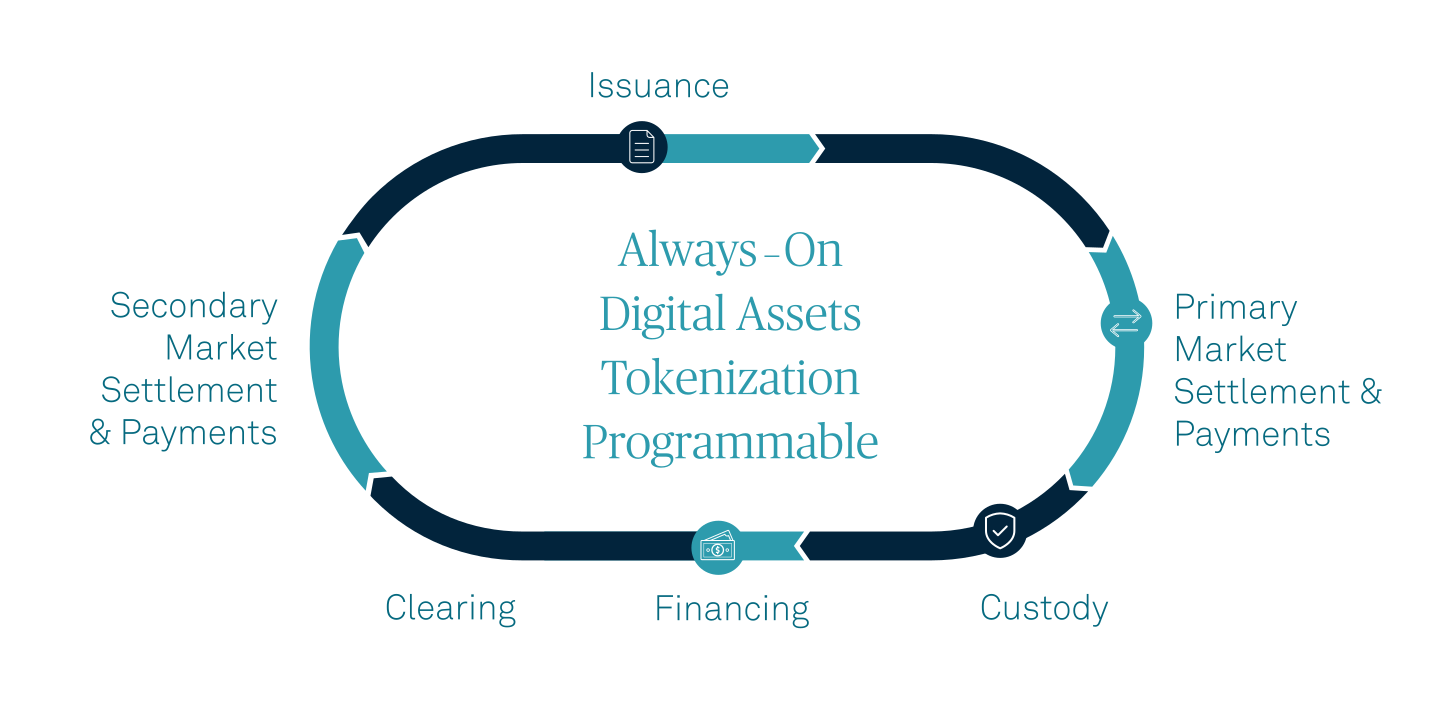
Digital cash1 is raising expectations for faster, always-available settlement, making liquidity and collateral management a 24/7 challenge, rather than one bound by local business hours. As the foundational layer of market access, cash and Treasuries determine how effectively institutions can meet obligations, source liquidity, manage collateral, and support activity across increasingly continuous markets. In Treasuries, that pressure is intensifying with sustained issuance, expanding requirements for central clearing, and the continued growth of collateral–intensive strategies.
Friction arises because trading is becoming more continuous while settlement, financing, and collateral mobility still depend on legacy operating windows.
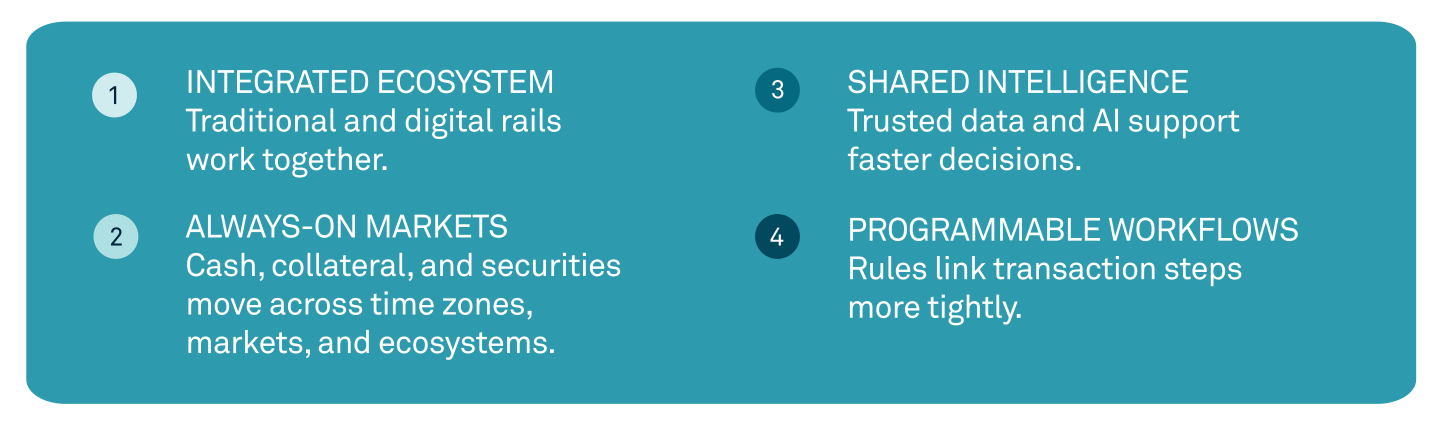
The most practical path forward is to both extend trusted, traditional rails, including settlement, repo, triparty, and collateral channels, while building digital rails to enable programmability, linking transaction steps more tightly for more coordinated movement of cash, securities, and collateral across time zones together supporting a more continuous market.
The lifecycle of an asset is accelerating due to blockchain and other new technologies, as they improve the visibility into the connectivity between assets, how they move, and how activity across that chain can be coordinated in near real–time. In turn, an always–on environment implies greater programmability of settlement cycles, and tokenization creates tighter links across books and records, ownership, and transfer processes.
Historically, custody and settlement have operated as separate stages in the asset lifecycle, but as digital and tokenized assets increasingly sit alongside traditional assets, client expectations are growing for more connected infrastructure that integrates these capabilities. As we discussed in Payments Without Pause, that expectation extends to payments activity; more continuous cash movement raises the need for tighter coordination across settlement, servicing, collateral, and liquidity workflows.
Custody will always be about safeguarding assets, but its value is becoming more closely tethered to how assets are settled, financed, and mobilized. In this model, custody evolves from a holding point into a gateway to the rest of the lifecycle, linking to ownership transfer, servicing, and collateral use. In the future state, traditional market infrastructure, such as settlement certainty, legal finality, operating controls, and institutional trust will remain foundational while digital capabilities grow to strengthen that foundation by reducing manual friction and increasing interoperability across traditional and emerging asset types, ultimately improving transparency, confidence, and control.
As markets evolve, the opportunities for connected systems are becoming clearer — how assets are financed, serviced, and mobilized across the lifecycle, at times constraining balance sheet efficiency, collateral utility, and operational complexity. Consider the possible new unlocks for money market funds, private markets, and less mobile assets more broadly as examples — the evolution has the potential to transform asset and wealth management businesses.
Overall, these changes can help make assets productive for longer, help reduce fragmentation, and help clients respond more effectively to changing liquidity and collateral needs.
As we noted in A New Architecture: Accelerating Private Market Growth, the strategic question is not just how to digitize an asset, but how to make it more usable across its lifecycle by making it easier to move, finance, and use as collateral. That same logic applies across institutional and wealth channels, where operational connectivity and asset mobility can drive both efficiencies and future growth.
As activity across the asset lifecycle becomes more connected, data and AI can add the next layer of value by helping institutions interpret activity faster, identify exposures more clearly, and make better decisions across pricing, settlement, collateral, servicing, and risk. It can also enable more rules–based workflows, allowing assets or cash to move automatically when conditions are met. But automation is only as effective as the infrastructure underneath it, particularly where traditional and digital infrastructures coexist.
As transactions, ownership records, and servicing activities span multiple systems, institutions will need a clearer, more actionable view of assets, exposures, and obligations. The challenge is to turn fragmented data into trusted intelligence that supports both human judgment and AI–enabled workflows. Creating that view requires common identification standards, consistent lifecycle tracking, and governance frameworks that make intelligence traceable, interoperable, and trustworthy for both humans and machines. Over time, this intelligence layer could become a defining feature of next–generation market infrastructure, helping firms not only process transactions, but continuously understand, anticipate, and optimize liquidity, collateral, and risk.
Client needs are accelerating the evolution towards more continuous and connected financial markets, extending well beyond tokenization of assets. Greater mobility of assets, cash, and collateral across markets and ecosystems — leveraging trusted data and AI — may supercharge the next phase of growth.
In this evolved ecosystem, institutions must combine the strengths of traditional market infrastructure with the capabilities of emerging digital systems to improve flexibility without sacrificing trust or resilience.
In our view, those with broad roles across the asset lifecycle are best placed to help build the financial architecture of the future — and to help clients navigate change with resilience.
Convergence of scaled traditional systems and blockchain technology
Authors:
Jennifer Barker, Global Head of Payments & Trade and Depositary Receipts; Head of Europe (including UK)
Allie Barone, Global Head of Product Commercialization, Product and Innovation Hub
Jason Granet, Chief Investment Officer
Jayee Koffey, Chief Global Affairs Officer
Laide Majiyagbe, Global Head of Markets
Emily Portney, Global Head of Asset Servicing
Brian Ruane, Global Head of Clearance and Collateral Management, Credit Services and Corporate Trust
Jess Stern, Senior Director, BNY Institute
Cathinka Wahlstrom, Chief Commercial Officer
Carolyn Weinberg, Chief Innovation & Market Transformation Officer
BNY Institute content provides thought leadership and is not investment research. Views are the authors’ and may change. This material is for informational purposes only and does not constitute investment advice or an offer. For full disclosures, click here.