Global Payments & Trade
Move and manage your money, securely.




Private markets are entering a pivotal inflection point that will define their next phase of growth, one characterized by increasing convergence. As public market constraints have increased, capital requirements have grown, and bank balance sheets have come under pressure, private capital has become an important engine of financing across the global economy.
Private equity, private credit, and other private market strategies continue to expand, becoming more central to capital formation and portfolio construction. Investors are also beginning to view private and public assets as part of a single portfolio, challenging the conventional divide between them. This convergence is reshaping how capital is raised, deployed, and managed, while increasing the need for infrastructure that can support greater scale, interoperability, and standardization across a more connected ecosystem.
Yet, while private markets have evolved dramatically, the infrastructure supporting them has not. Much of today's private market lifecycle remains manual, fragmented, and paper-intensive, creating operational friction that limits scale, speed, transparency, and broader participation. As private markets become more integrated into mainstream portfolios, the underlying market architecture must evolve.
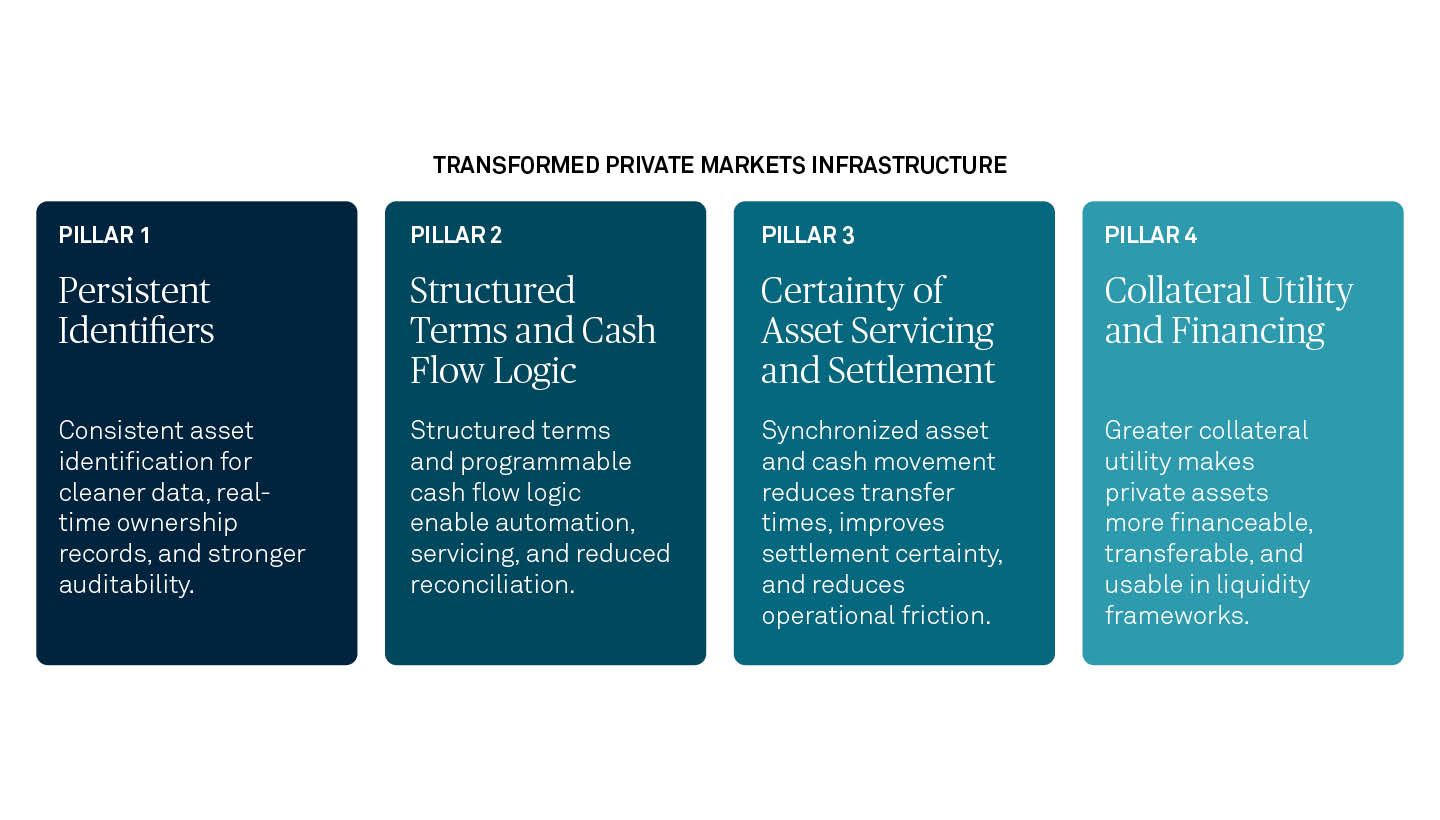
This paper outlines a practical framework for modernizing private market infrastructure across four pillars, persistent digital identifiers, structured terms and programmable cash flow logic, certainty of asset servicing and settlement, and collateral utility and financing, to drive more connectivity, transparency, and scale across the private asset lifecycle. In this next phase, the source of alpha will increasingly come from origination, underwriting, and investment insight, not operational complexity. The sections that follow define and explore the core building blocks required to support the continued evolution of private markets.
Once defined by a concentrated base of institutional investors and closed-end fund structures, private markets are expanding into wealth and advisor channels, driving a new wave of product innovation. Assets under management (AUM) in semi-liquid and evergreen structures have more than doubled since 2022, exceeding $500 billion as of September 2025.1 More broadly, private markets are becoming increasingly central to how capital is formed, deployed, and scaled across the economy, as private capital is increasingly used to finance a wider range of economic activity.
While AUM continues to expand, the operating models and systems supporting private markets have not kept pace. Asset servicing, cash movements, collateral pledging, and ownership records remain fragmented across intermediaries and disconnected platforms, introducing operational friction as volumes grow and participant ecosystems become more complex. Across the lifecycle, from onboarding and subscription through servicing, capital calls, liquidity events, and secondary activity, legacy infrastructure is straining to support the scale, speed, and flexibility that this next phase of growth demands. This evolution reflects more than a temporary expansion cycle. It represents a structural shift in how capital markets operate. As private assets become more accessible and increasingly coexist alongside public market exposures, the distinction between private and public markets is beginning to blur.
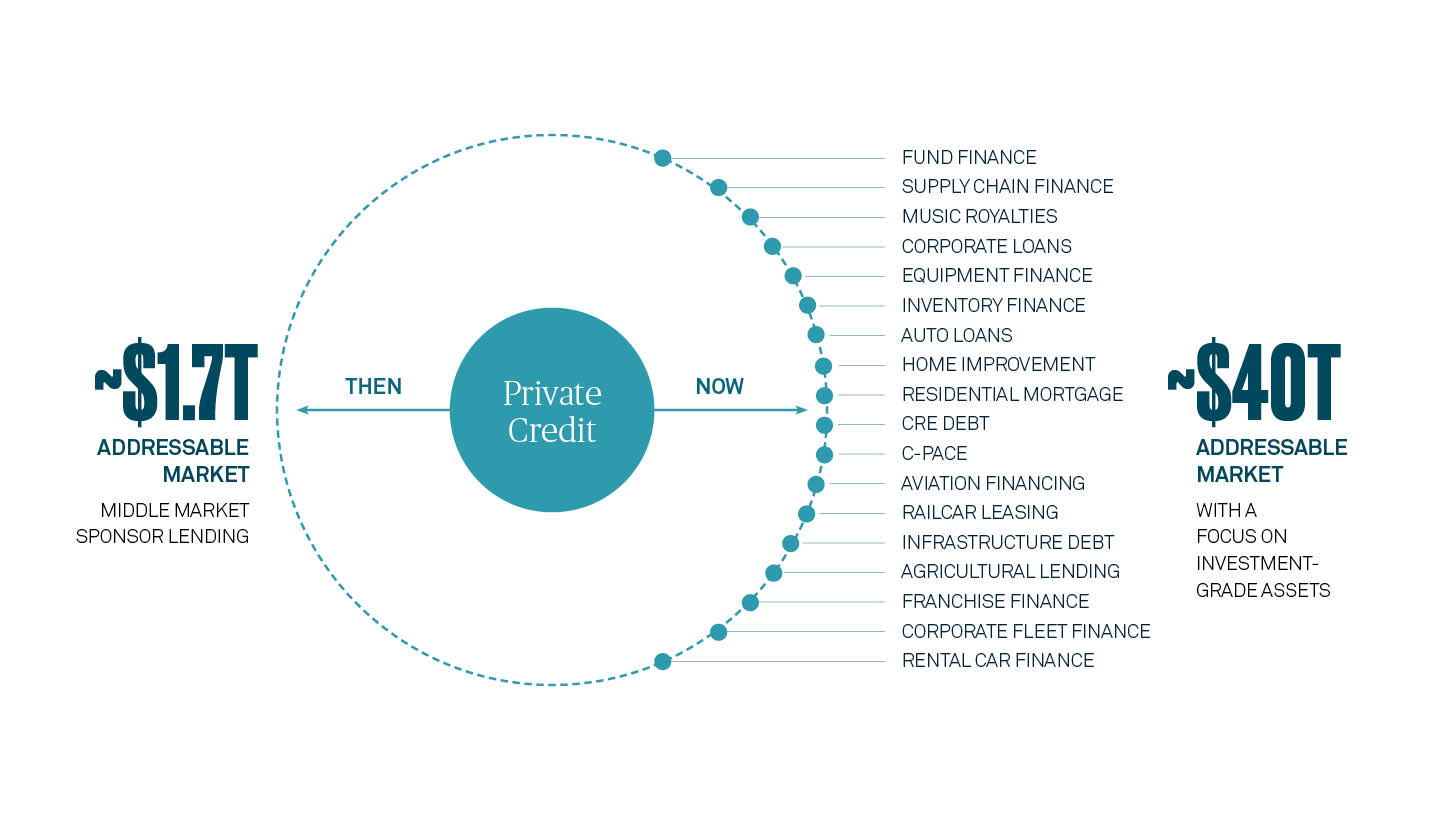
Once viewed as a narrower alternative allocation, private credit is evolving into a much wider financing category, spanning corporate loans, asset-backed lending, real estate debt, infrastructure debt, and other forms of income-oriented exposure. Its growth reflects durable shifts in how capital is intermediated and how investors seek income, diversification, and access to non-public opportunities. As the category broadens in scope and becomes more relevant to portfolio construction, so too does the need for infrastructure that can support better data, transferability, settlement, and liquidity management.
Source: Apollo Global Management
The opportunity goes beyond digitizing processes. Modern market infrastructure enables a more dynamic, liquid, and interconnected ecosystem. Rather than layering technology onto legacy processes, the question becomes what infrastructure is needed for the next stage of private markets growth?
Private markets’ expansion will require a more deliberate redesign of core capabilities, plugging private markets into an interoperable architecture where valuation, custody, servicing, financing, and secondary trading can function as a more integrated system. In private credit especially, where instruments are often bespoke, documentation-heavy, and operationally fragmented, this evolution begins with a small number of foundational building blocks: the ability to identify assets consistently, understand the terms and conditions that govern their behavior and cash flows, transfer them with certainty of settlement, and use them as collateral within broader funding and liquidity frameworks. These aspects form a practical, four-pronged framework for re-architecting private markets infrastructure for a more digital, connected, and scalable future.
A digitally-enabled framework for modernized private markets infrastructure
Modern private markets require a clearer and more persistent way to identify assets across the lifecycle. Today, ownership records, servicing data, and transaction histories often remain fragmented across counterparties, administrators, and internal systems, creating operational friction and making it harder to establish a consistent view of the asset. Core components of this foundation include:
BNY is developing solutions to better allow data to be cross-referenced across systems and datasets. This helps establish the cleaner, more interoperable data foundation needed to support scale in private markets and is an underlying facet to broader data innovation underway at BNY.
A private credit asset is ultimately defined by the terms and conditions that govern it and the cash flows that result from it. However, these features are often embedded within highly customized legal documents, side letters, amendments, and servicing records. For example, commercial loans often involve structural features, liens, payment statuses, and corporate events that make them difficult to consistently monitor, value, and mobilize. Tokenization and GenAI enable these characteristics to be built into digital infrastructure. Core components of this pillar include:
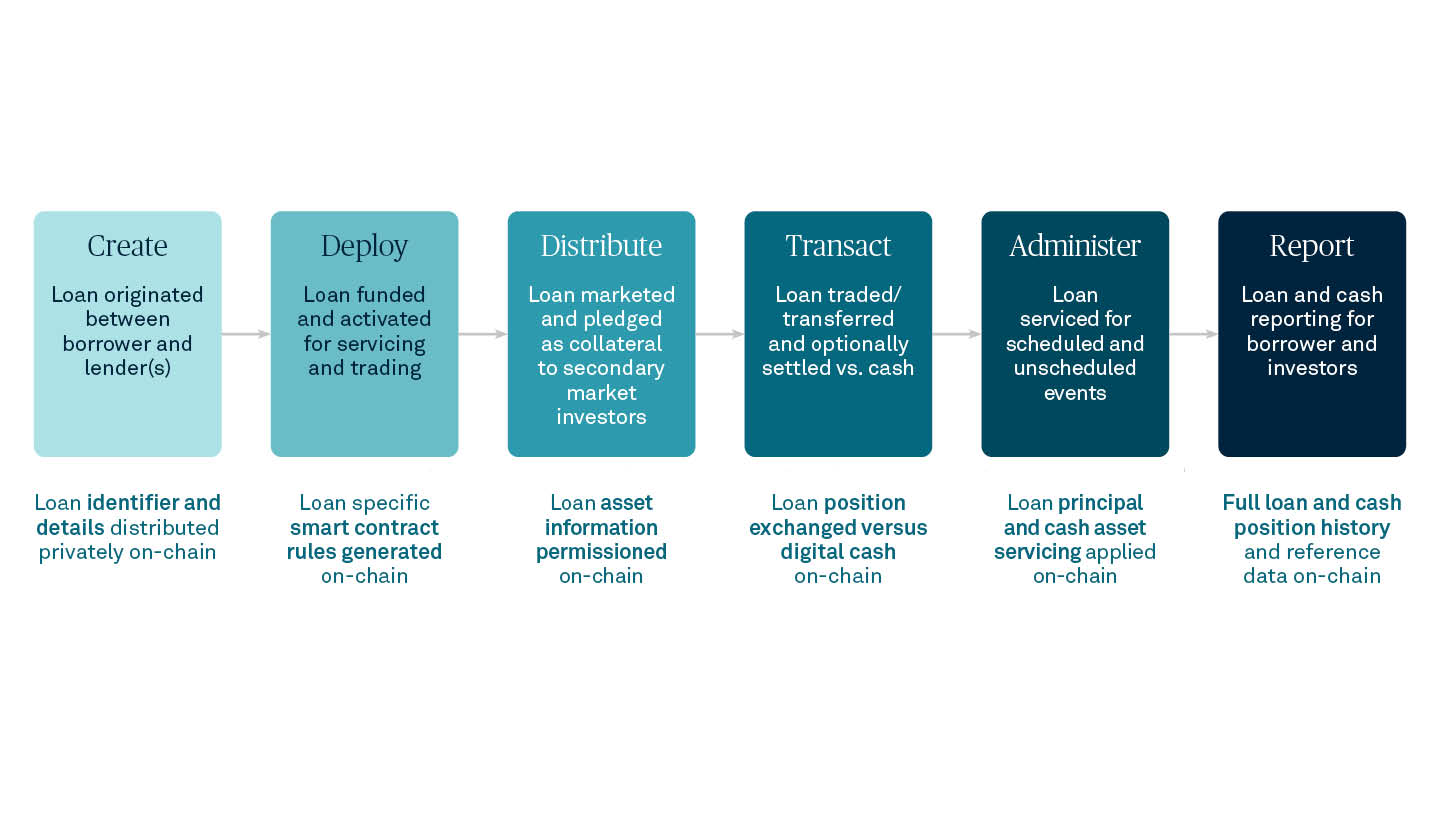
BNY is exploring how to leverage AI-powered capabilities to extract unstructured data from credit agreements to power loan smart contracts that enforce how a tokenized loan operates. This could includes the hierarchy of covenant structures, financing dependencies, payment behaviors, and relevant connections to market data. Taken together, these elements help define the behavior of the loan itself. By turning unstructured documentation into operational data, this would help create the foundation for more automated and scalable private market workflows.
Historically, private market transactions have been manual, episodic, and relationship driven. Traditional settlement relies on sequential coordination across multiple parties, which can result in delays and failed transactions. For private credit, that has meant loan transfers taking up to 30 business days to complete and cash wires that are often difficult to match and reconcile. Tokenization enables near-instant delivery-versus-payment (DvP), synchronizing asset and cash movements and reducing operational risk. Critical aspects of this pillar include:
BNY is exploring the potential of this model and the benefits of executing transfers in a DvP manner, for example, reducing the risk of cash breaks and helping confirm that settlement only happens when both the seller has agreed to the sale and the buyer has the digital cash or tokenized deposits to match the transfer. In practice, this means supporting a more controlled transfer process in which settlement occurs only when both the asset transfer and the corresponding digital cash or tokenized deposit are ready to be exchanged.
Through the identification of the asset and the understanding of the underlying terms and cash flows, market participants can unlock the ability to utilize the asset as collateral. The growing relevance of private assets in the collateral ecosystem can in turn spur the growth of secondary market activity and contribute to the overall growth of the asset class. As markets move toward more continuous, or “always-on,” operating models, delays in traditional cash movement can become a constraint on liquidity and efficiency. Tokenized representations of cash and instruments such as U.S. Treasurys, that have long been the foundation of global collateral markets, can help address this gap by enabling faster settlement, intraday liquidity, and more dynamic collateral management. Key drivers of this pillar include:
BNY is building the infrastructure needed to move from collateral movement to intelligent collateral optimization, orchestrating cross-venue collateral flows and extended-hours Treasury activity. The objective is not simply to move collateral, but for BNY to enable more intelligent collateral optimization across funding, liquidity, and risk management workflows.
Tokenized assets derive value from the networks they can access. Interoperability, the ability to move and manage tokenized assets, along with associated cash and data seamlessly across systems including blockchains, custody and settlement platforms, fund administration systems, triparty collateral venues, as well as reporting and analytics tools, is key to unlocking the potential benefits from tokenization. Without it, digital infrastructure risks recreating the same fragmentation that exists today, with workflows duplicated across siloed platforms and limited connectivity between participants. As private markets evolve, asset managers, custodians, administrators, and liquidity venues must operate within a connected ecosystem where assets, cash, and collateral can move efficiently, and the degree of interoperability achieved will determine whether tokenization remains a series of isolated use cases or develops into systemic market infrastructure.
For private markets, greater interoperability with liquid collateral and digital cash could make these assets more transferable, more financeable, and more usable within broader portfolio and funding frameworks. When tokenized assets are interoperable with liquid collateral and digital cash, market participants can mobilize capital more efficiently, pledging and reallocating collateral with greater speed and precision while reducing idle balances. This shifts liquidity management from a supporting function to a core element of market infrastructure. As liquidity is the lifeblood of private markets — mobility makes it flow.
As private markets become more central to capital formation, the next phase will require a re-architecting of the core infrastructure that supports them. That means building the foundational capabilities to identify assets consistently, structure and operationalize their terms and cash flows, transfer them with certainty of settlement, and use them more dynamically within collateral and funding frameworks. Connected through interoperable infrastructure, these capabilities can help reduce fragmentation and enable private assets to function more efficiently and at greater scale.
BNY operates at the center of global financial markets, across custody, trustee, collateral, settlement, payments, investment management, and data. Our role in U.S. Treasurys, collateral, and liquidity markets is particularly critical, providing the link between emerging digital asset capabilities and the traditional funding and risk management frameworks that underpin global markets. BNY is investing to build the infrastructure needed to support this evolution, with a focus on interoperability, resilience, and integration across both traditional and digital financial ecosystems. This model is designed to connect private assets with broader ecosystems, enabling seamless entry and exit through integrated on-ramps and off-ramps, and supporting more dynamic capital formation and allocation at scale. Our position provides a unique vantage point to advance digital market infrastructure in a way that integrates with existing systems rather than fragmenting liquidity across parallel platforms.
Allie Barone, Head of Product Commercialization
Sean McGovern, Vice President, Markets and Policy Analysis, BNY Institute
Jess Stern, Senior Director, BNY Institute
BNY Institute content provides thought leadership and is not investment research. Views are the authors’ and may change. This material is for informational purposes only and does not constitute investment advice or an offer. For full disclosures, click here.