Global Collateral
Collateral management and mobility to optimize liquidity needs.



With markets accelerating and the operating backdrop growing increasingly complex, boards and CEOs are looking to finance teams for more than discipline, control, and resilience. They now expect CFOs and their teams to help the business respond faster, invest more effectively, and improve performance in a less predictable environment. For CFOs, this is driving a growing need for balance sheet flexibility and better infrastructure to improve the quality and speed of decision-making, transforming the finance function into one that is more continuous, data-driven, and action-oriented.
At BNY, we have been modernizing our finance function to support the next phase of our growth journey, building the foundation to improve resilience and create capacity to invest. We also work with leading CFOs across industries and segments every day, giving us a front row seat to the discussions defining their evolving mandates.
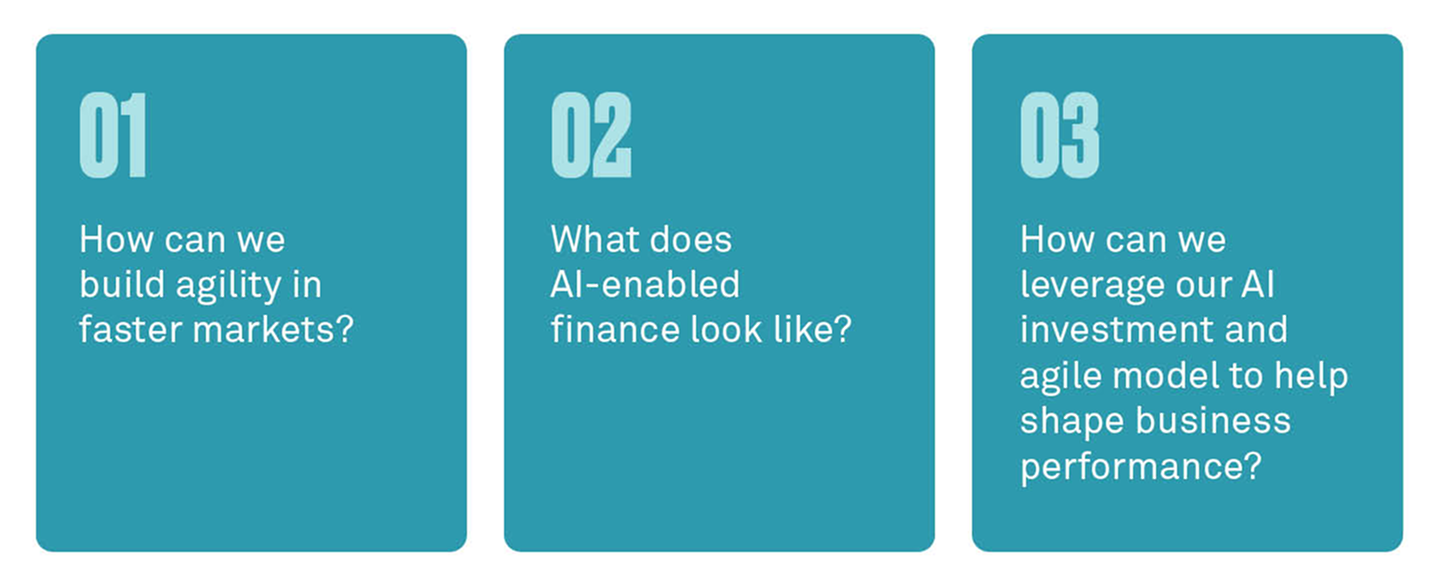
Three key questions keep surfacing:
Here, we break down each of these questions, sharing our perspectives on what they mean for the evolving role of the CFO, informed by our own journey and what we have learned from peers, clients, and other key industry players.

The financial environment facing today’s CFOs is one marked by policy divergence, evolving market structure, and technology-driven changes. Layering in geopolitical tensions and uneven growth across regions contributes to an even more dynamic landscape, resulting in interconnected funding conditions, liquidity access windows, collateral mobility strategies, and payment execution considerations, all of which are increasingly sensitive to timing, infrastructure, and jurisdiction. This is driving the need for enhanced treasury capabilities beyond safeguarding liquidity, helping firms respond faster to volatility, fund strategic opportunities, and deploy resources with greater confidence. Leading CFOs recognize that these enhanced capabilities bring a new level of balance sheet and liquidity agility that can also be a source of competitive advantage.
In practice, that advantage shows up in everyday management decisions: whether a firm can fund an opportunity quickly, adjust its funding mix as conditions change, redeploy trapped cash, or respond to volatility without materially affecting business activity. From BNY’s vantage point across payments, liquidity, collateral, custody, and financial markets, we see that the firms best positioned to move quickly are often those that have already built the infrastructure to see, mobilize, and deploy resources with confidence.
Key to building greater agility is recognizing the distinction between always-on operations and always-available liquidity. More electronic trading, quicker settlement, real-time payments, and accelerating information flow are all driving finance faster, and when combined with episodic volatility, this puts pressure on them to move cash and collateral faster, with fewer manual handoffs and greater certainty of settlement. While markets may trade for longer and some payment rails operate 24/7, core liquidity sources still depend on operating windows, eligibility rules, and intraday constraints. This makes liquidity access planning critical – knowing which assets can be financed intraday, which facilities are readily accessible, and what must be pre-positioned.
At the same time, the liquidity toolkit is evolving. Central bank facilities, market structure, and post-trade infrastructure vary meaningfully across jurisdictions, and cross-border collateral movement remains slow and operationally complex. In a faster environment, agility goes beyond maintaining adequate balances to ensuring cash and collateral can be mobilized quickly as conditions change. We are therefore seeing leading CFOs expanding their collateral strategies, leaning on their teams to put idle balances and underused collateral to work without sacrificing safety or control – optimizing pledging decisions, broadening eligible collateral where appropriate, and improving substitution capabilities as conditions change.

As payment methods proliferate, interoperability becomes essential to reducing friction, improving settlement certainty, and freeing cash earlier for reinvestment. Many treasury architectures were built for end-of-day reporting and batch processes; now systems must communicate across banks, payment rails, and custody platforms. A reliable intraday view across payments, settlements, and collateral movements enhances flexibility, yield, and operating agility.
This signals a new era for asset-liability management, which leading CFOs have already started to embrace. With cash cycles shifting, static assumptions about tenors and liquidity sources quickly become outdated. More dynamic tools, including scenario-based forecasts, stress testing tied to more accurate payment and margin timelines, and greater flexibility in adjusting instruments and maturities, can help CFOs avoid both over-buffering and under-preparing.
Liquidity management has become a core pillar of agility: it directly influences working capital, investment flexibility, risk preparedness, and the organization’s ability to act with confidence. At the same time, so has speed, and many CFOs know that in order to operate at the level of speed they are looking for, they need to invest in AI.

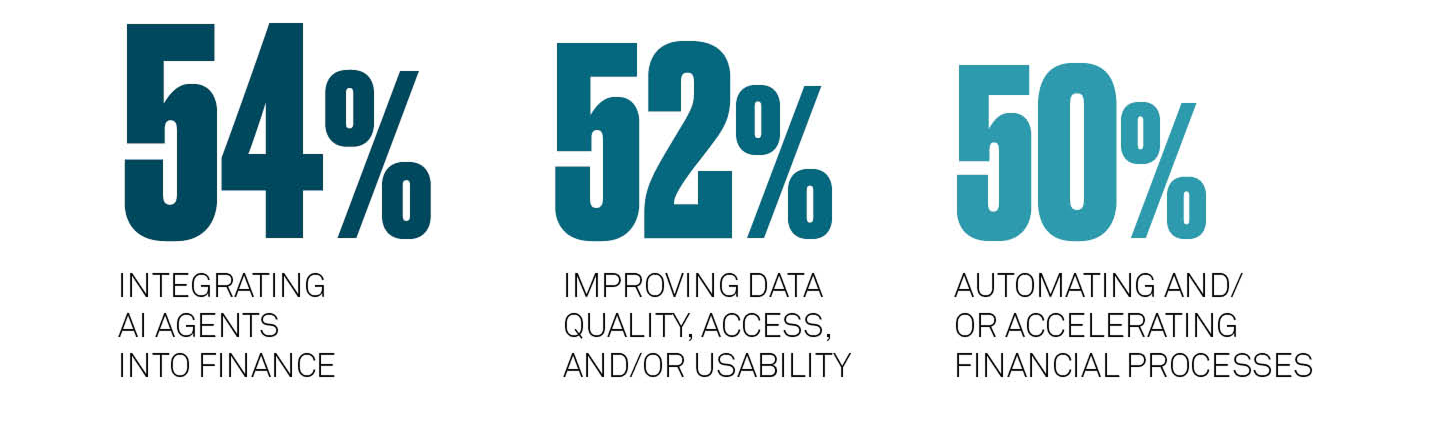
AI has quickly moved from experimentation to prioritization on the CFO agenda. According to Deloitte’s 2026 CFO Signals survey, half of CFOs surveyed identified finance transformation as a top priority, with 54% highlighting integrating AI agents as a priority for the year.1 Modern CFOs recognize that in an environment defined by intraday events, payment exceptions, market moves, and faster decision cycles, manual monitoring no longer scales. From anomaly detection to cash forecasting, scenario analysis to reconciliation and more, finance teams are automating key manual processes to scale, improve timeliness, focus human attention, and strengthen decision quality.
TOP THREE CFO PRIORITIES FOR 2026
Excerpt from Deloitte's CFO Signals Survey
Source: Deloitte, BNY
We believe the organizations that benefit most will be those that treat AI not as a standalone technology initiative, but as part of a larger redesign of processes, workflows, and finance operating models. It’s critical to establish clear governance, defined success metrics, and human oversight from the outset. While the full potential of an AI-enabled finance function has yet to be seen, one early win many leading CFO teams target is better balance sheet and liquidity transparency, achieved by consolidating data across accounts and entities, improving timeliness, and making it easier to audit variances. That transparency is often the first step toward real-time or near-real-time liquidity management, making later automation far more effective. There is still so much to learn about how the function can transform as capabilities evolve, as well as how it can be integrated within existing technology stacks, talent pools, and fragmented data.
At BNY, we have a dual-track approach: we are building differentiated finance capabilities through our enterprise AI platform, Eliza, while supplementing them with key capabilities embedded within strategic vendor platforms. Through a combination of agent-supported workflows, in-development digital employees, and easily accessible AI tools for day-to-day tasks, we have started to transform our finance function into AI-enabled decision intelligence. Beyond the technology itself, execution of this strategy sits on the shoulders of our people – our finance leadership team and the close partnership with our Engineering organization to set the tone, our “AI Champions” to design, pilot, and help integrate new initiatives, our product-based operating models to continue to leverage these initiatives, and our People team colleagues to provide our people with the support and training they need for continued learning and innovation.
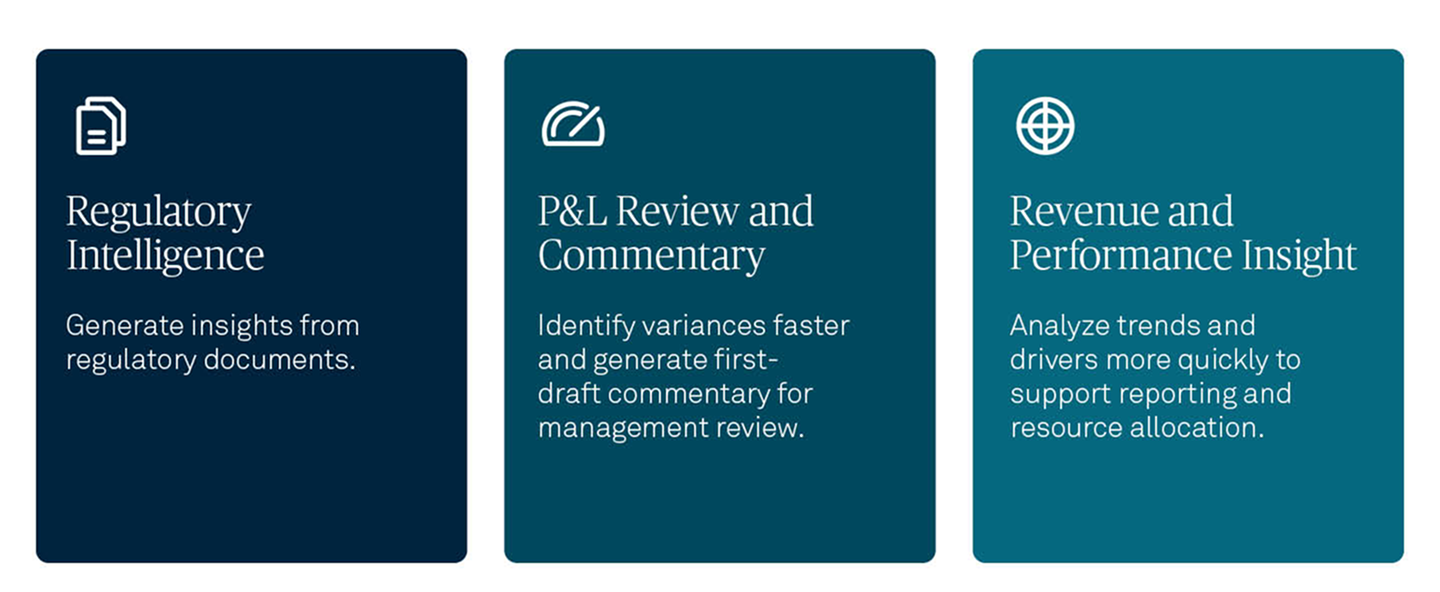
THREE EXAMPLES OF AI IN FINANCE AT BNY
Together, these use cases help reduce manual reporting burden and free finance teams to focus more on judgment and decision-making.
In the near-term, value in finance can be realized through targeted AI agents built for specific workflows. These agents are designed to support a defined task or decision domain, helping teams retrieve, structure, analyze, and summarize information more efficiently. Examples at BNY include agents that help controllers teams generate insights from regulatory documents, accelerate month-end and quarter-end P&L review through automated variance analysis and commentary, and enable faster revenue and business performance insight through trend analysis. Together, these capabilities help the CFO team devote more time to strategic decision-making. Over the longer-term, many organizations are likely to move toward more end-to-end digital employees: AI-enabled capabilities that can operate across multiple systems and process steps with greater autonomy, under strong controls and human oversight.
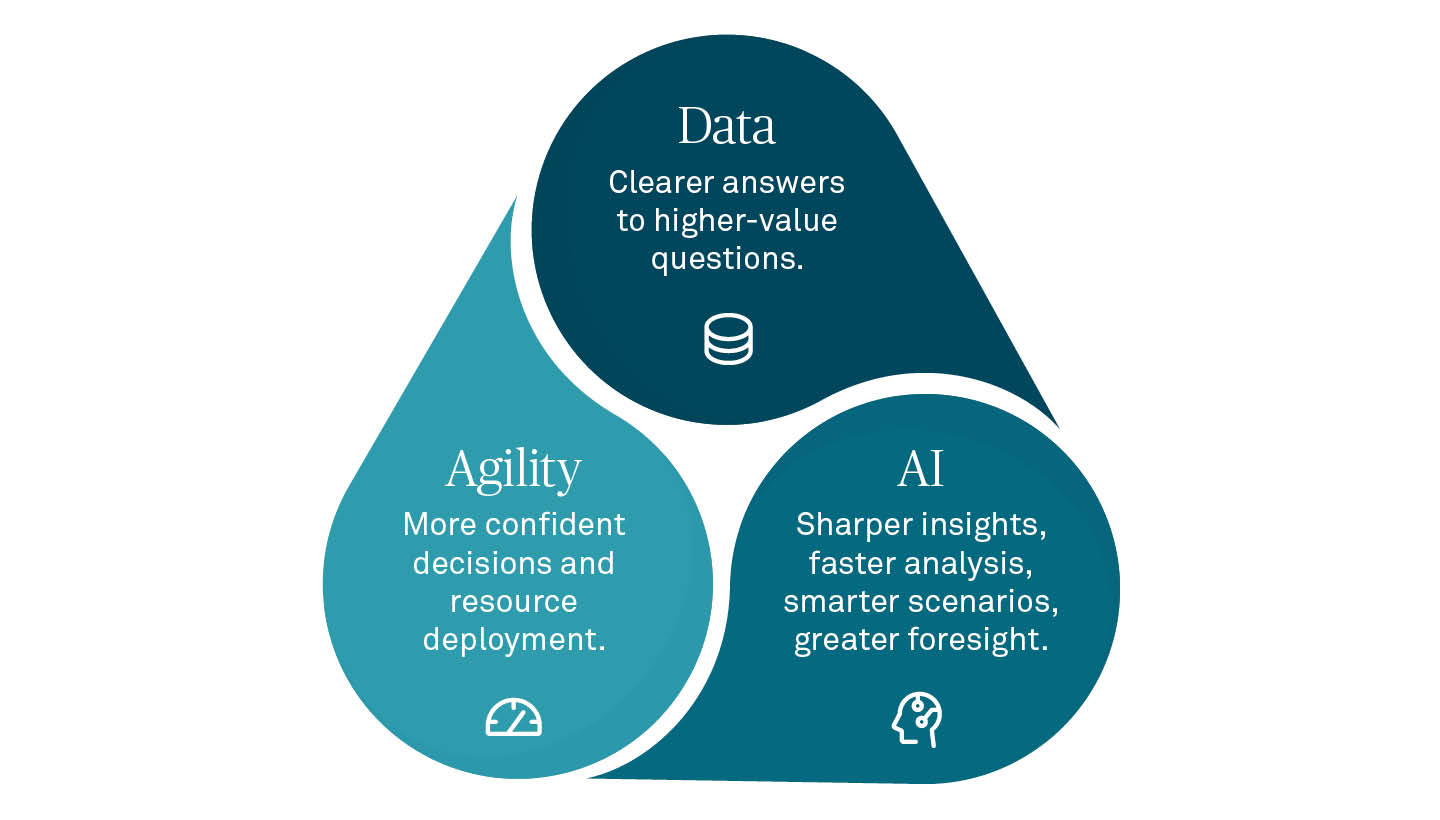
Sitting across revenue, cost, and capital, CFOs have the clearest view of where value is being created or lost. As their role is increasingly centered around helping to define how the business is structured, where capital goes, and how efficiently it’s deployed, AI and stronger agility make that possible, with data as the foundation. Data creates visibility, AI turns visibility into insight, and agility provides the ability to act. The combined effect is greater enterprise flexibility and better business outcomes.
Data creates visibility, AI turns visibility into insight, and agility provides the ability to act. The combined effect is greater enterprise flexibility and better business outcomes.
GREATER ENTERPRISE FLEXIBILITY DRIVING BETTER BUSINESS OUTCOMES
Data creates visibility. With sharper, standardized, and consolidated data, CFOs and their teams can help the enterprise answer higher-value questions, such as: Which products, clients, channels, or geographies are generating the strongest economic returns? Where is organizational complexity eroding margin? Which processes or activities are consuming disproportionate resources relative to value created? Where can capital and talent be redeployed to improve performance?
AI turns visibility into insight. AI can help CFOs identify emerging patterns faster, test alternative outcomes more dynamically, and improve responsiveness in a changing environment. AI-enabled forecasting can also help improve planning accuracy by recognizing demand patterns, seasonality shifts, and operational signals that traditional models may miss.
Agility provides the ability to act. When finance leaders can see liquidity and balance sheet data more clearly and manage it dynamically, they are better equipped to make more timely decisions about investment pacing, capital priorities, and resource deployment across the enterprise.
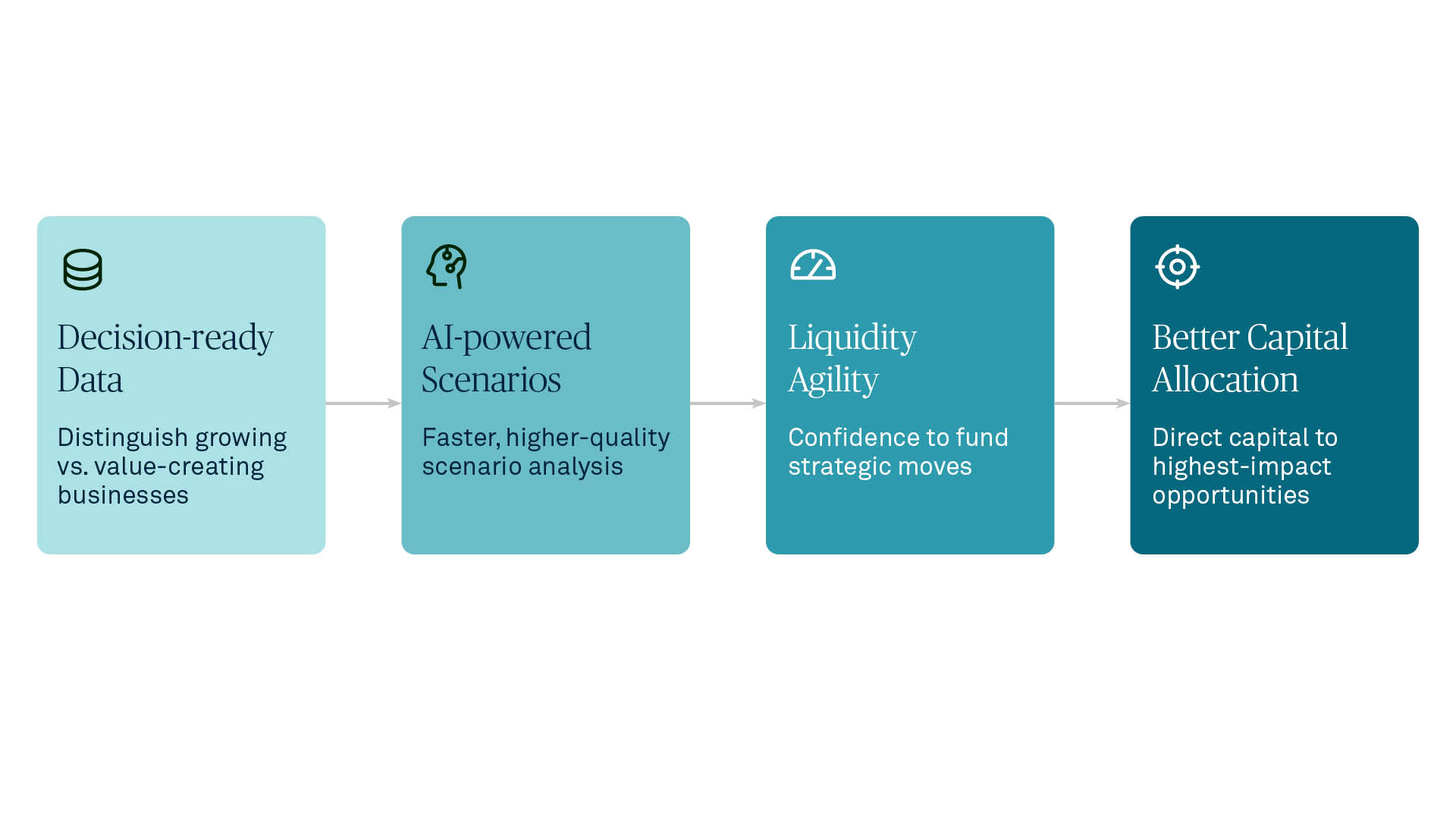
One of the best ways CFOs are leveraging these capabilities is through budgeting and capital allocation, which for many organizations, has historically been too static, too slow, and too detached from the real pace of business change. This process is increasingly becoming a strategic mechanism for performance improvement, helping management evaluate tradeoffs, test scenarios, and direct capital toward the highest-impact opportunities. Decision-ready data can help distinguish between businesses that are growing and those that are truly creating value. AI can improve the speed and quality of scenario analysis. Liquidity agility can increase confidence in the organization’s ability to fund strategic moves. The result is a budgeting model that is more adaptive, more strategic, and more aligned to actual business conditions.
STRATEGIC BUDGETING AND CAPITAL ALLOCATION
From static, slow, and detached to adaptive, strategic, and aligned
With increasing complexity, margin discipline requires a broader lens. Input costs, wage pressure, investment needs, pricing competition, and uneven growth are forcing companies to work harder to protect profitability. Leading CFOs are shifting from a cost-containment mindset toward a broader margin expansion agenda, focused on improving productivity, simplification, operating discipline, and smarter resource deployment. This represents another area where the combination of data-enabled AI and agility can drive success. Better data helps finance teams isolate where value is lost to friction or complexity. AI can improve the quality of margin analysis and surface non-obvious drivers of performance. Agility provides the balance sheet flexibility to invest in the changes required to improve productivity and long-term returns. These tools can give CFOs a better view of cost-to-serve across products, clients, and channels, pricing realization versus headline price increases, profitability impact of organizational complexity, where activities can be automated, centralized, or redesigned, and where current business mix is supporting or suppressing margin performance.
Beyond the finance function, CFOs are increasingly central to deciding which AI use cases across the organization merit funding, how success should be measured, and how to balance near-term productivity gains with longer-term transformation goals: Which use cases reduce cost? Which improve decision quality? Which enhance productivity or free up talent for more strategic work? Which can scale across the enterprise rather than remain isolated pilots? As AI investment becomes less discretionary and more tied to transformation agendas, CFOs are best placed to connect those investments to measurable efficiency, operating leverage, and disciplined funding.2
In addition to the process itself, token usage will become an increasingly important part of resource allocation as companies continue to invest in AI. This creates a new opportunity for CFOs to help shape the forward trajectory of the business, by defining where and how firms make investments into third-party vendors, platforms, models, training and recruiting, and process automation.

The CFO organization is becoming even more central to how companies detect change, respond to pressure, and allocate resources. Over the next five years, the whole function is likely to look different from that of today. More monitoring, forecasting, and analysis will be automated or agent-supported. Treasury and finance will operate with a more connected view of cash, collateral, and business performance. Decision cycles will become more continuous, with finance playing an even larger role in determining where resources should be deployed, where investment should be accelerated or slowed, and how the business can respond to an increasingly uncertain environment.
Within that context, the role of the CFO will likely continue to expand: from reporting on business performance to helping shape it; from preserving resilience to enabling flexibility; from overseeing the company’s assets and liabilities to helping define enterprise priorities. The organizations that will gain competitive advantage will be those that not only adopt new tools, but build a model in which data improves visibility, AI strengthens insight, and agility makes faster, better action possible.
BNY Institute content provides thought leadership and is not investment research. Views are the authors’ and may change. This material is for informational purposes only and does not constitute investment advice or an offer. For full disclosures, click here.