Global Collateral
Collateral management and mobility to optimize liquidity needs.




Introduction
Collateral management plays a foundational role in financial markets, driving core liquidity, funding, and risk management practices across the industry. In today’s markets, the ability to identify, allocate, and move collateral efficiently has real financial consequences, directly influencing funding costs, balance sheet flexibility, liquidity, and an institution’s ability to act with confidence in changing market conditions.
Effective collateral management hinges on a simple premise: the right asset, in the right place, at the right time. In practice, this requires navigating complex constraints, including legal entities, jurisdictions, currencies, collateral schedules, settlement windows, and liquidity requirements. Collateral management is never a "one and done" function, it consists of a series of evolving choices, and as markets become faster, more interconnected, and increasingly global, these choices become even more important and complex.
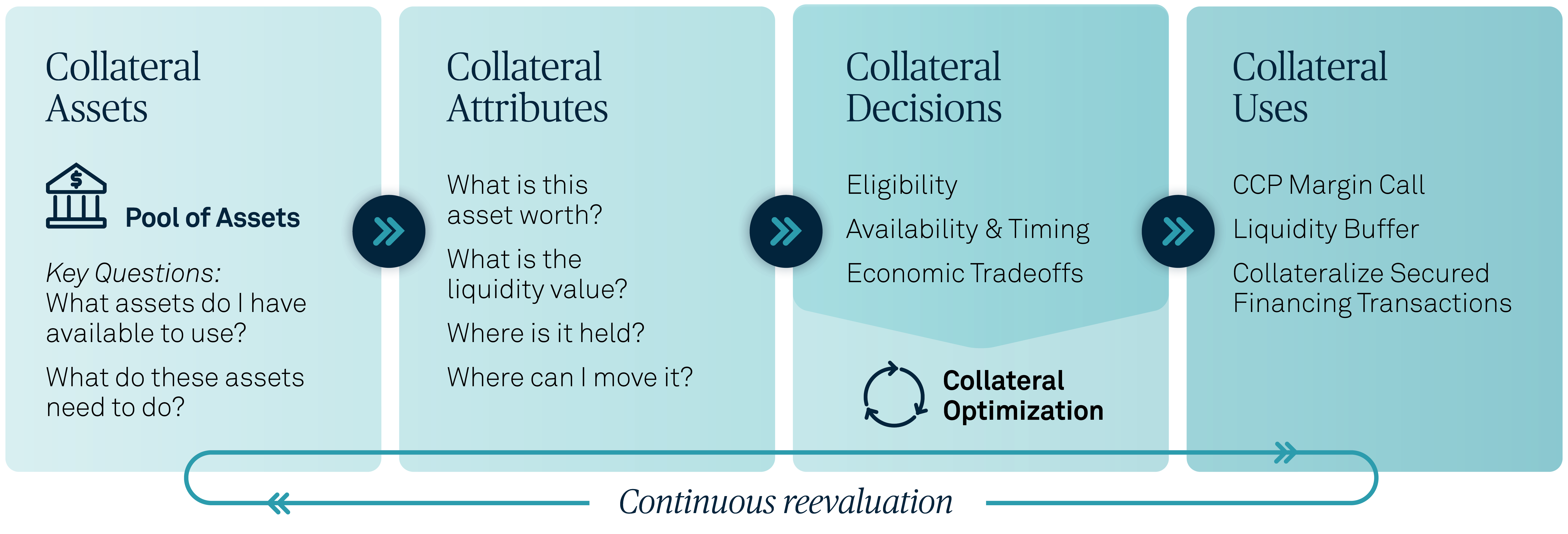
While collateral management assesses whether the right asset is in the right place at the right time, collateral optimization finds the best use of each asset, given the assets available, the obligations due, and the constraints in place. The “optimal” answer is rarely simple. Once a firm has identified what it needs its assets for, decisions will need to be made that require asking several more questions, such as: is this a high-quality liquid asset (“HQLA”) needed for liquidity buffers? Where is it and where can I use it? How did I source the asset and what did it cost? Who would accept it, and at what discount? Collateral optimization is the act of taking all these considerations into account when deciding the most efficient use of an asset.
Regulation over the last several years has also evolved the collateral management and optimization landscape, making decisions more interconnected with liquidity and capital planning. Changes that promoted a safer financial system also added complexity, requiring institutions to evaluate assets not only for eligibility and availability, but also for liquidity value, funding impact, capital treatment, legal entity constraints, and opportunity cost. As a result, collateral decisions come with a real economic impact, prompting institutions to be more deliberate about which assets to hold, pledge, transform, or mobilize, and how to optimize collateral across competing needs. For many firms, the most persistent challenge is not a lack of assets, as the collateral may exist, but it may be fragmented across entities, locked in a market with limited mobility, constrained by eligibility schedules, or unavailable when it is needed.
Collateral Optimization finds the best use of each asset, given the assets available, the obligations due, and the constraints in place
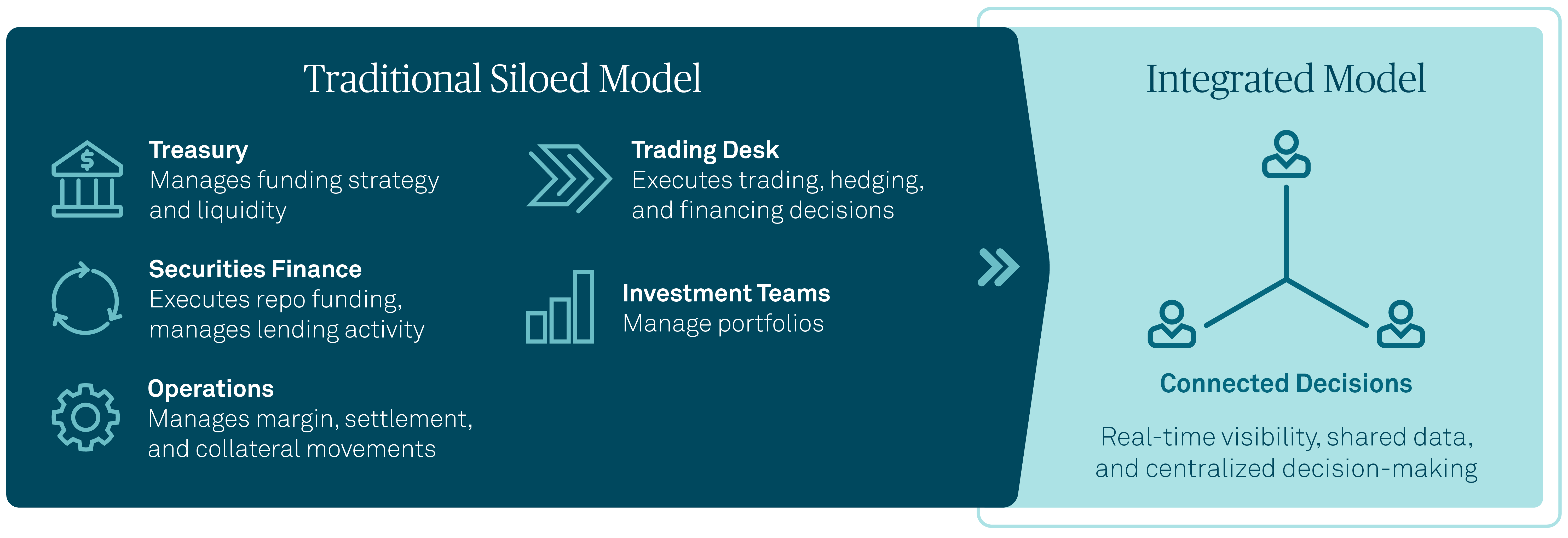
Historically, many institutions approached collateral management through separate but connected functions: treasury managed funding strategy and liquidity needs; securities finance teams executed repo funding, managed lending activity, and sourced collateral market opportunities; operations teams managed margin, settlement, and day-to-day collateral movements; trading desks executed trading, hedging, and financing decisions; and investment teams managed portfolios within their own mandates. These groups collaborated where needed, but the operating model was generally built around distinct responsibilities, systems, and asset pools. That approach worked when markets moved more slowly and liquidity needs were more predictable. In today’s markets, where funding decisions, margin requirements, and settlement obligations can shift quickly across regions and products, and a change in one can affect the others, that approach has become more difficult to sustain.
As markets move faster, decisions in one area directly impact others, requiring an integrated approach
Enterprise-wide visibility is therefore often the starting point. Institutions need to understand what collateral exists, where it sits, how it is valued, whether it is encumbered, and where it can be used. From there, they can make more informed decisions about best-use allocation: should this asset be posted for margin? Retained for liquidity? Financed through repo? Lent through securities finance? Or held for investment purposes? The “cheapest” asset is not always the asset with the lowest immediate cost; the right decision may also depend on liquidity value, capital impact, substitution costs, settlement certainty, currency needs, and future optionality.
As market infrastructure evolves toward a more digital ecosystem and 24/7 markets, collateral management will require a different kind of interconnectedness, with greater visibility across asset inventories, stronger connectivity across venues, and the ability to optimize collateral across both traditional and digital rails.
The direction of travel is clear: cash, collateral, and margin workflows are becoming faster, more global, and more interconnected. Settlement cycles are compressing, with the U.S. moving to T+1 for applicable securities transactions in 2024 and the UK and EU set to follow in 2027. As settlement windows shorten, collateral mobility will need to keep pace. Institutions will need to understand not only where assets can be financed in normal conditions, but how they can be pledged, transformed, or reallocated across private funding markets and public-sector liquidity facilities when conditions change. This interoperability can help preserve optionality, reduce trapped liquidity, and deploy collateral where it has the greatest funding value.
Market innovation is also shifting liquidity management from an overnight orientation toward more precise intraday tools. BNY’s intraday triparty repo capabilities, including its recent pilot of the first-ever GBP intraday triparty repo, demonstrate how market participants can source liquidity for specific periods, such as early morning funding needs, rather than relying on a full overnight funding window. This ability to access liquidity more precisely can help institutions manage funding costs, improve collateral efficiency, and better align available liquidity with actual obligations.
Collateral complexity is increasing as requirements expand across derivatives, financing markets, and a broader set of market participants. On one side of a trade, portfolio managers are focused on preserving performance, reducing cash drag, and making better use of securities as collateral where appropriate. On the other side, these choices are also becoming more directly linked to trade economics, because the assets an institution posts can influence how counterparties evaluate liquidity value, funding cost, and regulatory treatment.
As operating models become more complex, many institutions are moving toward centralized treasury or collateral functions supported by technology that provides a clearer view of assets across locations, entities, and custodians. However, visibility is only the starting point. Institutions also need connectivity to the venues and counterparties where collateral can be delivered, financed, or transformed. With the right operating model and infrastructure, they can optimize assets across margin requirements, repo, securities lending, and other collateral uses, improving flexibility, discipline, and efficiency.
Digital asset innovation is accelerating this shift. As adoption increases, tokenization could have a meaningful impact on collateral markets by enabling assets, cash, and eligibility rules to interact more efficiently. A practical building block in that evolution is the digitization of collateral schedules, which can help convert complex eligibility terms into more structured, usable data that supports optimization decisions. Over time, optimization may evolve toward programmable eligibility, tokenized ownership records, near-real-time settlement, automated substitutions, and more continuous liquidity management, helping connect collateral, cash, and settlement workflows across traditional and digital infrastructure. However, programmability alone is not optimization. Effective collateral management requires balancing liquidity, funding, eligibility, capital, and opportunity cost considerations across the enterprise. These continuous decisions must be connected across collateral, cash, funding, margin, and settlement workflows, spanning both traditional and digital rails.
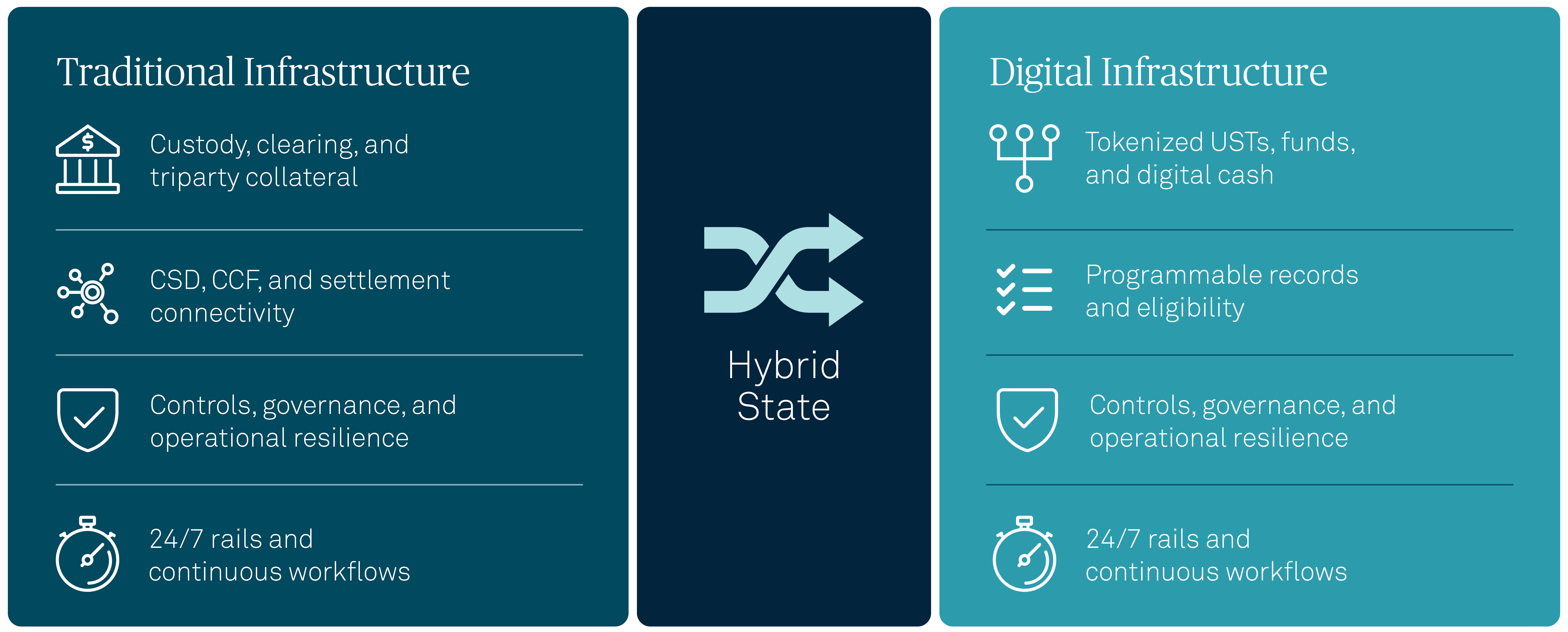
Traditional custody, triparty, and collateral infrastructure will need to operate alongside digital cash, tokenized funds, and blockchain-based records as markets move closer to a 24/7 environment. In the near term, this will lead to a hybrid model which may add complexity as institutions manage collateral across both traditional and digital rails, connecting collateral, cash, and settlement activities across multiple infrastructures. Institutions that proactively evaluate their collateral frameworks, and invest in the operational, governance, and connectivity capabilities required, will be best positioned to navigate this transition.

A hybrid ecosystem that connects proven market infrastructure with emerging digital rails
These developments matter because they connect innovation to practical use cases: reducing friction, increasing transparency, improving settlement certainty, and helping institutions unlock liquidity within a resilient, trusted network. As collateral markets evolve, trusted partners and proven infrastructure will remain essential. Greater speed, programmability, and connectivity can create value, but only when supported by strong controls, clear governance, operational resilience, and the safety and soundness market participants require.
As markets become faster, more complex, and more global, collateral optimization will continue to play a central role in liquidity resilience, funding efficiency, and risk management. Institutions best positioned to benefit will be those that can see their collateral clearly, mobilize it efficiently, and allocate it appropriately across products, entities, currencies, and markets. The next era of collateral will be defined by transparency, mobility, programmability, and trust. Rather than a secondary objective, optimization will be a strategic capability at the heart of resilient, efficient, and always-on markets. This makes the choice of trusted partner and infrastructure more important than ever before. Grounded in more than 240 years of market trust, BNY’s continued investment in infrastructure, data, automation, and digital capabilities is helping clients connect traditional market infrastructure with emerging digital rails, navigate this transition, and support the safe, efficient evolution of global collateral markets.
BNY Institute content provides thought leadership and is not investment research. Views are the authors’ and may change. This material is for informational purposes only and does not constitute investment advice or an offer. For full disclosures, click here.