Global Collateral
Collateral management and mobility to optimize liquidity needs.

At its third-quarter Global Investment Council meeting, BNY’s market and investment experts debated a market environment shaped by countervailing forces around growth, inflation, policy, and market leadership.
Will the Fed’s next meaningful move reflect renewed hawkishness or extended patience?
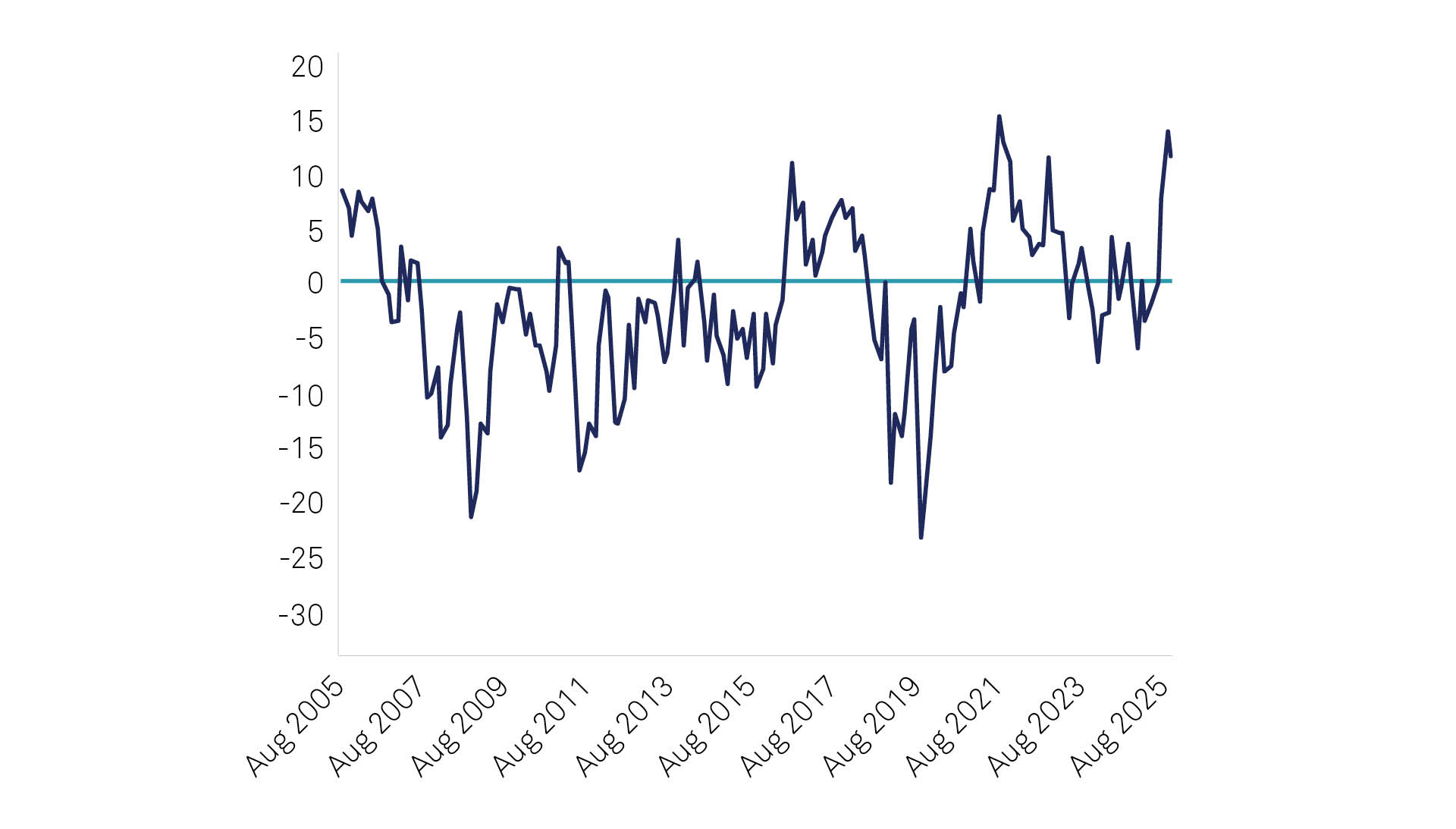
Bloomberg Fed Sentiment Index
Source: Bloomberg. Data as of Aug 19, 2026.
Fed sentiment continues its hawkish pitch after surprise shift toward rate hikes among policymakers in June FOMC minutes.
Inflation risks may prove more persistent than they appear and market pricing still implies some possibility of further policy firming. Three of the twelve FOMC voters dissented from the choice to hold steady in July, claiming that hiking now could avoid steeper, more costly tightening later. The hawkish case rests less on current data than on the lagged pass-through from the oil shock. The question is how far those price pressures will spread through the rest of the economy, and whether the Fed can keep looking through another supply shock after years of prices running far from target, making it prudent to position for a higher-for-longer path in rates and a more selective risk backdrop.
Parts of the economy are already cooling. At the July FOMC meeting, policymakers highlighted continual housing market weakness and noted that risks to their employment and growth forecasts were seen as skewed to the downside. Core inflation has eased throughout the past two months and the Fed may prefer to look through the recent energy shock as a one-time event, as it has in the past, and observe whether softer fundamentals gradually reduce underlying inflation pressure. With a material portion of price volatility tied to supply disruption, the argument can be made for keeping duration optionality and avoiding a potential overreaction to near-term inflation noise.
Will capital, power, or policy be the reason for a potential slowdown in the AI buildout?
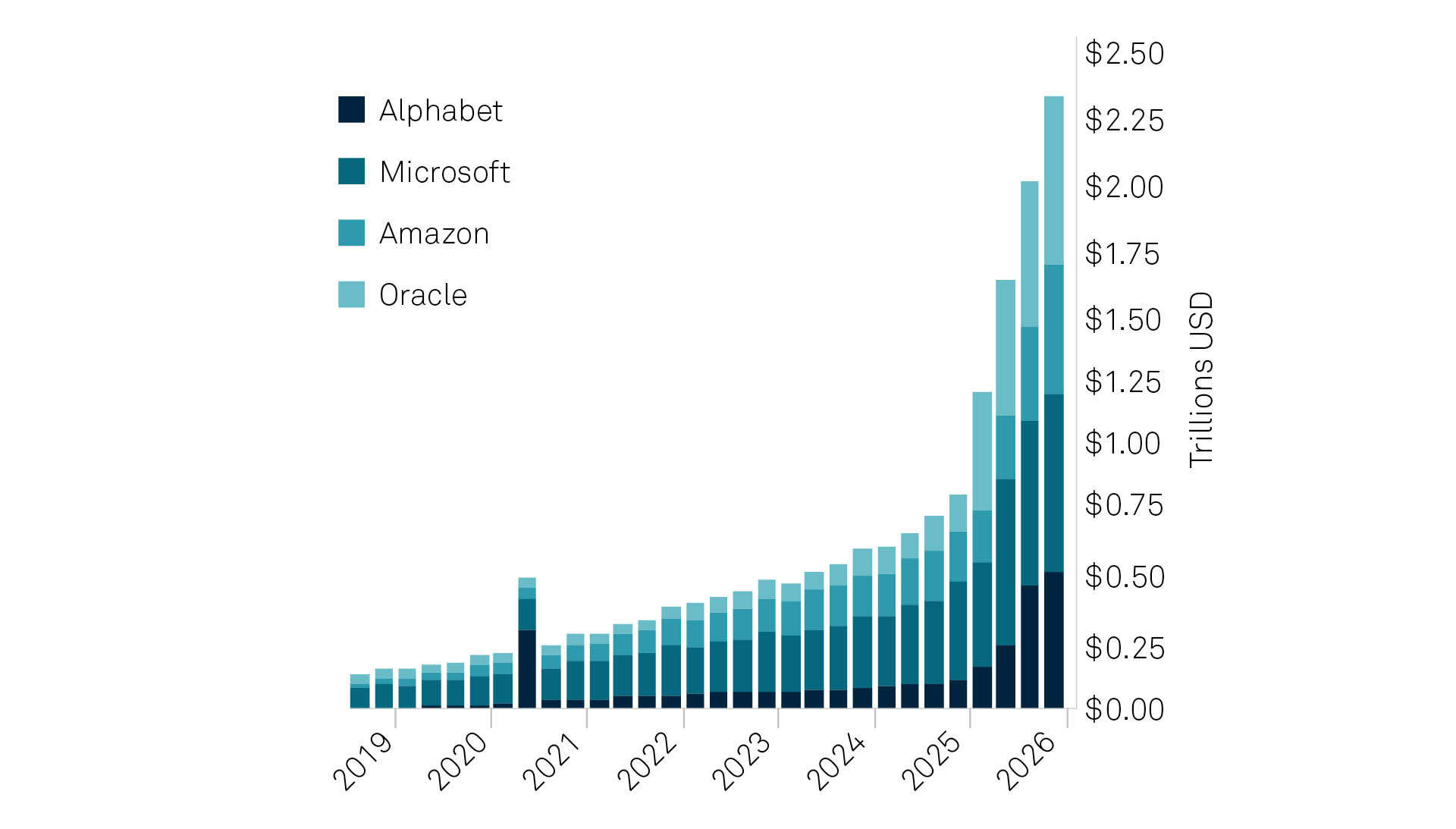
Hyperscalers’ Remaining Performance Obligations
Source: Macrobond, BNY. Data as of Q2 2026.
Year-over-year growth rate of total RPOs among four major hyperscalers has accelerated to 186% in the latest quarter.
AI is increasingly as much a financing story as a productivity story. Long-dated compute commitments, expensive data center buildouts, and rising competition from cheaper models all shift attention toward the sustainability of future earnings, especially as debt loads rise alongside investment needs. A key part of that financing chain is the growth in remaining performance obligations (RPOs): commitments to multi-year compute contracts with hyperscalers and neocloud providers, booked as backlog and used to finance new data center capacity. In that sense, part of the AI buildout is funded not from current earnings, but against expected future demand. If confidence in future monetization weakens, or financing conditions tighten, the capital cycle could slow quickly. That may favor companies with clearer monetization, stronger balance sheets, and less dependence on external funding.
The larger constraint is physical and political. Compute demand remains intense, but power availability, grid interconnection, land and permitting bottlenecks, and broader infrastructure needs are all becoming more binding. Policy constraints may then compound these issues, as cybersecurity requirements, model testing standards, local opposition to data centers, and broader regulatory scrutiny slow approvals and raise execution risk. The hurdle is securing energy, infrastructure, and regulatory clarity, favoring exposure to enablers and a more selective approach to beneficiaries whose growth depends on unconstrained buildout assumptions.
Is global market leadership broadening or concentrating in a few advantaged regions and themes?
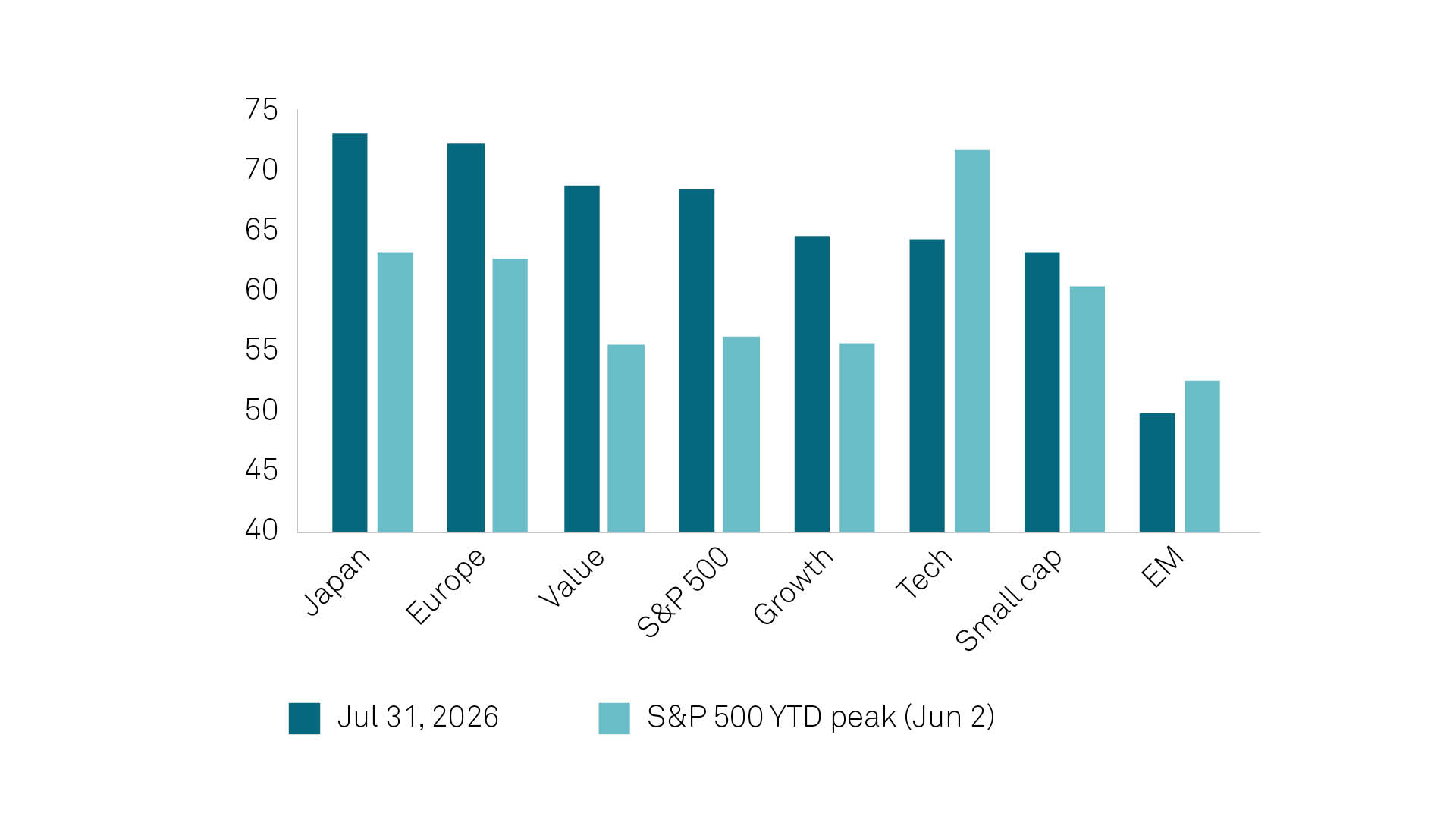
Percentage of stocks above 200-day moving average
Source: Bloomberg. Data as of Jul 31, 2026.
~70% of S&P 500 companies are above their 200-day moving average, near the highest in 18 months.
Market leadership appears to be broadening beyond a narrow set of mega-cap winners. Breadth has improved across regions and styles, and participation has strengthened in areas such as small caps, Europe, EM, and Japan. Expected earnings growth outside the largest U.S. growth names also suggests that cyclical rotation may have further room to run, supporting more diversified portfolio allocation.
The appearance of broader participation may overstate how much leadership has truly changed. Returns, earnings visibility, and investor attention still seem heavily tied to AI capex beneficiaries, U.S. tech, and a narrow set of advantaged themes. In this view, diversification has improved at the margin, but focusing on markets and sectors with durable earnings visibility may be superior to assuming breadth alone will carry returns.
BNY Institute content provides thought leadership and is not investment research. Views are the authors’ and may change. This material is for informational purposes only and does not constitute investment advice or an offer. For full disclosures, click here.