Liquidity & Financing
Integrated platform orchestrating liquidity, margin and financing.



In Driving Towards Always-On, Connected, and Programmable Markets, BNY Institute described how financial markets could evolve towards a more continuous and interconnected operating model. From an institutional perspective, demand from global macro traders and fintechs is accelerating the need for infrastructure that better reflects the speed, flexibility, and geographic reach of the markets in which they operate. Both traditional firms and fintechs are offering weekend sessions to provide access to a variety of assets, and at the same time, digital cash and cash equivalents in the form of tokenized money market funds, tokenized deposits, and stablecoins are raising expectations for faster settlement, enabling collateral markets to seamlessly operate. U.S. Treasury bonds are among the most in-demand asset classes for always-on markets. BNY shares a long and interconnected history with the U.S. Treasury market going back to 1789, when then Treasury Secretary Alexander Hamilton negotiated a $200,000 loan from The Bank of New York to fund the U.S. government. Since that first loan – Warrant #1 – BNY has played an important role in building the deepest and most liquid bond market in the world.
U.S. Treasuries are foundational to global collateral, funding, and risk management as the world’s primary risk-free asset. Treasury activity currently runs in a near-continuous, follow-the-sun model across Asia, Europe, and North America, with trading venues open for up to 22 hours a day and futures markets operating from Sunday evening through Friday evening. Yet, key elements of today’s market infrastructure remain anchored to operating windows designed for an earlier era. The result is a growing disconnect between the pace of trading and the movement of funding and collateral, a defining operating challenge in the next phase of U.S. Treasury market evolution.
We believe growing demand to access liquidity and manage risk whenever needed, and to settle wide-ranging U.S. Treasury trading activity such as purchase/sale, repo, and margin, without the constraints of traditional U.S. operating hours, will drive the evolution of a market that delivers access, mobility, and continuity both globally and 24/7/365.
Existing scaled and resilient systems have long provided the trust, settlement finality, and institutional safeguards that support liquidity and collateral flows across the financial system.
These connected capabilities are important reasons the U.S. Treasury market remains the world’s primary liquidity market, reflecting decades of evolution built around the resilient movement of cash and securities. A continuous market requires more than the ability to move assets on demand; it also requires liquidity, balance sheet capacity, credit intermediation, and risk management to be available when and where activity occurs.
The ingredients that power the U.S. Treasury market remain institutional as much as technological, and they will continue to depend on trusted, regulated, and scaled financial participants. As central clearing expands, central counterparties (CCPs) will also play an important role by helping manage counterparty risk and supporting the efficient netting and settlement of activity across a more continuous Treasury ecosystem. For this reason, the first phase of market evolution is likely to come from extending existing (or traditional) rails. Because settlement and collateral frameworks are already embedded in U.S. Treasury workflows, simply extending those operating windows could reduce timing frictions and improve collateral mobility without requiring market participants to redesign established and trusted processes.
The benefits of connected markets are especially clear when Treasury securities need to be converted into collateral or funding during stress periods. During these times, resilience depends not only on the ability to have high-quality collateral on balance sheet, but also on the ability to mobilize it across liquidity channels in a timely and reliable manner. As we explored in Collateral Management in an Always-On Market, the efficient deployment and mobilization of collateral is becoming increasingly central to market resilience and liquidity management. More continuous access to repo, triparty, and related funding markets could reduce the need for precautionary cash buffers, improve market functioning as conditions evolve, and marginally increase the attractiveness of holding U.S. Treasuries by making them easier to liquidate quickly when needed. These improvements can build on the infrastructure and workflows the market already uses, while preserving the settlement confidence and institutional protections on which participants rely. Market-moving developments do not always happen during traditional open windows, which can create immediate liquidity needs while key infrastructure is less accessible. Simply extending operating hours would allow participants to continue mobilizing collateral and funding positions as conditions change, helping align the movement of liquidity with the increasingly continuous nature of Treasury activity.
Case Study
How it Works: Today, global dealers must buy or sell U.S. Treasuries (USTs) for cash to move securities or funding between their U.S. and European affiliates. The mechanism is called delivery-versus-payment (DvP), where the Treasury security and cash are delivered at the same time. Today, UST markets operate for price formation around the clock, but settlement and funding remain tied to specific operating windows.
Therefore, for a global dealer to move USTs and cash between two of its entities, one entity must sell the UST for cash and one entity must buy the UST and deliver the cash. Just because each entity has the cash and securities, it may not be able to settle the transaction exactly when needed because of time zones and settlement windows. The challenge global dealers face is not a shortage of liquidity in aggregate, but specifically for each affiliate to be capitalized. The challenge becomes ensuring cash and USTs can be mobilized efficiently across affiliates or over-capitalize each affiliate.
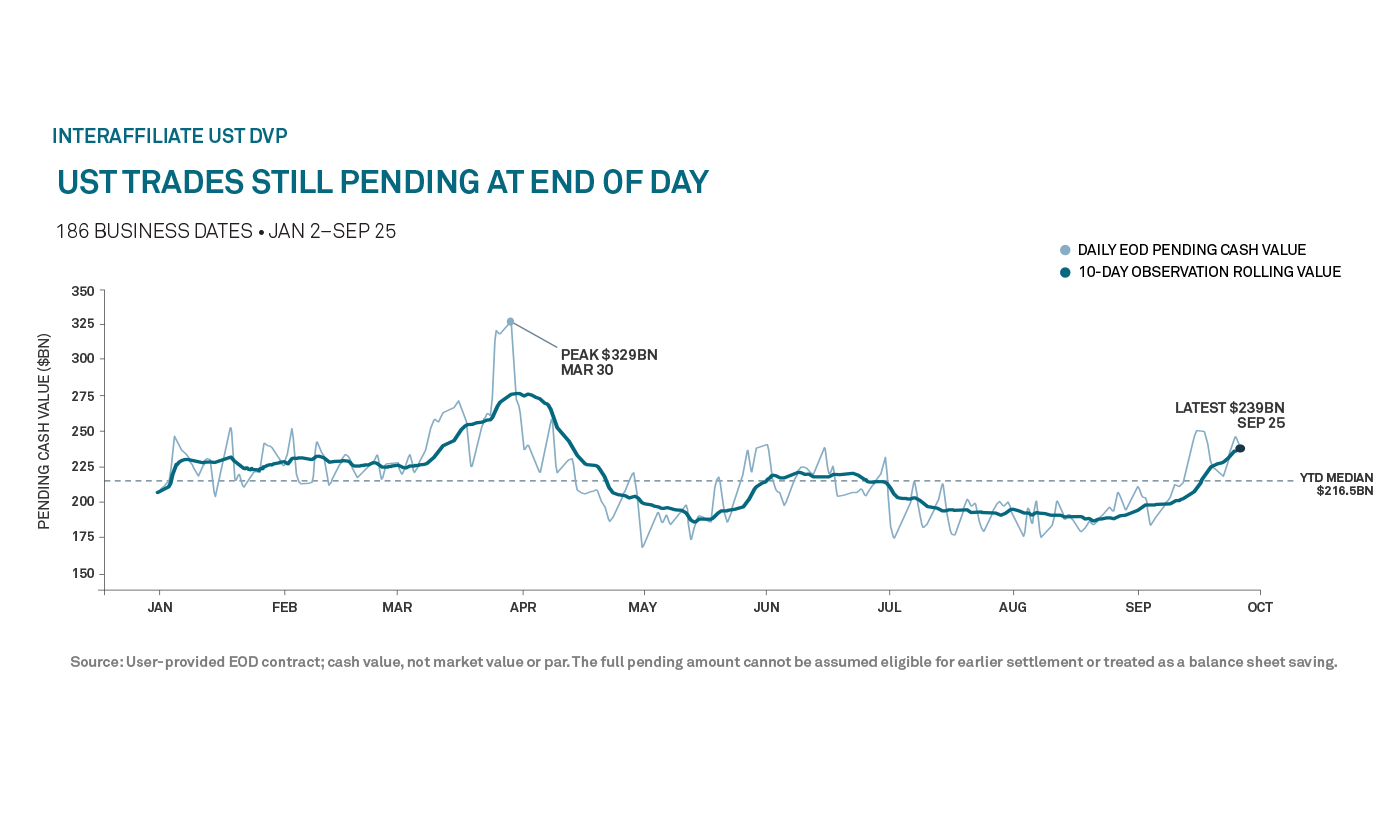
Why it matters: These constraints can make it more difficult to align liquidity availability with trading and settlement activity. Delays in repositioning resources across entities can leave funding and collateral in the wrong place at the wrong time, contributing to the ~$239 billion of activity that remains unsettled at the end of each day.
What it Means for Firms: For dealers and their affiliates, those costs are tangible. Firms often compensate by pre-positioning collateral or holding larger cash buffers to ensure liquidity is available when needed. The result is trapped liquidity, missed yield opportunities, and less efficient use of capital. More continuous UST settlement could make existing resources more accessible, allowing firms to put more capital to work rather than holding it in reserve.
While extending operating windows by adjusting our existing scaled systems alone can address a meaningful share of new opportunities, digital infrastructure can add the next set of unlocks for market participants by linking financing workflows more closely. In fact, tokenization can be most useful by connecting tokenized securities, cash, and collateral to the traditional systems and workflows that the market already trusts at scale. Tokenized assets and cash can support workflows in which transaction logic is embedded directly into the settlement process, allowing collateral transfers to be linked automatically to margin requirements, financing flows to be coordinated with securities settlement, and liquidity to move dynamically based on predefined conditions. This kind of automation has the potential to reduce manual intervention and improve coordination across interconnected markets. Beyond coordination, programmable settlement can optimize workflows, as digital infrastructure creates the potential to sequence transactions around funding and collateral requirements.
The efficiency discussed with extended settlement hours for interaffiliate funding transfers, for example, could be executed automatically according to predefined rules, helping reduce liquidity demands and settlement risk. Beyond faster settlement, this would allow for more efficient deployment of liquidity and collateral.
Digital infrastructure can provide the operational leverage needed for always-on markets, as automated workflows can reduce reliance on manual intervention, making it easier to support activity outside traditional operating hours. However, a more continuous market cannot be built through digital rails alone. While tokenization is often associated with faster or even instantaneous settlement, it does not remove the need for the core mechanisms that support the movement of assets, liquidity, and risk through the system. In fact, shorter transaction timelines likely increase the importance of having funding, collateral, and balance sheet capacity available precisely when and where they are needed.
The path forward is therefore likely to unfold along two complementary tracks: extending the hours of traditional rails beyond historic operating windows and introducing digital rails that can make market workflows more connected and efficient. Together, these tracks offer the clearest path toward a more interoperable U.S. Treasury market infrastructure model.
Case Study
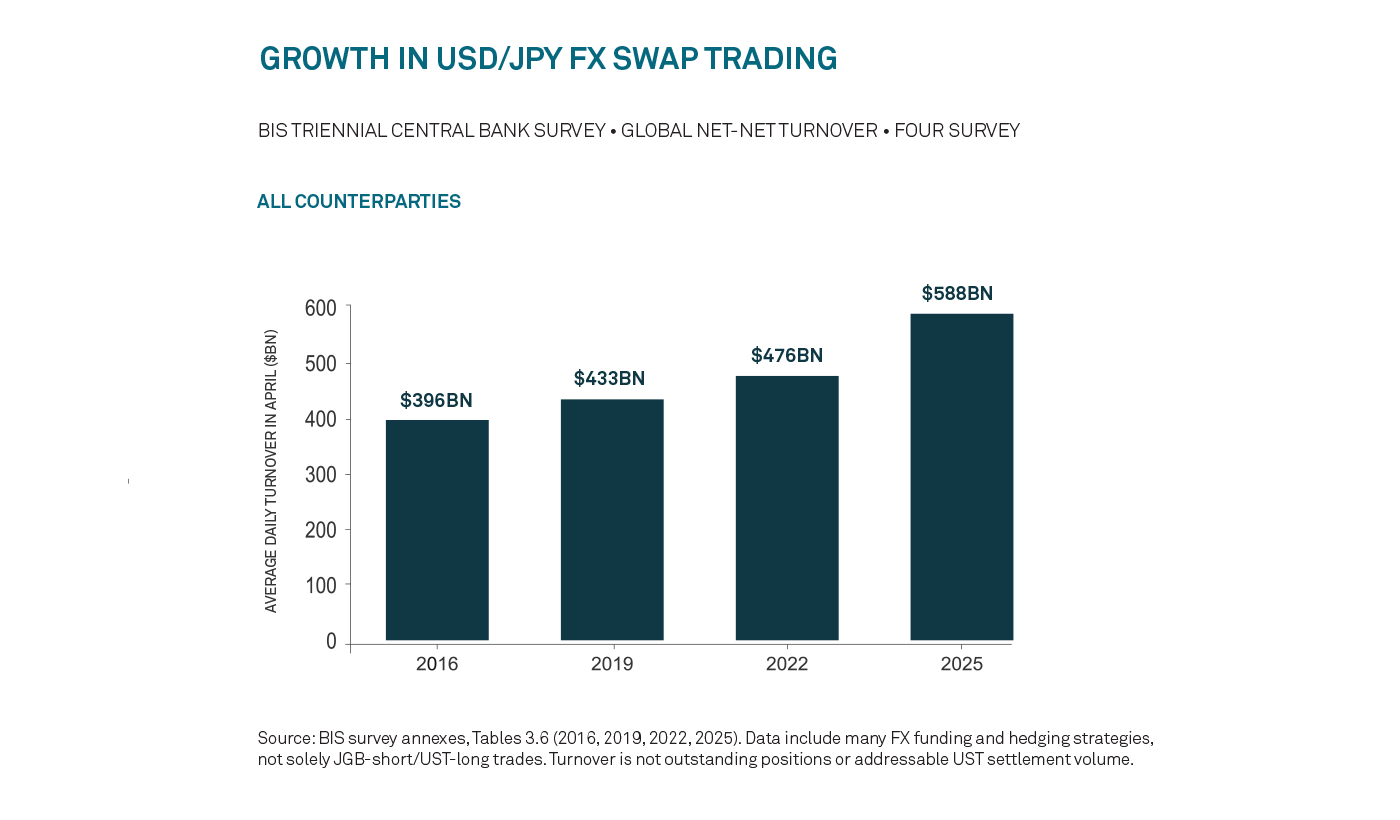
How it Works: A hedge fund uses a dealer to raise liquidity against a JGB position, converts the proceeds through foreign exchange (FX), and deploys the funds into USTs. While the investment decision can be executed quickly, the supporting movement of cash, securities, and collateral still occurs through separate infrastructures operating on different timelines. The fund owns the investment exposure, while the dealer bridges the timing gaps between transaction steps.
A typical workflow involves several transaction legs that settle sequentially rather than simultaneously, meaning a trade executed quickly may take hours to become fully funded and deployable.
Why it Matters: As transactions span multiple markets, funding and settlement processes do not always align. Cash may be available before securities settle, while collateral may remain tied up until another step is complete. Dealers play an important role in connecting those timing differences, helping transactions progress smoothly across markets and settlement cycles. At scale, reducing those timing mismatches could create opportunities for even greater efficiency in the movement of capital and collateral.
What it Means for Firms: The costs ultimately fall on market participants. Dealers may need to warehouse exposures and commit balance sheet capacity for longer than necessary, while investors may prefund transactions or maintain larger liquidity buffers to ensure execution certainty. In effect, firms are deploying capital to manage operational timing rather than investment risk. Extending the hours of traditional rails could reduce those constraints by making funding and collateral available closer to when activity occurs. Digital rails could go further by linking transaction steps through programmable workflows, helping capital move more efficiently across the transaction lifecycle.
We believe U.S. Treasury market infrastructure will evolve toward an interoperable ecosystem in which traditional and tokenized assets coexist across a more flexible liquidity environment. Traditional infrastructure will continue to provide the market’s institutional foundations, while digital rails will add a new layer of connectivity and control. The path to get there requires traditional and digital infrastructure to evolve together to support more efficient liquidity deployment, better collateral utilization, lower timing-related balance sheet costs, and greater resilience in a market that already operates on a near-round-the-clock basis. This way, market participants can preserve trust while aligning infrastructure closer to the way the market already trades.
BNY is already taking steps towards this interoperable model. Later this year, we expect to extend operating hours for our traditional settlement platforms for Fed-eligible assets, with a view to extend into European and Asian trading hours next year. In parallel, we plan to introduce additional digital cash and tokenized deposit capabilities designed to support more efficient on-chain settlement and financing activity for institutional clients. In 2027, BNY aims to support 24/7 clearing for traditional and tokenized U.S. Treasuries and 24/7 bilateral and triparty financing across a range of traditional and tokenized assets.
BNY Institute Contributors:
Allie Barone, Global Head of Partnerships and Commercialization, Market Transformation & Innovation Hub
Leon Crutchley, Head of Strategy, Global Clearing
Cale Newhouse, Senior Director, Global Collateral
Victor O’Laughlen, Executive Platform Owner, Global Clearing
Benjamin Phillips, Vice President, Markets and Policy Analysis, BNY Institute
Rajeev Sambyal, Head of Digital Market Infrastructure, Market Transformation & Innovation Hub
Jess Stern, Senior Director, BNY Institute
Nate Wuerffel, Global Head of Market Structure and Head of Product, Global Collateral
BNY Institute content provides thought leadership and is not investment research. Views are the authors’ and may change. This material is for informational purposes only and does not constitute investment advice or an offer. For full disclosures, click here.