Digital Assets
Infrastructure connecting traditional and digital ecosystems.
BNY Institute
Future of Finance:
Key Developments in 2026
Time to Read: 5 minutes
The world continues to move faster. The pace of change and innovation is accelerating organizational and infrastructure changes across the financial system. In 2026, we will see developments across five focus areas: greater speed in securities settlement and real-time payments, central clearing in U.S. Treasury markets, greater collateral mobility, increasing adoption of digital assets and blockchain technology, and AI’s ability to transform productivity and growth. Preparations to provide continuity, resiliency and optionality will be critical to maintain client trust and safety in this rapidly changing environment.
Asset and payment flows are accelerating as global capital markets are modernizing. Institutions now demand fully integrated, end-to-end platforms and institutional clients want speed, certainty and real-time visibility on transactions.
After the transition to T+1 settlement in the U.S., the rest of the world is working to make faster settlement a reality. In From SIU to T+1: Transforming Post-Trade Settlement in Europe, we noted how the EU, U.K. and Switzerland are expected to implement T+1 by October 2027, with the EU aiming for full systems implementation by the end of this year and testing beginning early 2027. In Asia, market participants are actively reviewing the feasibility of implementing T+1 for different types of securities before setting firm transition timelines.
The year ahead will be an important one for this transition. Across the EU, U.K. and Switzerland, the focus will be on implementation and client readiness. Misalignment could ripple through the chain, therefore successful migration will depend on:
Global real-time payments will continue to scale rapidly across markets, expanding use cases, increasing volumes and interoperability. In 2026, we expect expanded payment rail connectivity and further technological innovations (see section 4) to drive faster, more transparent cross-border payments. Key opportunities for 2026 include:
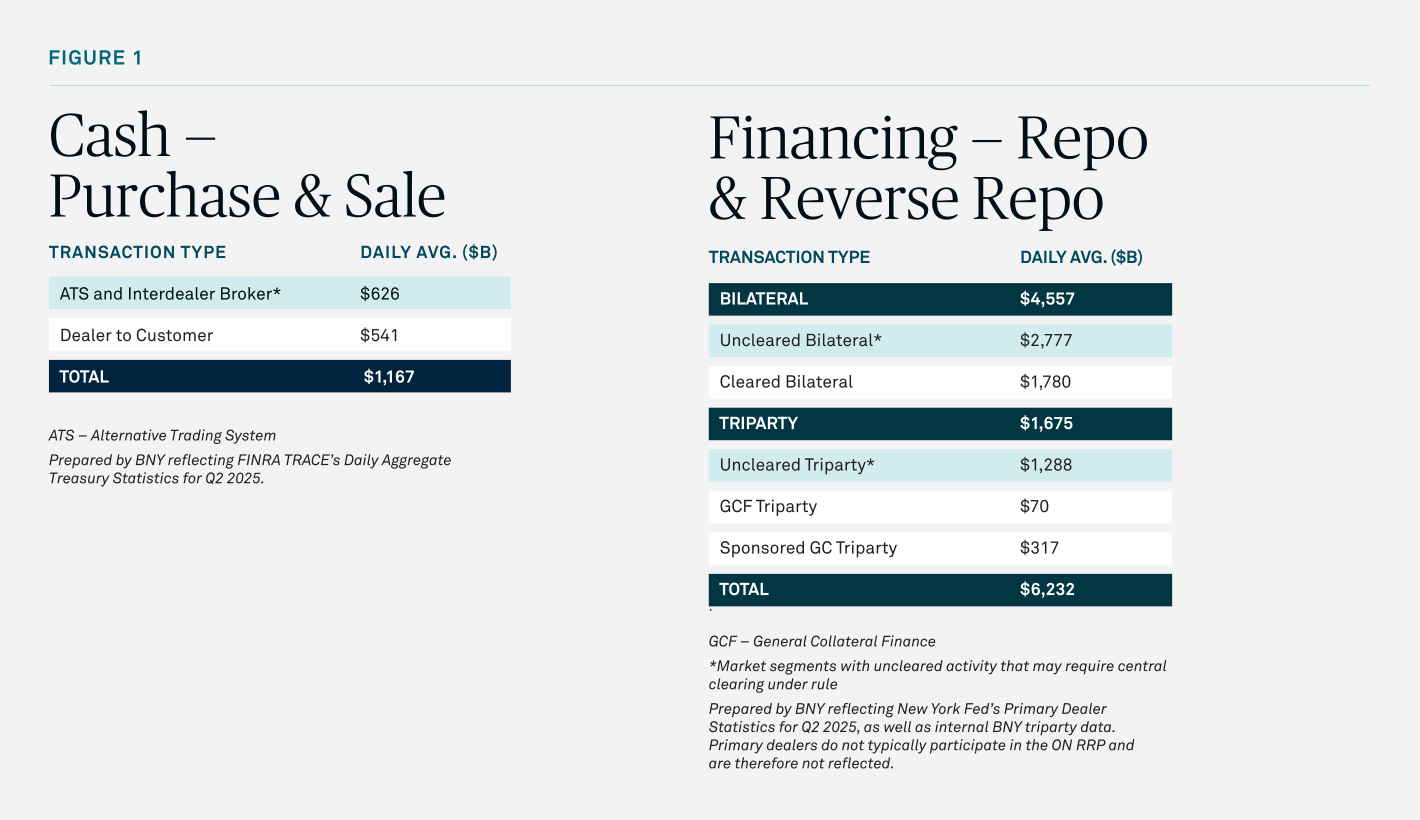
By the end of the year, eligible cash transactions in the U.S. Treasury market will transition to central clearing, with eligible repo and reverse repo transactions transitioning by June 2027. With an estimated $4+ trillion in daily uncleared transactions in scope, (Figure 1) this shift is significant, and we have continued to provide our perspectives to clients through its evolution. U.S. firms recently reported that they have a high degree of confidence in readiness for the transition while Europe and Asia need to work quickly to catch up. This year will be important for all firms to make meaningful progress and prepare for the transition, including:
Institutions looking at new investment opportunities will pursue additional ways to put their assets to work, increasing the strategic importance of collateral mobility and intraday liquidity. Central banks and private sector platform providers will build off their work in 2025 to harmonize collateral systems and optimize collateral use. In Europe, following the launch of the Eurosystem Collateral Management System, market participants across public and private sectors will look to further refine their operations. In the U.S., following the expansion of the Federal Reserve's Standing Repo Operations (SRP), there will likely be a push to create more interoperability between collateral platforms, including the Fed’s Discount Window and SRP, the Federal Home Loan Bank system and private sector third-party platforms. As with other market developments, institutions will need to prepare by:
In The Digital Revolution: Transforming Financial Market Infrastructure, we highlighted how the rise of blockchain technology is enabling a new operating model in which traditional financial infrastructure is evolving (as noted above), while also embracing digital rails — fundamentally transforming how assets are recorded, transferred and moved. Three key areas stand out as ones to watch in 2026 as adoption of digital assets and blockchain technology progress:
These developments will progress throughout this year and over the longer term, but the key to unlocking these opportunities will be the interconnectivity between traditional and digital systems.
With greater speed and 24/7/365 operating models for institutions and markets, humans can benefit from AI-driven tools to help proactively identify risks, prevent fraud and strengthen market resilience. At BNY, we are using AI-based solutions to further improve quality and agility. For example:
In AI In the Next Phase: Driving Adoption, we detail our AI journey and offer several learnings that can help firms navigate further adoption in 2026:
As these developments drive modernization in global markets, preparation will be essential to unlocking the benefits. BNY stands ready to help our clients navigate these changes, enabling a trusted ecosystem that supports growth and investment.
Disclaimer
BNY Institute content provides thought leadership and is not investment research. Views are the authors’ and may change. This material is for informational purposes only and does not constitute investment advice or an offer. For full disclosures, click here.