


Securities Services
BNY's securities services help financial institutions simplify complexity, unlock capacity and scale through integrated platform capabilities. Learn more.
BNY Institute
Capital at Work: Growing the World Through Infrastructure Finance
Time to Read: 8 minutes
Global infrastructure is no longer just a public-sector priority — it has become a core asset class for investors worldwide with McKinsey estimating a cumulative $106 trillion in necessary investment through 2040 to meet the need for new and updated global infrastructure.1 The very definition of infrastructure has expanded; traditionally referencing assets such as power grids, roads, ports and bridges, advances in technology are bringing other assets such as hyperscale data centers into scope. While aging assets, as well as shifts in population, climate and global supply chains, are increasing the need for upgrades to traditional infrastructure, new technology is boosting electricity demand and fueling rapid growth in data centers, with global electricity use from AI data centers expected to quadruple by 2030.2 As a result, power generation and distribution are becoming core “utilities,” as vital as ports and roads have been.
Estimated investment needed through 20401
Expected global electricity use from AI data centers by 20302
Current total infrastructure AUM1
Many regions are stepping into the spotlight with expanding infrastructure needs, either focusing on modernizing traditional infrastructure assets or investing in new types of infrastructure projects. Some examples include:
Infrastructure remains one of the most attractive asset classes, driven by its stability, long-term capital growth and diversification. Long-term contracts and regulated return frameworks provide predictable, inflation-protected cash flows, especially valuable in a macroeconomic environment shaped by inflation, geopolitical uncertainty and volatility. These assets also tend to appreciate over time, thanks to their scarcity value, essential-service nature and increasing demand.
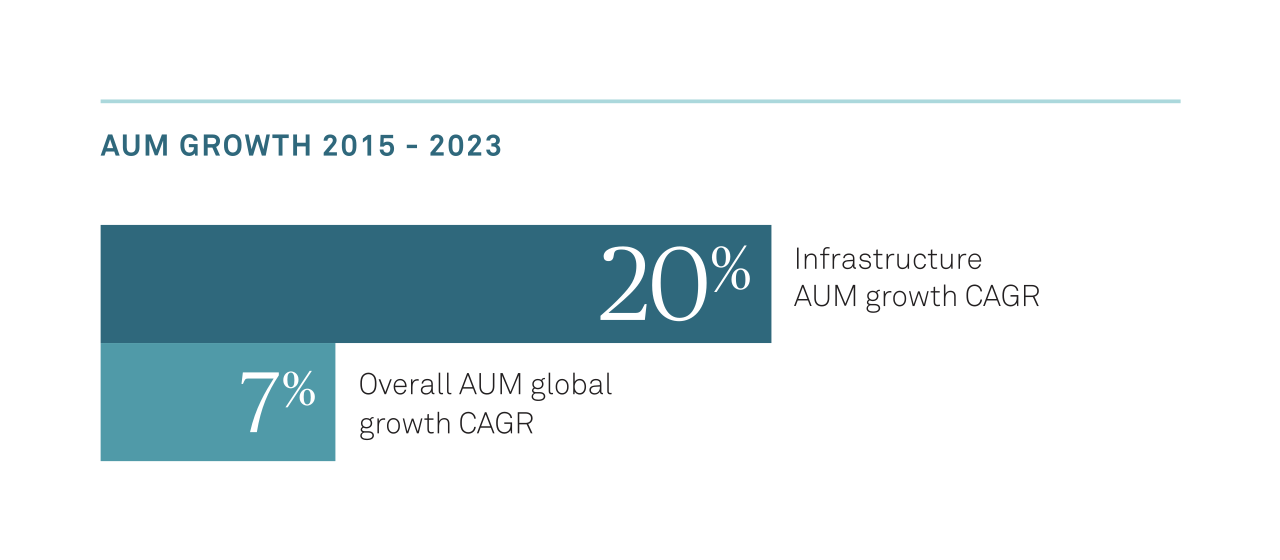
We are seeing an increased volume of M&A transactions in the space, with larger investment managers acquiring specialist infrastructure managers to expand their ability to invest, which we expect to continue. Global infrastructure assets under management (AUM) has been growing at a CAGR of ~20% since 20153 — almost 3x faster than overall global AUM.
KEY GROWTH DRIVERS 2024 AND BEYOND
Evolving infrastructure types
Geographical considerations
Broader investment base
At the same time, infrastructure ETFs, semi-liquid interval funds, tokenized infrastructure securities and fractional ownership platforms are enabling broader access to the asset class. Private markets managers and financial institutions are responding by creating new channels, wrappers and digital formats to deliver infrastructure exposure across end-investor segments. Wealth intermediaries and RIAs are opening the retail channel and broadening access through evergreen and interval fund formats.
Overall, these evolving dynamics are driving both opportunity and complexity. New types of projects with bigger deal sizes across a broader set of geographies bring not only different liquidity and risk considerations, but also a variety of potential regulatory implications. Additionally, the wider set of investor types and vehicles brings a heightened level of transparency requirements and reporting demands. As a result, investors increasingly require reliable administration, transparent payment flows and robust escrow services to manage multi-party transactions and mitigate counterparty risk. Taken together, these dynamics underscore an ecosystem in transition, where operational excellence and trusted financial infrastructure are as critical as capital itself.
BNY capabilities include specialized agency, multi-currency payment infrastructure and digital escrow solutions designed for complex, cross-border projects.
Origination and structuring in infrastructure are evolving in tandem with the broader set of capital sources. On the debt side, traditional bank loans still anchor project finance, but they are increasingly paired with Public Private Partnership (PPP) frameworks, infrastructure debt funds and private placements that can be tailored to tenor, covenant and sector risk. To attract credit investors, structures now emphasize optimized capital stacks, credit enhancements and blended finance approaches that deliver stronger risk-adjusted returns and address perceived policy, construction and demand risks. On the equity side, infrastructure funds aggregate institutional capital, while coinvestments, sidecar vehicles and SMAs offer targeted exposure and alignment.
Newer financing structures coming into play:

Governments can lease or sell mature assets to fund new builds (“asset recycling”)

Simple availability‑payment contracts let the public sector pay a fixed fee for keeping assets running, reducing demand risk

Future user fees can be packaged into bonds

Short construction loans can be refinanced once operations begin

Portfolio options like loans against operating assets, continuation funds and tokenized shares can help improve liquidity and access
In this environment, selecting the appropriate partners can help capital move efficiently across geographies and investor segments, matching project needs with the most suitable pools of capital. We believe the next phase will be defined by interoperable structures, rigorous operating discipline and data-rich transparency at scale. As new fund formats, wrappers and tokenized vehicles mature, we expect convergence around more standardized documentation, embedded risk controls and improved secondary liquidity — bridging institutional and retail channels. Project financing will increasingly be coordinated through data-driven workflows that match precise sponsor requirements with curated pools of capital globally.
As capital moves from commitment to deployment, efficient execution and settlement are key to maintaining momentum and mitigating risk to meet investor needs. This part of the investment lifecycle is shifting from linear processes to more orchestrated, multi-party workflows that demand global connectivity, rigorous controls and transparent, real-time reporting. Beyond cross-border cash movements and regulatory alignment, sponsors and investors now expect integrated operating solutions — sophisticated trustee and escrow services that release capital against conditions and milestones, global custody to safeguard assets and centralize data, treasury capabilities to optimize liquidity across currencies and jurisdictions and collateral management to secure exposures and enforce waterfalls. Escrow has become a strategic lever, synchronizing debt and equity tranches and reducing timing and counterparty risk as projects scale. Overall, streamlining settlement, enhancing transparency and building the operational resilience required to deliver target returns will be crucial to scaling in a more complex, diversified infrastructure ecosystem.
Brian Ruane, Global Head of Clearance and Collateral Management, Credit Services and Corporate Trust
Post execution, the focus shifts to ongoing administration — ensuring assets are monitored, reported and maintained throughout their lifecycle. This spans performance management, regulatory compliance and transparency communications to investors and stakeholders. As projects grow more complex, managers must integrate performance, compliance and liquidity data across jurisdictions and vehicles, tailoring outputs to diverse investor needs. Institutional LPs expect granular analytics, disclosures and stress tests, while retail channels benefit from simplified reporting and real-time visibility. Embedding performance monitoring, regulatory reporting, document and cash-flow automation and targeted investor communications into workflows can help reduce operational risk, uphold governance and empower faster, better informed decisions throughout the lifecycle. Looking ahead, emerging technologies and end-to-end services will further elevate transparency and efficiency. Institutions that combine traditional servicing expertise with next generation digital capabilities — pairing comprehensive fund and loan administration with global custody, automated workflows and integrated risk and collateral controls that deliver actionable insights and audit ready records — will be best positioned to meet evolving investor expectations.
BNY delivers these services through global asset servicing, digital reporting platforms, and integrated data solutions that support multi-asset, multi-jurisdictional portfolios.
Effective exit strategies are necessary for optimizing returns and managing portfolio risk, evolving from one-off sales to engineered, programmatic strategies that optimize value, timing and transparency. Secondary transactions including partial stakes and whole-asset transfers now rely on sophisticated structuring, data-rich pricing and seamless transfer operations to preserve value and meet regulatory standards. Institutions with robust liquidity solutions and transfer agency capabilities can facilitate seamless transitions, providing investors with confidence that their divestment objectives align with broader market dynamics.
Infrastructure secondaries are poised for growth, driven by LPs seeking liquidity and GPs extending ownership of high-quality assets through continuation vehicles. Innovations such as tokenized fund interests, AI-driven pricing analytics and bespoke GP-led structures are poised to help further enhance flexibility and transparency, making secondaries a mainstream tool for portfolio optimization. For investors, this evolution can mean greater access to seasoned assets, accelerated liquidity and improved risk-adjusted returns — all supported by institutions that can deliver integrated liquidity, custody and transfer agency solutions at scale.
BNY provides access to investment vehicles, automated workflows and integrated reporting, enabling investors to manage liquidity efficiently during complex secondary transactions.
As capital stacks and contractual dependencies multiply with increasingly complex infrastructure projects, risk exposure compounds across counterparties and jurisdictions. To ensure return thresholds, investors are intensifying scrutiny of governance and risk management processes. Advanced tools ranging from integrated data analytics to automated reporting platforms enable managers to meet these demands while demonstrating accountability. Looking ahead, risk management will become more dynamic and essential as investors navigate safeguarding value in a market that’s increasingly more digital.
As the ecosystem evolves, resiliency and scalability will hinge on collaboration with trusted partners who bridge technology and governance — aligning expertise, digital capability and fiduciary strength to ensure compliance, security, investor confidence and sustainable innovation.
Sources
1“The infrastructure moment,” McKinsey & Company, May 2025, https://www.mckinsey.com/industries/infrastructure/our-insights/the-infrastructure-moment
2"AI is set to drive surging electricity demand from data centres while offering the potential to transform how the energy sector works", IEA.org, April 2025, https://www.iea.org/news/ai-is-set-to-drive-surging-electricity-demand-from-data-centres-while-offering-the-potential-to-transform-how-the-energy-sector-works
3 "Infrastructure debt: First among equals", Macquarie Asset Management, June 2024, https://insuranceaum.com/sites/default/files/2024-06/Infrastructure%20Debt_%20First%20among%20equals%20PERS-NO7-2024.pdf
Disclaimer
BNY Institute content provides thought leadership and is not investment research. Views are the authors’ and may change. This material is for informational purposes only and does not constitute investment advice or an offer. For full disclosures, click here.