No peace, no pivot
Start of the Week previews activities across global financial markets, providing useful charts, links, data and a calendar of key events to help with more informed asset allocation and trading decisions.
Start of the Week previews activities across global financial markets, providing useful charts, links, data and a calendar of key events to help with more informed asset allocation and trading decisions.

Wee Khoon Chong
Time to Read: 9 minutes
No peace, no war: The conflict in the Middle East is now stuck in a state of strategic limbo. President Trump recently asserted that he is taking a lower key approach to the conflict, indicating mounting economic – not military – pressure on Iran that might allow the U.S. to wait out the conflict. Meanwhile, the Strait of Hormuz remains mostly closed, save for a few shipments a day. Oil prices remain in the upper $80s, yet there are few promising options to bring about a resolution.
Soft data, sticky yields: Softer U.S. data over the last few weeks have reduced rate hike expectations for the rest of 2026. After Friday’s disappointing retail sales data, there’s less than one full hike priced into the swaps curve for December. Further progress on inflation over the next few months could seal the view that there won’t be a tightening of policy. Meanwhile, the back end of the U.S. Treasury yield curve stays elevated, with some commentators attributing higher yields to credibility concerns.
Intervention fades, BOJ must act: After joint U.S. Treasury and Japan Ministry of Finance (MoF) intervention to support the yen some two weeks ago, the Japanese currency has given back nearly half of what it gained as a result of the intervention. There’s growing acceptance that the BOJ will need to raise interest rates for any yen gains to be sustained and meaningful, something domestic fundamentals would justify. Whether further moves by U.S. or Japanese authorities are on the agenda is a relevant question, Treasury has signaled a desire to not sell USTs to fund further yen purchases.
AI debt vs. equities: The scale and size of AI infrastructure financing is starting to concern some market participants. Corporate debt issuance and circular financing agreements are increasing along with equity valuations. Higher interest rates could dampen enthusiasm for such large financing deals, and the link between debt, leverage and equity valuations is under more scrutiny.
North America: Will hike pricing continue to ease?
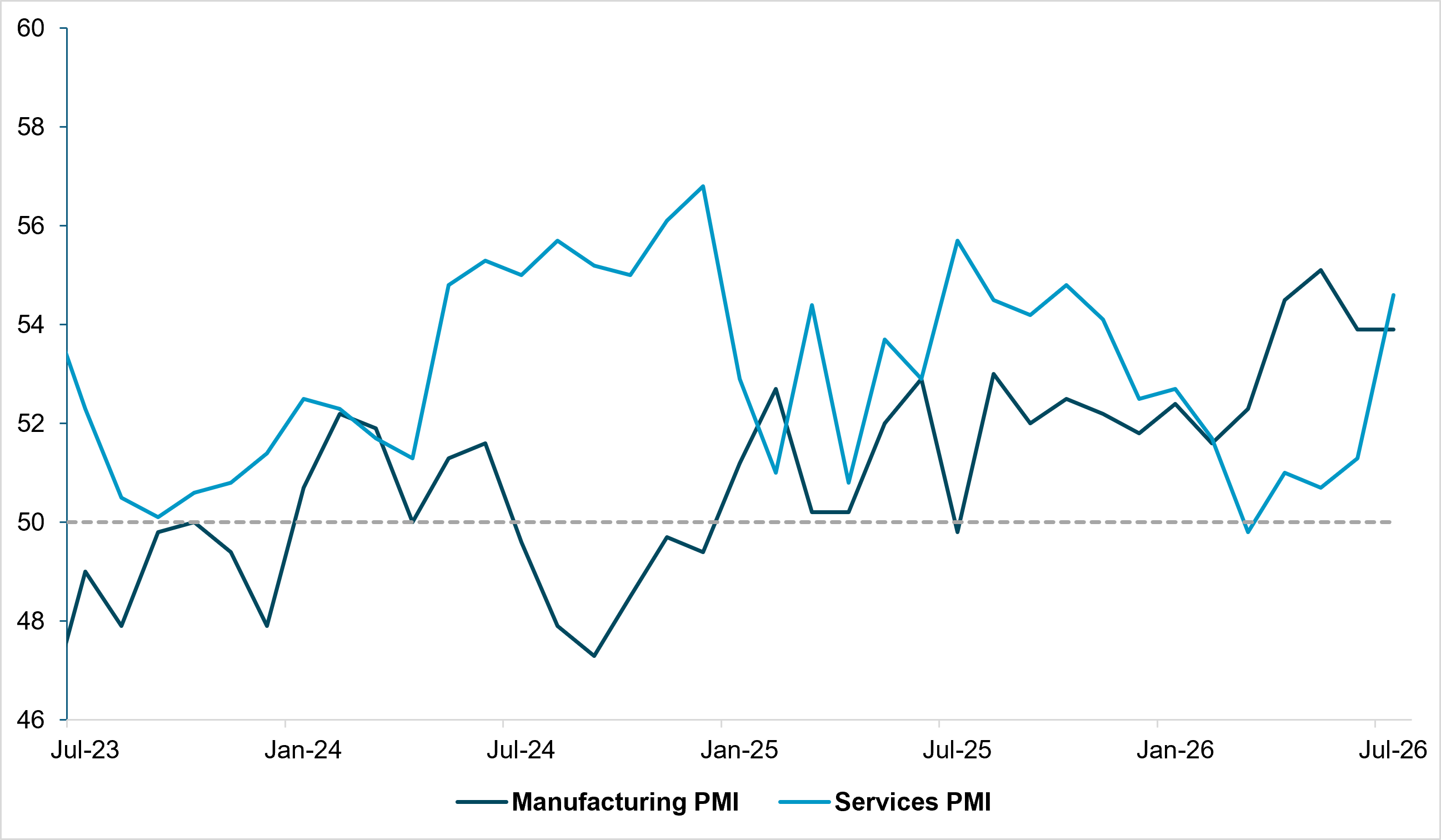
EXHIBIT #1: U.S. PMIS – RECENT TREND
Source: BNY
Our take: Last week, market pricing for a September hike eased as CPI printed in line with consensus and a better-than-expected PPI release helped cool fears that inflation is reaccelerating, at least in the short run. That leaves the near-term rates backdrop somewhat less hawkish, even if the broader policy debate remains sensitive to incoming data.
Next week’s calendar is comparatively light. The U.S. S&P Manufacturing and Services PMIs are expected to edge down modestly to 53.8 and 53.9, respectively, from the prior month. The FOMC minutes are also due, though we wouldn’t expect them to materially shift market pricing. In Canada, focus is on the CPI, where m/m inflation is forecast to rebound to 0.5% after the -0.4% print last month, which reflected easing tension with Iran back in June.
Forward look: The PMIs will be watched for confirmation that growth remains resilient even as inflation concerns have moderated, but unless they surprise meaningfully, we doubt they’ll move the rates complex materially. Similarly, the FOMC minutes should be useful for gauging the balance of views inside the Committee, but with recent data still fresh in investors’ minds, they’re unlikely to change the market’s broader Fed outlook.
Canadian CPI is important, not because it’s expected to deliver a major policy surprise, but because it will help determine whether the recent pullback in inflation pressure is temporary or more durable.
EMEA: Riksbank holds back on SEK
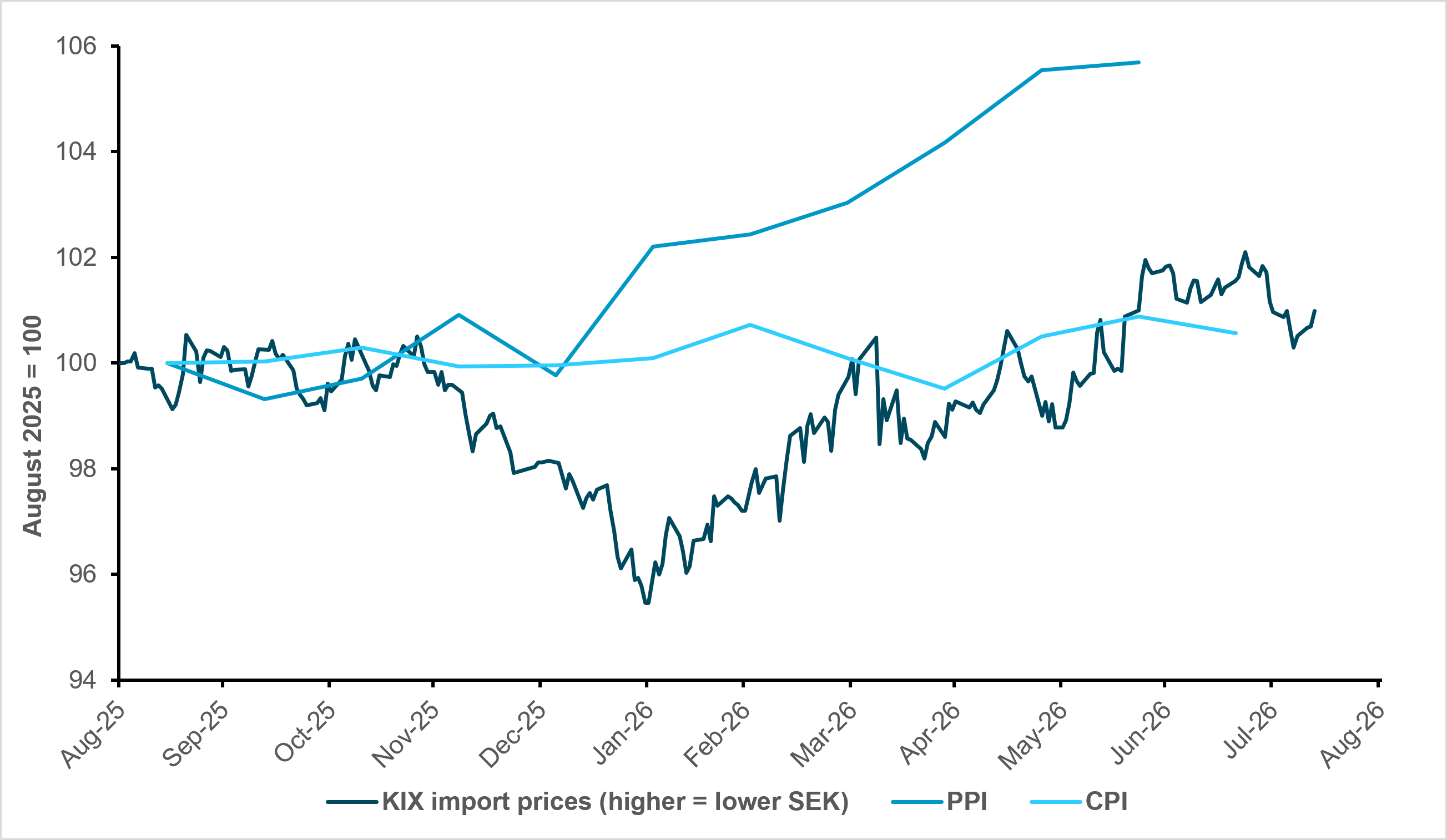
EXHIBIT #2: SWEDEN – SEK WEAKNESS, IMPORT PRICES, AND CPI
Source: BNY, Bloomberg
Our take: We believe Sweden’s Riksbank – along with the Swiss National Bank – is the most “at ease” with its current policy path as inflation remains well below target levels. As long as headline inflation continues to dip, supported by various regulated prices, inflation expectations in the country should remain well-contained. Keeping two hikes in the repo path is a mere acknowledgment of risk, but with the European Central Bank (ECB) pulling back from using policy to react to second-round effects, there isn’t much need for the Riksbank to be concerned with falling behind the curve. Underlying inflation suggests that demand acceleration is in place, but the low baseline has provided plenty of room for flexibility, especially once the seasonal factors are removed. The ability of the government to move on regulated prices where energy has been the direct driver – such as public transportation and fuel taxes – shows that targeted support can work to curb inflation risk, but only when there is fiscal credibility in place. This has been long-established in Sweden due to fiscal rules and creates headroom when needed.
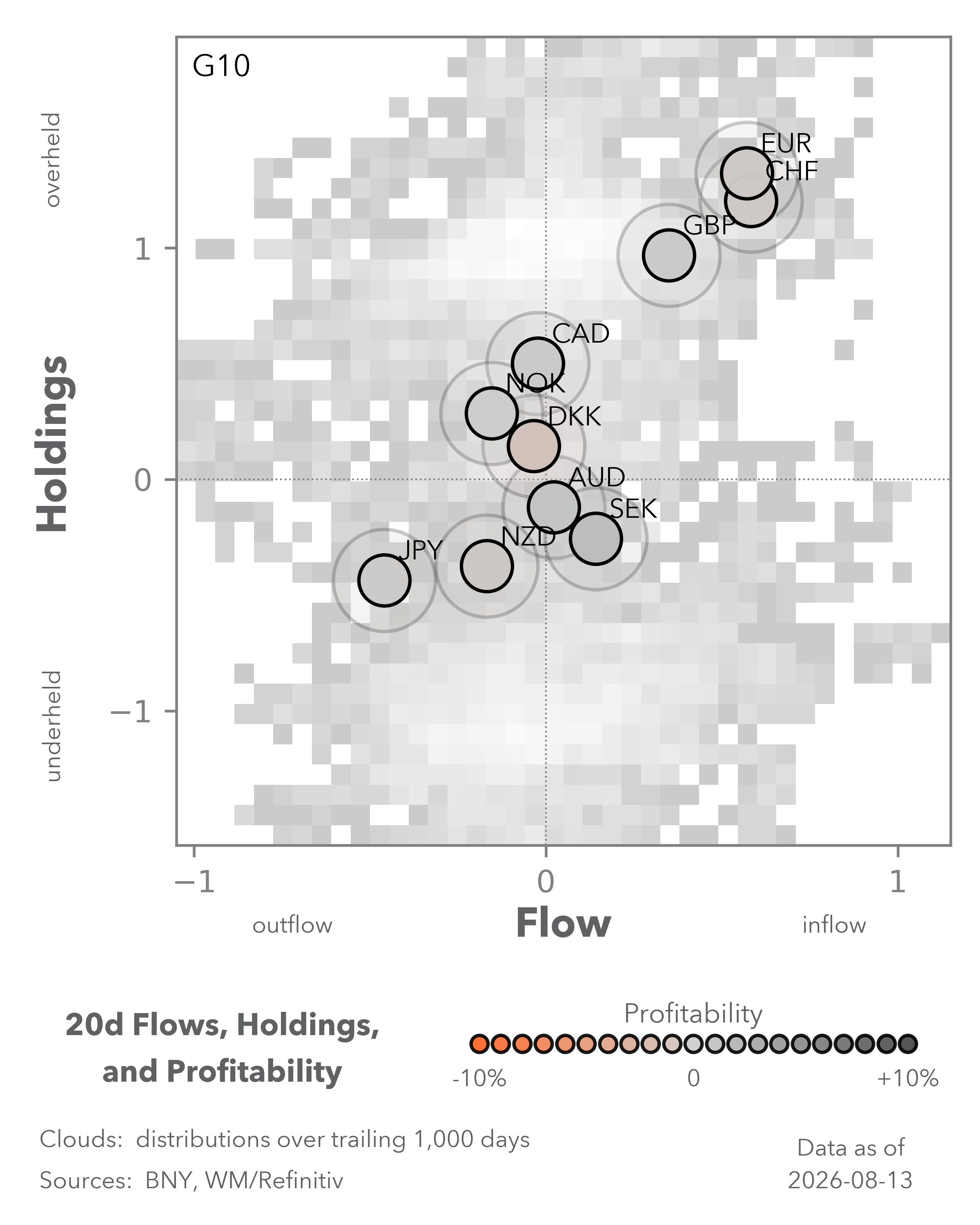
Given the favorable outlook on prices and real rates, SEK performance might leave much to be desired. Markets are caught between the quality argument and the valuations argument against the carry view. As volatility remains manageable, valuations are holding sway and limiting SEK appreciation. The KIX, Sweden’s import-weighted exchange rate index, remains at the upper end of its recent range, which would normally prompt the Riksbank to state that the currency is undervalued. The June Monetary Policy Report envisaged the KIX at an annualized average of 116.18, which is already an adjustment to reflect a weaker SEK (i.e., import prices go up). The average over the past six weeks has broken through 119, which means the currency has deviated significantly from its projected path. Swedish producer prices are clearly moving in tandem, but as long as CPI is anchored (Exhibit 2), we expect the Riksbank to hold off on being more assertive by bringing forward the two hikes currently in the repo path.
Forward look: Europe’s data calendar is centered on inflation, labor markets and business activity as a gauge of future ECB policy reaction. The final July CPI is unlikely to alter the policy outlook materially, shifting attention to Q2 negotiated wages, labor costs and medium-term inflation expectations for evidence that the trajectory of underlying price pressures is receding. August flash PMIs will provide the first read on economic momentum in Q3, while the ZEW survey and consumer confidence will indicate whether sentiment is improving amid easing monetary conditions and persistent trade uncertainty.
In the U.K., inflation and labor market data will dominate as investors reassess the Bank of England’s future decisions following the 6-3 vote in July to keep interest rates unchanged at 3.75%. Retail sales, consumer confidence, housing indicators and the August flash PMI will offer a broader assessment of domestic demand and business activity following recent signs of softer growth.
South Africa’s July CPI will be the key release, helping shape expectations for the South African Reserve Bank’s policy trajectory.
APAC: China data, Japan CPI, antipodean reads and BI
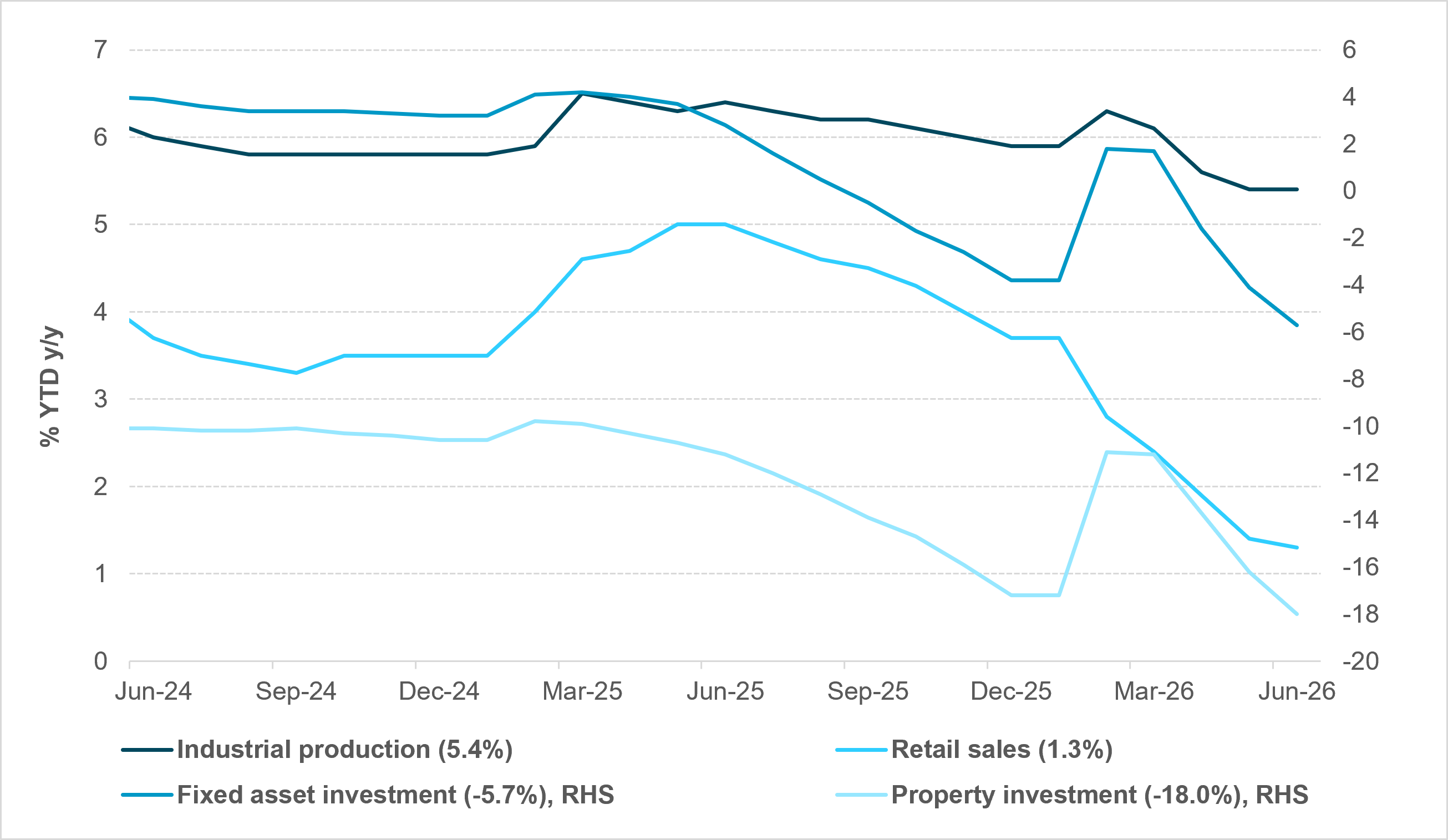
EXHIBIT #3: CHINA: CONSUMPTION, PRODUCTION, AND INVESTMENT
Source: BNY, Bloomberg
Our take: Asia’s macro calendar is dominated by growth, inflation and central bank policy, with investors assessing whether domestic demand is beginning to offset a softer external backdrop. China takes center stage as July activity data – including retail sales, industrial production, fixed asset investment and property indicators – provide the most comprehensive assessment of economic momentum. The Loan Prime Rate fixing is expected to remain unchanged as policymakers continue to rely on targeted fiscal and credit support rather than broad-based monetary easing. Elsewhere, Japan’s Q2 GDP and July CPI will be closely watched for evidence that inflation and wage gains are translating into firmer domestic demand, reinforcing expectations for further BOJ policy normalization. Australia’s labor market, Q2 Wage Price Index, and inflation expectations will also be key for refining the Reserve Bank of Australia’s policy outlook following recent shifts in the inflation trajectory.
Trade remains another key regional theme. Japan’s exports, South Korea’s early August export figures, Taiwan’s export orders, Singapore’s electronics and non-oil domestic exports, and Malaysia’s exports will provide a timely read on the durability of the technology and manufacturing cycle. Policy attention will also turn to Bank Indonesia, where rates are widely expected to remain unchanged as policymakers balance rupiah stability against a still-fragile growth backdrop, with the Q2 balance of payments and external debt data offering further insight into external financing conditions. Thailand’s Q2 GDP is likely to maintain momentum after a strong 0.7% q/q, 2.8% y/y in Q1, while New Zealand’s trade, producer prices and services activity will help gauge the pace of domestic recovery.
Across the region, the week’s releases should help clarify whether Asia’s growth remains supported by resilient domestic demand as external conditions become increasingly challenging.
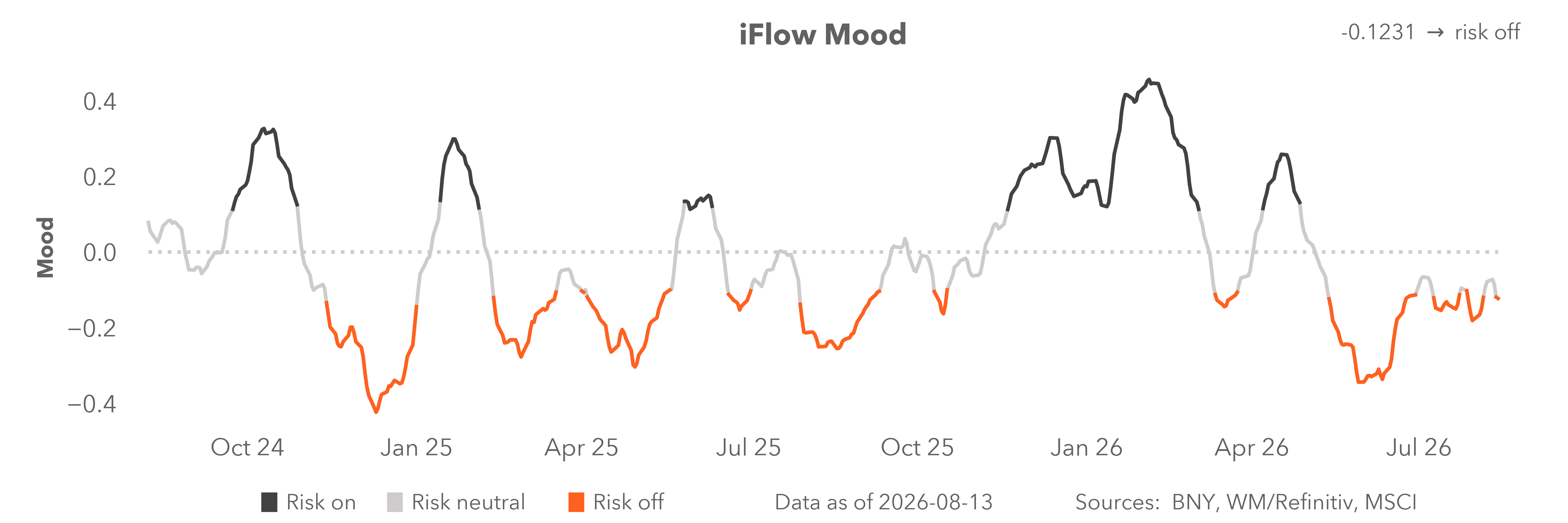
Forward look: Risk appetite improved but remains selective, with equity demand concentrated in technology. Sentiment is supported by renewed foreign inflows and relatively muted APAC FX depreciation despite the rebound in the U.S. dollar. CNY appreciation has clearly slowed alongside deteriorating domestic macro conditions. The latest July China credit growth slowed further with financial institutions’ loan growth at a new record low at 5.1%, while M2 dropped from 8.0% to 7.7% y/y. Our call to raise CNY hedge ratios has proved correct, with further room to increase hedges. The widening of counter-cyclical factor in People’s Bank of China fixings reflected a more measured pace of appreciation.
Elsewhere, two FX dynamics stand out. PHP and INR remain vulnerable, as active central bank smoothing has yet to arrest depreciation momentum. TWD/KRW should favor TWD, supported by stronger foreign inflows, while KRW faces normalization pressure following July’s outsized technical rally.
Latin America: Limited improvement in carry risk-reward
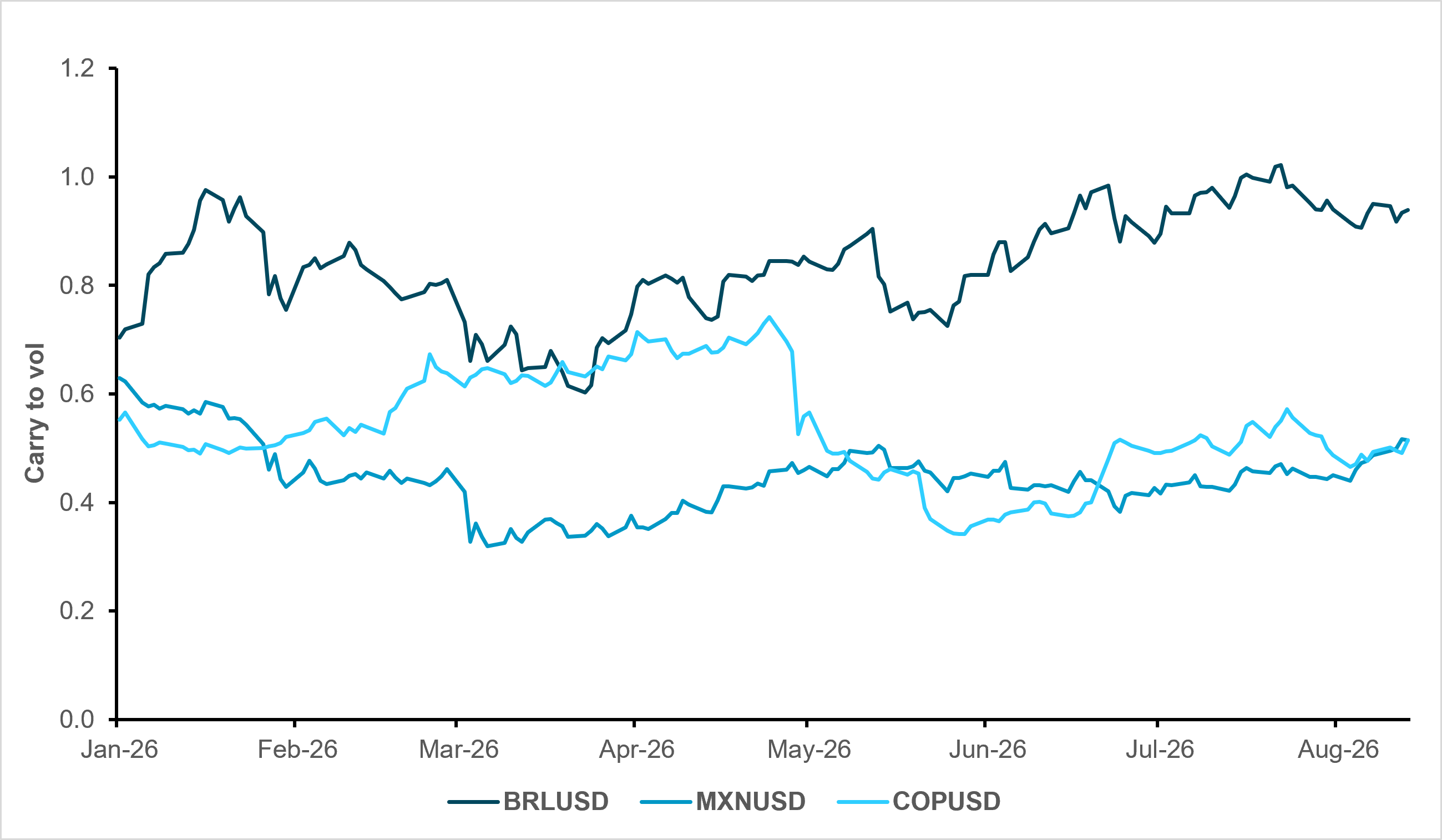
EXHIBIT #4: CARRY-TO-VOL RATIOS – LATIN AMERICAN HIGH-YIELDERS
Source: BNY, Bloomberg; based on 1y1y forwards swap spread vs. 1m implied volatility
Our take: The lack of hawkish catalysts for the Fed has provided clear breathing space for risk appetite. Fears of the Fed falling behind the curve, running out of credibility or markets pushing up real yields haven’t materialized since the July FOMC, and this would normally be a good environment for carry trades to perform. In a data- and event-light summer environment, Latin America-focused positions have performed on a seasonal basis, but the story isn’t consistent. Over the past five years, MXN’s performance averages are strongest through August and September, whereas BRL tends to have a strong July. The broader policy regime matters, of course, especially as both Banco de Mexico and Brazil’s COPOM are no longer pursuing tightening. Colombia is the odd one out, but Banco de la República’s (BanRep) July decision to hold rather than impose an additional 50bp hike indicates that the entire region is calling a timeout on hikes.
The main question is whether inflation has been tamed in Latin America or there’s no longer a need to “chase” a hawkish Fed; the July FOMC must have had a bearing on BanRep’s decision two days later. A dovish Fed is not a sufficient condition for outright Latin American FX outperformance, however. We’ve already highlighted how the market failed to engage in a large “commodity bid” after the July Fed, which pointed to growth concerns globally. The risk of policy error by the Fed – albeit lower, based on recent payrolls and inflation prints – will keep fixed income volatility elevated, which in turn reduces risk-reward in the carry trade because funder volatility remains elevated. A scan of carry-to-volatility ratios across Latin America supports this view (Exhibit 4). The risk-reward recovery in MXN, BRL and COP since the original U.S.–Iran ceasefire deal is clear, but levels have struggled since July and have clearly fallen in the case of BRL and COP. Idiosyncratic risk may also begin to support volatility on the carry legs in the near term. Consequently, we continue to see duration, with ample FX hedging as the best expression of positive Latin America risk in the current environment.
Forward look: The week ahead is dominated by activity data. Brazil’s IBC-Br, COPOM’s monthly activity indicator, opens the week on Monday and gives the clearest monthly read on whether growth is losing momentum under restrictive financial conditions. Chile and Colombia release Q2 GDP on Tuesday. Chile enters from a weak base, with Q1 GDP down 0.5% y/y and 0.3% q/q despite firmer domestic demand, making another sequential contraction the main risk. Colombia grew 2.2% y/y in Q1; the focus is whether private-sector activity has broadened beyond the earlier contribution from public services. Mexico’s retail and services indicators on Friday provide a useful check on domestic demand ahead of the more important release – IGAE, Mexico’s monthly GDP proxy – the following week. Argentina’s trade balance on Thursday is secondary.
Politically, Brazil is the main focus as the first full week of official election campaigning gets underway. Fiscal commitments, coalition signals and polling will increasingly matter for BRL, rates and domestic equities.
Central bank decisions
Central Bank Decisions
Indonesia, Bank Indonesia (Wednesday, August 19): We expect BI to keep its benchmark rate unchanged at 5.75% as it continues to pivot from interest rates toward macroprudential policy. It’s likely to focus on preserving currency and financial stability through its triple FX intervention strategy – including offshore NDF operations and attractive SRBI (Sekuritas Rupiah Bank Indonesia) yields – and ensure effective implementation of announced incentives to support foreign portfolio inflows. The likely appointment of Destry Damayanti as the next governor should ensure policy continuity.
Sweden, Sveriges Riksbank (Thursday, August 20): The Riksbank is expected to keep rates on hold at 1.75%. Sweden is one of the most insulated in Europe as having barely registered any inflation jump throughout the U.S.–Iran conflict, and general growth expectations remain soft. The monetary policy board is keeping rate hikes in its repo path almost by default and is unlikely to shift until the ECB rules out additional moves. Financial conditions need to remain loose, but recent SEK weakness could prompt Riksbank to introduce stronger language on currency valuations.
Source: BNY
Source: BNY