Why rising rate vol could upset the carry trade
iFlow > Special Report

David Tam
Time to Read: 4 minutes
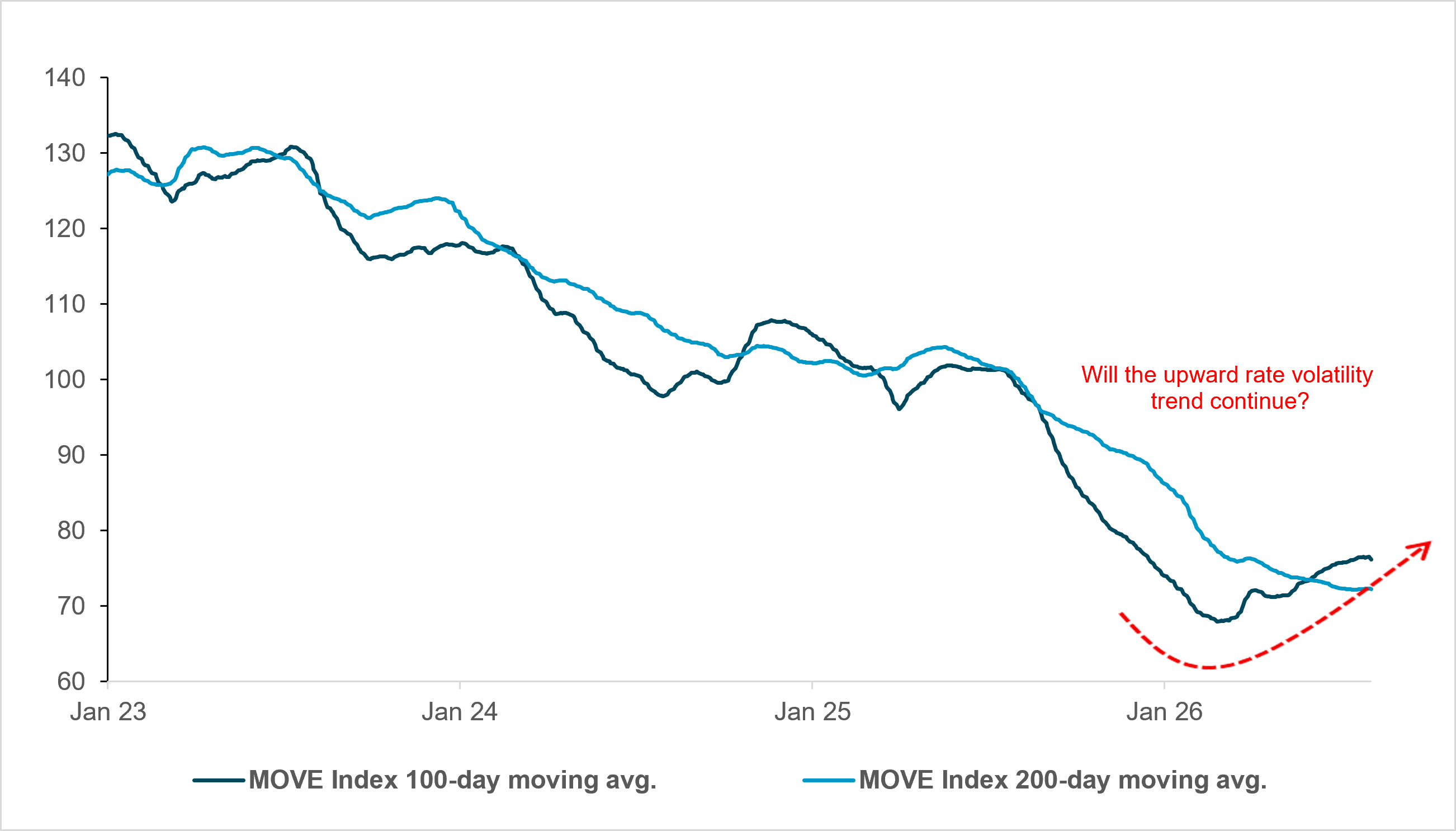
EXHIBIT #1: U.S. RATE VOL IS INFLECTING UPWARD
Source: BNY Markets, Bloomberg
Rate vol will continue to rise: As we’ve been arguing in recent notes, rate vol is inflecting higher as an effect of less communication around the rate path from the Warsh-led Fed. Though it’s perhaps a necessary corrective after nearly 20 years of the market being closely guided on the Fed’s intentions, the immediate effect is greater front-end rate vol.
Rising rate vol drives divergent currency performance: We argued in our recent note that rising U.S. rate vol will lead safe-haven currencies to appreciate through a mix of safe-haven and repatriation flows. Conversely, high-beta, risk-sensitive currencies could depreciate due to a shift in global risk sentiment.
This hits both legs of a carry trade: As bond vol rises, safe havens used as funding currencies should appreciate, while crowded risk-sensitive currencies should get hit. This harms both legs of the FX return and reduces the risk-adjusted attractiveness of the carry trade.
Carry trades are short vol: Carry trades thrive in high-rate-differential, low-vol environments where sufficient levels of leverage can be put on to provide meaningful returns. All else being equal, when vol rises in one of the currencies (either the funding currency or the high-yielder), it increases the probability of spot losses and reduces the leverage permitted by vol targets or VaR budgets.
The implication is clear: Through a number of channels, rising rate vol will make the carry trade setup less appealing.
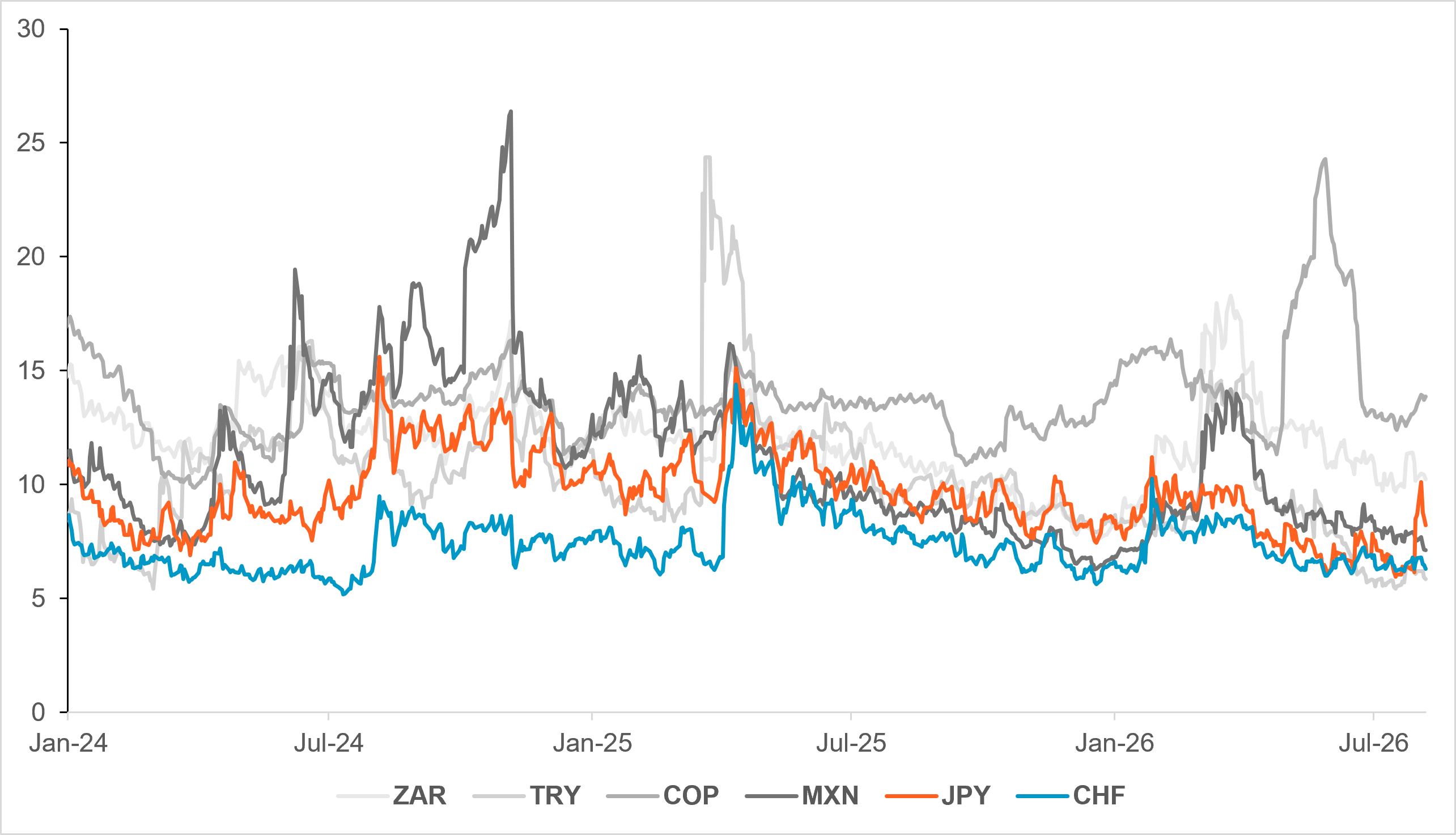
EXHIBIT #2: IN NORMAL TIMES, HIGH-YIELD CURRENCIES HAVE HIGHER VOL THAN LOW-YIELD FUNDERS
Source: BNY Markets, Bloomberg
Note: High yielders are grouped in red while funders are grouped in blue.
The ideal funder is low vol: Funding currencies are typically chosen not only for their low-yield and cheapness to borrow, but also for their lower and more stable vol. Exhibit 2 shows that funders typically have lower and more stable vol than high-yielders.
Vol sparks unwinds: If the funding currency becomes volatile, particularly if it strengthens sharply, carry traders can face sudden losses and forced unwinds. If the funder’s vol spikes, the whole trade structure is threatened.
Funder vol is worse for carry than high-yielder vol: While high-yielder vol also hurts, that risk is often more “expected” by traders because these currencies are typically EM currencies with more embedded vol.
Rising funder vol disproportionately hits due to portfolio construction: A carry trade investor typically is funding a relatively larger basket of high-yield currencies supported by a relatively smaller number of funders. The universe of high-yielders is simply larger and more varied. As a result, a vol spike or sharp appreciation for a funding currency is more impactful for unwinding carry trades as it hits more carry-trade pairs simultaneously than if any one high-yielder were to suddenly depreciate.
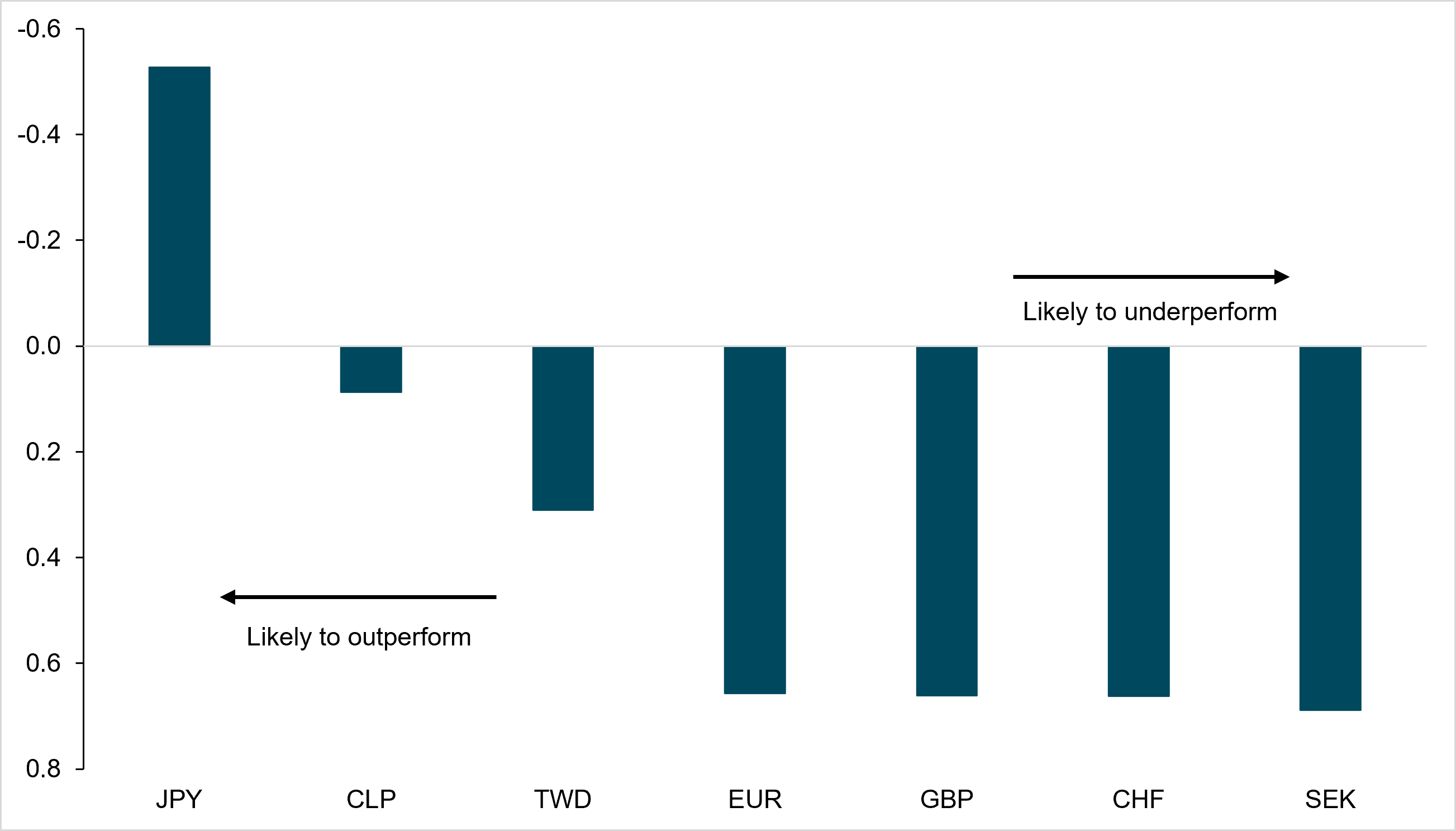
EXHIBIT #3: JPY APPRECIATES ON RISING U.S. RATE VOL, UNIQUELY AMONG FUNDING CURRENCIES
Source: BNY Markets, Bloomberg
Note: Return analysis was conducted over 3y horizon.
The JPY strengthens when rate vol increases: The JPY exhibits a unique property among low-yielding funding currencies. Historical bouts of increasing rate vol tend to correlate with JPY appreciation while other funding currencies tend to depreciate.
For the sake of completeness, we include several currencies that are not as ubiquitously used as funders including SEK, GBP, TWD, and CLP which have either fallen out of favor, have only recently come into fashion, or are used as local funders against regional peers.
EXHIBIT #4: IFLOW CLIENTS ARE NET LONG JPY AND CHF
Source: BNY iFlow, WM/Refinitiv
Note: Scored flow is trailing 1y standard deviation of flow; scored holdings is trailing 1y mean absolute magnitude. Analysis over the past quarter.
Real money is net long funding currencies: iFlow data shows net long scored holdings in both the JPY and CHF, which we believe to be driven primarily by safe-haven flows or the uncertainty of the joint Bank of Japan–U.S. Treasury intervention leading to de-risking. Interestingly, iFlow also shows net short holdings of the EUR and USD, leading us to speculate that real money clients could be shifting to using these currencies as funders.
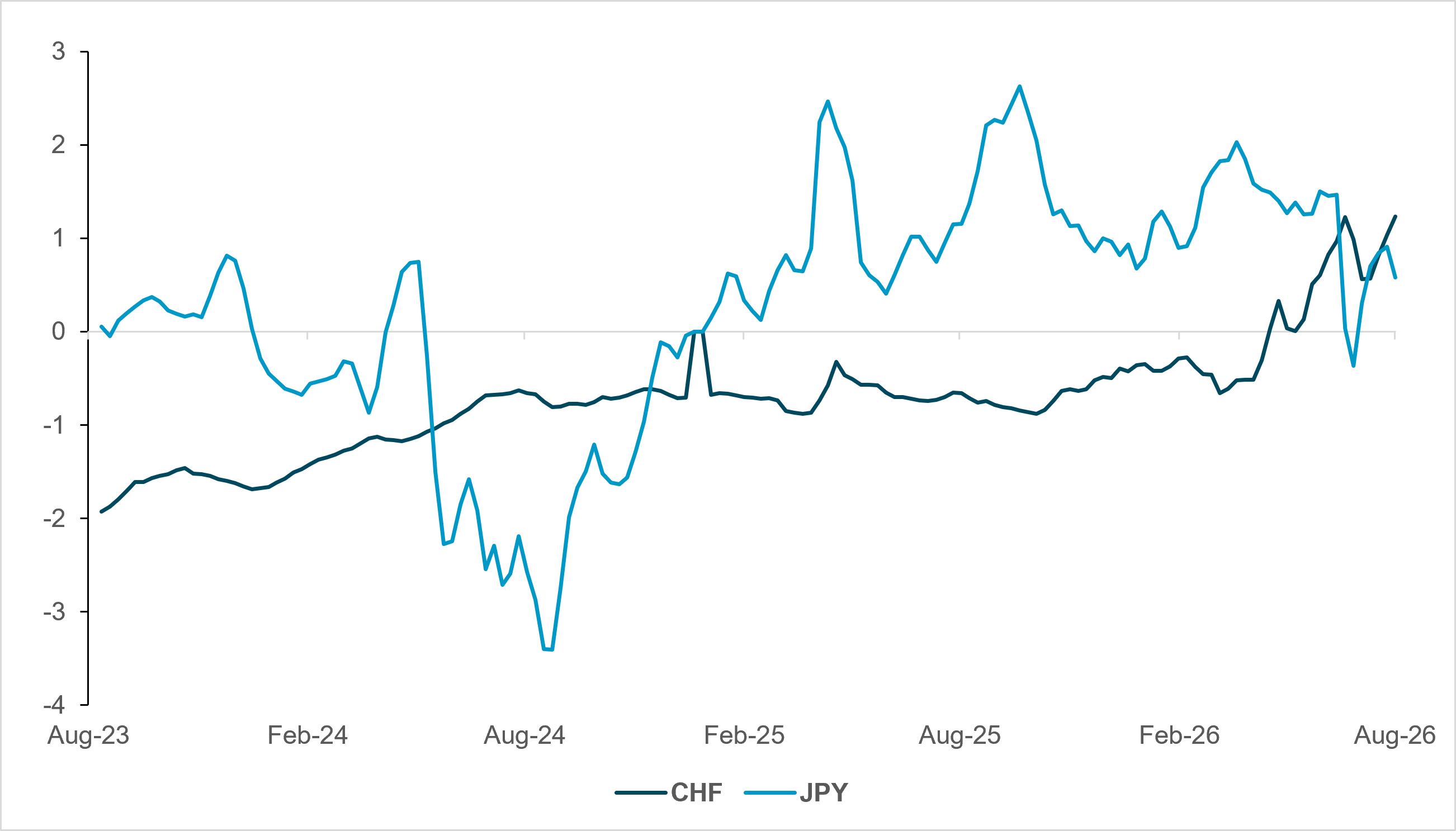
EXHIBIT #5: IMM DATA SHOWS HISTORIC NET SHORT POSITIONING OF JPY
Source: CFTC, Bloomberg
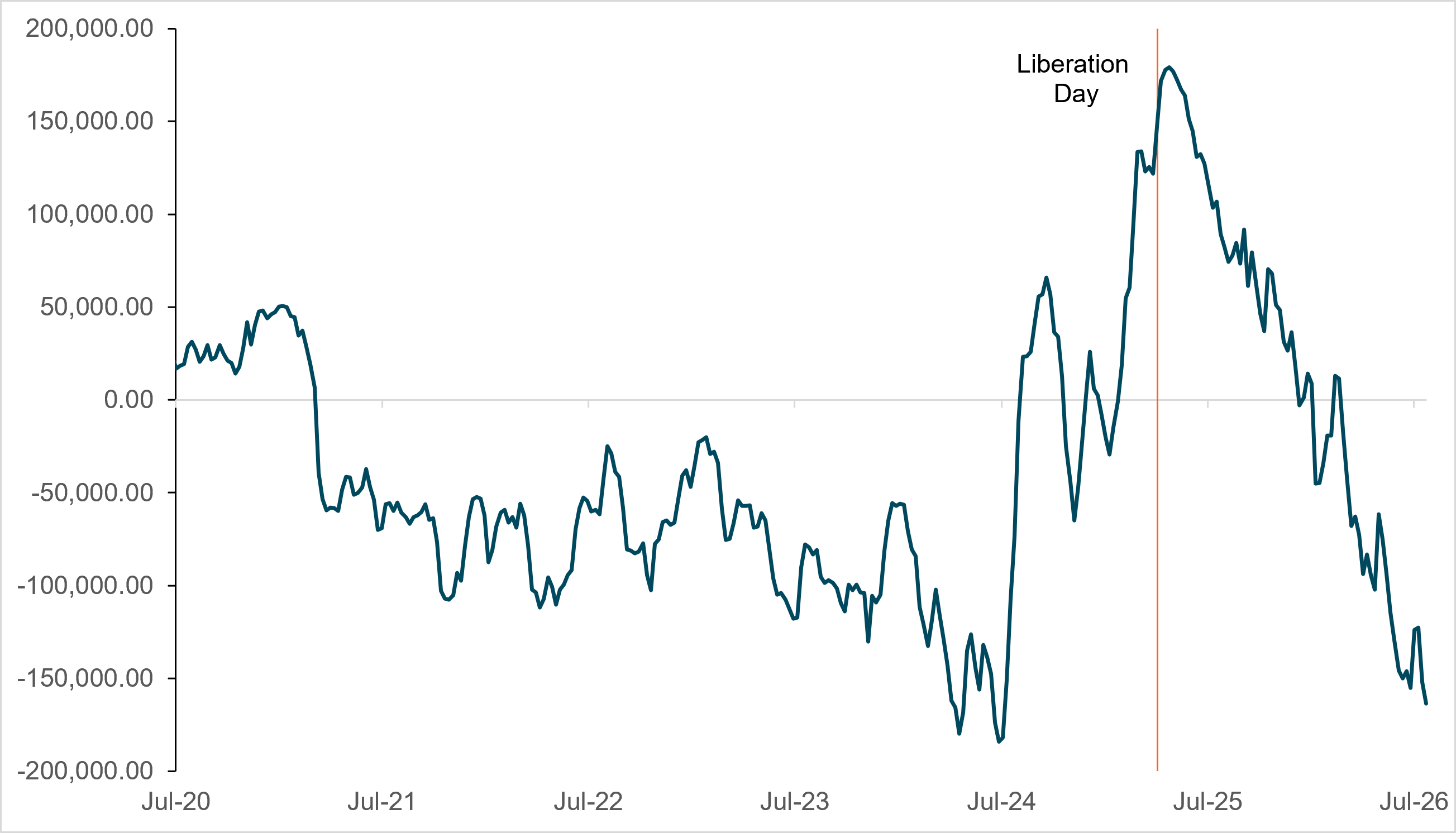
Speculators are net short: By contrast, the CFTC’s Commitment of Traders (IMM) data shows near-historic levels of net short positioning of non-commercial futures positions in the CHF and JPY. The JPY has seen a steady march down since April 2025, when trend-following traders such as CTAs and other momentum traders first began unwinding their historic net longs in the wake of Liberation Day. They have continued to short the yen such that after almost a year and a half, the short position has grown to near-historic shorts. The recent appreciation of the JPY following joint intervention has not yet shown up as reduced net short positioning in the data.
This positioning divergence could create a trading opportunity: With real money investors preparing for defensiveness and fast money investors leaning the other way, markets could be vulnerable to a sharp squeeze. For investors who expect JPY to appreciate, the positioning divergence argues for upside in both JPY and CHF. The JPY is the cleaner trade: if speculative shorts are forced to unwind, the move should be sharper.
Rate vol: Track the MOVE Index and its 100- and 200-day moving averages (Exhibit 1). If they keep rising, U.S. bond vol will continue to be a cross-asset theme including in FX.
Risk sentiment: Track FX performance of funding vs. high-beta currencies. Persistent JPY outperformance could be a key confirmation signal.
Positioning: Track the divergence between iFlow scored holdings and IMM net positioning data. The greater the divergence, the greater the potential correction that might result from an unwind.