December FOMC probably too early for balance sheet expansion

iFlow > Short Thoughts

Published on Tuesdays, Short Thoughts offers perspectives on US funding markets, short-term Treasuries, bank reserves and deposits, and the Federal Reserve's policy and facilities.

Subscribe to Our Publications

In order to start receiving iFlow, please fill out the form below.

Subscribe
arrow_forward
BNY iFlow Short Thoughts,BNY iFlow Short Thoughts

Key Highlights

  • As funding spreads widen, will the Fed announce reserve management purchases?
  • Open market purchases are likely in early 2026, though we think it’s still early and the market is well prepped.
  • The expected eSLR change may not lower yields by much but should increase dealers’ ability to intermediate the UST market.

Tighter funding conditions will eventually lead to open market operations, just not yet

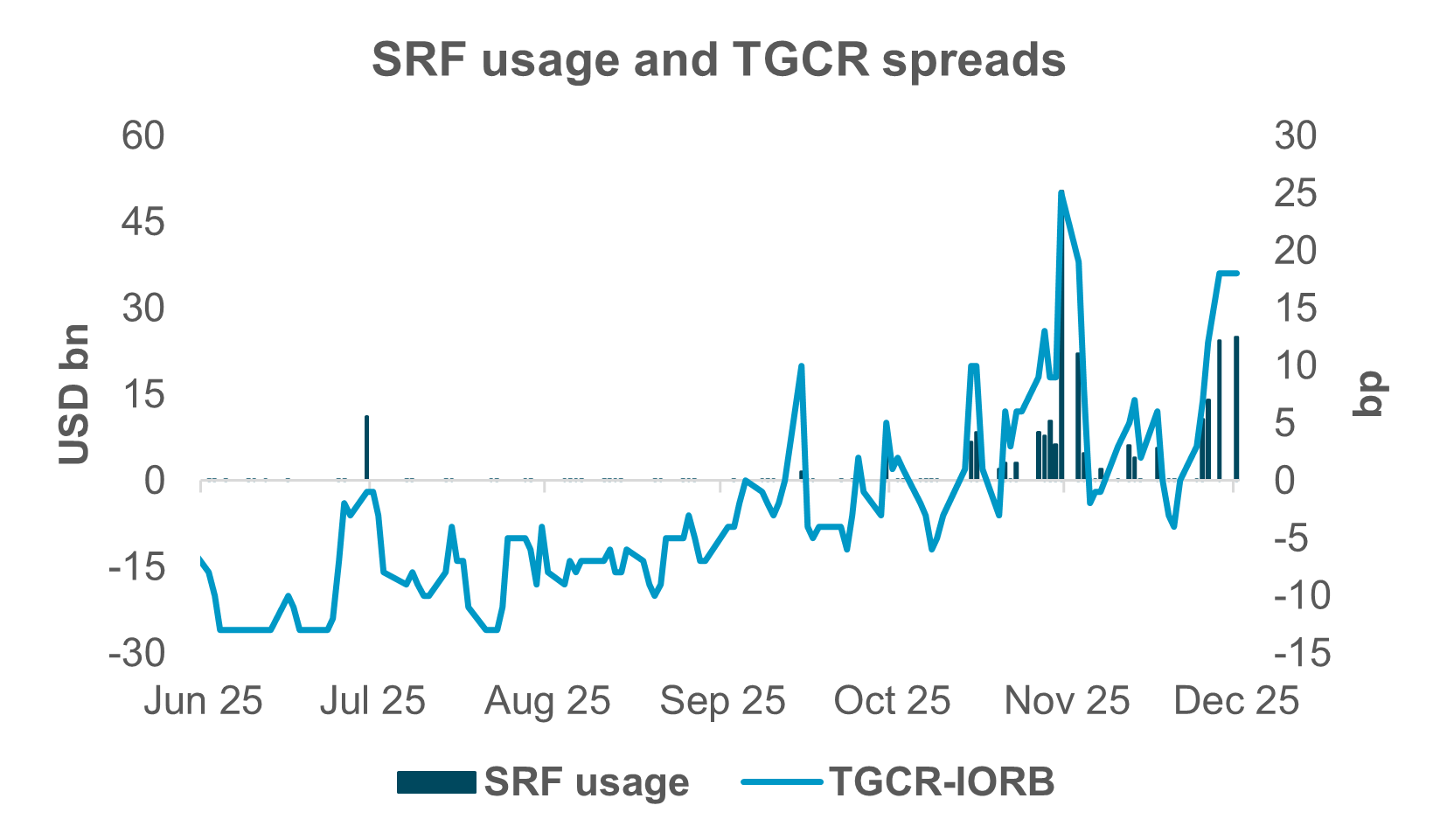
EXHIBIT #1:  SRF USAGE CLIMBS WHEN SPREADS WIDEN

Source: BNY Markets, Bloomberg, Federal Reserve Bank of New York

The Fed’s standing repo facility (SRF) was tapped for $26bn over the course of the day on December 1, making it the largest daily uptake since $50bn in usage on October 31. Also on December 1, the tri-party general collateral repo rate (TGCR) rose to 18bp over the interest paid on reserves at the Fed (IORB). Both developments speak to tightening in funding markets heading into year end. The current situation is hardly a surprise, as we have commented on recently (see here and here).

However, on November 28, the effective federal funds rate moved up a basis point, from 4.88% to 4.89% with TGCR-IORB spreads at 18bp. This illustrates the Fed’s discomfort with such upward pressure on repo spreads. Tight liquidity conditions in the funding markets can ultimately lead to upward pressure on the Fed’s operating target, threatening rate control.

While funding pressure has materialized around specific dates (month- and quarter-ends, settlement days, tax dates), there is the risk it will happen more frequently, including on otherwise uneventful days. This is why the Fed has indicated it will eventually need to resume increasing its balance sheet. As other balance sheet liabilities increase (namely, currency in circulation), reserves will fall, exacerbating tight liquidity conditions in the funding markets. Reserves are currently reckoned to be no longer abundant, but merely ample. Reserve management operations will eventually feature in the Fed’s toolkit, although pinpointing when they might commence is difficult.

Exhibit #1 shows the daily usage of the SRF over the past half year and illustrates how its usage increases when funding is stressed. It’s worth noting that the Fed would probably prefer to see the SRF used more frequently and in larger sizes than it currently is, reducing the eventual need for open market operations. Moving to the latter presents a potential communications problem for the Fed, which would have to make it clear that such operations are not a return of quantitative easing, but are indeed reserve management policies. The SRF’s attractiveness suffers due to both internal and executive stigma, as well as a lack of central clearing.

We wrote about the Fed’s upcoming monetary policy decision last week and will write a formal preview of the FOMC next week. However, it’s worth asking here whether the Fed would announce reserve management operations at next week’s gathering. We think it’s unlikely to occur so soon. For one thing, there have so far been only vague references to such market operations in the Fed’s public communications. We would have expected more specific guidance if they were to commence soon.  Furthermore, with funding market strains still mostly limited to specific dates, it could be a bit premature to set up such operations. Nevertheless, we expect them to begin early in 2026, as funding markets gradually tighten further.

Supplementary leverage ratio reform: Will it really change things?

EXHIBIT #2: HOW MUCH MORE ROOM FOR DEALERS TO ADD USTS?

Source: BNY Markets, US Treasury Department, Federal Reserve Bank of New York

At the end of November, regulators signed off on a plan modifying the enhanced supplementary leverage ratio (eSLR) for large U.S. banks, adjusting the capital requirements for G-SIBs lower. One of the main aims of the eSLR change was to encourage banks to participate in low-risk activity, such as intermediating U.S. Treasury markets. This change, following adoption of the original ratio during the GFC in 2008, had been one of the cornerstones of the new administration’s plans for reforming bank oversight, touted as a way to boost dealers’ ability and incentives to hold more USTs on their balance sheets. It has been argued that this would lower yields and increase the ability of such banks to participate in the Treasury market, especially in intermediating supply and demand for these securities.

We’re not convinced that the effect on yields will be to take them notably lower. For one, this reform had been expected since the election and was first broached by the Fed’s then-new Vice Chair for Supervision Michelle Bowman back in the spring of this year, so it’s not really “new” news. More importantly, dealers have already been holding relatively large quantities of USTs, and we’re not sure if the new and relaxed leverage ratio will induce banks to add more to their balance sheets. Exhibit #2 shows that in absolute terms, dealer holdings of UST coupons are close to record highs. As a portion of all coupon securities in circulation, we’re at levels last seen in 2018, well before the pandemic. There could be room to add, but not too much.

EXHIBIT #3: SWAP SPREADS HAVE WIDENED SINCE ESLR REFORM WAS DISCUSSED

Source: BNY Markets, Bloomberg

The effect on swap spreads, through which other holders of long-duration USTs hedge rate risk, is likely to see them widen (i.e., make them less negative), although much of that has happened already – first, when the reform was first proposed this spring, and more recently as the adoption of this regulatory change grew more likely. Exhibit #3 shows the behavior of the 10y and 30y spreads since the pandemic.

By releasing more balance sheet capacity for banks, especially the G-SIBs’ subsidiaries, this may lead them to increase more profitable activities like lending, rather than owning more Treasurys. If the reforms lead banks to hold more USTs, they could also increase interest rate risk on balance sheets, potentially adding instability during stress events, even if holding more Treasurys could help during dislocations.

Rates outlook

Chart pack

Media Contact Image
John Velis
Americas Macro Strategist
john.velis@bny.com

Ready to grow your business? Speak to our team.