
Key Highlights
- Record issuance, near-tightest spreads – high all-in yields supporting investor demand
- Concentration risk building – sentiment shift could expose it quickly
- Dealer intermediation showing strain, Warsh Fed unlikely to backstop a selloff
Historic issuance, historic tightness
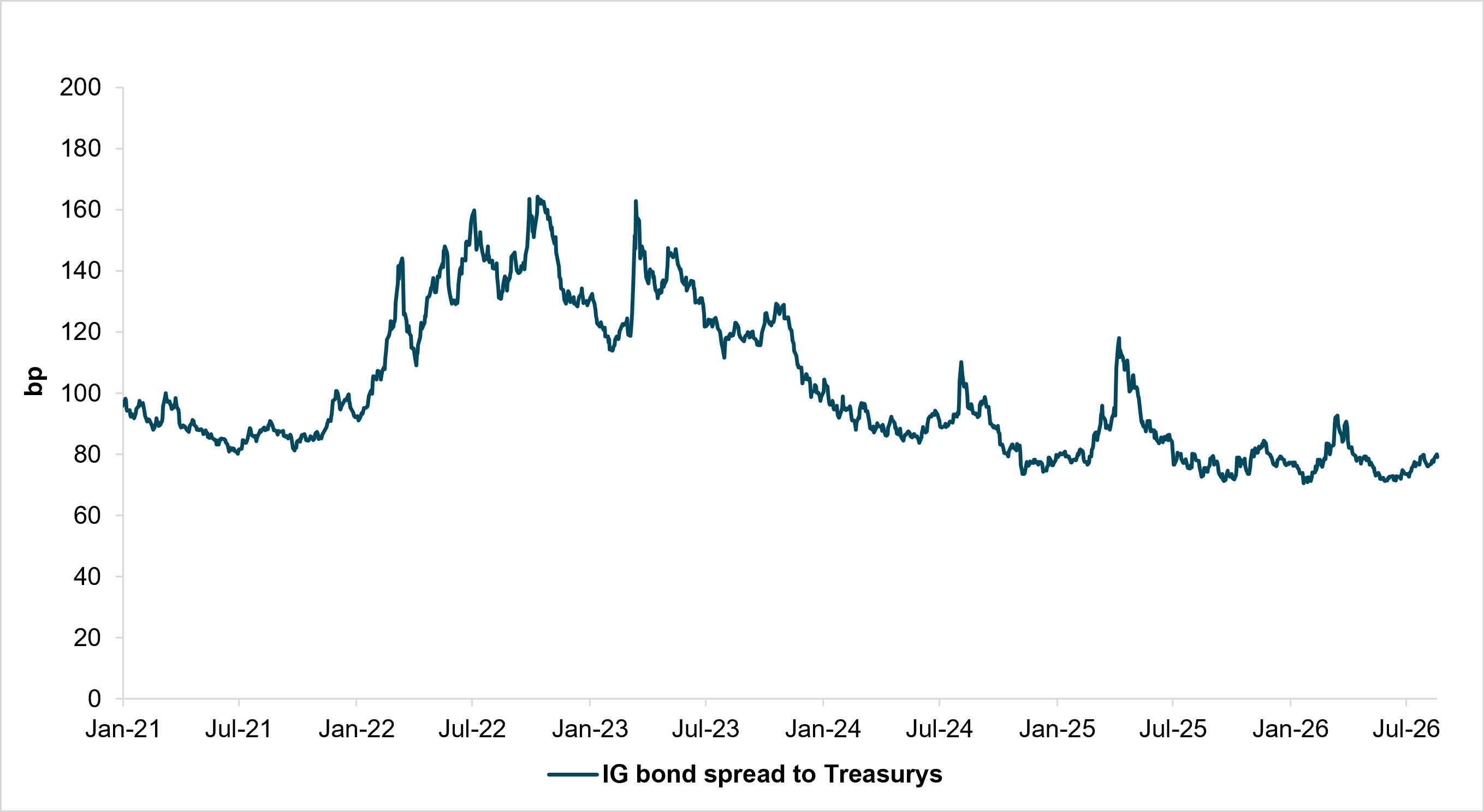
EXHIBIT #1: IG SPREADS NEAR TIGHTEST SINCE COVID
Source: Bloomberg
Record issuance and emerging risks: Our previous note discussed how hyperscaler issuance has helped lead 2026 to a record-breaking pace of IG issuance, now above $1.5tn for the year. The note also argued that fresh doubts about the AI capex theme or changes to the regulatory or political environment could lead hyperscaler bond spreads to widen.
Near-historic tightness: Despite the record level of issuance, IG spreads to U.S. Treasurys are close to their narrowest levels since Covid, as shown in Exhibit 1.
High all-in yields driving investor demand: What is driving the tightness and why aren’t investors demanding concessions given the record level of issuance? In short, even though credit spreads are very tight, their all-in yields are quite high. This affords credit investors a continuing attractive entry point and keeps demand strong.
Poised for a reversal: Could IG and in particular hyperscaler bonds be poised for a widening or even a selloff? As mentioned above, a spread widening or slowdown in demand could come from investor doubts around the long-term return to AI capex or regulatory or political drivers. Whatever the cause, investors should be asking themselves who would be the marginal buyer in the event of a selloff in hyperscaler debt or broader IG credit?
High all-in yields
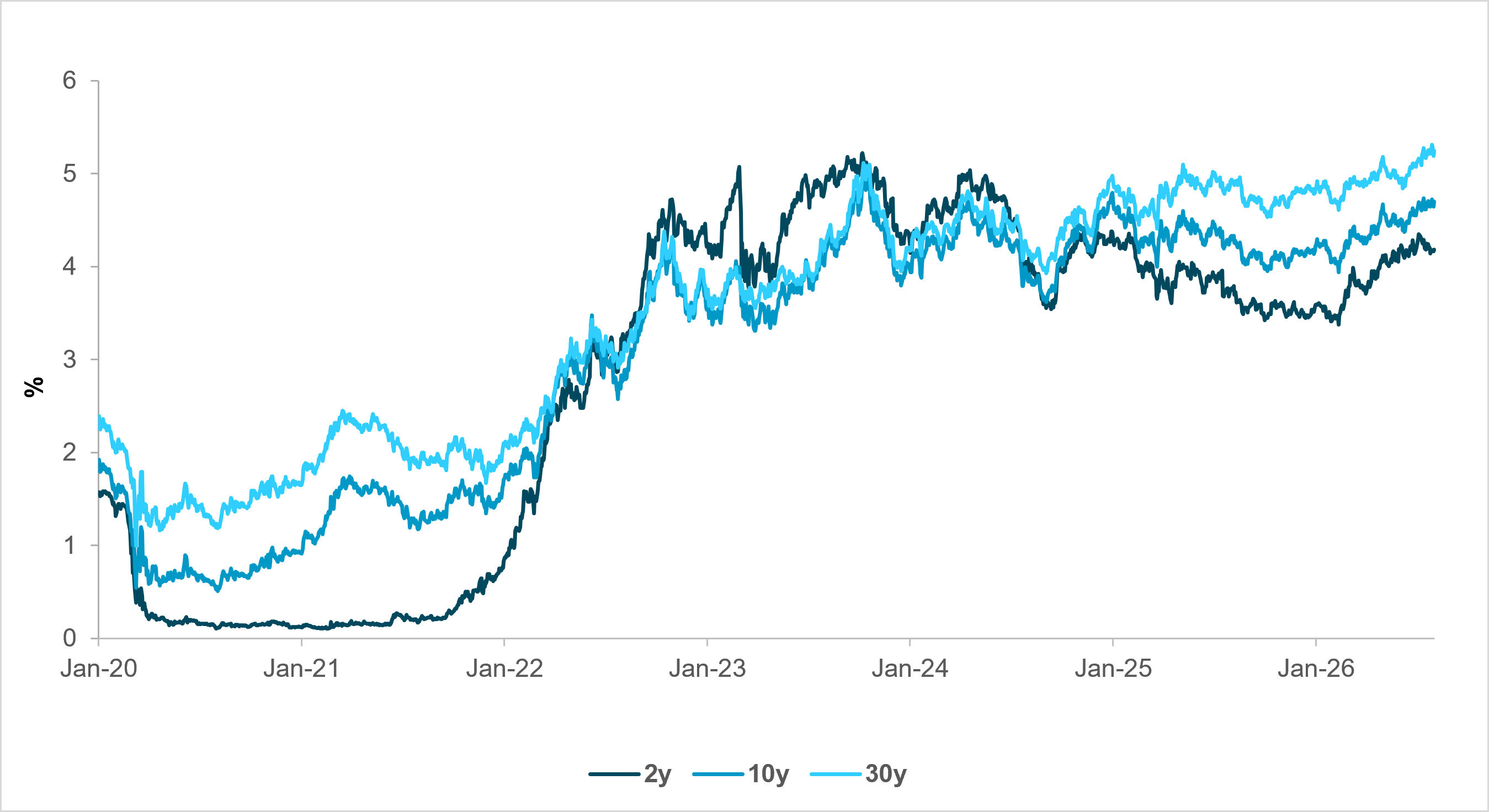
EXHIBIT #2: TREASURY YIELDS NEAR HIGHEST SINCE COVID
Source: Bloomberg
Steeper curve supports credit: Though IG spreads to Treasurys are at historic lows, all-in yields remain attractive due to the persistent rise in sovereign yields, particularly at the long end of the curve. As Exhibit 2 shows, notwithstanding Treasury’s recent announcement to buy back long-dated securities, 30y Treasury yields are at post-Covid highs (and in fact, higher than any level since the early 2000s).
Hyperscalers pull up long-end yields: Some of this is circular: higher yields attract the very investors buying hyperscaler debt, enabling further issuance. While the primary drivers of rising long-end sovereign yields are investors’ concerns around fiscal sustainability and reaccelerating inflation, in our view, part of the rise is attributable on the margin to hyperscaler issuance. This has pushed the price of money substantially higher, both outright and on the curve.
Hyperscalers issue farther out the curve: Hyperscalers are inordinately issuing at the long end relative to other issuers. Their voracious cash needs are forcing them to spread out their issuance across the curve, including at the long end. In fact, though their outstanding debt only represents around 4% of the IG universe, they have accounted for one-third of issuance 30 years and longer. This means the absolute yields on their credit are at some of the most favorable levels for investors in the whole IG universe.
Non-hyperscaler duration is more selective: Issuers in other sectors are avoiding the long-end given the steepening of the Treasury curve. Unlike the hyperscalers, other issuers have more modest cash needs, allowing them to be more selective.
Dovish Fed Path: Recent labor and inflation data have been softer and the market-implied number of Fed hikes by year end has declined from one and one-third hikes to just under one hike. For investors who feel that the data will allow the Fed to follow a more dovish path, and that such a path could lead sovereign yields to decline, now might be the time to lock in higher yields in credit.
Investor demand presents a mixed picture
Domestic investor demand remains strong: Tight spreads are supported by a persistent bid from domestic end investors. iFlow data show that insurance companies (+$18bn), asset and investment managers (+$12bn), and corporates (+$3bn) have all increased their holdings of IG credit in 2026. Furthermore, there are still large cash balances sitting on the sideline with U.S. dollar money fund assets in excess of $8tn which could be a source of continued incremental demand.
Foreign demand is tepid: But investor demand is not universal. iFlow data show that foreign-domiciled holdings of U.S. IG credit have marginally declined by just over $1bn in 2026 even in the midst of unprecedented issuance.
Oversaturation risk: Strong demand from domestic end investors also raises the risk of over-concentration in investor portfolios and their demand may start to wane on the margin. This is particularly true if spreads widen, leading to unrealized losses which would hamper investors’ willingness to buy the dip. iFlow data show that aggregated scored positioning and scored flows in IG credit have turned negative over the past week, suggesting a recent cooling in demand.
Are dealers prepared to intermediate a selloff?
Dealer balance sheet constraints: If end investors reduce their marginal demand for hyperscaler credit or even start to pare back their holdings through sales, the intermediation capacity of dealers comes into focus. Do dealers face balance sheet constraints or are there other indications that dealers might be less able to intermediate?
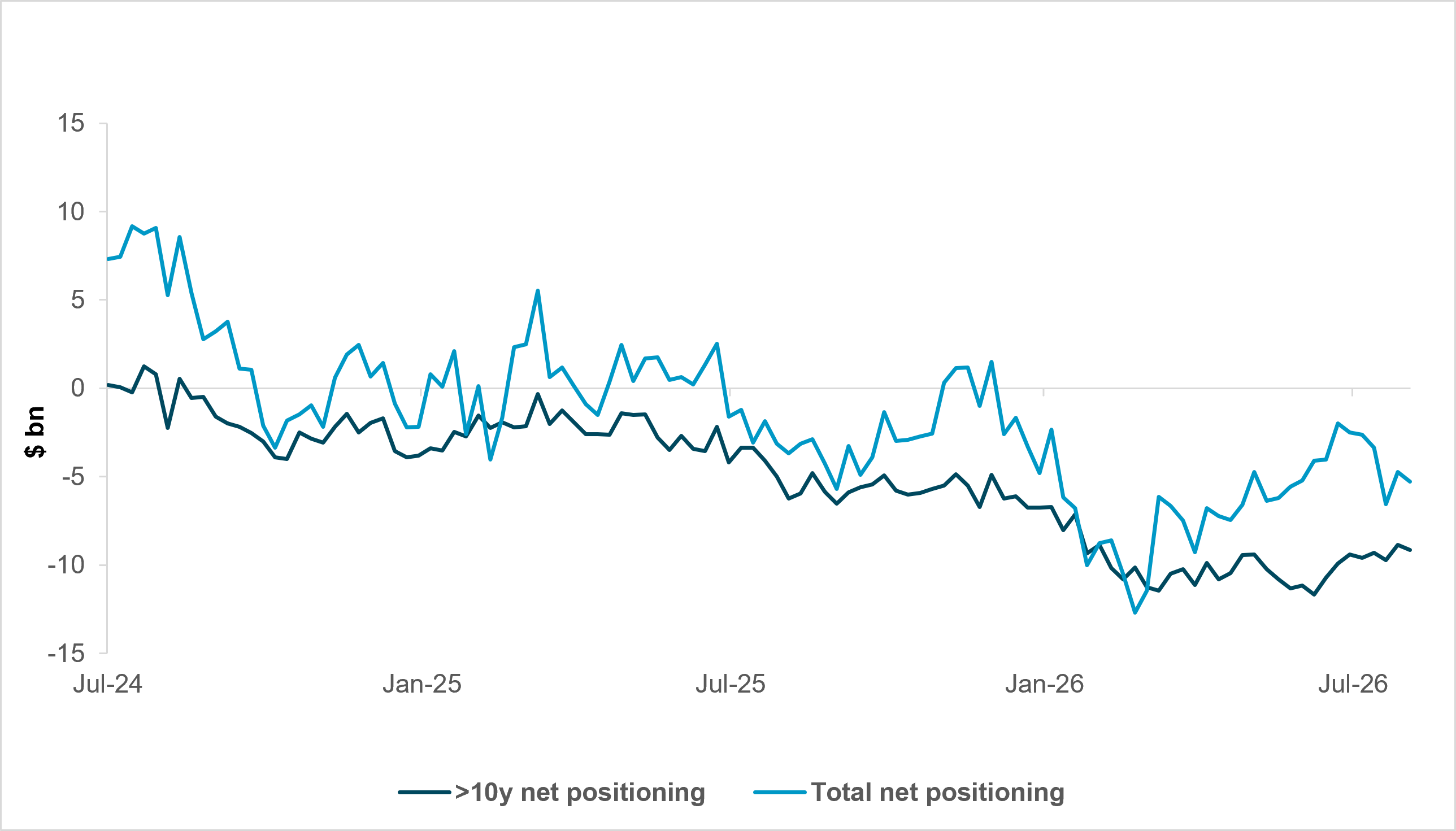
EXHIBIT #3: DEALERS HAVE GROWN NET-SHORT POSITIONS SINCE LAST YEAR
Source: FR 2004
Short positioning: Right now, dealers are net short corporate bonds according to FR 2004. Typically, in a period of heavy issuance, we might expect dealers to grow their net long positions as they warehouse some of the inventory. That they are net short suggests that dealers could be facing balance sheet constraints or that they are strategically remaining structurally short in anticipation of ongoing issuance. On the surface, that means that in the event of a selloff, they have capacity, at least initially, to be the marginal buyer by closing their net shorts.
Issue specific: It’s worth noting, however, that the data in FR 2004 are aggregated across all issues. Since IG market liquidity is highly issue-specific, it is difficult to say if the aggregate net short positioning will be at all relevant if specific sectors come under selling pressure.
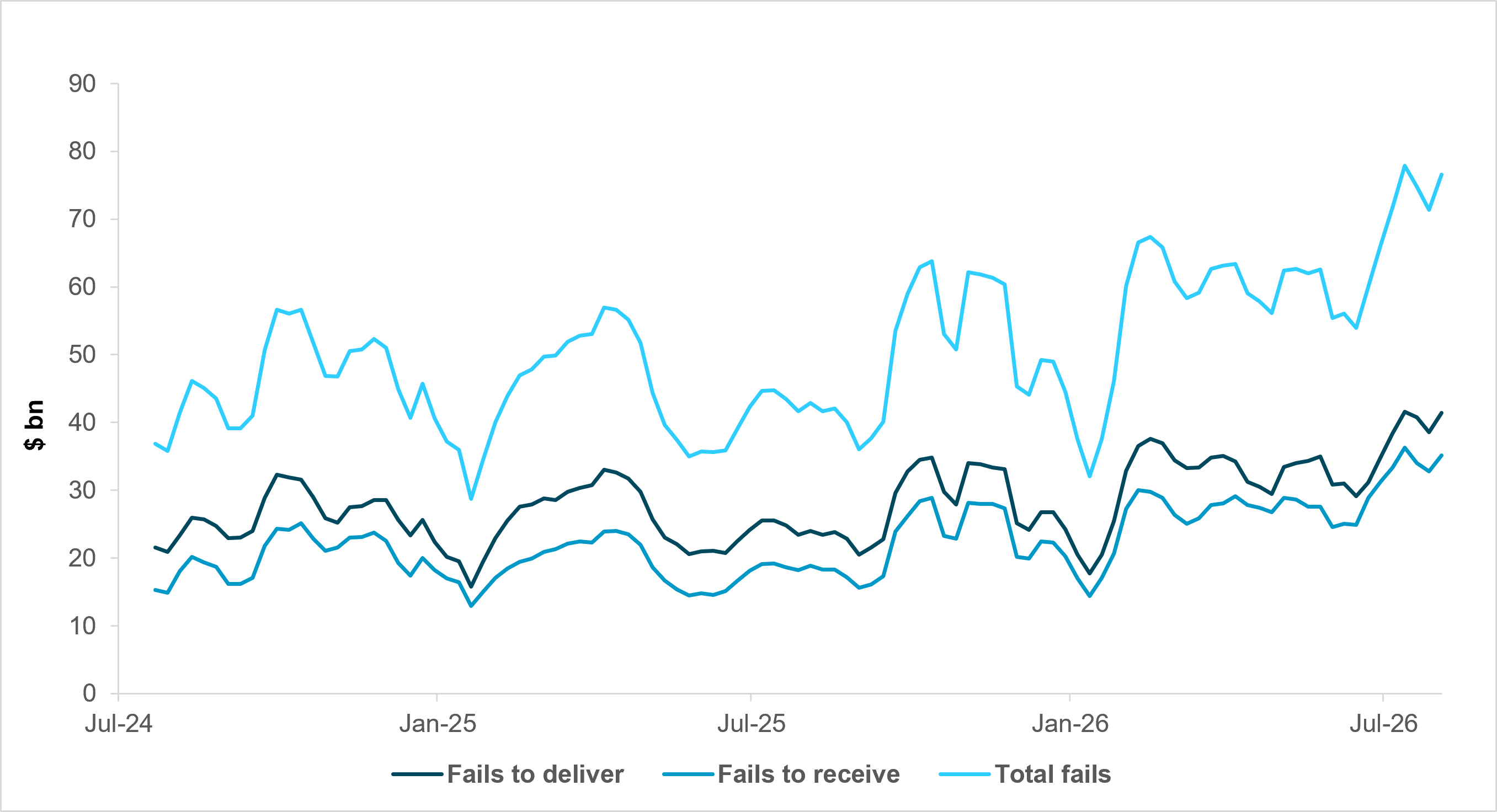
EXHIBIT #4: IG CREDIT FAILS ARE INCREASING
Source: FR2004. Note: Rolling four-week average.
Increasing fails: Fails to deliver and fails to receive have increased in recent months. Exhibit 4 shows the rolling four-week average of FTD and FTR for corporate bonds over the past year. Rising fails suggest that dealer intermediation is becoming less efficient and could point to impaired dealer intermediation capacity or heavier client repositioning across the secondary market. This could be an early sign that the street is struggling to recycle risk smoothly and provide immediacy in size, which could lead to a widening in spreads, regardless of dealer net positioning.
Will the Fed be a backstop?
Fed capacity: The Fed has the legal authority and institutional capacity to intervene in the event of a truly disorderly widening of credit spreads. During the early days of Covid, the Fed set up the Primary Market Corporate Credit Facility (PMCCF) and Secondary Market Corporate Credit Facility (SMCCF). The PMCCF ultimately saw no take-up while the SMCCF only saw $14bn, well below the headline capacity, but the programs are often credited with narrowing spreads through an announcement effect.
Fed unlikely to intervene this time: Critics of the Covid interventions respond, however, that the PMCCF, SMCCF and other Fed programs increased moral hazard. Our view is that the bar is extremely high for the Warsh Fed to intervene in private markets to address a widening of credit spreads in the way that the Fed has in the past. The Warsh Fed is more likely to view such an event as a localized crisis or an opportunity to impose discipline in a market that has enjoyed almost 20 years of a more interventionist Fed.
No immediate cause for alarm: To be clear, we see no immediate cause for alarm. At least at the moment, Bid-Ask spreads remain narrow, dealers are structurally short IG credit, end investor demand appears to be holding up, and spreads remain near their tightest levels. But investors should be aware that in the event of a selloff, some of the typical circuit breakers, a marginal end investor ready to step in, the dealer community, or the Fed might not be as willing or able to contain a gap wider in spreads.
How to track our thesis
- As dealers are the first line of defense in a selloff, keep an eye on dealer net positioning (Exhibit 3) and total fails (Exhibit 4). Dealer positioning moving more toward neutral or even net long might suggest greater balance sheet constraints and a continued rise in fails could suggest intermediation frictions
- Keep an eye both on spreads (Exhibit 1) and on long-end yields (Exhibit 2). A widening in credit spreads might suggest that investor sentiment is cooling, while a decline in long-end yields might make the value proposition less compelling.