BNY Pershing/Wealth Services
Streamline operations and strengthen client relationships with technology for wealth management firms and financial advisors.

Global financial wealth is projected to grow at approximately 7% annually through 2030,¹ setting the stage for a new phase of expansion across wealth management. For wealth management firms, this represents a significant opportunity to accelerate growth, increase share of wallet, and strengthen client relationships. Yet across these organizations, a consistent gap is emerging between growth ambition and operational reality.
Fragmented data environments, layered technology stacks, reactive AI implementation, and undifferentiated client servicing models are constraining firms’ ability to scale advisor capacity, deploy AI effectively, and deliver segment-specific experiences. As the future of wealth management is being redefined, the critical challenge for growth, technology, and operations leaders is less about identifying opportunity and more around building an operating model that can consistently convert that opportunity into durable organic growth.
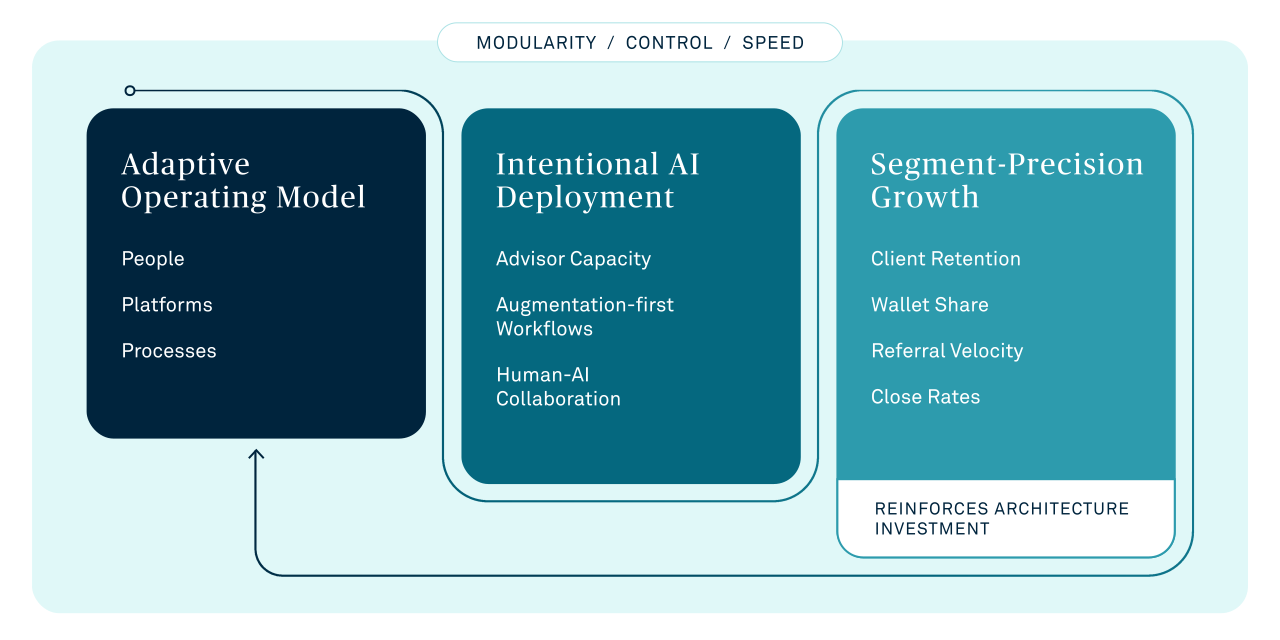
At BNY's INSITE 2026 conference, wealth management firm leaders were candid about the strategic gap between the current opportunity and their operating capacity. The wealth management firms beginning to capture disproportionate organic growth are those that are applying a new operating model framework, based on three interdependent pillars (as noted in Figure 1 below), to establish adaptability for the enablement of both intentional AI deployment and segment-precision growth.
Source: BNY INSITE 2026
Margin pressure, evolving client expectations, and integrating technology to enable data-driven decision-making while navigating regulatory risk are some of the biggest factors driving wealth management firm leaders to rethink their operating models.
"We are completely rethinking our operating model for our business," explained Channing Olson, COO of Wealthspire, during INSITE 2026.2 "That includes technology, it includes changing and simplifying our legal entities, because in my mind, you cannot scale complexity. We have some very high growth goals, and to be able to grow, you need to simplify the underlying complexity."
Taking a hard look at the inner work of a firm's operating model is daunting because it requires stitching together people, platforms, and processes through different workstreams, while integrating in each the attributes of modularity, control, and speed. Many growth, strategy, and heads of technology and operations are approaching the operating model rebuild by focusing on four priority workstreams.
The foundational layer for data architecture on which AI performance, segmentation, and advisor productivity all depend. Fragmented data architectures without a single source of truth continues the cycle of further fragmented processes.
Modularity: Centralized data architecture as the prerequisite for vendor flexibility3
Control: A single source of truth facilitates stronger governance
Speed: AI output only influences operational execution based on the quality and extent of the data it can leverage
Where “swivel-chair” inefficiency most directly damages client experience and, by extension, referral activation. Industry leaders attending INSITE 2026 also attest that relationship quality and retention rates improve as seamless client experiences free advisors to deepen relationships, which, in turn become the primary engine of referral-driven growth.4
Modularity: Streamlined onboarding and transfer workflows are structural growth levers
Control: Automating portions of account opening and transfer workflows, with appropriate supervisory and exception controls, can streamline operations and reduce manual error
Speed: Applying AI intentionally across end-to-end workflows leads to process simplification
Where preservation of control happens by staying ahead of technology deployment. Organizations that allow AI tools to proliferate without anchored ownership, defined use cases, and clear accountability are building AI complexity, not AI capability.5
Modularity: AI tool proliferation can become an architectural risk
Control: Establishing the right level of governance enables the right level of agent oversight. Ask: What governance models are purpose-fit for the right use case without slowing innovation?
Speed: Move governance reviews and approvals upstream in the design phases rather than downstream at review phase
Where an adaptable talent model must become structural, not aspirational. One firm eliminated its traditional client services operations team entirely, redeploying those professionals into client-facing relationship functions.6 The efficiency gain was not the result of technology alone but rather asking a harder question about where the organization needed stronger human engagement and redesigning accordingly.7
Modularity: Evaluate where teams are “passing the baton” to eliminate bottlenecks and find talent-restructuring opportunities
Control: Identify subject matter experts to anchor change management, execute pilot programs, and establish centers of excellence
Speed: Evaluate the ratio of time spent on executing change management; spend 20% to 30% of time gaining consensus on what to build and building it, and the rest driving adoption8
Creating modularity, control, and speed within each workstream as wealth management firms rebuild is what helps build a more durable architecture versus managing short-term disruption. For growth officers, getting the architecture right is not a technology initiative, but rather the precondition for intentional AI deployment and client segmentation precision that follows.
For leaders of wealth management firms already deep into rebuilding their operating model, the competitive question around AI has shifted to establishing intentional, connected AI workflows that fuel human-AI collaboration and free advisors to concentrate efforts where human judgment and engagement are non-negotiable.9 Precision matters because fragmented AI deployment and adoption multiplies complexity without multiplying output.
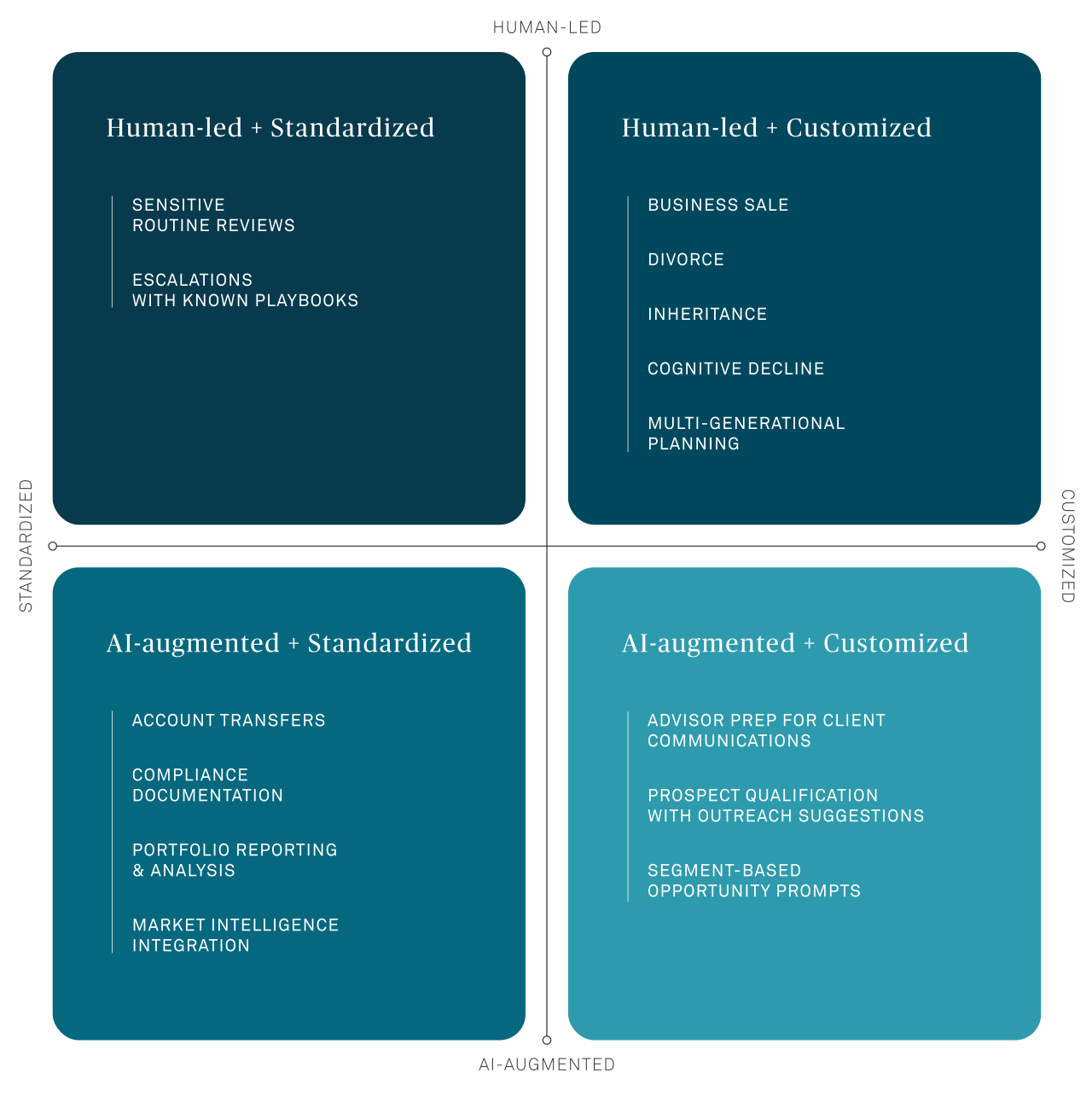
This important distinction is being evidenced through augmenting pattern-dependent, high-volume functions first. Advisor preparation for client communications, prospect qualification with outreach suggestions, account transfers, compliance documentation, portfolio reporting and analysis, and market intelligence integration are all areas to potentially capture meaningful capacity, which can then be translated into business value.
Examples from INSITE 2026 of how wealth management firms are taking a hybrid approach to applying “intentional AI” to give wealth advisors more capacity to drive client impact through human engagement and more customized advice.
Source: BNY INSITE 2026
Where clients still expect human engagement is in staying ahead of life events such as business sales, divorce, inheritance, cognitive decline, multi-generational planning, and any interaction requiring household-specific judgment. This is where AI tools can serve as preparation and infrastructure, helping advisors to be fully present for the work that builds lasting client relationships.10
Before pursuing any AI initiative, growth leaders should target workflows that directly drive client impact, such as through client retention or advisor capacity. Discussions at INSITE 2026 defined key guiding questions to help direct resources toward the initiatives that would deliver the greatest impact.
Source: BNY INSITE 2026
A critically important shift in perspective on AI deployment was described best by Ray Sclafani, Founder & CEO at Clientwise, during INSITE 2026. “AI is not a tech project. This is a talent strategy issue, and it’s evolving quickly.”11
Research Sclafani discussed at INSITE 2026 suggests a growing share of affluent clients expect advisors to use AI to improve responsiveness and personalization.12 Among Gen Z workers, 59% already believe that strong AI skills will be essential to their career advancement,13 and employers expect 39% of workers’ key skills to change by 2030.14
Segmentation — moving beyond asset-based client tiers to psychographic understanding* (i.e. source of wealth, how they make decisions, what they value, what is unique to them) and deliberate advisor-client matching — remains the most underleveraged growth lever in the industry.15 According to a Broadridge study conducted in 2023, the number of U.S. advisors who have a defined marketing strategy reached its lowest level (20%) in five years.16 The consequences of that gap create the risk that client relationships are shallower, less referral-active, and more vulnerable to attrition than wealth management firms recognize.17
When specific client niches become part of the firm’s operating model, the potential impact on growth cannot be underestimated. Heather Ettinger, now CEO of Luma Thrive, but previously CEO of her own registered investment advisor firm, attributes growth in assets under management from $500 million to $5 billion to focusing predominantly on specific client niches, with a significant emphasis on the women’s wealth segment.18
“The misconception is that niches limit your growth,” Ettinger explained. “Our firm was an example of when we moved to niches as part of our marketing plan, we went into significant double-digit growth and doubled our margins.”
Three pillars that define a durable segmentation strategy include:
Match advisors to segments based on relevant experience, psychographic alignment,* and deep familiarity with the financial and emotional complexity of the clients they serve best.19 Ask: Which advisors do our target clients need?
Differentiate solutions capabilities by segment so that a referral up the value chain represents a genuinely upgraded experience, not a cosmetic one. Without material product differentiation between segments, internal referral systems lose their rationale and quietly collapse.20
Configure workflows, reporting architecture, and client-facing tooling to reflect the specific needs of each segment. Ultra-high net worth clients with concentrated positions, indirect ownership structures, and multi-generational planning requirements need reporting infrastructure that platforms designed for mass-affluent clients are not built to support.21 Serving both segments on the same technology stack is not operational efficiency but rather structural under-service at the top of the book.
Source: BNY INSITE 2026
Once segments are newly defined, the execution challenge becomes change management: realigning advisor compensation, transitioning long-standing client relationships, and communicating the strategic rationale internally with sufficient specificity that advisors choose to lead the transition rather than resist it. Firms that have navigated this successfully report consistent movement in the metrics that matter most: client engagement, wallet share, close rates on right-fit prospects, and referral velocity.22
When embarking on a comprehensive operating model rebuild, each architectural choice should create the conditions the next choice requires. Unified data architecture helps enable the AI workflows that amplify advisor capacity; amplified advisor capacity makes genuine segment-level personalization scalable; scalable personalization drives the organic growth and referral velocity that sustain the model23 to compete for the next decade of wealth transfer. The firms that lead the next decade of wealth will be those that architect their operating models with intent, aligning data, AI, and segmentation to systematically convert opportunity into durable growth.
*Panelists in the INSITE 2026 sessions “Unlock Organic Growth: Harnessing Client Segmentation Strategies to Prioritize Opportunities” explained that asset-level categorization of clients alone provides the least actionable form of client segmentation, noting that two clients with similar AUM profiles are likely very different in terms of psychographic criteria, such as source of wealth, financial complexity, values, and behavioral orientation — that can help to produce genuinely actionable service-model differentiation.
1"The Great Reordering," Global Wealth Report 2026, Boston Consulting Group, May 2026, https://web-assets.bcg.com/84/95/538c1f4b439a91d3ef8ae90b6e89/2026-gwr-may-2026.pdf
2, 3, 5, 6, 7, 8 INSITE 2026, "The CTO and COO Edge: Insights in Driving Innovation and Strategy in Modern Wealth Management," Moderator: Ranjit Samra, Head of BNY Investments, Wealth and Pershing Engineering; Panelists: Rashmi Badwe, EVP and COO for Wealth Management, TIAA; Chris Keller, EVP and Director of Business Services, Benjamin F. Edwards and Co.; Channing Olson, COO, Wealthspire.
4 INSITE 2026, "Modernize Your Operating Model: Stay Responsive Amid Fintech Disruption," Moderator: Farayi Chimbangu, Client Executive, BNY Pershing Wealth Services Platform; Panelists: Peter Antonucci, SVP of Business Architecture, Voya Wealth Management; Hilda Wong-Doo, Founding Partner, GreenLine Consultants LLC; and "Wealth Management 2030: Who Will Win in the Future of Wealth Management," Moderator: Ben Harrison, Head of Client Coverage, BNY Pershing Wealth Services Platform; Panelists: Jeff Dekko, CEO, Wealth Enhancement; Susie Cranston, CEO, Cresset Capital.
9, 10, 23 INSITE 2026, "Outcome-Driven AI for Wealth Management," Moderator: Ed Fandrey, Global Head of Sales and Client Coverage, BNY; Panelists: Karen Del Vescovo, Corporate Vice President of Financial Services, Microsoft; Ainsley Simmonds, Executive Platform Owner, BNY Pershing Wealth Services, BNY.
11, 12 INSITE 2026, "Win the Talent Race: Attract, Develop and Retain Top Performers," Moderator: Steve James, Global Head of Marketing, BNY; Panelist: Ray Sclafani, Founder and CEO, ClientWise.
13 Elizabeth Faber, “2025 Gen Z and Millennial Survey,” Deloitte, May 2025, https://www.deloitte.com/content/dam/assets-shared/docs/campaigns/2025/2025-genz-millennial-survey.pdf
14“The Future of Jobs Report 2025,” World Economic Forum, January 2025, https://www.weforum.org/publications/the-future-of-jobs-report-2025/in-full/3-skills-outlook/
15, 17, 19, 20, 21, 22 INSITE 2026, "Unlock Organic Growth: Harnessing Client Segmentation Strategies to Prioritize Opportunities," Moderator: Damian Peter, Client Executive, BNY Pershing Wealth Services Platform; Panelists: Joe Calabrese, Chief Operating Officer, Key Wealth Management; Jess Landy, Senior Vice President, Marketing and PR, Ficomm Partners.
16 "Fifth Annual Broadridge Survey Reveals Time and Expertise Top Challenges in Advisor Marketing Strategies," Broadridge, Feb. 7, 2024, https://www.broadridge.com/press-release/2024/fifth-annual-broadridge-survey
18 INSITE 2026, "Scale Personalization: Serving High-Growth Segments While Protecting Margins," Moderator: Nancy Gordon, Head of Advisor Growth, Platform Product Lead, BNY Pershing Wealth Services Platform; Panelists: Heather Ettinger, CEO, Luma Thrive; Julia Littlechild, Founder and CEO, Absolute Engagement; Alvina Lo, Head of Advice, Planning and Fiduciary Services, BNY Wealth.
BNY Institute content provides thought leadership and is not investment research. Views are the authors’ and may change. This material is for informational purposes only and does not constitute investment advice or an offer. For full disclosures, click here.
©2026 BNY. All rights reserved. Member FDIC.