Trustee and Depositary Services
Global consistency with local expertise offered via a resilient, scalable platform.

The European Commission’s 2025 Supplementary Pensions Package proposes to align depositary requirements for DC occupational pension schemes with the UCITS V framework. Ton Tol, Head of Netherlands Trustee and Depositary Services at BNY, examines what the shift from national discretion to a common EU standard means for pension funds, depositaries and administrators across Europe.
Europe’s two-decade effort to build a single market for investment funds has progressively raised the bar for investor protection. Now, that same standard is extending to occupational pensions. The European Commission’s 2025 Supplementary Pensions Package proposes to align Institutions for Occupational Retirement Provisions (IORP) depositary requirements for Defined Contribution (DC) pension schemes with the UCITS V framework, bringing one of the EU’s most rigorous investor safeguard models the retirement savings of millions of European workers and creating implications for pension funds and the service providers that support them.
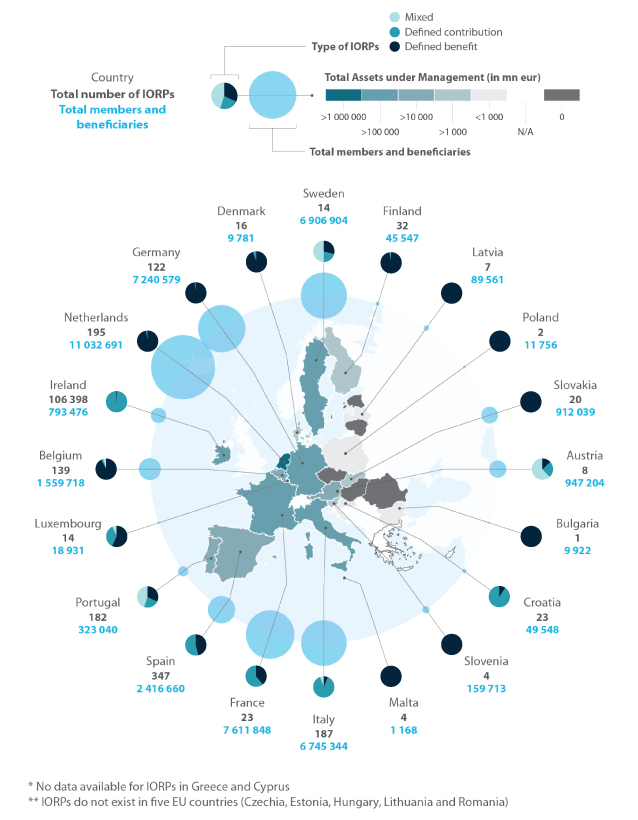
Source: European Court of Auditors (ECA), based on European Insurance and Occupational Pensions Authority (EIOPA) data, 2025.
While the IORP framework, established in 2003, has provided the regulatory foundation for occupational pensions in the EU, establishing standards for prudential supervision, governance, and the protection of members and beneficiaries, it has not fully succeeded in directing sufficient savings to capital markets and contributing to the Savings and Investments Union. 1
The original IORP directive, left the appointment of a depositary or custodian to Member State discretion. IORP II, adopted in 2016 and still in force, went further — defining depositary responsibilities in Articles 34 and 35, covering safekeeping of financial instruments, ownership verification, oversight of IORP instructions and monitoring of asset-related transactions. However, it stopped short of requiring a single, harmonised approach. Member States could require one or more depositaries, and some extended depositary obligations beyond regulatory requirements. The result was a patchwork of national frameworks, varying in scope, cost and investor protection.
The 2025 Supplementary Pensions Package, published on December 1, 2025 and forming part of the broader Savings and Investments Union strategy, seeks to help ensure effective supervision while harmonizing the framework across Member States. The proposed amendments to the IORP II directive would require DC pension scheme where participants fully bear the investment risk, to appoint a single, independent depositary aligned with UCITS V standards. The intent is to bring supplementary pension investors the same level of protection that UCITS investors already receive.
For pension schemes and their service providers, this is not a distant regulatory development. It represents a fundamental shift in how depositary obligations are defined, scoped and enforced.
The proposed move to a single, UCITS-standard depositary model is a crucial change, restructuring how pension schemes source, evaluate and contract with their service providers. The practical implications differ materially by member state, and by the current state of each scheme’s depositary arrangements.
For DC pension schemes in markets with concentrated custodian arrangements
Large pension funds may use multiple custodians and depositaries to diversify operational and concentration risk. Under the proposed amendments, that model would need to change. A single entity would be responsible for safekeeping, oversight and cash flow monitoring — with clearly established liability rules aligned to UCITS V.
The UCITS framework does not allow for the contractual discharge of depositary liability to sub-custodians. For pension funds accustomed to distributing that liability across multiple providers, this creates a genuine structural question that requires legal and operational review.
There is, however, a degree of flexibility built into the proposal. Recital 31 of the amending directive provides that Member States may maintain existing, alternative safekeeping measures where those measures provide a level of protection comparable to that of a qualifying depositary. 2 In some European markets, IORPs already benefit from comparable asset-safeguarding measures, including solvency and asset-coverage rules tailored to occupational pension institutions, as in Sweden. In others, similar functions and responsibilities are carried out by service providers, such as external auditors, administrators, fiduciary managers, and custodians, alongside robust regulatory and supervisory frameworks. 3
Under IORP II, pension schemes are required to appoint one or more depositaries. The new proposal instead mandates that pension schemes appoint a single, independent depositary consistent with UCITS standards. The responsibility for safekeeping, oversight, and monitoring cash flow is centralized under a single entity with clearly established liability rules. In a jurisdiction like the Netherlands, large pension schemes may use multiple custodians and depositaries to diversify operational and concentration risk. Since UCITS does not allow for a contractual discharge of liability to sub-custodians, delegation to another custodian presents challenges.
By aligning IORP depositary requirements with the UCITS V oversight framework, the depositary is obligated to carry out all essential oversight activities similar to those of a UCITS depositary. This includes responsibilities that go beyond Article 35 duties, such as monitoring subscriptions and redemptions, as well as overseeing valuation and net asset value calculations. The design and implementation of these oversight activities should be based on an assessment of the risks of the IORP, considering the nature, scale and complexity of the investment policy and strategy of the IORP and with the organisation. Pension funds are inherently distinct from investment funds, which can result in variations in the practices employed by each type of fund. For example, oversight related to the subscription and redemption of UCITS units does not apply to pension funds because these funds neither issue, nor are represented, by units.
Although cash flow monitoring is currently not a depositary obligation under IORP II, adherence to the UCITS standard requires the depositary to undertake cash flow monitoring activities.
The UCITS V oversight model introduces obligations that have no direct precedent in the pension fund context. Monitoring subscriptions and redemptions, overseeing net asset value calculations and conducting cash flow monitoring are standard depositary duties under UCITS but they do not map cleanly onto pension fund operations.
Pension funds do not issue units. The lifecycle of contributions, benefit payments and drawdowns differs fundamentally from investment fund flows. For depositaries entering the pension market, this requires adaptation rather than replication. UCITS oversight workflows will need to be restructured around the specific mechanics of pension fund operations.
The proposed alignment with UCITS V introduces obligations that go beyond those currently required under IORP II Article 35. Cash flow monitoring — currently absent from the IORP framework — becomes mandatory under the proposed standard. Expanded oversight responsibilities covering valuation, net asset value calculations and contribution flows will require depositaries to build or adapt capabilities specifically for the pension fund context.
That operational investment is accompanied by a significant market opportunity. DC pension schemes across the EU that do not currently operate under a UCITS-standard depositary arrangement represent a new and substantial addressable market. Depositaries and administrators that develop the competency in DC pension fund accounting. Depositaries and administrators that build expertise in DC pension fund accounting, contribution-flow and benefit-payment oversight, and the safekeeping and supervision of the broad range of asset classes in which IORPs invest, will be well placed as the regulatory framework takes hold.
With a powerful combination of global custody, asset servicing, institutional accounting and reporting, post-trade compliance monitoring and depositary services, BNY provides the infrastructure, expertise and scale IORPs need to operate confidently in an increasingly demanding regulatory environment. Drawing on our deep institutional servicing experience, and the understanding that pension fund operations differ fundamentally from traditional investment funds, we are well positioned to support pension funds with trusted solutions tailored to their specific operational and oversight needs.
The Member State text addresses the issues discussed in this paper. This includes more explicitly adopting the flexibility referred to in Recital 31 for Member States to allow alternative safekeeping measures if those measures provide a level of protection comparable to that of a qualifying depositary. In addition, the new proposed text seems to acknowledge the practical implication of the requirement to appoint a single depositary per scheme by allowing for an IORP to appoint the same depositary to act for one or more of the pension schemes it operates, or to appoint more than one depositary per pension scheme.
The European Parliament is now considering its position on the EU Commission’s legislative proposal ahead of trialogue discussions with Member States.
The outcome of those deliberations will shape the final framework for narrowing the governance gap between investment funds and pension funds and extending the investor protections built into UCITS to a sector that has long operated under a more fragmented standard.
BNY, working across nine EU member states supporting depositaries, custodians and fund administrators, supports the intention of the original EU Commission proposal to apply the same Savings and Investments Union agenda that has driven the expansion of ELTIF 2.0, the proposed depositary passport and wider reforms to European fund distribution to the occupational pension sector.
The question for pension schemes and their service providers is not whether to engage with the proposed framework, but how to assess their current arrangements against it — and on what timeline.
1 European Commission . (2025). Proposal for a Directive of the European Parliament and of the Council; amending Directives (EU) 2016/2341 and 2016/97 as regards the strengthening of the framework for occupational retirement provision.
2 EIOPA. (2025). Technical input for the reviews of the IORP II Directive and the PEPP Regulation in the context of the Savings and Investments Union, paragraph 1.5.3 and IORP II, recital 31.
3 Council of the European Union. (March 2026). IORP WP 18 March: Consolidation of the Presidency questionnaire on the discussion paper on amendments to IORP II Directive, following the WP of 26 February. Replies from 21 MS (WK 4192/2026 REV 1)
4 EIOPA. (2023). Technical advice for the review of the IORP II Directive and EIOPA (2012). EIOPA’s Advice to the European Commission on the review of the IORP Directive 2003/41/EC
Disclaimer BNY is the corporate brand of The Bank of New York Mellon Corporation and may be used to reference the corporation as a whole and/or its various subsidiaries generally. This material and any products and services mentioned may be issued or provided in various countries by duly authorized and regulated subsidiaries, affiliates, and joint ventures of BNY. This material does not constitute a recommendation by BNY of any kind. The information herein is not intended to provide tax, legal, investment, accounting, financial or other professional advice on any matter, and should not be used or relied upon as such. The views expressed within this material are those of the contributors and not necessarily those of BNY. BNY has not independently verified the information contained in this material and makes no representation as to the accuracy, completeness, timeliness, merchantability or fitness for a specific purpose of the information provided in this material. BNY assumes no direct or consequential liability for any errors in or reliance upon this material.
This material may not be reproduced or disseminated in any form without the express prior written permission of BNY. BNY will not be responsible for updating any information contained within this material and opinions and information contained herein are subject to change without notice. Trademarks, service marks, logos and other intellectual property marks belong to their respective owners.
© 2026 BNY. All rights reserved. Member FDIC.