Trustee and Depositary Services
Global consistency with local expertise offered via a resilient, scalable platform.

As private markets undergo rapid democratization, accelerating growth of asset management revenue, depositaries, investment management companies and fund administrators are facing the need for strategic and operational change to fully capitalize on the scalable distribution opportunity of alternative assets across wealth and retail channels.
As private markets undergo rapid democratization, accelerating growth of asset management revenue, depositaries, investment management companies and fund administrators are facing the need for strategic and operational change to fully capitalize on the scalable distribution opportunity of alternative assets across wealth and retail channels.
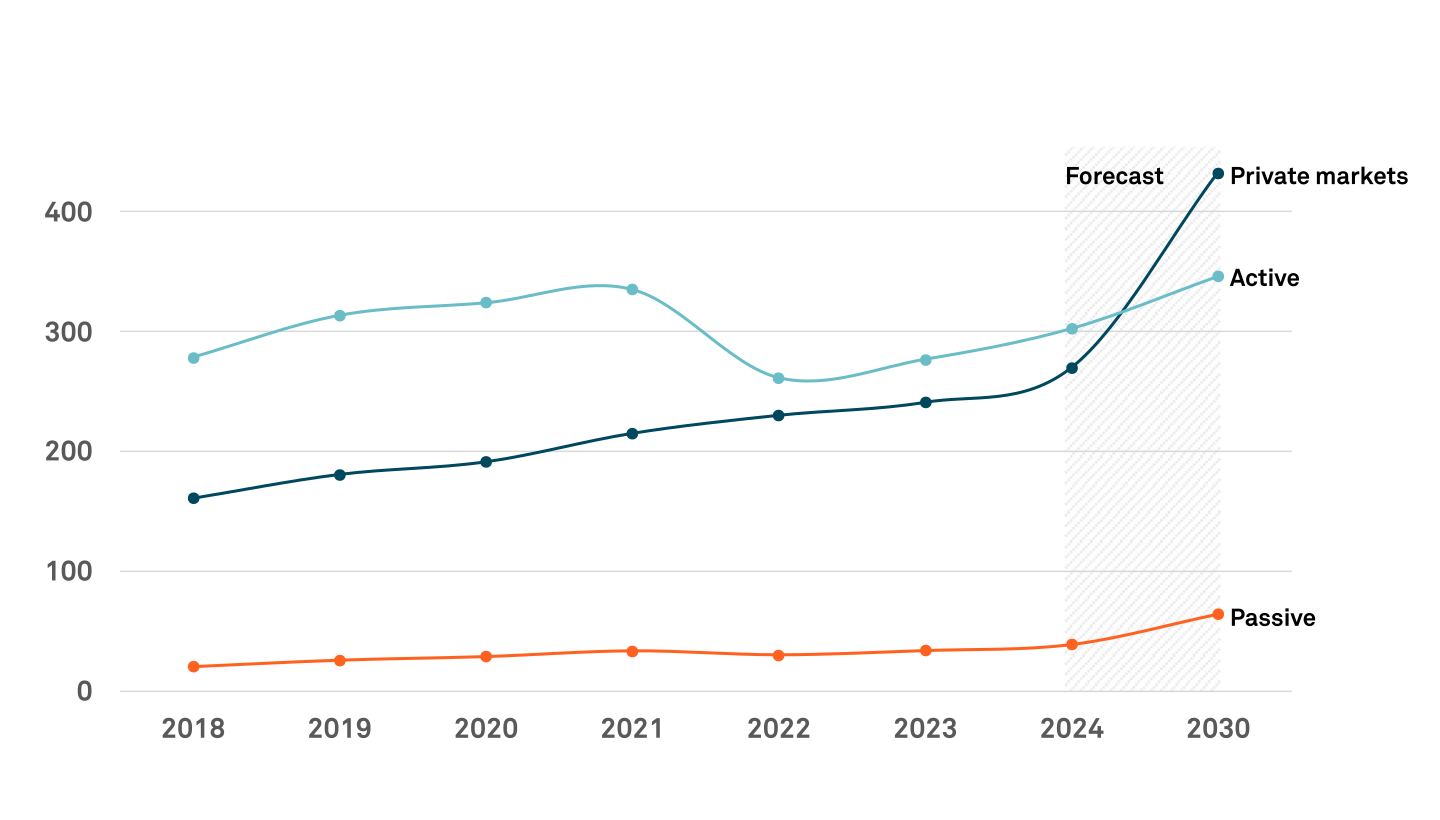
The economics underline the urgency. This shift toward greater participation in private market investments comes at a time when margins are under pressure across many traditional revenue streams in asset management. Private markets today produce approximately four times more profit per billion dollars of assets under management (AUM) than traditional asset managers. By 2030, private markets revenues are projected to reach $432.2 billion — accounting for more than half of total asset management industry revenues.¹ (Figure 1) The firms that align their infrastructure to this opportunity now will be better positioned to compete as private markets go mainstream.
PwC estimate, USD billions
Source: PwC Global AWM & ESG Research Centre
Regulatory change is helping accelerate the transformation of private markets and the wider investment management industry. In Europe, the Savings and Investment Union (SIU) is designed to channel household savings into long-term productive investment, reduce reliance on bank financing and broaden access to growth assets. In support of that objective, more harmonized investment frameworks are taking shape, including the revised European Long-Term Investment Fund (ELTIF) regulation, ELTIF 2.0, alongside national regimes such as Luxembourg’s Part II Undertakings for collective investment (UCI) framework.
Revisions to ELTIF 2.0 have significantly expanded the structure’s scope and practicality. The updated framework removes minimum investment thresholds for retail investors, broadens the range of eligible assets to include areas such as private credit and infrastructure, introduces more flexible liquidity management tools and simplifies distribution across the European Union. Taken together, these changes strengthen the ELTIF’s role as a vehicle for connecting retail capital with private markets.
European policymakers are seeking to mobilize household savings for long-term investment while maintaining appropriate investor safeguards. The European Commission has positioned ELTIFs as an important bridge between retail capital and private markets, closely aligned with the broader ambitions of the SIU.
Luxembourg’s Part II UCI regime has also emerged as a flexible route for distributing alternative strategies to a broader investor base. Because these structures are not bound by strict eligibility, diversification or liquidity requirements, they can invest across private equity, private credit, real estate, infrastructure and other illiquid asset classes while remaining open to retail investors. That flexibility has made Part II UCIs an established vehicle for semi-professional and retail distribution, particularly through private banks and insurance wrappers. Industry projections from KPMG indicate that UCI Part II alternatives under administration are expected to double to €200 billion by 2028.2 This represents an anticipated Compound Annual Growth Rate (CAGR) of 20% to 25%. UCI Part II has positioned itself as a compelling “Goldilocks Solution" enabling fund managers to effectively connect institutional-grade strategies with retail private wealth investor segments.
Similar developments are also taking shape in the United Kingdom and the United States.
In the U.K., where the Long‑Term Asset Fund (LTAF) regime was designed to facilitate investment in illiquid assets by defined‑contribution pension schemes, it was later expanded to broaden access to certain retail investors.
In the U.S., regulators have expanded the use of interval funds and semi‑liquid structures investing in private assets, alongside clearer expectations on valuation, disclosure and liquidity management.
Europe is advancing harmonised regulation to mobilise retail capital into private markets through SIU and ELTIF 2.0. These reforms expand access, broaden eligible assets and simplify distribution, strengthening ELTIF as a scalable vehicle connecting retail investors with private markets while maintaining investor safeguards.
Luxembourg’s Part II UCI regime offers a flexible structure for distributing alternative strategies to semi-professional and retail investors. Its broad investment scope and fewer restrictions have driven adoption, positioning it as a key vehicle linking institutional strategies with private wealth, supported by strong projected growth.
The investment management industry is already reconfiguring itself. According to PwC estimates, full-scale private-to-public investment management hypermarkets are projected to account for 49.5% of the increase in asset and wealth management revenues by 2030. These are asset management firms that will offer both public and private markets investments at scale, leveraging data and technology to deliver personalized portfolios with breadth and operating scale.3
For service providers, greater volumes of investors accessing private market structures mean greater volumes of subscriptions, reporting requirements, valuation workflows and oversight responsibilities — many of which are more complex and more manual than their public markets equivalents.
To thrive in this rapidly evolving landscape, depositaries, investment management companies and fund administrators need to move from a relatively standardized, low-touch service model toward a more specialized, data-rich, high-judgment operating model.
As fund structures increasingly combine liquid and illiquid assets within a single vehicle, the longstanding reliance on asset-class-specific and highly bespoke platforms is becoming harder to sustain.
The servicing model itself will need to shift toward a more complex asset servicing approach. Competitive advantage will no longer come primarily from processing routine activity efficiently. Private markets differ fundamentally from traditional long-only public funds: transaction volumes are lower, manual events are more common, structures are more complex and investor reporting is often far more tailored. As a result, depositaries will need to move beyond a traditional safekeeping role by strengthening oversight across ownership verification, cash monitoring and alternative asset event monitoring. Management companies will need to become more effective orchestrators of third parties, conflicts, liquidity terms, valuation governance and regulatory reporting. Fund administrators will need to operate less as NAV production engines and more as strategic operating partners for private markets.
Not only are depositaries, management companies and fund administrators pressed to rethink their operating models, but there is also the need to invest in their data and technology capabilities to meet the needs of an asset class known for having inconsistent source data, document-heavy workflows, delayed valuations and limited interoperability across managers, administrators and service providers.
The practical implications vary by role. Depositaries need data models capable of capturing ownership evidence, cash events, legal structures and oversight actions. Management companies require integrated oversight dashboards spanning delegates, funds, valuation, liquidity and compliance. Fund administrators need scalable infrastructure that can support bespoke reporting without creating excessive manual rework.
This impending evolution calls for a deliberate upskilling of operational teams, which have often been specialised by product type (Undertakings for Collective Investment in Transferable Securities (UCITS) fund versus Alternative Investment Funds) rather than by multi-asset fund complexity. Providing staff with the appropriate tools, expertise and governance frameworks will be essential to service this new generation of private markets investment vehicles effectively.
1, 3 Asset and wealth management revolution 2025, “The profitability paradox: Competing for relevance and returns,” pwc.com, PwC, November 24, 2025, https://www.pwc.com/gx/en/issues/transformation/asset-and-wealth-management-revolution.html
2 Mickael Tabart, Niels Ozeree, “Retailization of private markets in Europe,” KPMG, February 4, 2026, https://kpmg.com/lu/en/insights/value-creation/retailization-private-markets-europe.html
BNY is the corporate brand of The Bank of New York Mellon Corporation and may be used to reference the corporation as a whole and/or its various subsidiaries generally. This material and any products and services mentioned may be issued or provided in various countries by duly authorized and regulated subsidiaries, affiliates, and joint ventures of BNY. This material does not constitute a recommendation by BNY of any kind. The information herein is not intended to provide tax, legal, investment, accounting, financial or other professional advice on any matter, and should not be used or relied upon as such. The views expressed within this material are those of the contributors and not necessarily those of BNY. BNY has not independently verified the information contained in this material and makes no representation as to the accuracy, completeness, timeliness, merchantability or fitness for a specific purpose of the information provided in this material. BNY assumes no direct or consequential liability for any errors in or reliance upon this material.
This material may not be reproduced or disseminated in any form without the express prior written permission of BNY. BNY will not be responsible for updating any information contained within this material and opinions and information contained herein are subject to change without notice. Trademarks, service marks, logos and other intellectual property marks belong to their respective owners.
© 2026 BNY. All rights reserved. Member FDIC.