Global Clearing
Reimagined self-clearing, outsourced and hybrid clearing solutions.
Post-trade fragmentation is becoming a growing drag on capital, liquidity and operational efficiency. Discover how a connected operating model can help firms streamline workflows, mobilize collateral faster and prepare for T+1 settlement, tokenization and continuous markets.
For banks, investment firms, broker-dealers and other global market participants, market expansion compounds post-trade complexity. Every additional clearing venue, settlement location, collateral pool, currency and time zone increases operational interdependency across securities and derivatives transactions. Firms must also navigate faster markets, regulatory change, tokenized assets and continued pressure to improve capital and liquidity efficiency. Together, these developments are turning fragmentation in post-trade execution from an operating challenge into a direct constraint on capital efficiency.
Although specific post-trade circumstances vary by market, firms operating across jurisdictions face the same underlying challenges to coordinate securities, cash, collateral and liquidity across market infrastructures that were not designed to function as a single operating model.
Europe’s repo market provides a particularly visible example of this global challenge. Outstanding volume rose 24.6% year over year to EUR 13.7 trillion, according to the International Capital Market Association’s (ICMA) European Repo Market Survey conducted in December 2025,[1] increasing the volume of securities and cash that firms must coordinate across clearing, settlement, collateral and payment infrastructure.
Figure 1: European Repo Market Growth
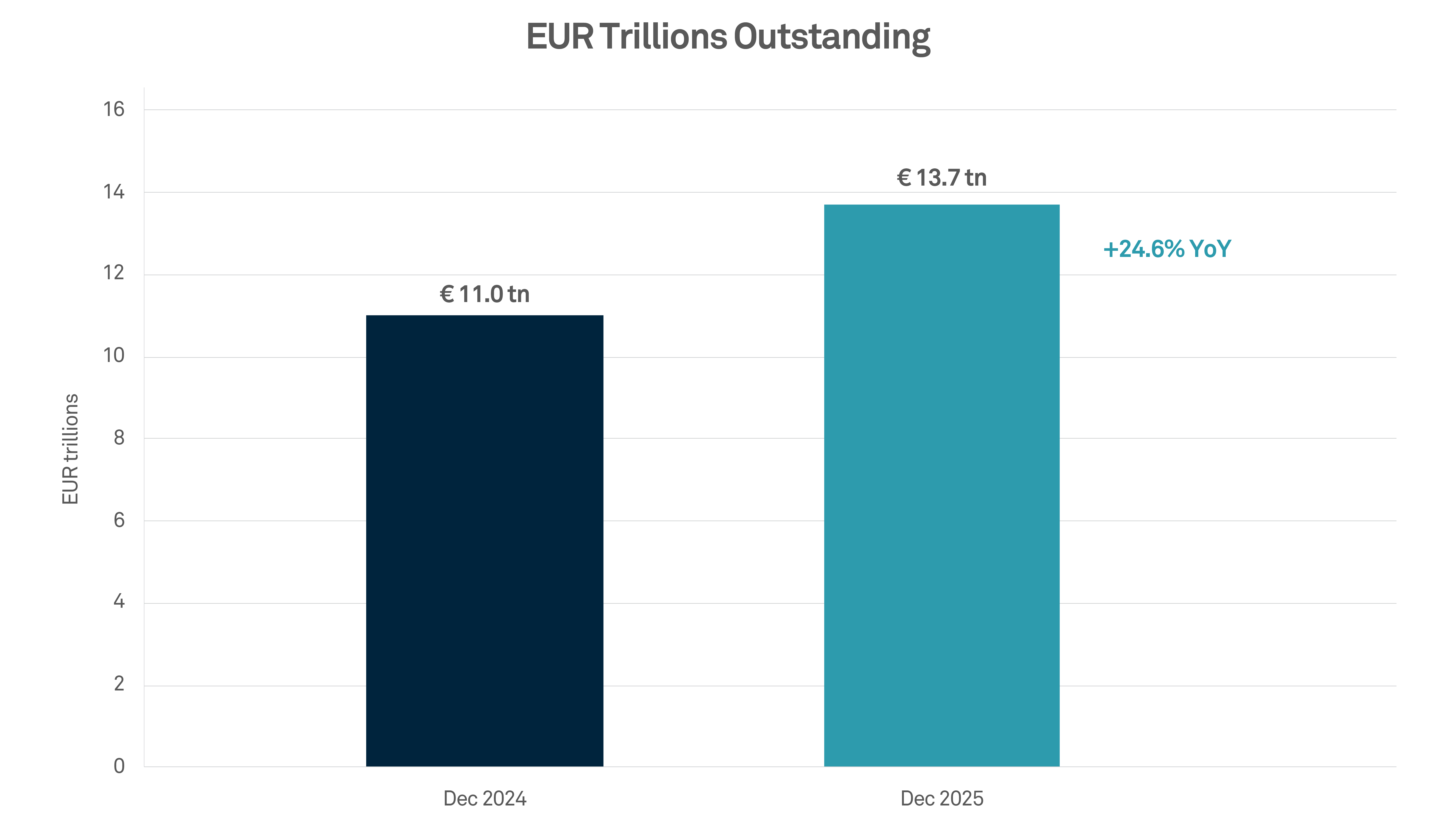
Source: ICMA European Repo Market Survey No. 50, conducted December 2025 and published March 2026 | Units: EUR trillions outstanding.
At the same time, the European Union, United Kingdom and Switzerland are set to move to T+1 settlement on 11 October 2027, compressing the time available to allocate securities, fund cash obligations and resolve exceptions across time zones. Regulatory change is adding further pressure. European Market Infrastructure Regulation (EMIR) 3.0 is reshaping the derivatives clearing regime, while the Digital Operational Resilience Act (DORA), is tightening requirements for managing cyber threats, technology disruptions and third-party dependencies.
Given such complexity, many firms are reaching the same conclusion: as markets become more connected, managing fragmentation is no longer enough to achieve sustainable growth. Although Europe makes the challenge especially visible — with 28 central securities depositories and international central securities depositories (CSDs and ICSDs) and 14 central counterparties (CCPs) in the EU and European Economic Area (EEA) alone — fragmentation is not region-specific. It emerges wherever firms must connect multiple clearing venues, settlement locations, collateral pools, currencies and time zones so a different operating model integrating every post-trade requirement is now a necessity. This new operating model for post-trade requirements should reduce external handoffs, release trapped capital, improve balance-sheet efficiency and support growth without adding proportional operational complexity.
Traditionally firms have responded to fragmentation by adding interfaces, reconciliations and operational layers, then absorbing the cost as fixed overhead. A more effective response is to remove securities and derivatives fragmentation from the operating model itself. That means creating a model that can extend across markets efficiently and consistently. Integrating assets, data, collateral, cash and liquidity also creates a practical foundation for introducing tokenized instruments without building a separate operating environment.
Five principles define an integrated post-trade model that can be applied across markets while accommodating differences in local infrastructure, regulation and operating practice:
As settlement cycles shorten and tokenization and always-on models reshape how assets may be issued, mobilized, financed, and settled, continuing to manage fragmentation rather than reducing it will become increasingly costly. The next question is how to put these principles into practice on infrastructure that operates across markets today.
The value of a connected operating model is measured in outcomes — fewer handoffs, faster collateral deployment, lower liquidity buffers, and the ability to add markets without adding complexity.
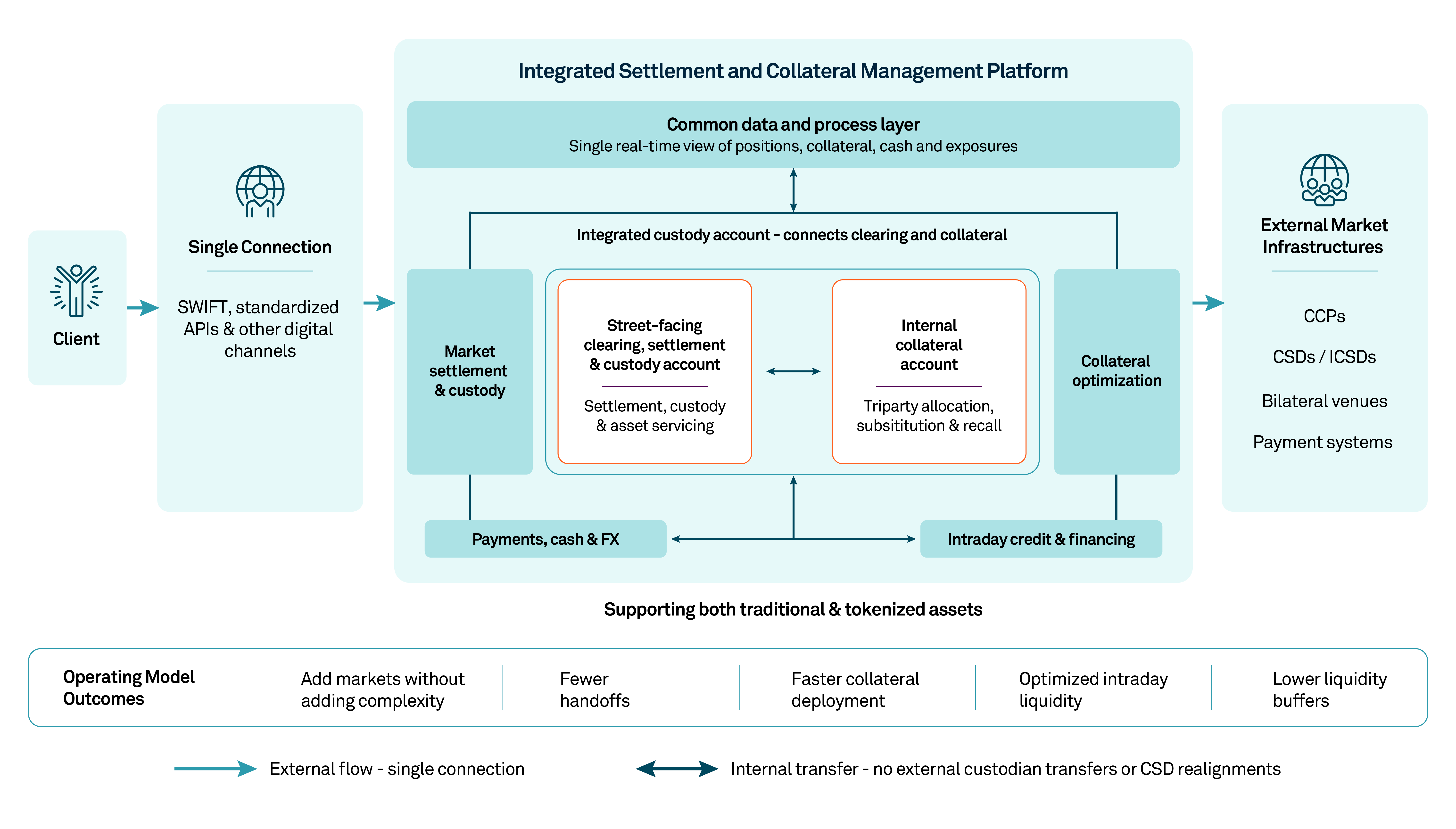
BNY’s Integrated International Settlement and Collateral Management Operating Model (Figure 2) brings together settlement, global custody, collateral, payments, intraday credit and financing as connected elements of a scalable multi-market model rather than separate capabilities layered together.
Figure 2: BNY’s Integrated Post-Trade Operating Model
In an integrated model, clearing, settlement and collateral operate on one platform, so assets move internally rather than across providers internationally.
At its core is an integrated custody account that connects clearing and collateral activity, creating the foundation on which payments, intraday credit and financing can interoperate against a consolidated view of positions. The model builds on an approach operating at scale in the United States and extends that architecture across Europe and other international markets. Clients retain control of trading and books and records while benefiting from:
Repo provides a practical example of how the above integrated operating model can reduce fragmentation across the post-trade lifecycle.
A repo transaction provides a useful global illustration because the same need to coordinate securities, collateral, financing and cash arises across markets, even where local infrastructure and settlement practices differ. In today’s fragmented model, the required collateral may be held at a local CSD or ICSD through one custodian, while the repo is managed by a different triparty agent and the cash leg is settled through a separate bank.
Mobilizing the collateral can require an external transfer or realignment between custodians, accounts or depositories before it can be financed. Each handoff introduces delay, cost and settlement risk, while fragmented reporting makes it harder to establish a complete intraday view of available inventory, funding requirements and settlement obligations.
In an integrated model, clearing, settlement and collateral management are coordinated through a common platform and data backbone. The repo can be matched against real-time inventory held across the firm’s settlement and collateral accounts, with eligible collateral selected and optimized across trading and collateral requirements. Where assets are already held within the provider’s network, they can be transferred internally from the settlement account into triparty without external custodian transfers or CSD realignments. This makes the collateral available for financing, margin or settlement in near-real time, while reducing settlement costs, late-settlement penalties and fail risk.
As positions change, intraday credit and financing can respond to actual asset and cash balances. Collateral substitutions, recalls and adjustments can be processed throughout the day, while cash and liquidity are managed against a current view of obligations rather than separately prefunded across multiple custodians and venues.
At maturity, the cash repayment, collateral return and release of financing are processed through the same infrastructure, creating a consistent record and a single real-time view through dashboards and APIs.
An integrated operating model also provides a practical pathway to tokenization. Traditional and tokenized assets can be viewed and mobilized within the same portfolio, allowing firms to adopt tokenization progressively without creating separate operating models or isolated liquidity pools.
The result is faster collateral mobility, lower liquidity and capital drag, fewer external movements and reconciliations, and higher settlement efficiency.
Understanding the impact of fragmentation starts with a simple self-assessment.
These ten questions apply across jurisdictions, regulatory regimes and settlement timelines, helping to clarify where the current model is creating friction and where an integrated approach would deliver the most value.
Answers to the assessment questions are meant to help reveal whether a firm's operating model is built to adapt to change, reduce fragmentation and create value across the business to unlock capital and increase liquidity, strengthen resilience and time to market.
As market infrastructure continues to evolve, management teams that identify and quantify the cost of infrastructure constraints in preparation for a more integrated post-trade operating model could avoid critical operational and capital inefficiencies piling up in favor of capturing its capital, liquidity and growth benefits.
Collateral Management in an Always-on Market explores how evolving market structures, settlement acceleration, collateral mobility and digital asset innovation are reshaping the future of collateral optimization.
1 Richard Comotto, “ICMA European Repo Market Survey Number 50,” International Capital Market Association, March 2026,
https://www.icmagroup.org/assets/documents/Regulatory/Repo/Surveys/ICMA-European-Repo-Market-Survey-number-50-conducted-December-2025-published-March-2026-260326.pdf.
Disclaimer BNY is the corporate brand of The Bank of New York Mellon Corporation and may be used to reference the corporation as a whole and/or its various subsidiaries generally. This material and any products and services mentioned may be issued or provided in various countries by duly authorized and regulated subsidiaries, affiliates, and joint ventures of BNY. This material does not constitute a recommendation by BNY of any kind. The information herein is not intended to provide tax, legal, investment, accounting, financial or other professional advice on any matter, and should not be used or relied upon as such. The views expressed within this material are those of the contributors and not necessarily those of BNY. BNY has not independently verified the information contained in this material and makes no representation as to the accuracy, completeness, timeliness, merchantability or fitness for a specific purpose of the information provided in this material. BNY assumes no direct or consequential liability for any errors in or reliance upon this material.
This material may not be reproduced or disseminated in any form without the express prior written permission of BNY. BNY will not be responsible for updating any information contained within this material and opinions and information contained herein are subject to change without notice. Trademarks, service marks, logos and other intellectual property marks belong to their respective owners.
© 2026 BNY. All rights reserved. Member FDIC.