Liquidity & Financing
Integrated platform orchestrating liquidity, margin and financing.

An Australian financial institution can make a global investment decision in seconds. Moving the cash, settling the securities, and mobilising the collateral can take longer. Those timing gaps can affect funding costs, investment flexibility, and customer service. Australian institutions are entering a new phase of growth, one shaped by larger pools of capital, greater cross-border investment activity, and a financial system that is becoming faster, more interconnected, and more data-driven.
The superannuation system is a clear signal of this shift: with approximately A$4.8 trillion in assets as of June 2026, it is already a major source of global investment capital.1 As capital expands, the opportunity is significant — but realising it will depend on infrastructure that can support this growth with greater connectivity across cash, collateral, data, and operations. Here, we bring together perspectives from BNY experts to explore the key themes shaping the opportunity set for Australian institutions.
By George Maganas and Clint Craft
Capturing these opportunities means that investment decisions and the ability to fund, settle, and service them need to be designed together, yet many institutions still operate across systems built for a slower era – assets held in one environment and often pledged, financed, and settled in others. For an institution operating during Australian business hours, the constraint may be the timing of overseas settlement and funding services rather than the investment opportunity itself. However, the shift towards always-on market infrastructure is reshaping this landscape: tokenisation and digital cash and cash equivalents are contributing to an evolution of market infrastructure beyond traditional time-bound processes towards models that support greater settlement certainty, improved liquidity, and more efficient cross-border activity. The direction of travel points to a more seamless financial ecosystem enabled by interoperable traditional and digital rails, defined by transparency, mobility, programmability, and trust.
Australia's own infrastructure is evolving rapidly. ASIC’s October 2026 consultation on proposed digital asset platform and tokenised custody standards brings the discussion closer to implementation.2 The RBA and DFCRC published Project Acacia findings in May 2026, identifying potential benefits and challenges in scaling wholesale tokenised markets.3 The Corporations Amendment (Digital Assets Framework) Act 2026 establishes a framework for digital asset platforms and tokenised custody platforms, with implementation work underway.
AI is accelerating these shifts, initially through operational efficiency, but increasingly through insights, helping clients make better-informed decisions faster than ever before. The most convincing applications are specific: identifying settlement exceptions before they cascade, improving exposure analysis across fragmented portfolios, and assisting scenario assessment under stress.
Underpinning all of this is data. Beyond visualisation tools, investing to enhance the underlying data is becoming the foundation for faster, better-informed decisions. A consistent view of exposures, cash requirements, and commitments connects investment decisions to customer outcomes. Connecting programmable infrastructure with reliable data can help institutions identify exposures sooner and coordinate settlement more effectively. On the investment management side, a total portfolio approach requires a consistent view of risk and liquidity across asset classes, so investment decisions reflect the portfolio as a whole.
Key Takeaway: Better data connects investment decisions to customer outcomes. A consistent view of exposures, cash requirements, and commitments can support both institutional decisions and client servicing. For investment and wealth managers, connecting portfolio data with administration can help scale tailored portfolios and retirement-income servicing. The value becomes visible in clearer reporting, fewer manual hand-offs, and more dependable payments to clients.
By Fabian Khoshbakht and George Maganas
Digital assets and blockchain technology are moving beyond experimentation into institutional reality. Digital cash and tokenised investment products, including stablecoins, tokenised deposits, and tokenised money market funds, are reshaping how capital is allocated, settled, and mobilised. Real-time rails are becoming the foundation for a new treasury and working capital ecosystem, increasingly the expectation rather than a differentiator. Cash, collateral, and payments are converging, and the strategic focus is now on making assets more usable across the lifecycle. Distinct use cases are beginning to take shape, with stablecoins offering potential payment applications and tokenised money market funds enabling new servicing and collateral workflows, subject to their investment, redemption, and eligibility terms. This is helping move treasury beyond batch- and dashboard-based management toward a more programmable, real-time liquidity model, with automation operating within defined mandates and controls.
For Australian asset owners, tokenisation offers potential operational benefits; investment diversification depends on the underlying assets, while investment managers are evaluating tokenised fund structures and transfer agency platforms that connect traditional and digital issuance. Tokenised money market funds may offer institutions additional ways to hold and mobilise short-duration investments, subject to redemption terms and counterparty acceptance. BNY’s recent completion of a tokenised U.S. Treasury triparty repo workflow with Citadel Securities illustrates a connected settlement and financing process. A two-year Treasury note was represented on BNY’s private digital ledger, settled within minutes, and subsequently used as collateral for overnight financing. For Australian institutions, this illustrates how connecting settlement and financing could reduce timing gaps across time zones; the result depends on available funding, eligible collateral, and counterparty participation. These capabilities point to emerging opportunities in cross-border liquidity management, faster collateral mobility, and broader adoption of digital asset market infrastructure, as Australian institutions look to modernise financing and treasury operations.
As we progress towards a future likely defined by interoperable traditional and digital systems, other capabilities are emerging: BNY’s Pay-to-Wallet enables participating banks to send cross-border payments to retail digital wallets in approved markets and corridors, and through BNY's collaboration with its Australian banking partners, clients can now send payments to Australia 24/7 via the New Payments Platform (NPP), with beneficiaries accessing funds in as little as 60 seconds.
Key Takeaway: Tokenisation's business case starts with a specific use case. Identify a costly process, then assess whether digital infrastructure improves it. Faster settlement can also leave less time to arrange funding, so the design of cash and collateral processes becomes more important.
By Marian Azer
Across the Asia Pacific region, the path into 2027 is likely to be uneven as geopolitical, macroeconomic, and public policy directions diverge. APRA has made clear that geopolitical shocks should be treated as a material prudential risk: its June 2026 communication set minimum expectations for embedding geopolitical risk into governance, scenario analysis, operational resilience, and capital planning — including within annual SPS 220 declarations for superannuation funds. Boards often now test how severe but plausible geopolitical scenarios could affect financial and operational resilience, and the stakes extend beyond compliance: APRA’s system-wide stress test found that while all participating banks and superannuation funds withstood the modelled shock, the six participating funds reported that 53% of aggregate cash holdings were available within three days. However, all participants withstood a hypothetical shock.4 This distinction matters because assets classified as cash do not all have the same access terms. The practical question is whether liquidity plans remain executable when external providers or markets are disrupted.
As a Global Systemically Important Bank (G-SIB), resilience is at the core of everything BNY does. The landscape is changing rapidly, and we are investing in using AI to not only drive productivity and innovation, but to help protect against an evolving set of risks. BNY treats operational resilience as a strategic priority embedded enterprise-wide, investing in continuity, cyber defence, and the data systems that let institutions understand exposures and act before disruption.
Key Takeaway: Resilience must keep pace with speed. Faster transactions require faster controls, clear decision authority, and dependable funding arrangements. For Australian financial institutions, the relevant test is whether critical payments, collateral movements, and servicing can continue through disruption, with clear escalation and recovery arrangements.
By Otto Vaeisaenen
In a more volatile financial environment, institutions need to distinguish resources that can be deployed more efficiently from buffers needed to meet obligations under stress. Optimising liquidity, collateral, and capital efficiency is no longer just a balance sheet exercise; it is a source of competitive advantage. Stronger data and forecasting capabilities are helping firms respond more quickly to changing market conditions. The institutions best positioned to benefit will be those that have a clear view of available collateral and the ability to move it where it is needed most.
The shift toward central clearing in the U.S. Treasury market adds another important dimension: as clearing requirements expand, market participants will need to post eligible margin more consistently and manage collateral flows with greater precision. For many Australian financial institutions trading U.S. Treasuries or using Treasury repo, the practical priorities are understanding which transactions are in scope, selecting clearing access arrangements, and forecasting margin and funding needs. It also heightens the importance of efficient collateral transformation, inventory optimisation across jurisdictions and time zones, and scalable clearing arrangements that reduce friction. Financial institutions that build these capabilities will be better placed to meet new market structure demands and deploy capital more effectively. The SEC compliance dates are fast approaching, with 31 December 2026 for eligible cash-market transactions and 30 June 2027 for eligible repo transactions.5 Financial institutions should assess the implications for their own activity and access arrangements.
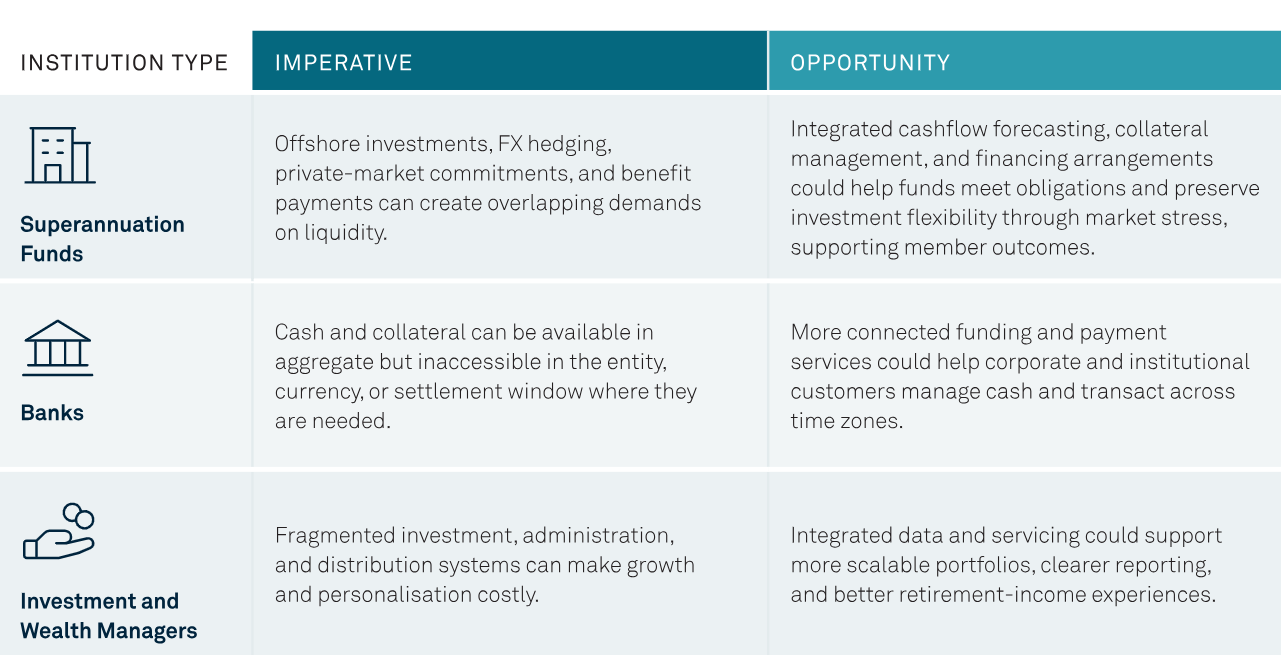
As Australian superannuation funds balance private-market commitments with liquid investments, the active management of liquidity is increasingly central to portfolio design, and growing retirement payments make fund-specific cashflow forecasting and member behaviour increasingly important. The tools are evolving in tandem: repo and committed liquidity facilities, broader collateral eligibility, triparty infrastructure, and optimised FX hedging can help funds manage liquidity more efficiently.
Key Takeaway: Always-on markets can change the value of liquidity. The usefulness of an asset depends partly on when and where it can become usable cash or collateral.
For Australia’s financial institutions, the opportunity is to make global scale work better for the people they serve: more flexible investment implementation, dependable payments, and services that can grow with demand.
As you prepare for the next phase of growth, consider these questions for your organisation:
1Australian Prudential Regulation Authority, “APRA releases superannuation statistics for June 2026”, 30 June 2026, https://www.apra.gov.au/news-and-publications/apra-releases-superannuation-statistics-june-2026
2Australian Securities & Investments Commission, “Digital asset law reform implementation: Proposed standards and guidance”, October 2026, https://download.asic.gov.au/media/0pqj5lgc/cp392-published-15-october-2026.pdf
3Reserve Bank of Australia, “RBA and DFCRC Release Findings From Project Acacia”, 18 May 2026, https://www.rba.gov.au/media-releases/2026/mr-26-13.html
4Australian Prudential Regulation Authority, “System Risk Stress Test”, 30 June 2026, https://www.apra.gov.au/news-and-publications/system-risk-stress-test
5U.S. Securities and Exchange Commission, “Treasury Clearing Implementation”, 23 September 2026, https://www.sec.gov/featured-topics/treasury-clearing-implementation





BNY Institute content provides thought leadership and is not investment research. Views are the authors’ and may change. This material is for informational purposes only and does not constitute investment advice or an offer. For full disclosures, click here.