Market Movers: Fragility
Market Movers highlights key activities and developments before the U.S. market opens each morning.
Market Movers highlights key activities and developments before the U.S. market opens each morning.

Geoffrey Yu
Time to Read: 6 minutes
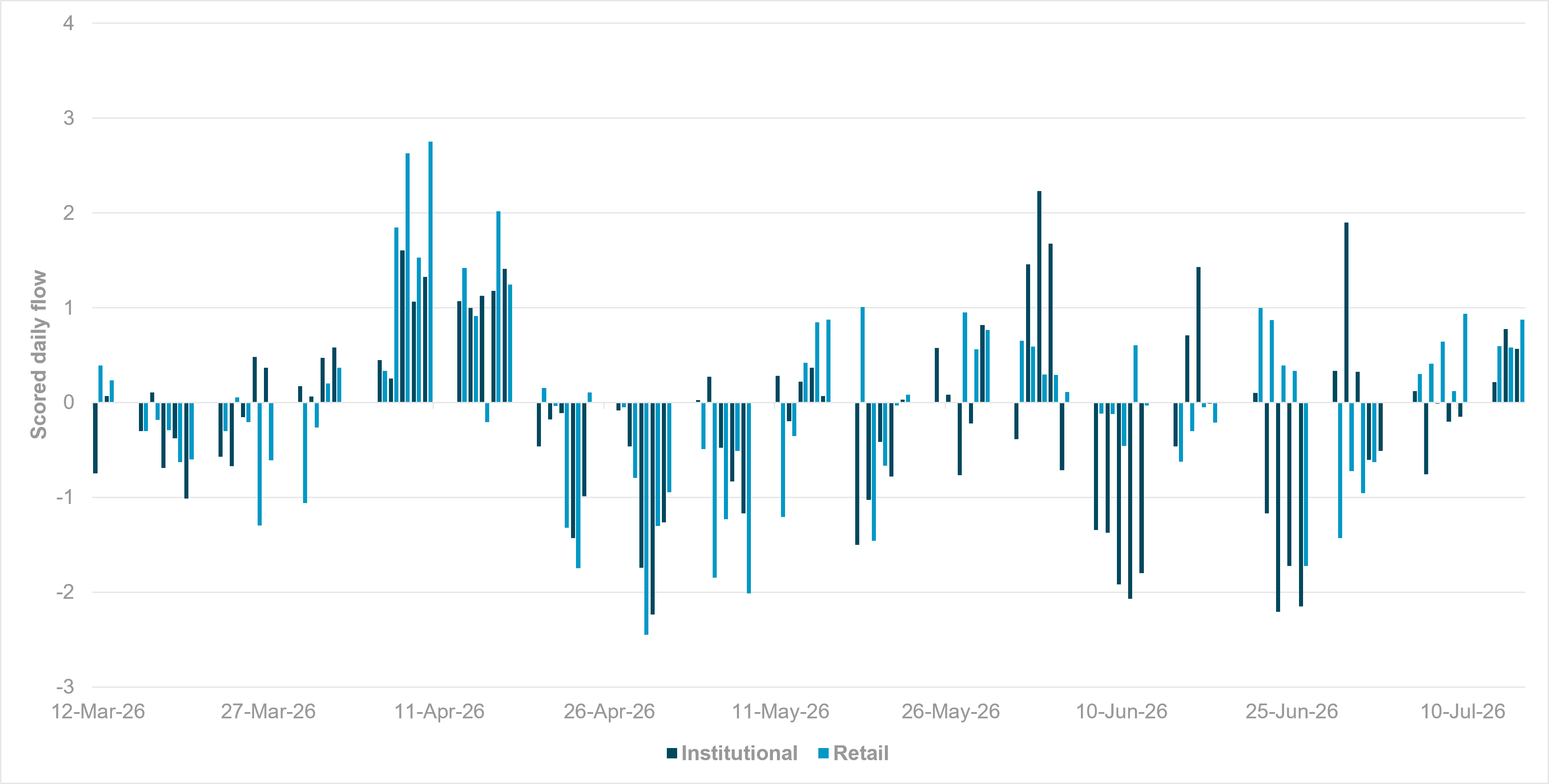
Strong alignment between retail and institutional flows into Taiwanese equities
Source: BNY, GPIF
Taiwanese stocks fell in a technical correction after Taiwan Semiconductor Manufacturing Co.’s results fueled worries about heavier spending and weaker profitability outlooks. The move was driven by broad losses in Asia chip shares. TSMC fell 7.3% in Taipei after it raised its spending and revenue projections for the year, even though the results were broadly seen as positive. The decline pushed the TAIEX down 6.5%, leaving it nearly 11% below its June high, while Bloomberg figures show foreign funds sold a record $5.8bn (USD) on a net basis.
Over the past quarter we have highlighted the risks of high levels of retail positioning in Asian equity markets, particularly South Korea, where divergence vs. institutional flows is very large. As institutional outflows from South Korea have been very substantial YTD, the recent burden of adjustment will likely fall on retail. Taiwanese flow behavior is different. Our data show that for much of the year, institutional and retail flows have been well-aligned. Through to April, net purchases and liquidation took place in tandem. Like South Korea, its institutional sales became more pronounced in June, but retail purchases led initial recovery flows in July and have since been joined by institutional names. Both groups now face exit pressure, producing self-reinforcement and the record outflow seen overnight.
Asia unwind: Asia’s tech-led selloff is now testing the U.S. open. Taiwan fell more than 6%, with foreign investors posting a record one-day net sale of Taiwan stocks, and the pressure has rolled into U.S. futures, with Nasdaq futures sharply lower before cash trading. This is not the AI or semiconductor growth story collapsing; it is crowded leadership being repriced under the pressure of stretched valuations and fiercer Chinese competition.
Japan wrinkle: Sanae Takaichi’s latest push for the GPIF and households to invest more domestically matters for the longer-term home-bias story, but the yen is not getting support because markets do not yet see any immediate flow change. Any future GPIF rotation also risks selling overseas assets into a falling global market.
Risk amplifier: Middle East tensions are not driving the selloff, and markets are still discounting the conflict without a clearer oil or supply shock. But when positioning is already being unwound, external shocks need less force to amplify risk aversion.
U.S. test: AI and semi capex has been doing real work in the U.S. growth story, lifting earnings, investment and index leadership. Weakness confined to mega-cap tech and semiconductors would still look like a positioning clean-up; spillover from APAC selling into broader U.S. sectors, credit or small caps would be more serious, because it would hit the growth pillar that has been masking wider fragility.
Bottom line: Markets look fragile because leadership is crowded, leverage is being unwound and the geopolitical backdrop is still hostile. Today’s U.S. data slate – import prices, housing starts, permits, industrial production and the preliminary University of Michigan survey – will test whether the soft landing story can absorb the AI unwind. A benign set could stabilize the tape; a messy one risks turning Asia’s de-risking into a broader U.S. risk-off session.
Global markets sold off sharply as investors dumped technology and semiconductor shares, with Asia leading the decline and Japan and Taiwan posting their steepest drops in months. The move followed growing skepticism over the pace and scale of AI spending, despite strong earnings from some chipmakers. Netflix’s weaker outlook added to the risk-off tone. Futures pointed to further losses in U.S. and European equities, and bond yields were mixed as Treasurys held steady. Brent crude slipped after earlier gains but remained set for a strong weekly advance, while the yen remained close to a multi-decade low despite fresh warnings about possible intervention from Japan’s finance minister. The dollar appreciated slightly as volatility rose. MSCI World -1.25% to 236, DXY -0.076% to 100.687, BBG Global Aggregate at 3.901%.
Japanese Prime Minister Sanae Takaichi has said that it is important to encourage households and the Government Pension Investment Fund to increase their investment in Japanese financial assets. Addressing parliament, she said the continued strength in the stock market supports efforts to promote broader participation in Japan’s growth by channeling more savings into domestic assets. Takaichi added that such measures could help to create a virtuous cycle between economic growth and household wealth accumulation. Her remarks focused on mobilizing public and pension fund investment to ensure that more people share in the benefits of Japan’s economic expansion. Nikkei -4.03% to 64141, USDJPY -0.062% to 162.29, 10y JGB -2bp to 2.699%.
Chinese President Xi Jinping has said China wants AI development and governance to be a global effort, not dominated by any one country. Speaking at the World Artificial Intelligence Conference in Shanghai, he reiterated Beijing’s criticism of what it sees as the overuse of national security concerns – a veiled swipe at U.S. restrictions that have limited China’s access to advanced technology. Xi said China will provide 5,000 AI training opportunities for developing countries over the next five years and expand cooperation with ASEAN, the Arab League, the African Union, CELAC, the SCO and BRICS. He also pledged access for 30 countries to a Chinese AI meteorological early-warning system. The remarks underscore China’s push to deepen global AI ties as tech rivalry with the U.S. intensifies. CSI 300 -3.6% to 4529, USDCNY +0.055% to 6.7765, 10y CGB -0.6bp to 1.732%.
Federal Reserve Vice Chair Philip Jefferson has said the policy stance is well-positioned for now, but the Fed should consider raising rates if inflation does not cool soon. He argued that existing rates should support the labor market while helping inflation fall, though persistent price pressures could force a policy rethink. Jefferson flagged rising energy prices and AI-driven demand as fresh inflation risks, warning that the combination creates a delicate balancing act and could unanchor inflation expectations. His remarks echoed more hawkish comments from Dallas Fed President Lorie Logan and Kansas City Fed President Jeff Schmid, both of whom warned that inflation remains too hot and above-target for too long. The Fed meets in Washington on July 28-29, after it held rates steady for a fourth straight meeting in June. S&P Mini -0.84% to 7514, DXY -0.076% to 100.687, 10y UST -2.2bp to 4.531%.
U.S. June import price index is forecast at -0.6% m/m, 6.7% y/y vs. 1.9% m/m, 6.7% y/y in May. Import price index ex petroleum is forecast to ease to 0.4% m/m vs. 0.8% m/m.
U.S. June export price index is forecast at -0.6% m/m vs. 1.3% m/m in May.
U.S. June housing starts are forecast to rise to 1.312 million vs. 1.177 million.
U.S. June preliminary building permits are forecast to ease to 1.402 million vs. 1.410 million.
U.S. June industrial production is forecast to rise to 0.2% m/m vs. 0.1% m/m.
U.S. June manufacturing production is forecast to rise to 0.1% m/m vs. 0.0% m/m.
U.S. June capacity utilization is forecast to hold at 76.2% vs. 76.2%.
U.S. July preliminary University of Michigan sentiment is forecast to rise to 51.0 vs. 49.5, current conditions is forecast to rise to 48.5 vs. 47.7 and the expectations measure is forecast to rise to 51.9 vs. 50.7.
U.S. July preliminary University of Michigan 1-year inflation expectations are forecast to ease to 4.5% vs. 4.6%, 5-10-year inflation expectations are forecast to hold at 3.3% vs. 3.3%.
Mood: iFlow Mood has stabilized in negative territory, with continued inflows into both global equities and core government bonds. Underlying sentiment remained resilient despite higher market volatility.
FX: G10 currencies attracted modest inflows, led by SEK and JPY. Elsewhere, FX flows were mixed but tilted toward outflows across the rest of the iFlow universe.
Fixed income: Buying remained concentrated in G10 government bonds, led by the Eurozone and Japan, followed by U.K. gilts and U.S. Treasurys. In contrast, APAC and LatAm sovereign bonds saw continued selling.
Equities: Equity inflows stayed concentrated in EM, led by India, Thailand, the Philippines, Türkiye and Chile. G10 equities were broadly sold, with the largest outflows from Canada, Sweden and the U.K., while U.S. equities bucked the trend and attracted inflows.
“The concept of surviving on average is meaningless. You’ve got to survive every day.” – Howard Marks
“Stability – even of an expansion – is destabilizing.” – Hyman Minsky
Euro area inflation for June came in at 2.8% y/y, down from 3.2% in May. EU-wide inflation also eased to 2.9% from 3.3%. Both the euro area and the EU recorded 0.1% m/m decreases. Services remained the largest upward driver, adding 1.51 percentage points to euro area inflation, followed by energy at 0.77 percentage points, food, alcohol and tobacco at 0.29 percentage points and non-energy industrial goods at 0.18 percentage points. Among member states, Sweden had the lowest rate at 1.0%, while Romania’s was again highest at 9.2%. Euro Stoxx 50 -0.73% to 6238, EURUSD +0.035% to 1.1446, BBG AGG Euro Government High Grade EUR +1.7bp to 3.382%.
Czech producer prices for June showed mixed inflationary pressures across sectors. Agricultural producer prices fell 13.5% y/y, extending a decline that dates back to December 2025 but easing slightly from May, while they dropped 0.6% m/m as eggs, cattle, pigs, poultry, milk and cereals weakened. Industrial producer prices rose 1.3% y/y and fell 0.4% m/m, supported by chemicals, rubber and plastics but held back by food, dairy and refined petroleum products. Construction work prices increased by 4.1% y/y, and service producer prices in the business sphere rose 3.2%, led by advertising, employment and media-related services. Prague SE +0.36% to 2591, EURCZK -0.075% to 24.196, 10y CZGB +0.9bp to 4.841%.
New Zealand petrol and diesel prices fell m/m again in June, down 4.2% and 12.1%. respectively, after rises in March and April. Despite the latest declines, both fuels remained sharply higher y/y, with petrol up 23.6% y/y and diesel up 57.1% y/y. Food prices rose 0.6% m/m in June, led by fruit and vegetables (+2.3%) and grocery food (+0.4%). On a y/y basis, food inflation eased to 2.5% from 3.2% in May. The biggest contributor was meat, poultry and fish (+6.2% y/y), followed by restaurant meals and ready-to-eat food (+3.1% y/y). Milk remained the largest driver overall, while tomatoes, fresh eggs and olive oil were notable offsets. NZX 50 +0.59% to 13695, NZDUSD 0% to 0.5843, 10y NZGB +0.7bp to 4.651%.
China’s State Administration of Foreign Exchange is aiming to issue a new round of QDII quotas as soon as possible to better meet residents’ demand for compliant overseas securities investments. It is also planning another package of measures to further improve cross-border investment and financing convenience. Officials said they may strengthen counter-cyclical adjustments and expectations guidance when needed to keep the foreign exchange market stable and guard against systemic risk. They noted that China’s external debt remains broadly stable, with fluctuations seen as normal, and said the balance of payments is expected to essentially remain balanced. On the flow front, onshore FX market turnover reached $22.1tn in H1, and bank client cross-border receipts and payments hit a record high of $9.2tn. Foreign investment inflows in the first five months rose by about $160bn. CSI 300 -3.6% to 4529, USDCNY +0.055% to 6.7765, 10y CGB -0.6bp to 1.732%.
Malaysia’s advance GDP estimate for Q2 showed the economy expanding by 5.8% y/y, up from 5.4% in Q1, with q/q growth rebounding to 1.7% from a 4.4% contraction in the previous quarter. Growth was broad-based, led by stronger manufacturing at 7.5% y/y (from 5.9%), a sharp turnaround in mining and quarrying to 10.2% y/y from -2.1% and solid construction growth of 6.6% y/y, despite easing from 7.7%. Services remained the largest driver, rising 5.4% y/y, slightly below Q1’s 5.6%, supported by wholesale and retail trade, information and communication, and transportation and storage. Agriculture contracted by 3.7% y/y, reversing 2.6% growth, weighed down by oil palm and fishing. Overall, GDP rose 5.6% in H1 vs. 4.5% a year earlier. KLCI +0.67% to 1734, USDMYR +0.226% to 4.0822, 10y MGB +0.3bp to 3.637%.
Malaysia’s headline and core inflation both rose 1.9% y/y in June, easing from 2.0% in May. The increase was mainly driven by the transport category, which slowed to 2.8% y/y from 3.8% y/y. Smaller gains in personal care, social protection and miscellaneous goods and services and in education also helped to constrain inflation, while insurance and financial services accelerated to 5.7% y/y from 4.9% y/y. On a m/m basis, headline CPI was flat in June after +0.1% in May, with transport falling 0.8% m/m and food and beverages up 0.2% m/m. In Q2, inflation averaged 1.9% y/y, up from 1.6% in Q1, led by transport and insurance-related services and partly offset by softer increases in personal care and restaurant services.
Singapore’s external trade data for June showed strong momentum. NODX (non-oil domestic exports) rose 20.7% y/y (May: +38.4%), easing from the previous month but still boosted by electronics (105.1% y/y), especially ICs, disk media products and PCs, while non-electronics fell 2.9% after a gain in May. NODX growth was led by Taiwan (123.3% y/y), the U.S. (36.7%) and South Korea (62.9% y/y). NORX (non-oil re-exports) expanded by 60.3% y/y (May: +33.5%), driven mainly by electronics, with additional support from non-electronics. Electronic exports to Taiwan (278.2% y/y), Hong Kong (59.5% y/y) and Thailand (38.2% y/y) increased sharply. Total merchandise trade grew by 49.3% y/y (May: +39.6%), as total exports rose 48.9% y/y and total imports increased by 49.8% y/y. Overall, the release points to broad-based trade strength, led by electronics and AI-related demand. STI -0.62% to 5505, USDSGD -0.008% to 1.2902, 10y SGB +0.7bp to 2.223%.