Fiscal dominance risks contained for now

iFlow > Investor Trends

Appearing every Wednesday, Investor Trends provides a deep dive into patterns and behaviors in equity, bond and currency markets around the globe, underpinned with deeper macro insights.

Subscribe to Our Publications

In order to start receiving iFlow, please fill out the form below.

Subscribe
arrow_forward
BNY iFlow Investor Trends,BNY iFlow Investor Trends

Key Highlights

  • GBP and JPY starting to recover after pre-budget hedging
  • JGB holdings struggling to find bottom
  • EM equity narrative struggling despite risk recovery

Hedging against fiscal largess in G10 appears to be easing off

EXHIBIT #1: MONTHLY SCORED CROSS-BORDER FLOW, GBP AND JPY

Source: BNY iFlow

Our take

The latest fiscal plans from the U.K. and Japanese governments in late November have been closely watched for signs of fiscal dominance amid relatively elevated inflation. iFlow had identified material defensive positioning in both FX and fixed income markets in the run-up to the releases. While there is some clear divergence in how the sovereign debt markets in these economies are behaving, largely due to different fiscal and inflation paths, both the GBP and JPY appear to have stabilized for now.

Given the differences in initial positions for these currencies, two distinct interpretations are warranted. For the GBP, cross-border positions are conventionally underheld, so the “recovery” reflects the removal of hedges on underlying assets. In contrast, the JPY has been overheld for several months, indicating interest in outright JPY appreciation, though such positions have more than halved over the last two months. In both cases, exposures have improved, but default positions imply divergent expectations for current valuations and equilibrium outcomes.

Forward look

The markets’ shift in flow direction for the GBP and JPY suggests growing confidence that both countries can avoid some adverse effects of fiscal dominance. However, the outlook for their debt trajectories remains challenging, and the burden of proof will be on respective governments to show that non-inflationary growth can be realized. In the near-term, currency price action will likely be determined by central bank policies, where we believe clear divergence is likely.

In our view, U.K. domestic data have softened enough for Bank of England (BoE) Governor Andrew Bailey to vote in favor of a cut, and we see current BoE terminal rates pricing as overly optimistic. In contrast, this week Bank of Japan (BoJ) Governor Kazuo Ueda signaled that a December hike is the bank’s base case, despite repeated pushback from government advisors. Consequently, the default positioning for GBP and JPY – underheld and overheld by cross-border investors, respectively – is unlikely to change.

JGB holdings fall sharply into underheld, leading APAC fixed income outflows

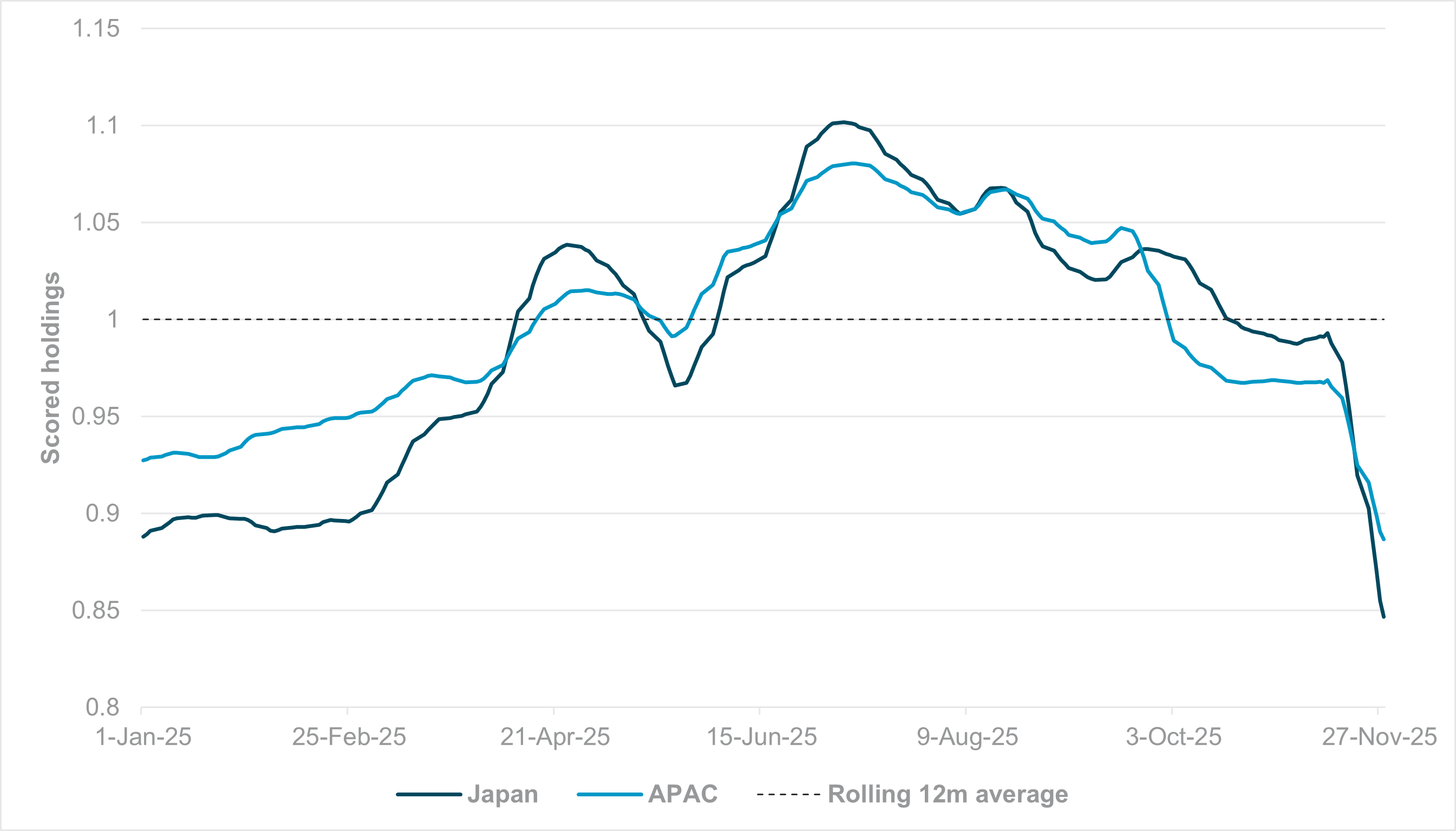
EXHIBIT #2: SCORED HOLDINGS JGBS VS. APAC FIXED INCOME 

Source: BNY iFlow

Our take

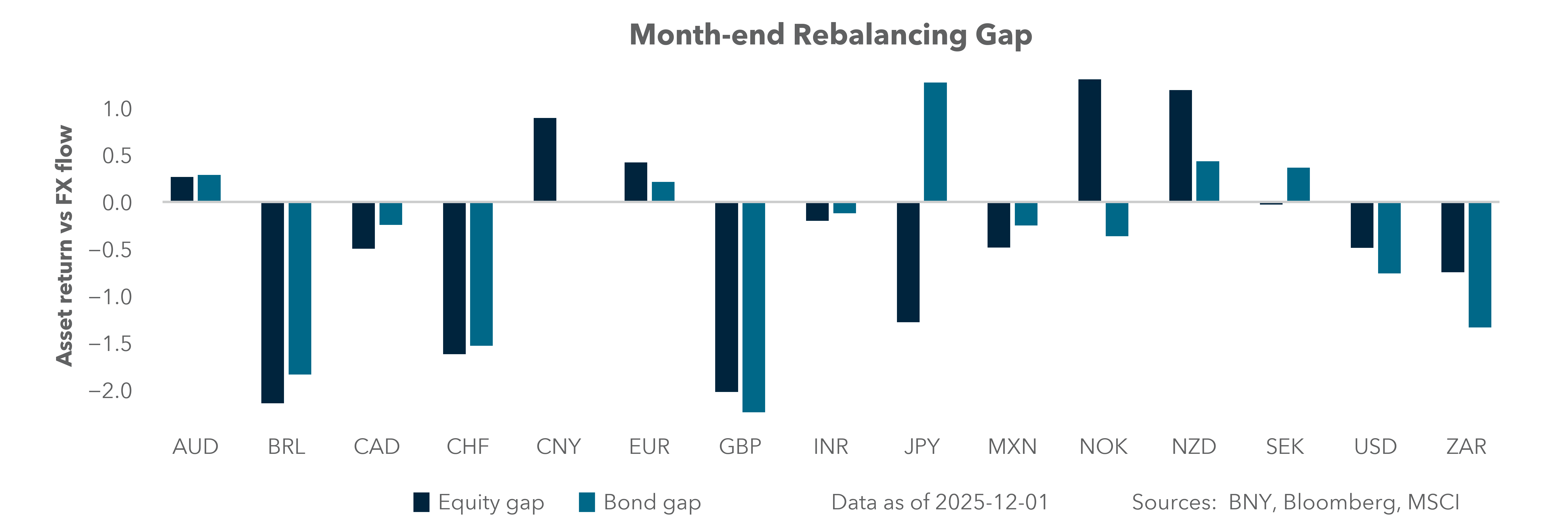
While the JPY will likely remain overheld, some recent currency purchases may reflect unwinding of prior hedges by cross-border investors. Even on a passive basis, the wide rate differential between the BoJ and some peers requires offsetting positions to manage the cost carry. Our data indicate a sharp drop in cross-border holdings of Japanese government bonds (JGB) (Exhibit #2) toward the end of November. The precipitous decline – from near-flat versus the rolling 12-month average to 15% below in the space of days) suggests month-end rebalancing activity.

We also note that overall JGB holdings have been declining since early summer, well before current Japanese leadership became the basis for market assumptions. Consequently, the recent fiscal package may have exacerbated long-standing concerns over long-dated JGB yields. Furthermore, the widening holdings gap between JGBs and aggregate APAC (developed and emerging market) sovereign bonds highlights rising fiscal concerns for Japan, despite the region’s reputation for ample savings and self-funding capacity.

Forward look

As the U.K.’s experience in 2024–2025 has shown, even fiscal consolidation could cause renewed stress in bond markets if there is growth or revenue slippage. Like the U.K., Japan continues to face elevated inflation expectations, which set it apart from much of Asia.

Ironically, the lack of inflation in EM Asia may help stabilize allocations to Japan. Fiscal stimulus in these economies will likely help narrow inflation differentials, allowing JPY weakness in real terms to prevail through the price channel, rather than through exchange rates.

Curve steepening across much of APAC is likely to be a key asset allocation trend next year. Given the trade is arguably nearing “completion” in JGBs, the adjustment burden will shift elsewhere. Ultimately, Japan does have sufficient savings to stabilize the JGB markets, but policy clarity is urgent.

Equities: EM equities struggling to fulfil value narrative

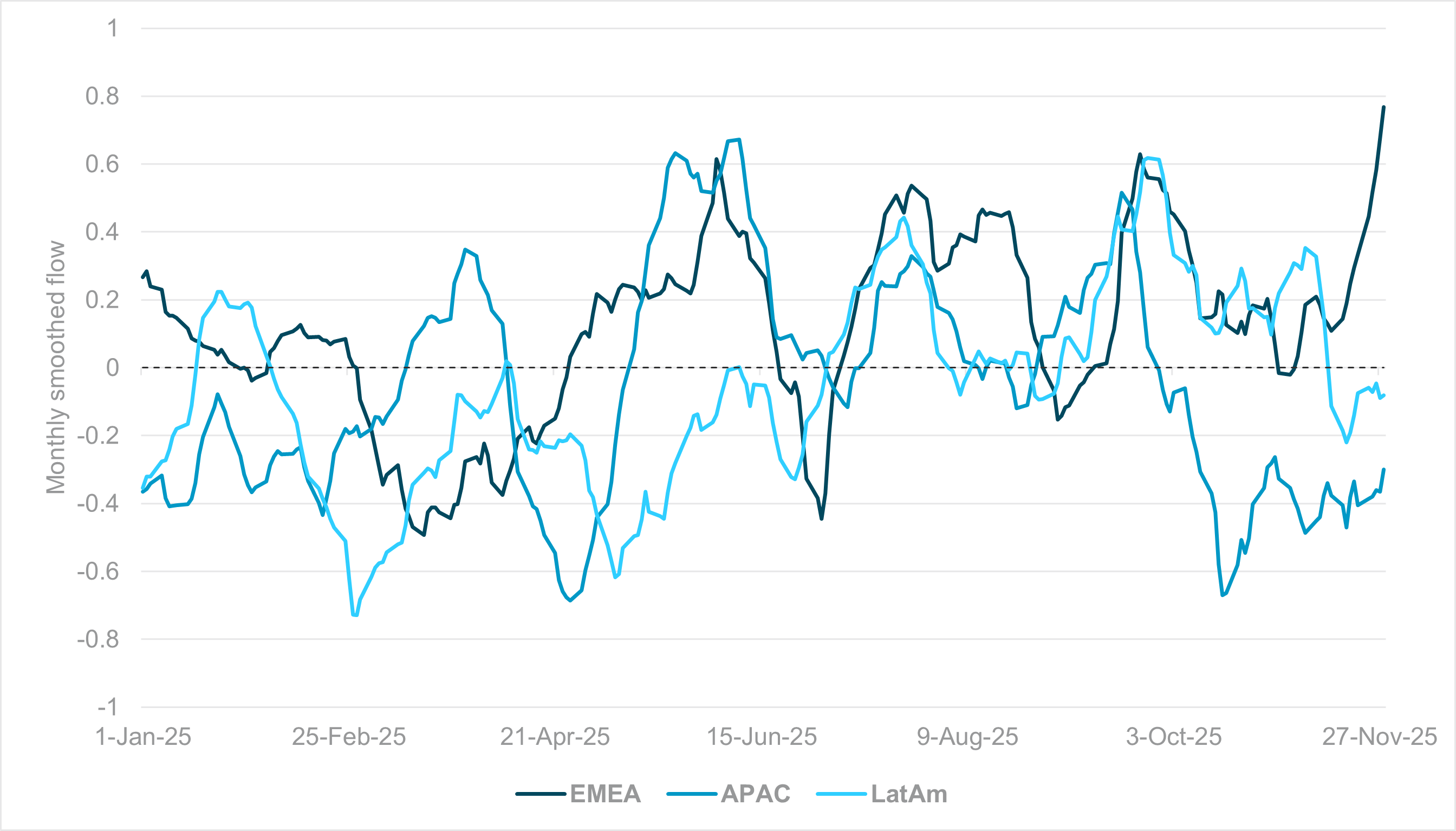
EXHIBIT #3: MONTHLY SMOOTHED FLOW, EM EQUITY MARKETS BY REGION

Source: BNY iFlow

Our take

There is a growing consensus that 2026 allocations will be skewed more toward emerging markets (EM) amid a broader search for value. We are on board with this view, as our data indicate that current weightings in emerging market equities are disproportionately low relative to growth and economic differentials. For example, our clients’ U.S. equity holdings (65%) are more than 80 times larger than their Chinese holdings (0.8%), based on share of total global equity assets. Even accounting for access restrictions, this ratio is extreme.

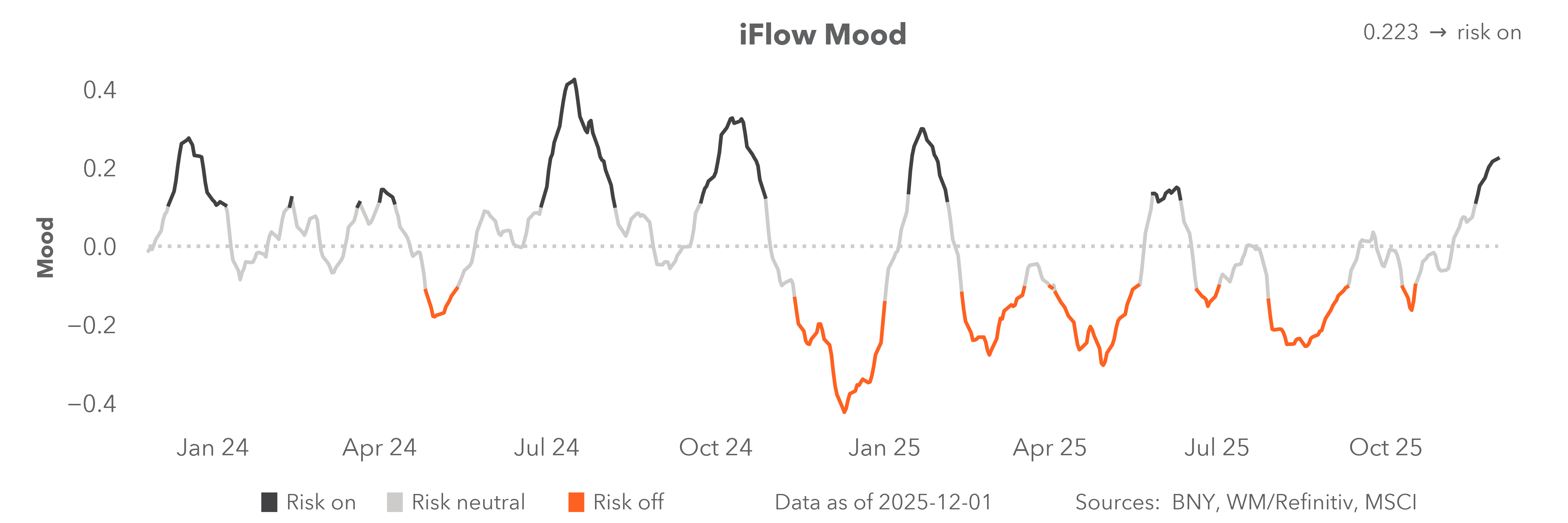
Yet, flows heading into year end show little sign of increased rotation, even with risk appetite recovering toward the end of November and early December. On a monthly smoothed basis, flows into EM APAC and EM Latin America have turned negative. Only EMEA is seeing a flow surge, reaching YTD highs (Exhibit #3). However, the underlying data indicate that flows are disproportionately heading into South Africa, which is benefiting from the mining narrative and institutional re-rating. Even hitherto well-held Central and Eastern European (CEE) markets are struggling, with fiscal dominance fears in Hungary, Poland and Romania threatening tighter financial conditions. Czech assets also face headwinds amid growing structural risks to Germany’s industrial outlook.

Forward look

A December Fed cut reverting to the market’s base case has clearly improved global financial conditions, but equity market reactions suggest the boost to U.S. equities from lower U.S. rates is now stronger than in other markets. In other words, U.S. tech now has the “highest beta” to the Fed, and there is little appetite to shift equity allocations into other markets.

Furthermore, EM continues to lack a reflation or earnings expansion narrative that Europe enjoyed in 2025. On the other hand, the solutions are clear, especially for EM APAC, which is expected to attract the lion’s share of any reallocation, as a stronger fiscal impulse to drive reflation a necessary condition. EM APAC remains the only region with such capacity, but we doubt markets will take a strong view until China’s fiscal plans are announced in late Q1 2026.

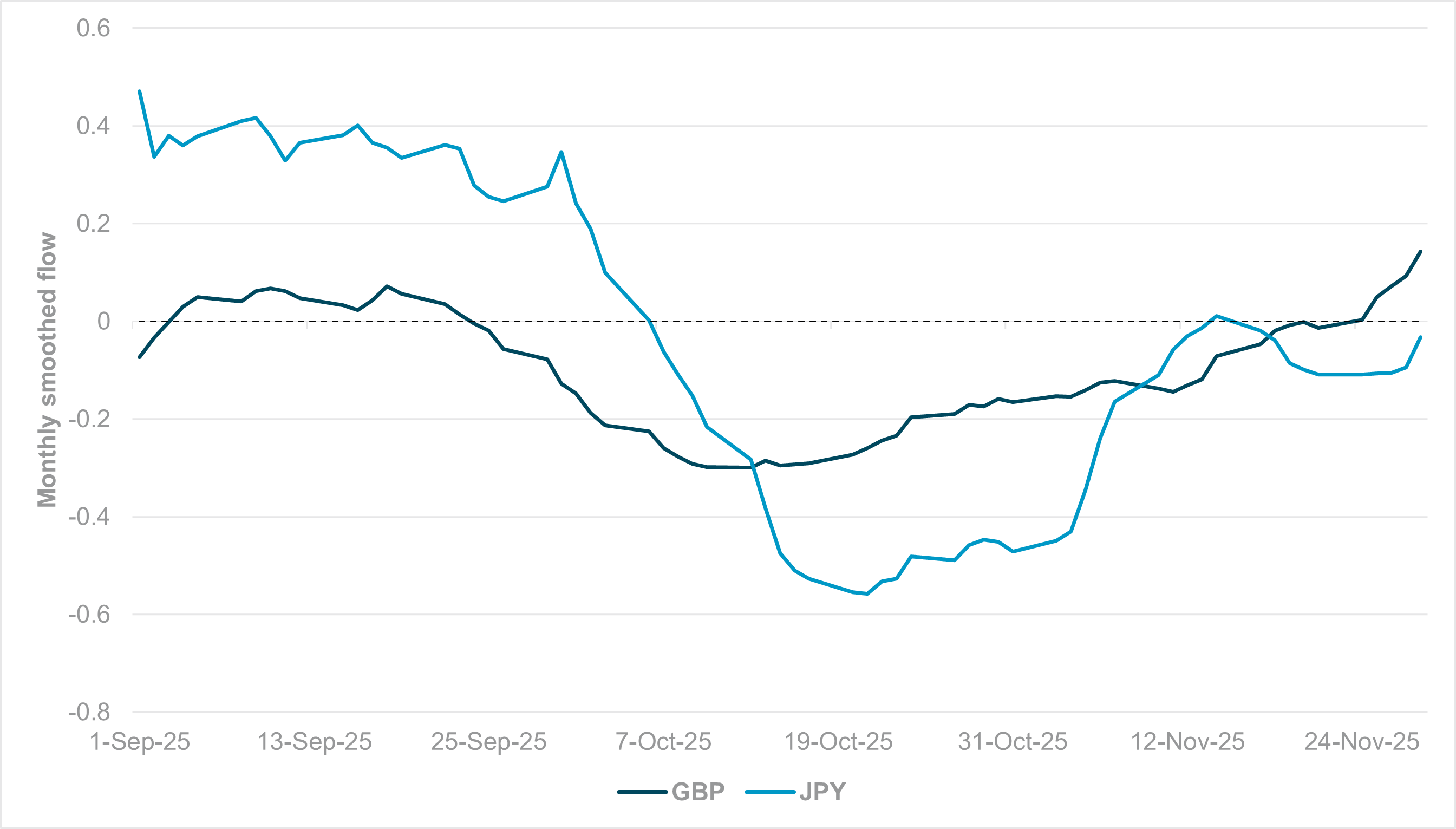
Chart pack

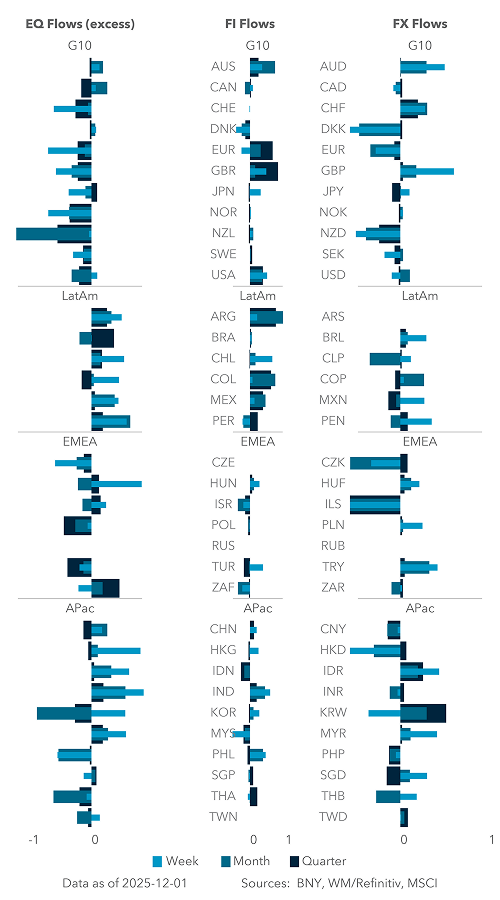
Equity (excess) top / bottom 5 flows
Media Contact Image
Geoff Yu
EMEA Macro Strategist
Geoffrey.Yu@bny.com

Ready to grow your business? Speak to our team.