The week that grades the Fed
Start of the Week previews activities across global financial markets, providing useful charts, links, data and a calendar of key events to help with more informed asset allocation and trading decisions.
Start of the Week previews activities across global financial markets, providing useful charts, links, data and a calendar of key events to help with more informed asset allocation and trading decisions.

Geoff Yu
Time to Read: 11 minutes
Fed credibility: The week ahead tests whether markets can keep looking through policy uncertainty while demanding firmer evidence from data and earnings. U.S. nonfarm payrolls are the main event. The Fed’s reaction function is harder to read, leaving its credibility tied to incoming data. A firm report, backed by resilient JOLTS and ISM surveys, revives the case for further tightening and pressures duration. A softer print validates the pause, but risks shifting markets from inflation concerns toward weaker growth.
Earnings test: Markets now expect growth across AI, industrials, consumer sectors and health care, not another narrow beat from large technology companies. The question is whether earnings are broad and durable enough to support valuations. Strong results paired with weak breadth, cautious guidance or margin pressure will struggle to satisfy markets priced for broader momentum.
Global growth test: PMIs across Asia and Europe will show whether cautious optimism has firm foundations. Europe is seeing a services recovery but rising input costs and limited pricing power point to stagflation risk rather than a durable rebound. China faces the opposite problem: repeated stimulus signals have yet to generate sustained momentum, while manufacturing and services remain soft.
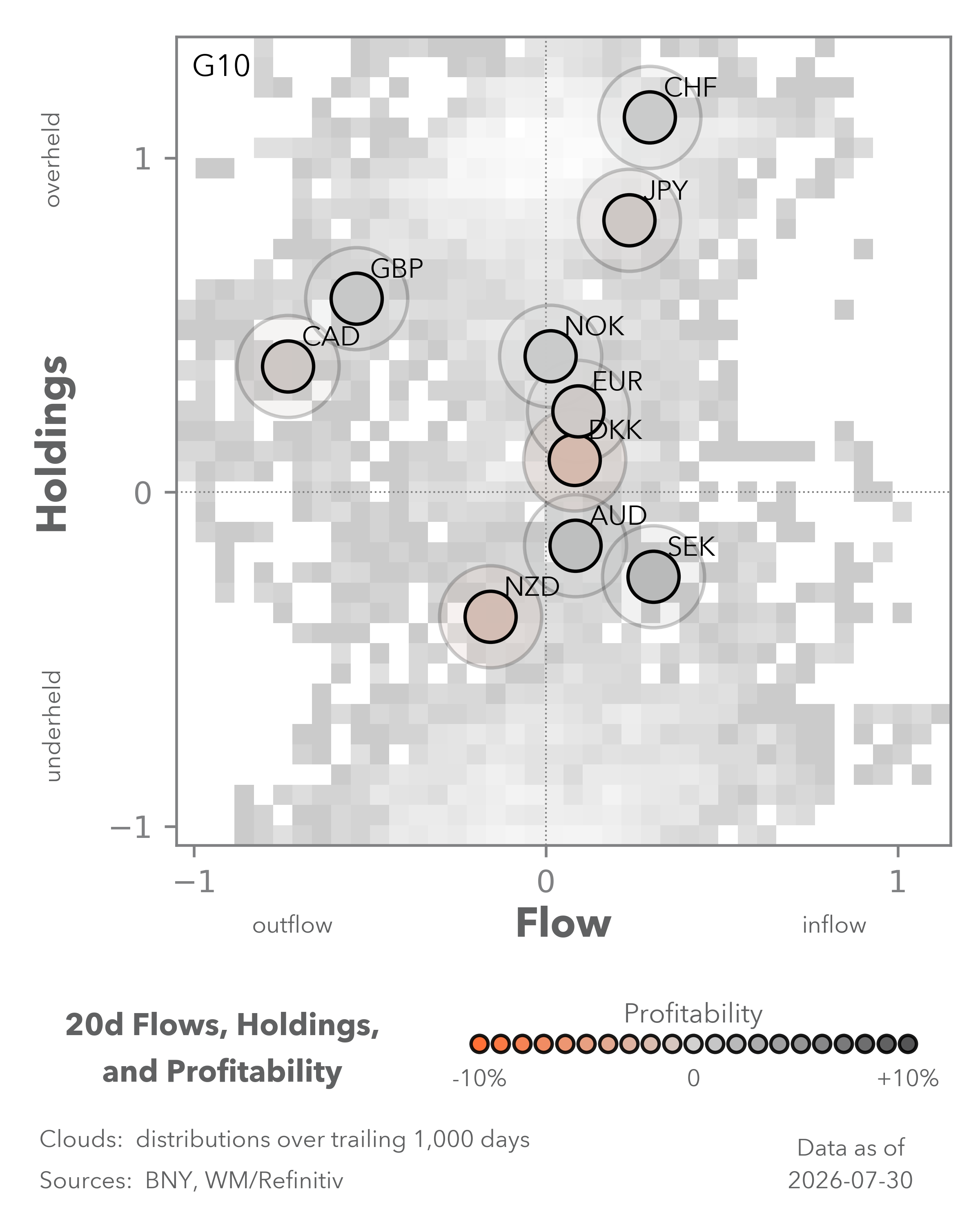
APAC stress: JPY price action is increasingly detached from domestic fundamentals. Intervention, even if coordinated, may slow depreciation, but its impact will remain limited without a shift in fiscal discipline and monetary-policy execution. South Korean and other AI-linked Asian equities remain vulnerable to sharp reversals in foreign flows, positioning and valuations, keeping regional volatility elevated.
Carry window: Lower U.S. real yields reopen the carry channel and improve the appeal of high-yielding sovereign debt where fiscal credibility and real-rate buffers remain intact. Latin America is best placed to benefit, but the opportunity is selective. Duration offers cleaner exposure than FX, while crowded positioning, weak Chinese demand, and input-cost pressure argue against indiscriminate buying.
Bottom line: These are testing times for policy credibility, earnings breadth and global growth. Payrolls, PMIs and corporate guidance will determine whether easier financial conditions become durable or merely create another opportunity to reduce risk.
North America: Labor data sharpens the Fed–market divide
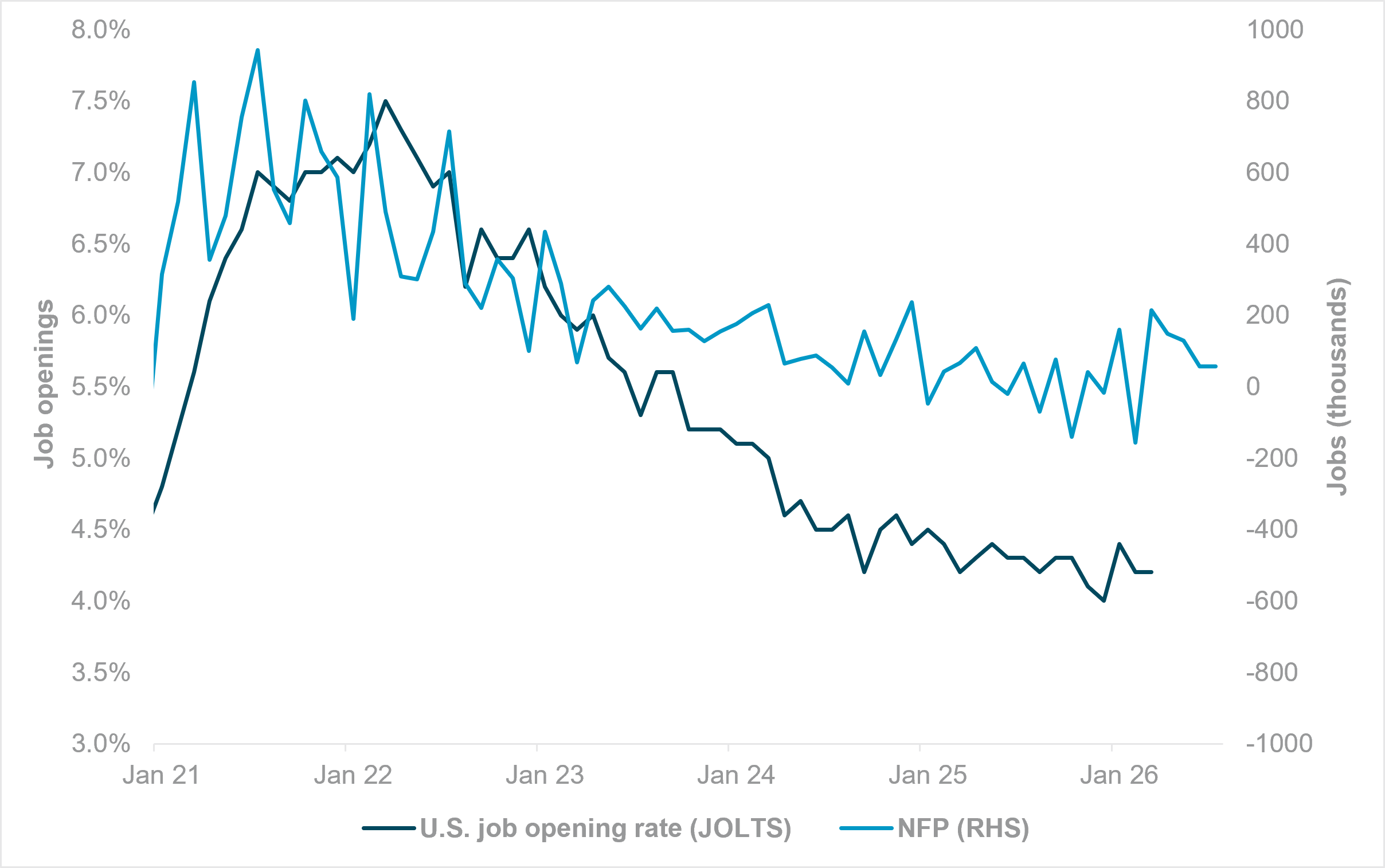
EXHIBIT #1: JOLTS VS. NFP
Source: BNY, Bloomberg
Our take: The Fed left rates unchanged last week following notably high pre-meeting uncertainty around the possibility of a hike. On the inflation side, PCE came in line with expectations at -0.1% m/m, reflecting the temporary easing in June as Iran-related tensions relaxed. We would not read that as durable given the subsequent return of the conflict.
Next week brings a much busier data calendar and should matter more for near-term market pricing, particularly because the Fed appears to be increasingly data-dependent. A handful of Fed speakers may offer incremental color, particularly if any of the dissenters appear. The main event is Friday’s nonfarm payroll (NFP) print, but the slate also features ISM Manufacturing on Monday, JOLTS and durable goods on Tuesday, and ISM Services on Wednesday. In Canada, PMI and unemployment will also provide a useful read-through.
Forward look: NFP is the clear focal point next week for rates markets and for the Fed narrative. With policymakers seemingly more attentive to incoming data, payrolls will be watched for both headline job creation and signs of easing or reacceleration in labor demand that could either validate the current pause or revive debate about another hike. JOLTS and the ISM surveys will help frame whether labor market cooling and softer activity are broadening or staying uneven, but they are secondary to NFP in terms of market impact.
For Canada, the PMI and unemployment data should be market-neutral unless they surprise meaningfully.
Fed speakers are unlikely to reset the outlook unless one of the hawkish dissenters presses their case more forcefully. In aggregate, the week is important less for a single policy decision than for whether data begin to reprice the odds of a more restrictive Fed path.
EMEA: Any demand recovery will come at a cost
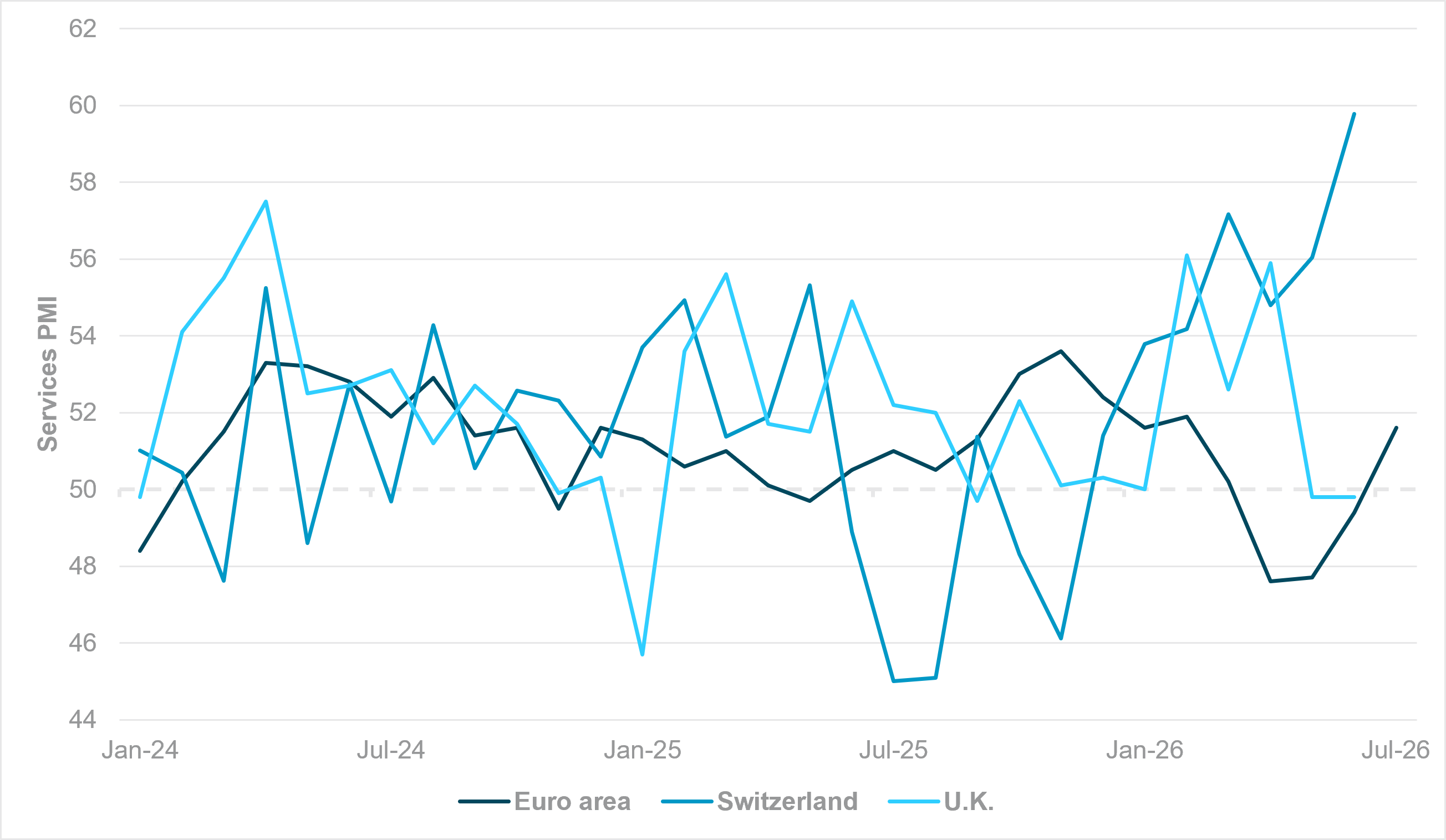
EXHIBIT #2: SERVICES PMI LEVELS – EUROZONE, SWITZERLAND AND THE U.K.
Source: BNY
Our take: The lack of additional tightening by the Fed has led to hopes of easier financial conditions globally and helped offset some ECB tightening through the external channel. Falling prices for dollar-priced commodities will generate some negative pass-through on the margins, but until there is clear visibility over the conflict, rates markets are unlikely to remove the near 45bp currently priced in additional tightening by year end.
The majority of Governing Council members do not see sufficient evidence of pass-through inflation. As long as this balance holds, we favor adding to received positions in European rates, which will also help alleviate financial conditions on the margins. We stress that the European inflation situation remains fundamentally different from that of the U.S., where there is a stronger demand case, led by investment growth.
There is a risk, however, that hawkish members will point to July’s final PMI figures this week for signals that services expansion is strengthening across the continent. Headline figures point to multi-year highs reached in Switzerland and clear recovery in the Eurozone. In contrast, the U.K. print is soft, and the Bank of England is incorporating the lack of services inflation to support the case to remain on hold (Exhibit 2).
Based on the Eurozone PMI details, the fundamentals behind services recovery don’t bode well for a sustainable demand lift. Softer headline prices have helped with the recovery, but the effect of price changes is overstated. The Eurozone PMI report highlights that prices charged for services have been largely unchanged since 2024, maintaining a healthy rate of expansion. Between 2024 and 2025, services input price expectations were generally stable, but they have surged over the past few months.
Even as the ceasefire was implemented, Services PMI input prices remained at their highest levels since early 2024. The spread between input and charged prices is now at its widest in nearly three years, pointing to significant margin pressure across the sector. Providers can only absorb potential losses for so long. Demand contraction will likely follow, through cutbacks or price increases.
Forward look: PMI releases across Europe are due this week. Otherwise, we expect significant focus on the inflation situation in Central and Eastern Europe (CEE). Czechia’s central bank decision is expected to indicate closer alignment with the ECB out of necessity, so a hawkish lean is the default, and a hike before year-end should not be ruled out at all. The country’s relative fiscal constraint has not dampened inflation expectations enough, and the central bank may prefer an insurance buffer.
Meanwhile, Hungary’s success in taming inflation faces serious challenges with the potential total shutdown of the country’s only nuclear power plant by mid-week, due to low water levels. The Paks Nuclear Power Plant supplies up to 50% of the country’s domestic energy generation and 35% of all electricity consumption. Reduced consumption and increased grid imports as an offset represent clear stagflation risk. There is sufficient demand restraint to force inflation below target, but some volatility in activity relative to prices should be expected in the near term.
Romania has also declared a start of alert in August due to power output declines. For a country with the worst real rates in emerging markets, by some distance, the outlook for the currency will deteriorate further.
APAC: Export recovery meets policy stress test
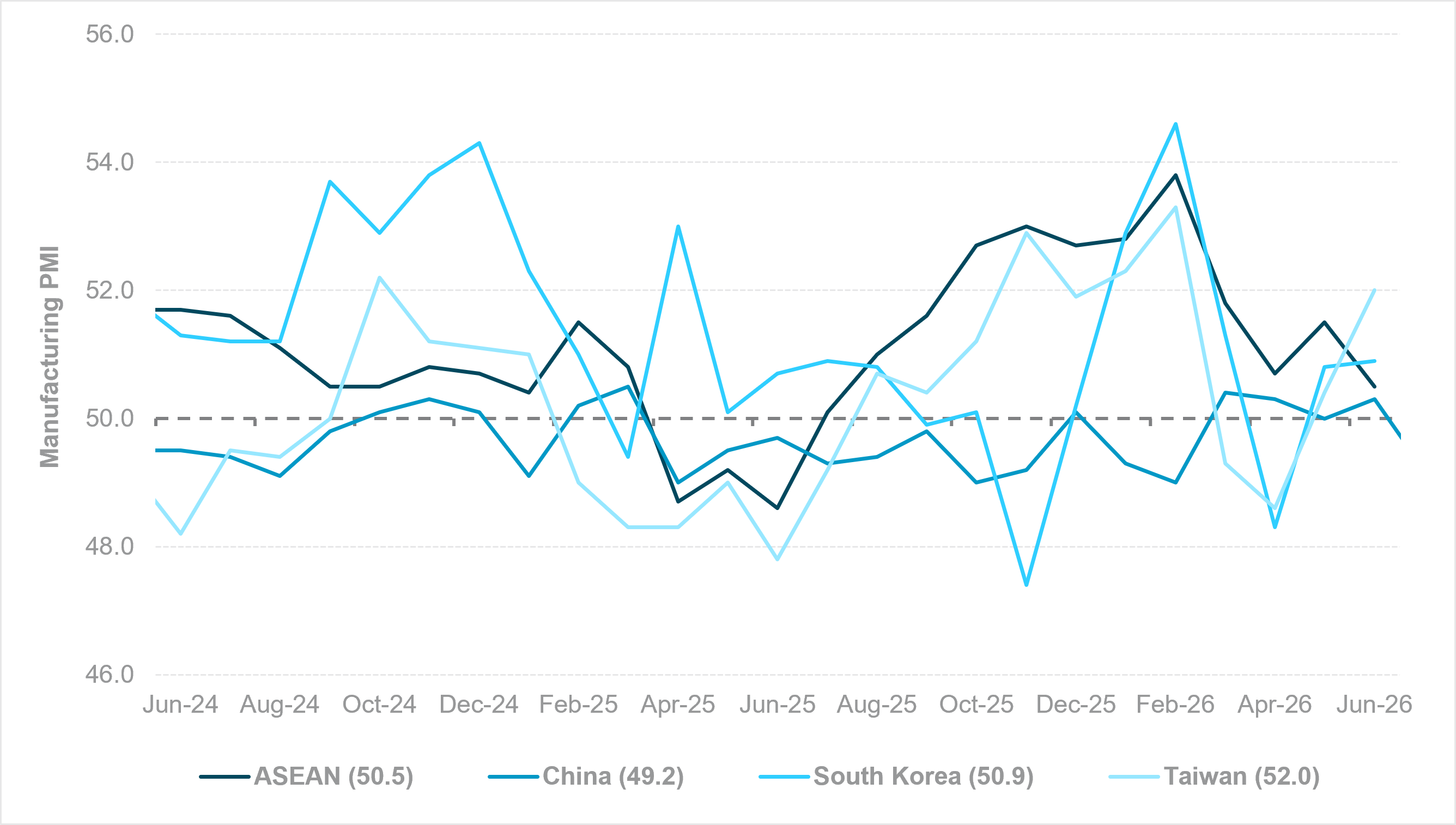
EXHIBIT #3: PMI: CHINA CONTRACTION, ASEAN SLOWDOWN, TAIWAN AND SOUTH KOREA RESILIENCE
Source: BNY, Bloomberg
Our take: Asia’s macro calendar is centered on trade, manufacturing sentiment and inflation. The key test is whether the export-led recovery can withstand a more challenging global backdrop. China’s July trade data will provide the first read on external demand entering Q3, while Taiwan’s exports will show whether AI-related demand continues to sustain the technology cycle. Regional PMIs will indicate whether the recovery is broadening beyond technology into wider manufacturing. Inflation prints from South Korea, Taiwan, Thailand, the Philippines and Indonesia will further shape regional monetary policy expectations, while foreign reserve data will offer insight into FX intervention and capital flow trends.
The policy focus is on the Reserve Bank of India, where rates are expected to remain unchanged as policymakers rely on macroprudential measures rather than tighter monetary policy to safeguard financial stability. Indonesia will also be closely watched, with Q2 GDP, June trade and July CPI providing an important assessment of domestic demand and external resilience. Any downside surprise could reinforce fragile sentiment following Governor Perry Warjiyo’s unexpected resignation.
Elsewhere, Philippine Q2 GDP will reveal whether growth has stabilized after slowing to a region-low 2.8% y/y in Q1. Japan’s labor cash earnings and household spending will be scrutinized for evidence that stronger wage growth is translating into consumption, a prerequisite for further Bank of Japan policy normalization. Australia’s household spending and trade data will complete the week’s calendar, providing another gauge of consumer resilience and external demand after its central bank’s recent policy shift.
Forward look: China’s July PMI unexpectedly slipped back into contraction in both manufacturing and services, highlighting a loss of growth momentum amid renewed Middle East tensions, technology valuation repricing and continued rotation out of the tech sector. Although the deleveraging cycle appears to be maturing, investors are likely to remain cautious as markets adjust to a higher-volatility regime.
The APAC macro backdrop remains biased to the downside despite pockets of resilience.
Latin America: Fed provides opening for Latin American duration to perform
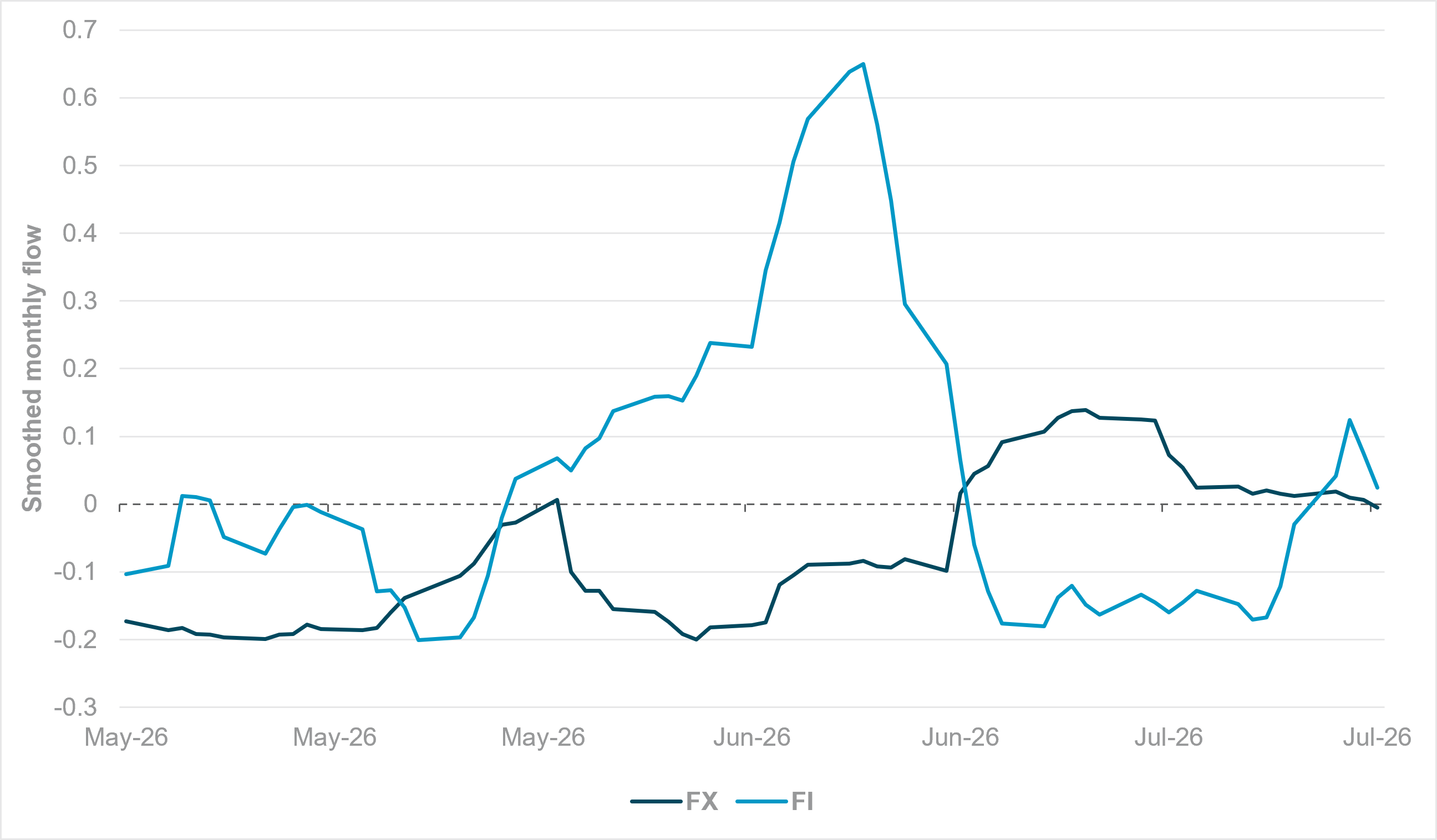
EXHIBIT #4: SMOOTHED MONTHLY FLOW, LATIN AMERICA CURRENCIES AND SOVEREIGN DEBT
Source: BNY
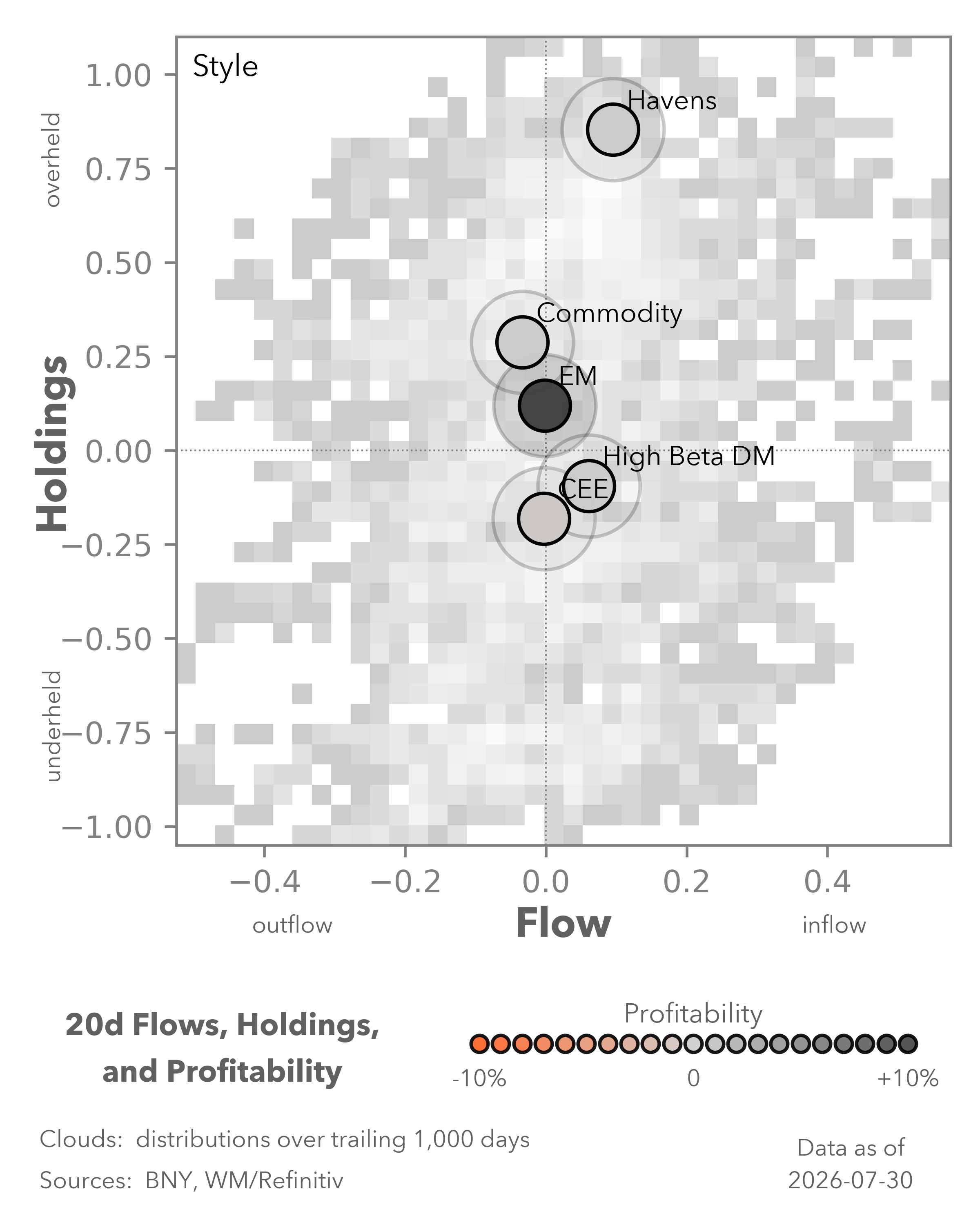
Our take: Central bank decisions in Brazil and Mexico will likely take place in a slightly more comfortable policy environment due to market reaction to the Fed decision. Front-end U.S. yields are better anchored, and the breakout in U.S. breakeven rates have significantly undermined the case for U.S. real yields, which matters greatly for EM duration. Brazil and Mexico will both retain comfortable nominal and real-rate buffers, and the region may benefit from any recovery in the U.S. “debasement” theme, which drove asset holdings in the region to very overheld levels in Q1.
Asset selection remains challenging for the region. Contrary to our expectations, the global carry trade has failed to make much headway amid cross-asset volatility and challenging geopolitics. Much of the region remains well held, which limits upside potential, and the FX market also looks bereft of traditional funders with a clearly dovish rate path apart from the CHF. The fall in dollar front-end rates has improved risk-reward, but we see more potential in sovereign debt. Latin American paper performed poorly through end-June and early July (Exhibit 4), leading to clear rebalancing potential toward month end. With the decline in U.S. real rates and dollar softness, the inflation outlook is set to improve further through the import channel, and the region is less exposed to global supply stress in any case. Lower hedge ratios than envisaged is a good way to pick up some FX exposure in the meantime.
The equity channel looks appealing on the surface as global materials is currently the worst-performing sector and industry group in July, in both developed and emerging markets. If the dollar rates view turns, the “debasement” trade can also help real assets perform, and commodity producers look set to benefit. The two main caveats apply: weak Chinese demand and higher energy and input costs. Even with insulation in the region, margins will likely remain under pressure, so any recovery flow should be cautious; the terms-of-trade theme offers poor risk-reward as a tactical trade. The softs/agriculture story is more compelling, but markets may choose direct exposures through futures instead of country- and company-level assets.
Forward look: The data calendar is relatively light. Brazilian and Mexican inflation figures will help with central bank decision calibration. Brazilian industrial production data due before the COPOM decision will provide an important reading on growth.
In Colombia, President-elect Abelardo de la Espriella won’t be inaugurated until Friday, but most of his cabinet is already in place. The COP has faced significant profit-taking but remains comfortably overheld. Along with Hungary, Colombia is a strong example of comprehensive asset re-rating due to political changes. The central bank’s hawkishness continues to provide a strong real-rate buffer, but the burden of proof will now shift toward the new government’s delivery.
Central bank decisions
India, Reserve Bank of India (Wednesday, August 5): We expect the RBI to leave the repo rate unchanged at 5.25%. The uncomfortable mix of sticky inflation and slowing growth reinforces a cautious, data-dependent stance. RBI’s focus is likely to remain on inflation expectations, supply-side risks, and macroprudential measures to preserve financial and currency market stability rather than via interest rates policy. June's macroprudential measures have already improved sentiment, supporting foreign inflows into Indian equities and bonds. Nevertheless, INR is likely to stay under pressure as elevated oil prices and a stronger U.S. dollar continue to weigh on the currency.
Brazil, Banco Central do Brasil (Wednesday, August 5): COPOM is expected to cut rates by a further 25bp to 14%. Inflation is softening sufficiently for Brazil to maintain a near double-digit real rate level, which is necessary to defend against ongoing Fed hawkishness. Activity levels are showing mild expansion but generally disappoint to the downside. We continue to see value in carry interest, but duration will likely perform better compared to outright currency exposures.
Czechia, Česká národní banka (Thursday, August 6): The CNB is expected to maintain rates at 3.75% despite inflation staying well above 2%. The ECB’s current stance renders it difficult for the CNB to open up a significant policy gap by easing, even though real rates remain at uncomfortable levels for the domestic economy. Relief from FX softness is also limited as the EUR itself hasn’t benefited strongly from the ECB’s stance. Recent appreciation is more attributable to concerns about dollar real rates.
Mexico, Banco de México (Thursday, August 6): Banxico is expected to pause at 6.5%, leading to a real-rate level of around 3%. Given the market’s shift in focus on the Fed’s path, there is some room for maneuver, but caution is needed for now. Growth is holding up, but we expect the policy board to once again highlight energy price volatility and other trade-related factors. That will contribute to uncertainty, which requires a more vigilant stance, especially as inflation remains moderately above target.
Source: BNY
Source: BNY