Stress-testing reaction functions
Start of the Week previews activities across global financial markets, providing useful charts, links, data and a calendar of key events to help with more informed asset allocation and trading decisions.
Start of the Week previews activities across global financial markets, providing useful charts, links, data and a calendar of key events to help with more informed asset allocation and trading decisions.

Geoff Yu
Time to Read: 9 minutes
Pricing pushback: Gulf escalation remains the dominant macro risk. Any disruption to production or shipping would keep oil elevated, tighten financial conditions and worsen the inflation-growth trade-off. Even so, the Fed on Wednesday and Bank of England (BOE) on Thursday may not validate the hawkish pricing embedded in rates. Recent softer inflation and market-led tightening give both central banks room to hold. Simply declining to endorse the full extent of tightening currently priced could pull front-end yields lower.
Fiscal credibility: The U.K. and Japan face the clearest policy tests. Prospective U.K. household relief could support disposable income, but it risks colliding with a narrow borrowing envelope and limited gilt-market capacity. In Japan, fiscal concerns are intensifying alongside renewed energy pressure and persistent yen weakness. This increases pressure on the Bank of Japan (BOJ) to show that monetary policy will not passively accommodate further fiscal impulse. Markets will judge both governments on whether support can cushion the shock without worsening inflation or bond-supply concerns.
Asia support: The Politburo meeting is the clearest potential source of policy support. Credible fiscal, housing or liquidity measures could stabilize Chinese assets. Across the region, however, risk appetite remains primarily technology-led rather than driven by China’s domestic cycle alone. Strong U.S. earnings and global semiconductor demand can support South Korea, Taiwan and the wider export complex. Even so, tighter financial conditions may prevent strong earnings from offsetting higher yields, dollar strength and equity volatility.
Stagflation and earnings: European GDP and inflation releases will test whether fragile growth is coming with renewed price pressures. That combination would leave the ECB reactive but constrained. Technology earnings should remain fundamentally strong, but delivery may no longer be sufficient. Higher yields, energy costs and volatility can overpower good results through multiple compression and tighter liquidity. Earnings are therefore becoming a test of resilience rather than a clear risk-on catalyst.
Bottom line: The week is less about whether policymakers tighten than whether they validate the assumption that they must. A restrained Fed and BOE, credible fiscal signals and meaningful Chinese support could stabilize conditions. Further Gulf escalation would overwhelm those offsets and push markets from apprehension toward broader de-risking.
North America: FOMC wrestles with uncertain inflation outlook
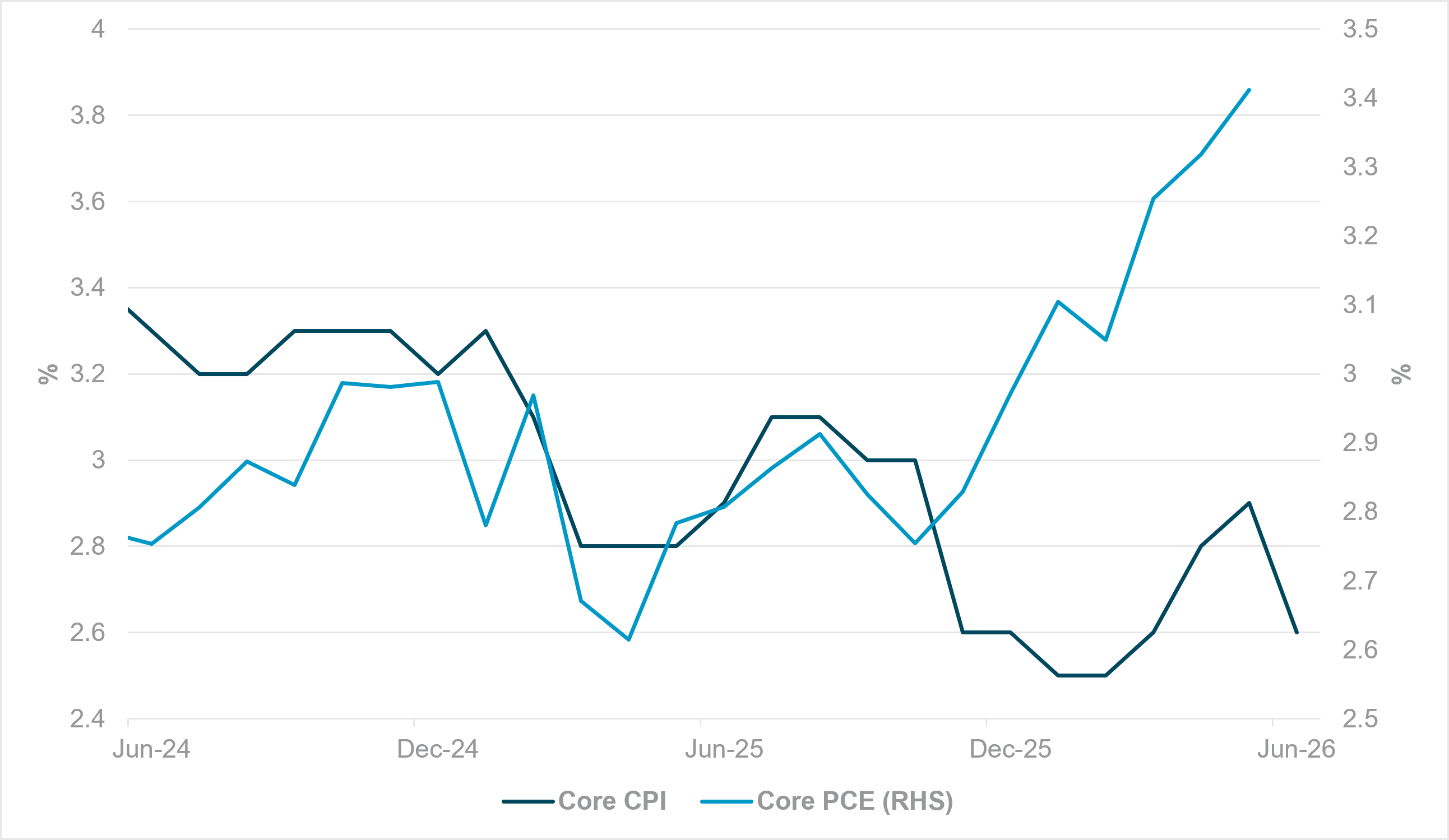
EXHIBIT #1: U.S. Y/Y CORE CPI AND CORE PCE
Source: BNY, Bloomberg
Our take: Last week was comparatively quiet on the North American data front, with PMI the only meaningful U.S. release coming slightly mixed with the manufacturing component coming in below expectations, but the services component beating expectations while Canadian CPI surprised to the downside and echoed the softer-than-expected U.S. CPI tone. That combination kept the inflation narrative from overheating, even as markets continue to price significant policy uncertainty into the FOMC.
This week is dominated by Wednesday’s FOMC decision, which is notable precisely because the Warsh Fed has offered less forward guidance than markets are used to. That leaves the meeting unusually open to interpretation for this late stage in the cycle, with pricing still reflecting roughly a one-third chance of a hike and close to two hikes by year end. We think the below-expectation June CPI print will allow the Fed to remain on hold, but the resurgence of the conflict might push inflation higher later in the year. Thursday’s PCE release will offer a fresh read on inflation, though it lands after the Fed meeting and is therefore more relevant for post-FOMC repricing than for the decision itself. Canadian GDP on Friday is the key domestic print north of the border.
Forward look: The FOMC is the central event for rates, FX, and risk assets. With limited communication from the new Fed leadership, we’ll watch the statement and press conference closely for any hint about the Committee’s thinking and whether market pricing for hikes later this year makes sense. Given the current setup, even small shifts in tone could move front-end rates materially.
PCE on Thursday is the most important U.S. data point, but mostly as a second-stage catalyst after the Fed. A softer print would reinforce the disinflation impulse seen in CPI and further weaken the case for hikes, while an upside surprise would affirm the current more hawkish end-of-year pricing. Canadian GDP should matter primarily for the BoC path and CAD, though unless it meaningfully surprises, it will likely be secondary to the Fed/PCE combination.
EMEA: BOE holds, ECB signals caution
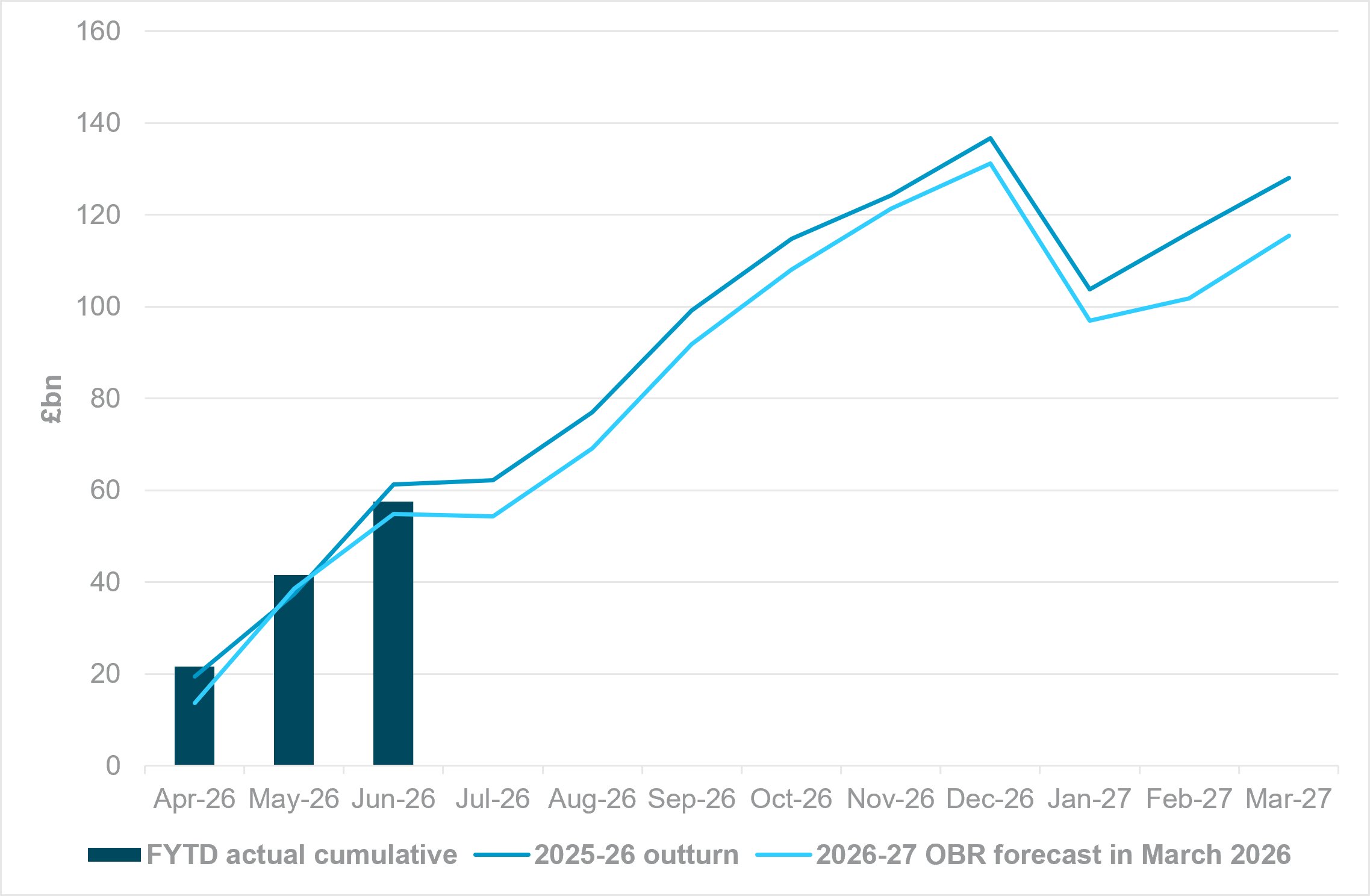
EXHIBIT #2: U.K. HAS ALMOST NO MARGIN FOR FISCAL ERROR
Source: BNY, Office for Budget Responsibility
Our take: The BOE is not expected to shift its policy stance next week despite renewed price pressures from energy. To paraphrase Governor Andrew Bailey’s views on transmission mechanisms, the market is already doing the tightening for them. Mortgage rates have already rebounded significantly due to the recent rise in swap rates, and even if tensions de-escalate, the reversal process is asymmetric and unlikely to be swift. Crucially, the labor market continues to slow structurally, albeit gradually. The latest BOE agents’ report found no conclusive evidence of a material increase in slack. The situation is similar for consumer demand, as spending increases are “predominantly driven by price inflation,” rendering a judgment on real demand more difficult.
In our view, the fiscal outlook will make a bigger difference to policy expectations. The new government has already launched several initiatives that reflect fiscal relief, with a major package due in early Q4. Reports point to raising tax thresholds as the main goal, helping offset the effects of fiscal drag in recent years. If realized, the net improvement in household disposable income would represent a far bigger challenge to the BOE’s current stance. Given the current level of U.K. savings rates and debt servicing costs, there is no guarantee of a demand boost, especially if offsetting spending cuts are not significantly back-loaded. Market capacity for debt issuance is very limited as the Office for Budget Responsibility expects a £13.7bn decline in net borrowing this year, serving as a brake on any excesses. We believe current BOE pricing of around 42bp in tightening by year end looks excessive, but upside growth surprises can help with GBP resilience.
Forward look: The string of commentary after the ECB decision had a very consistent message. Chief Economist Philip Lane highlighted the “reactive” nature of the Governing Council’s current approach, but the September meeting remains live. Even so, we also see headwinds to two more hikes this year as growth remains extremely fragile. The softness in recent services PMI prints suggests that demand is weakening, consistent with Governing Council warnings that the labor market was also slowing – a crucial development in confirming the lack of second-round effects. Policy commentary aside, EU GDP and inflation prints are due, and robust prints are expected: Germany’s July preliminary inflation is expected to rebound by 0.7% m/m to 2.7% y/y, but there will be a wide spread across the currency union as Spanish headline inflation is expected to remain unchanged on the month. Q2 GDP prints are also on a country-level basis: France and Germany are expected to disappoint at 0.2%q/q growth, while Spain continues to materially outperform at 0.6% q/q.
APAC: BOJ and MAS meetings dominate a busy data week
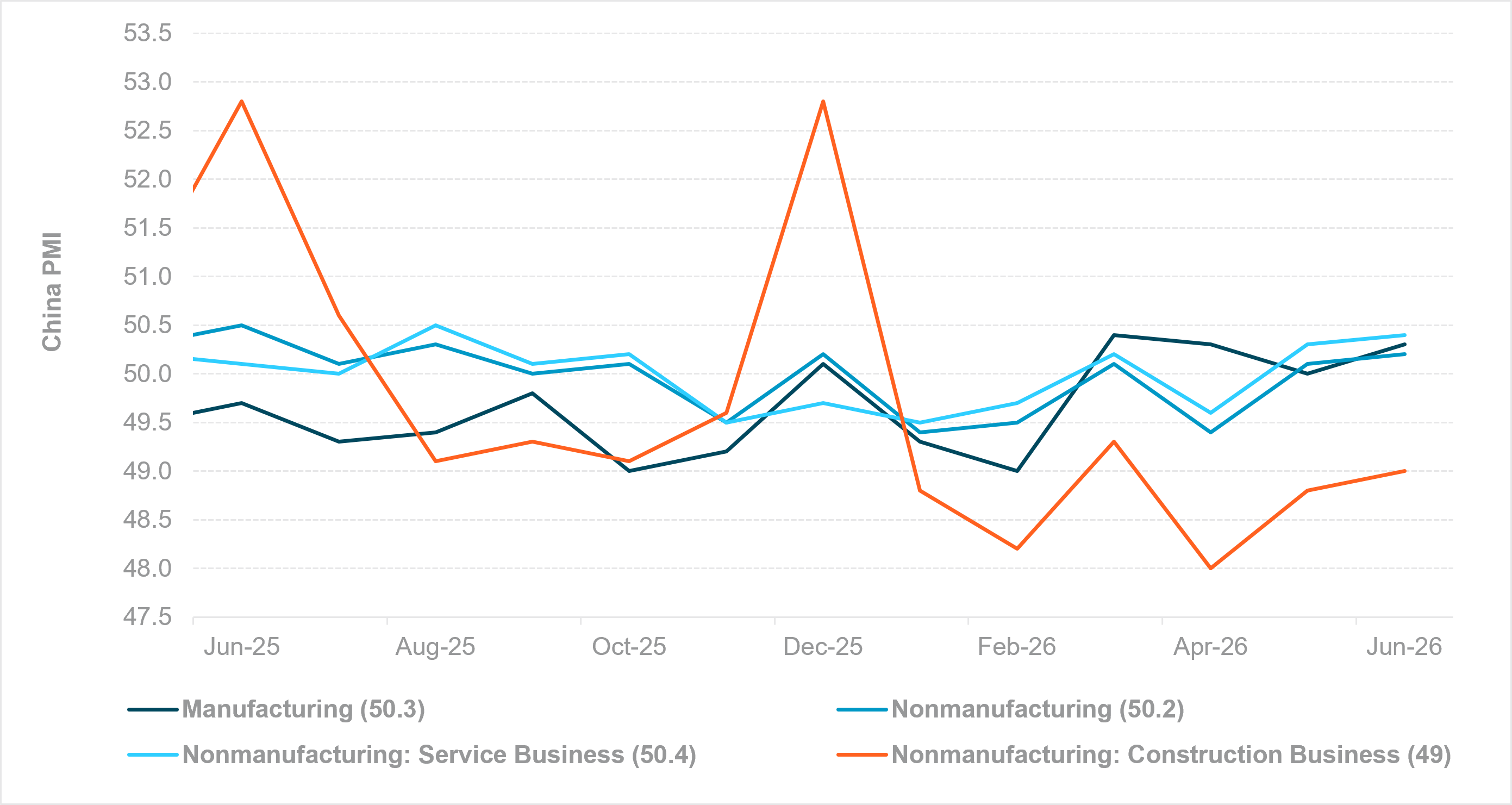
EXHIBIT #3: CHINA PMI MANUFACTURING AND NONMANUFACTURING
Source: BNY, Bloomberg
Our take: Asia’s macro calendar centers on central banks and key inflation and growth data, with the BOJ, Monetary Authority of Singapore (MAS) and China’s July PMIs dominating market attention.
The BOJ is widely expected to leave policy unchanged, with guidance and updated projections the key focus for timing signals. Tokyo CPI, retail sales and industrial production will provide the final assessment of economic conditions ahead of the meeting.
In Singapore, MAS is expected to keep its S$NEER policy unchanged despite stronger Q2 GDP and June CPI, as heightened global uncertainty argues for caution. Australia’s June CPI and Q2 PPI will be the final key inflation inputs ahead of the August meeting of the Reserve Bank of Australia, while private sector credit will offer an update on domestic demand.
Regional growth remains in focus. China’s July PMIs and June industrial profits will show whether recent policy support is gaining traction. South Korea’s industrial production, retail sales and business surveys will provide an update on manufacturing and domestic demand, while Thailand’s exports and factory output will offer another read on the regional trade cycle. Taiwan’s Q2 GDP is expected to confirm resilient export-led growth. India’s industrial production, fiscal data and bank credit will offer further signs of resilient activity. Singapore’s industrial production and the Philippines’ trade and credit data round out a busy week.
Forward look: The renewed escalation in the Middle East has reversed June’s oil price correction, pushing front-month crude back above $90/bbl and worsening the external backdrop for APAC currencies. Higher oil prices, a stronger USD, elevated equity volatility and renewed capital outflow pressure are likely to keep regional FX under pressure, particularly among net oil importers. A sustained rise in crude prices would weaken terms of trade, reduce import cover and increase balance-of-payments pressures.
Even so, currency performance has remained uneven. KRW has continued to outperform on reported corporate repatriation flows and early signs of improving foreign investor positioning. PHP has stayed resilient near historical lows with support from aggressive central bank intervention, while INR continues to trade in a tight range amid frequent intervention by the Reserve Bank of India. In contrast, THB has emerged as the region’s weakest performer.
CNY has remained resilient despite softer macro data, weaker capital flows and a sharp correction in Chinese equities. At the same time, exceptionally strong demand at July’s long-dated Chinese government bond auctions underscores the flight-to-safety bid.
Bank Indonesia’s shift from further rate hikes toward macroprudential measures marks a shift in policy approach. Markets will focus on whether stronger incentives for foreign portfolio inflows and broader liquidity measures can support the rupiah without additional policy tightening.
Elsewhere, USDJPY remains the region’s key risk indicator, as the pair approaches fresh highs. Any intervention or policy surprise from Japan could quickly spill over into broader APAC FX markets. Against this backdrop, demand for FX hedging is likely to remain elevated.
Latin America: Limited terms-of-trade boost expected
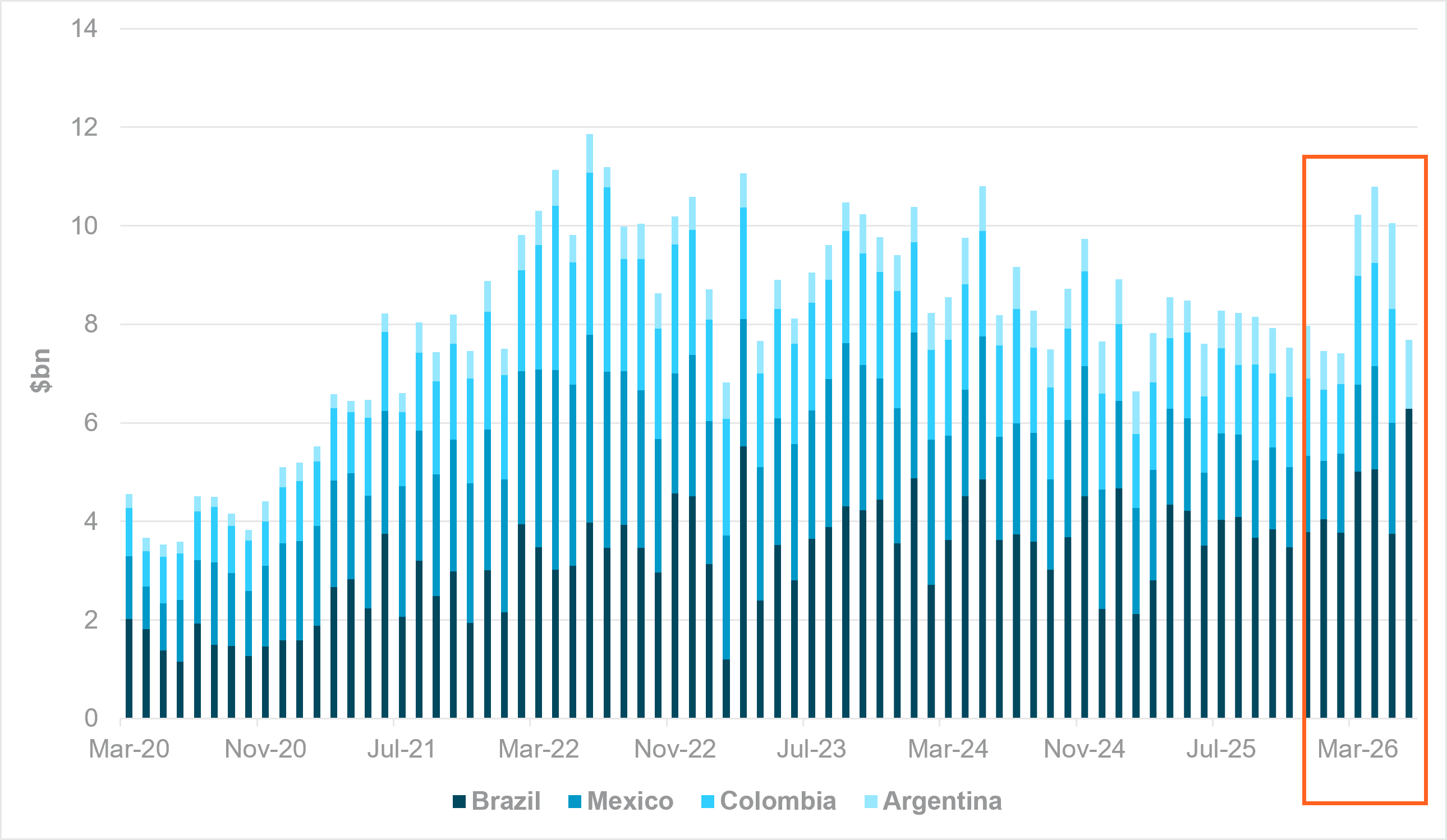
EXHIBIT #4: ENERGY EXPORTS, MAJOR EXPORTERS IN LATIN AMERICA (EX-VENEZUELA)
Source: BNY, Macrobond
Our take: Market apprehension over the wider risk and growth environment should not detract from Latin America’s evident advantages. The initial phase of the conflict generated significant uplift in energy exporters (Exhibit 4) in Q2, and we expect a repeat. As long as the real-rate anchor remains strong, terms-of-trade improvement will be reflected in the currency or duration, with the latter likely preferred by governments that are looking for more fiscal space. Major softs exporters such as Brazil and Argentina will provide an additional balance of payments lift, easing the pain of necessary reforms. Crucially, such efforts are being recognized, as Argentina’s latest ratings upgrade illustrates.
The main challenge is the Fed. As U.S. rates push higher, we don’t expect the current divergence in Latin American policy expectations to continue. The missing link, however, remains in productivity growth outside commodity sectors – the long-term challenge hindering asset allocation and market depth.
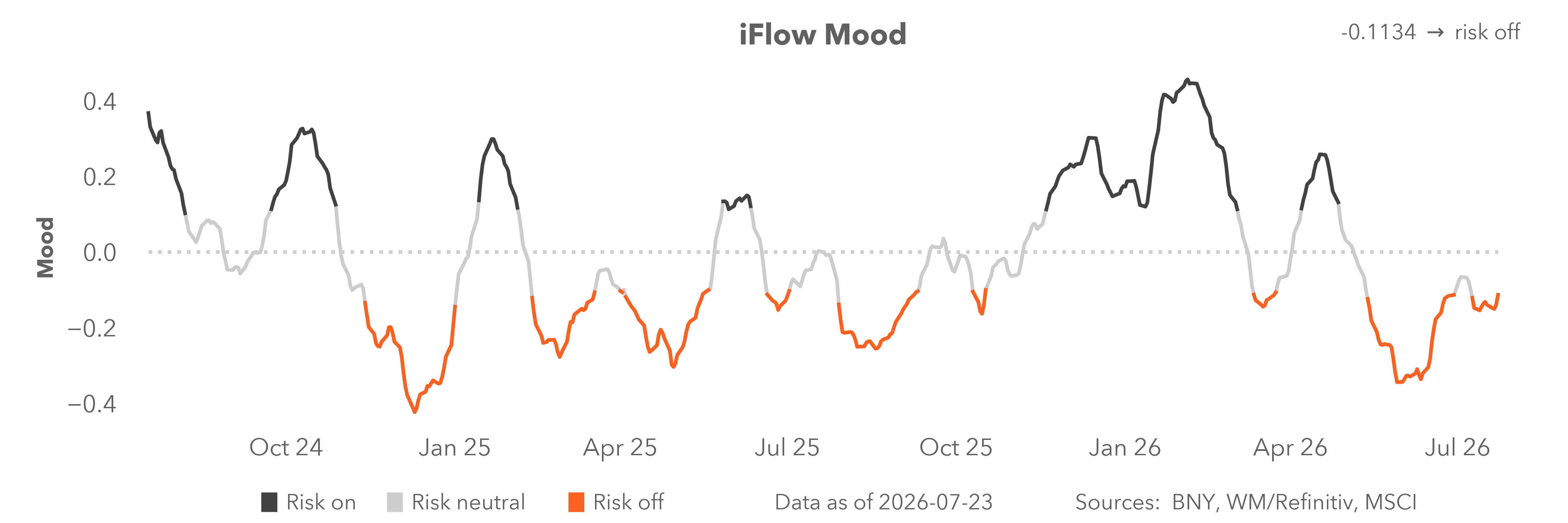
On a tactical basis, the case for Latin American holdings remains clear, but the carry trade momentum is clearly struggling despite flat positioning. We maintain our view that fixed income offers stronger risk-reward, but hedge ratios will likely remain higher until there is better visibility into the Fed’s intentions. The new challenge is that Kevin Warsh’s Fed may forgo forward guidance by design, necessitating structurally high hedge ratios.
Forward look: Colombia’s Banco de la República (BanRep) is expected to push rates to 12.50%, yet more confirmation that the central bank is probably the most hawkish globally. However, we note that the past week brought significant misses in EM policy decisions. The hitherto hawkish Bank Indonesia and South African Reserve Bank both chose to hold instead of hike, even with upside inflation risk. Like the ECB, they are choosing to be reactive and see very little information value in current inflation prints, especially if headline CPI remains an energy story.
As these economies rebuild fiscal credibility as a form of restraint, the market is choosing to look past real rate concerns. Both IDR and ZAR are showing greater resilience compared to March, and BanRep may opt for a similar reaction function, unless the Fed delivers a materially hawkish surprise.
Elsewhere, Banco Central de Chile is expected to keep rates on hold at 4.5%, but the real rate buffer is narrowing fast. A China stimulus announcement is a potential upside trigger, but CLP appears caught in a range.
Central bank decisions
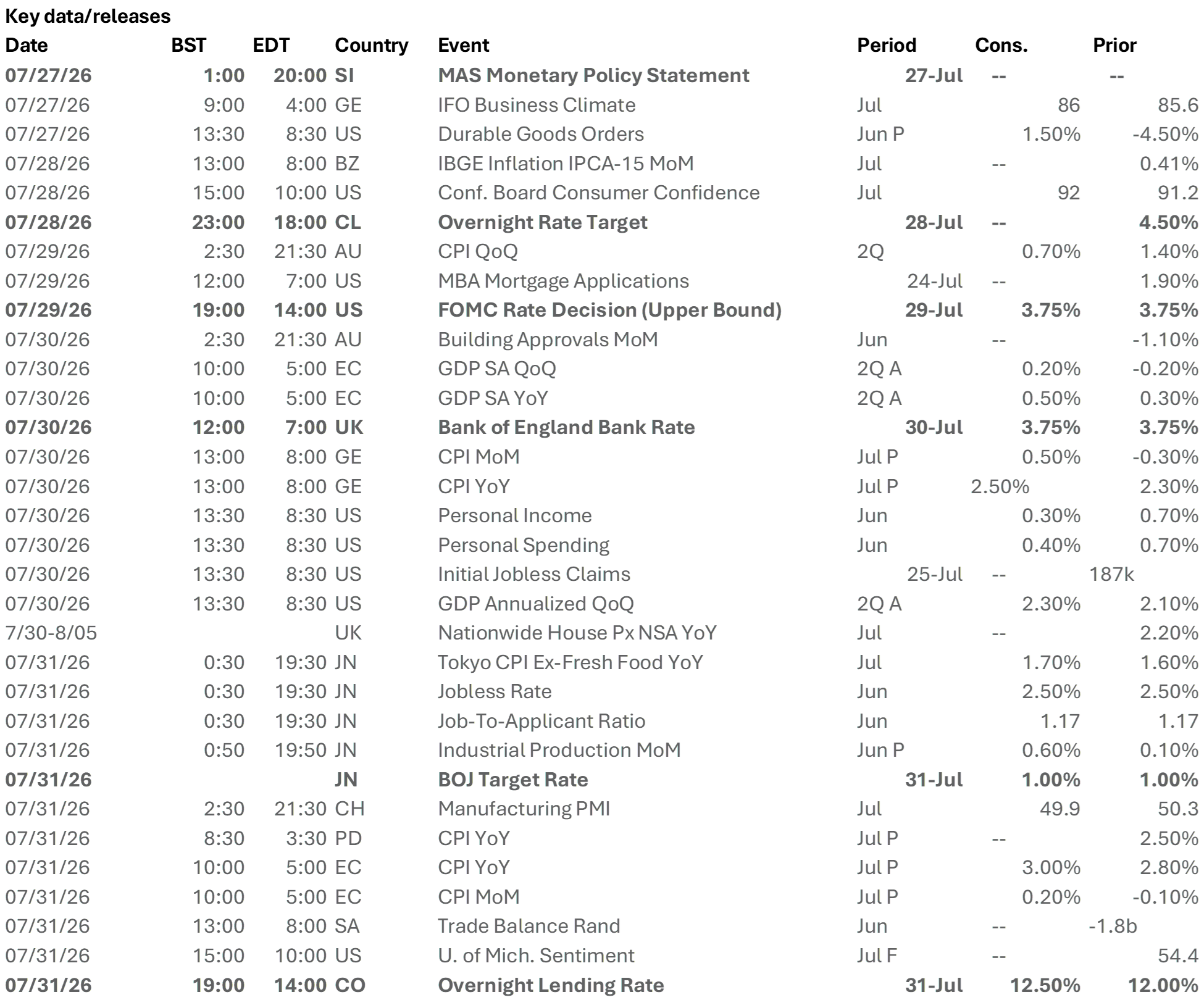
Singapore, Monetary Authority of Singapore (Monday, July 27): We expect the MAS to maintain the center, prevailing rate of appreciation and width of the S$NEER policy band, but we also maintain a relatively hawkish assessment given recent strong GDP growth momentum. Headline and core inflation both ticked up slightly in June at 1.9% and 1.6% respectively but within a manageable range.
Chile, Banco Central de Chile (Tuesday, July 28): No change is expected from the BCC but a hawkish lean is necessary given the current inflation pressures globally. Domestic inflation also surprised to the upside in June, and the real rate buffer is minimal, which isn’t ideal in an environment where the Fed’s bias also errs toward inflation vigilance. The currency may find support from a positive terms-of-trade shock due to global supply worries, but a lack of real-rate support limits upside.
United States, Federal Open Market Committee (Wednesday, July 29): We enter the week of an FOMC meeting with an unusual level of uncertainty as to what rate decision the Fed will deliver. Markets are currently pricing slightly more than a 1-in-3 chance the Fed will hike next week and slightly under two hikes by year end. While the below-expectation June CPI print should give the Fed some breathing room to remain on hold, the resurgence of the U.S.–Iran conflict might force the Fed’s hand later in the year.
United Kingdom, Bank of England (Thursday, July 30): The BOE is expected to hold rates at 3.75%, with at most two dissents. Although headline inflation risk has picked up, the Monetary Policy Committee is even more minded to focus on softer inflation. Governor Andrew Bailey continues to stress that wage growth is also slowing. The new government’s fiscal policies will be a factor over the next few meeting cycles, and the BOE will be mindful of any changes in household behavior.
Japan, Bank of Japan (Friday, July 31): The BOJ is expected to keep the target rate unchanged at 1.00%, but a hawkish message committing to further tightening is probably a matter of urgency as the JPY slides beyond four-decade lows. Fears are growing over fiscal conditions as well in light of the recent budget, and the BOJ needs to signal some tightening in financial conditions to manage the risks arising from fiscal impulse. Until the central bank gets ahead of expectations, the JPY will struggle, especially as balance-of-payments risks resurface.
Colombia, Banco de la República (Friday, July 31): BanRep is expected to hike rates by 50bp to 12.50%, underscoring its status as the world’s most hawkish central bank. Real rates currently stand above 6%, but activity and demand levels remain robust. Retail sales continue to expand by double-digits on an annualized basis, and consumer confidence rebounded strongly in June. The Fed’s approach will also matter for most Latin American central banks, but BanRep is likely to maintain a maximum buffer.
Source: BNY
Source: BNY