Blackout
Start of the Week previews activities across global financial markets, providing useful charts, links, data and a calendar of key events to help with more informed asset allocation and trading decisions.
Start of the Week previews activities across global financial markets, providing useful charts, links, data and a calendar of key events to help with more informed asset allocation and trading decisions.

Geoff Yu
Time to Read: 8 minutes
The Fed goes dark: Markets enter the pre-FOMC decision blackout with uncertainty rising rather than falling. The labor market has again demonstrated resilience, and bond yields remain elevated. With policymakers unable to guide expectations, markets are left to decide whether strong activity represents welcome resilience or simply requires more restraint. The U.S. Labor Day holiday offers a brief respite, but not much clarity.
Europe faces its own uncertainty: The European Central Bank (ECB) is expected to tighten again, with the focus shifting quickly toward how current activity compares with its baseline forecasts and how much additional restraint the economy can absorb. Political pressure is also building behind the scenes. European governments increasingly want a more explicit pro-growth agenda, while uncertainty over the ECB’s future leadership is becoming harder to ignore. Germany faces its own reckoning after regional elections, adding another layer of political risk to an already difficult policy mix.
Asia still looks outward: Dispersion remains extreme. China is sluggish, the semiconductor cycle continues to boom, and Japan’s currency volatility carries increasingly global consequences. Yet the common regional weakness is familiar: domestic policy choices are still too often deferred while governments and central banks wait for international conditions to improve. Fiscal policy remains the clearest example. External resilience has bought time, but hasn’t resolved underlying imbalances.
Buffers are thinning: Risk appetite continues to struggle because the usual shock absorbers are less dependable. Latin America no longer enjoys the same real-rate cushion, while global fixed-income volatility is eroding the risk-reward in carry. If inflation remains firm, policy paths may need to shift again despite the growth cost. The same trade-off is becoming visible across regions: preserving currency and policy credibility increasingly requires accepting weaker activity.
Bottom line: This is a blackout week in more ways than one. Markets will be guessing where the Fed is headed, who ultimately will lead the ECB, and where the next round of intervention will emerge. The trade-offs are becoming clearer even if policy answers aren’t.
North America: Fed hike expectations rest on CPI
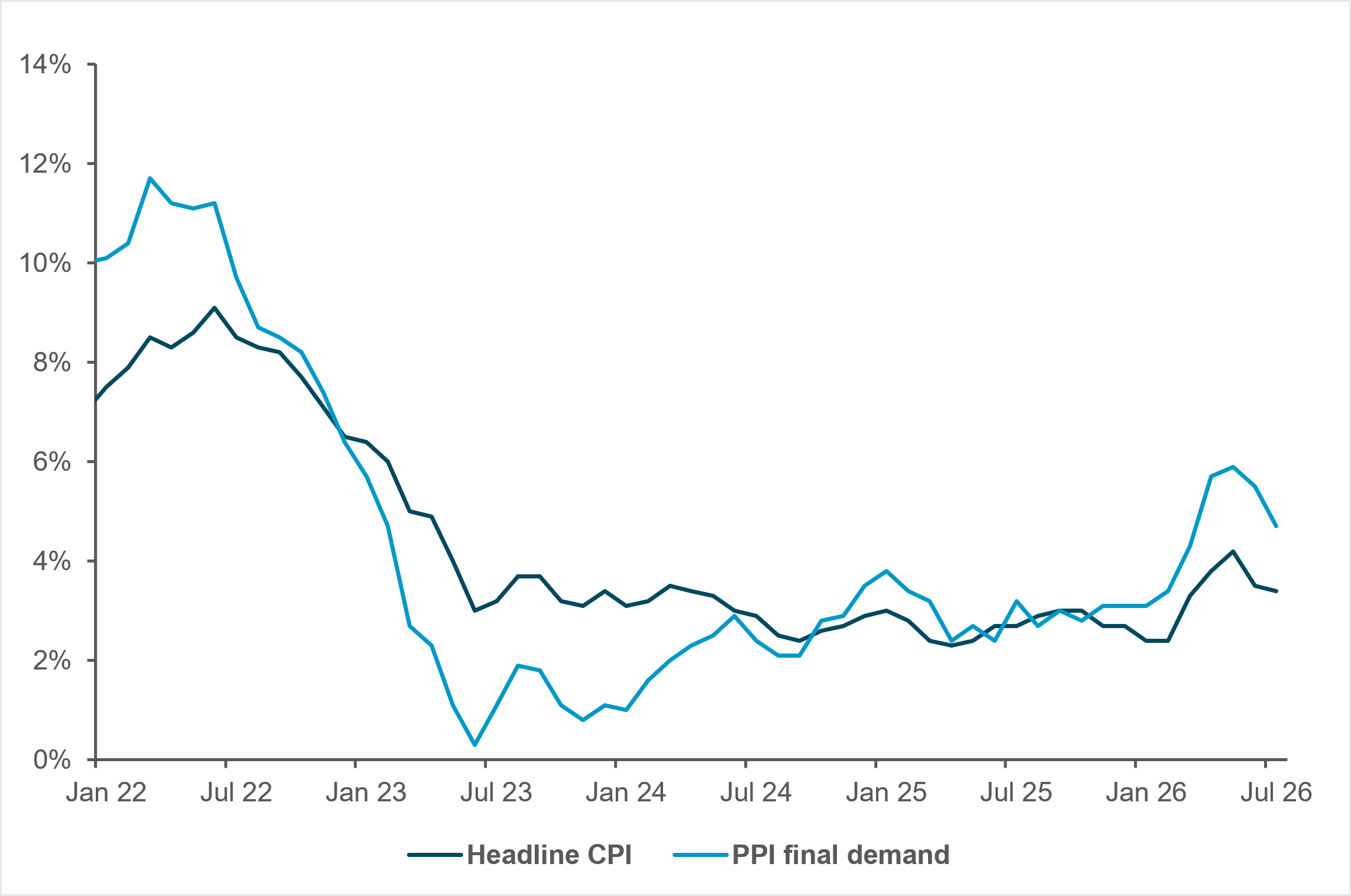
EXHIBIT #1: WILL DECLINES IN HEADLINE CPI AND PPI FINAL DEMAND CONTINUE?
Source: BNY
Our take: Last week’s upside surprise in U.S. payrolls – with nonfarm payrolls (NFP) at 162,000 vs. the expected 55,000 – pushed market-implied odds of a September Fed hike back up to around 60% from 50%, underscoring how much rate expectations remain tethered to the data backdrop. With the Fed now entering its two-week communications blackout, the focus of this holiday-shortened week will be squarely on inflation data. The marquee releases are August PPI on Thursday and CPI on Friday. In the absence of meaningful Canadian data, there is little to distract from the U.S. inflation prints. The combination of a strong labor report and any increase in price pressures should be enough to support hawkish repricing.
Forward look: The most important release this week is CPI, particularly the core measure, as it will shape whether last week’s jobs strength is interpreted as confirmation of resilient underlying demand or as an isolated labor-market outlier. Headline CPI is expected at 0.4% after last month’s 0.1% print. PPI matters as a useful cross-check on pipeline inflation, but in market terms, CPI will carry the greater weight for rates, front-end yields, and Fed expectations. A firm print across both would likely reinforce the case for a September hike and could extend the recent backup in short-end rates. By contrast, a softer CPI would give markets room to fade some of the renewed tightening odds, especially with the Fed sidelined and unable to steer the narrative. With Canada quiet, U.S. inflation will be the sole macro driver for North American markets this week.
EMEA: Enough insurance tightening and not just on rates
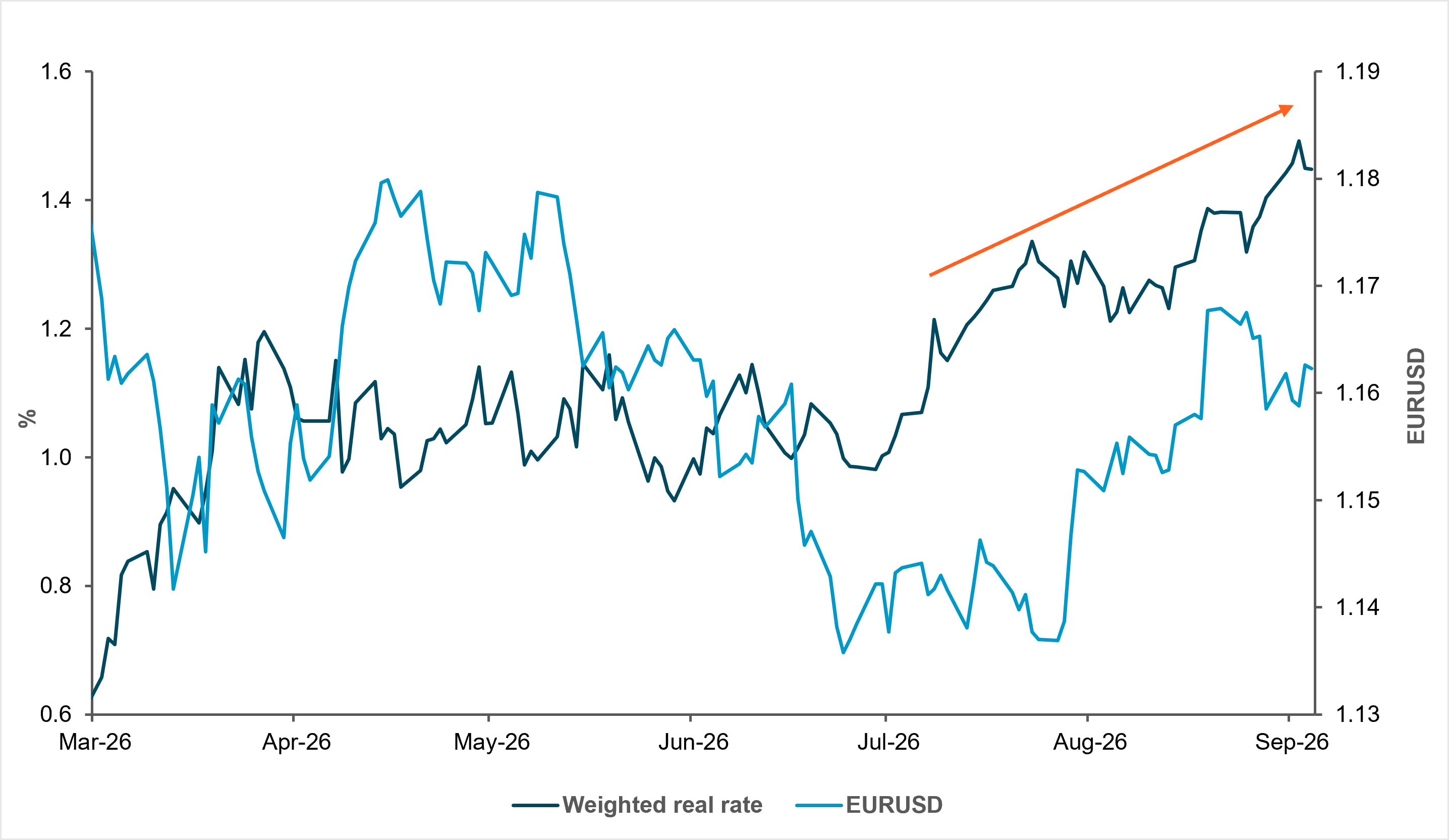
EXHIBIT #2: REAL RATES IN EUROPE AND THE CURRENCY ADD TO RESTRICTION
Source: BNY; real rate is an equally weighted basket of German, Italian and French 5y real rates
Our take: The ECB decision on Thursday could mark the beginning of the end for two narratives. First and more pertinent is the end of the 2026 rounds of insurance hikes. The communication on this is clear: when a Governing Council member as hawkish as Joachim Nagel affirms that second-round effects are not present and the central bank ought to move to a “meeting-by-meeting” basis, the case for an extended cycle is weak. Policy rates aside, real rates and exchange rates have both contributed to significant market-based tightening in financial conditions. Interest rate futures continue to price in three hikes over the next 12 months, whereas we believe economic and political conditions will start to make the case for renewed easing by year-end, once the effects of natural gas prices on inflation this winter are clear. The ECB needs to clear this remaining hurdle, and the September forecast round will provide better guidance on the distance to the adverse and extreme scenarios. The oil price risk is far lower, but natural gas remains a pressure point in the near term.
The second factor is ECB President Christine Lagarde’s future, where we expect significant questioning but very little in the way of answers. That she may depart before her term expires at the end of 2027 isn’t news, but there’s been a significant pick-up in official activity regarding her successor. German media have already reported that the German government will meet with the ECB with the topic in mind. Reports around the same time regarding ECB Executive Board Member Isabel Schnabel’s departure to the IMF in a year’s time will only add to the intrigue. Given the current timelines and ongoing policy uncertainty, a change in ECB leadership by year-end will have significant implications for policy outlook.
Forward look: Europe’s data flow will test whether the recent improvement in activity is broadening. Final Q2 Eurozone GDP should confirm modest growth, but the composition matters more than the headline – particularly household consumption and fixed investment. In Germany, industrial production and trade data will provide the clearest read on whether manufacturing is genuinely stabilizing after a prolonged downturn. Export performance remains the main vulnerability, especially with China-related trade tensions still high. Final German CPI should largely confirm the preliminary reading, leaving inflation uncomfortably elevated even as growth remains subdued. France’s industrial production will provide another check on whether the recovery is spreading beyond Germany.
Politics also matters. The market will be digesting the result of the Saxony-Anhalt elections, with implications for business confidence and federal coalition dynamics. In Greece, the government’s Thessaloniki package will be watched for any shift in fiscal support in one of Europe’s biggest fiscal success stories in recent years. In the U.K., monthly GDP is expected to stall after a stronger June, with the 3m/3m growth rate slowing materially. Industrial production and trade data will help determine whether that reflects temporary payback or a broader loss of momentum. The Bank of England’s key officials will testify in Parliament and inflation-expectations survey will also be important given elevated gilt yields and still-high household price expectations.
APAC: Asia defers again
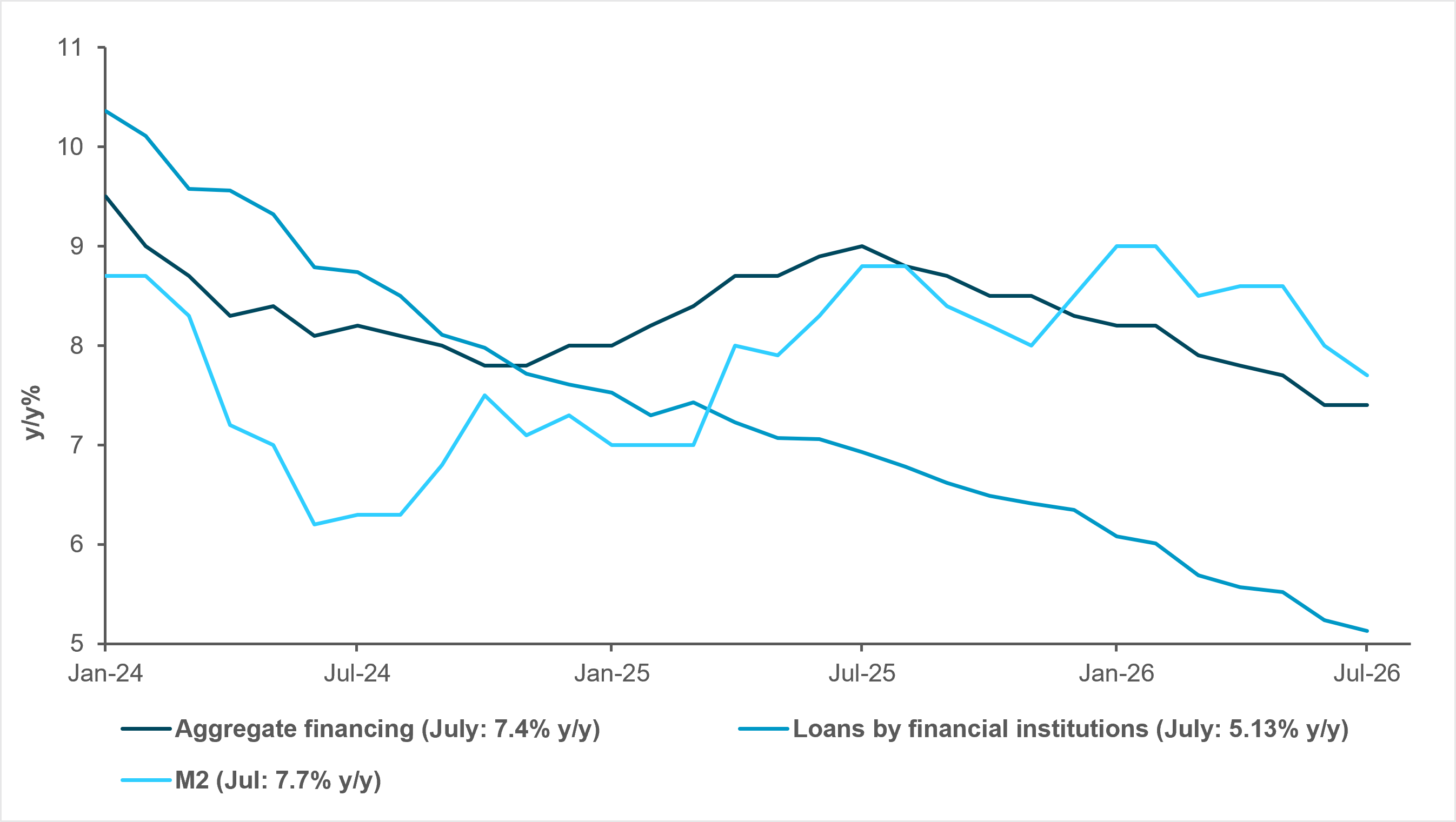
EXHIBIT #3: DETERIORATING CREDIT GROWTH IN CHINA
Source: BNY, Bloomberg
Our take: Asia’s macro calendar will test whether external demand remains resilient as domestic momentum stays uneven. China’s trade and credit data will be central, with focus on whether credit growth stabilizes after months of deterioration, particularly financial institutions’ loan growth at a fresh low of 5.1% y/y. South Korea’s early-September exports and Taiwan’s trade data will provide a broader read on the regional technology and manufacturing cycle. China’s CPI and PPI, alongside inflation data from Taiwan and Thailand, will gauge whether regional price pressures are firming. Japan’s labor cash earnings will be important for the Bank of Japan outlook, while South Korea’s Q2 GDP and activity indicators across Australia, Malaysia, Singapore and New Zealand will provide further evidence on domestic demand.
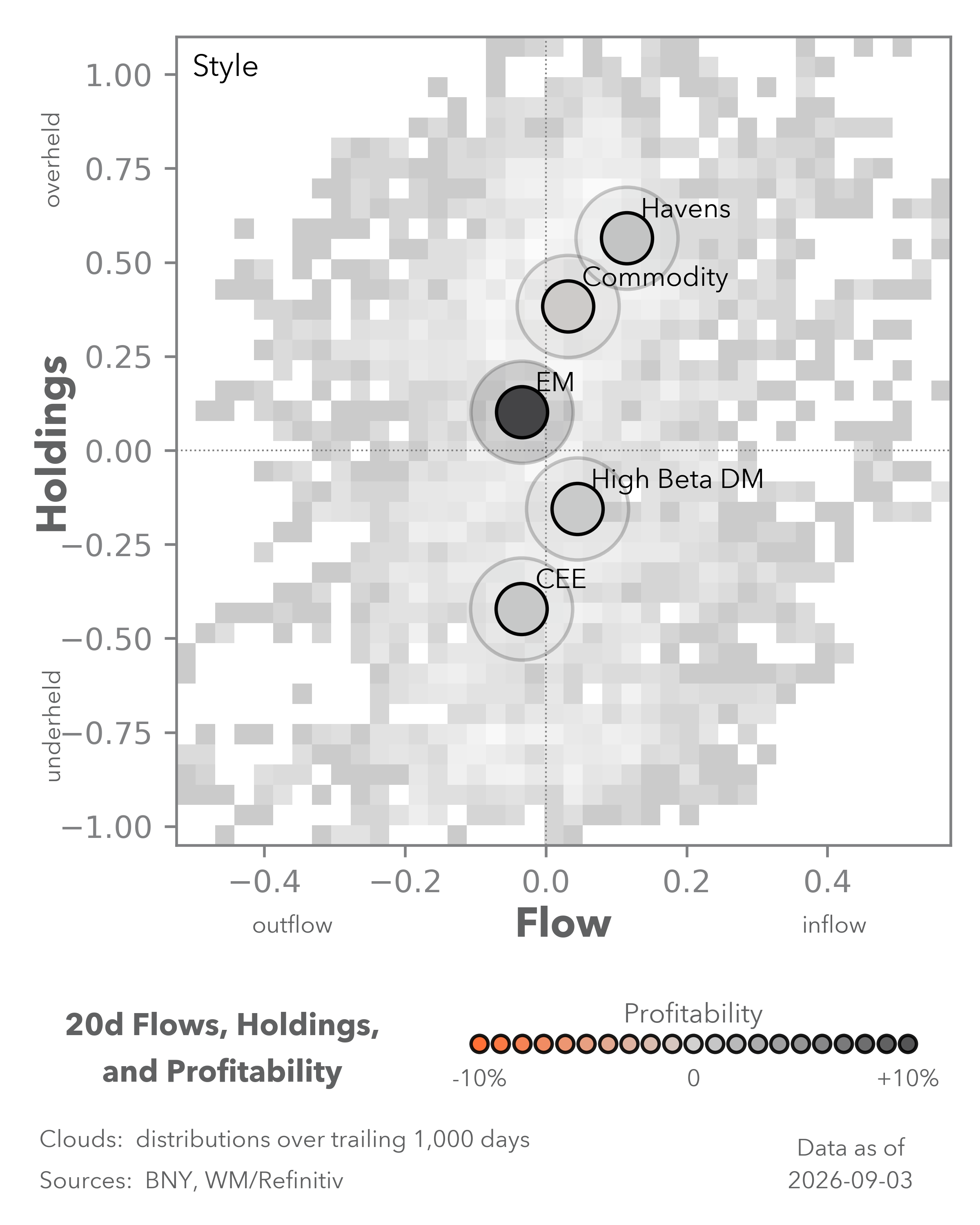
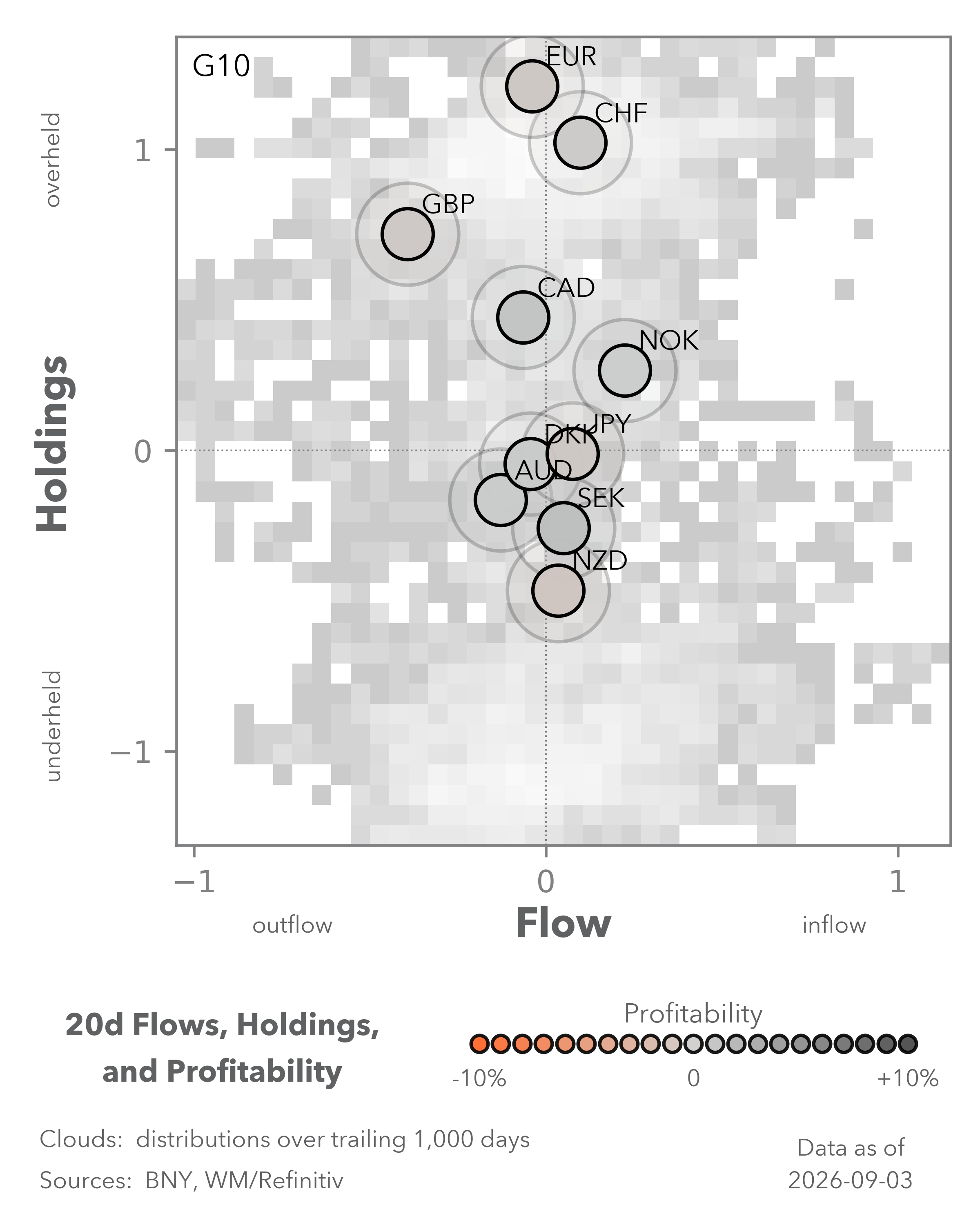
Forward look: A stronger U.S. dollar, elevated oil prices, rising global bond yields and renewed foreign outflows continue to pressure Asian currencies, equities and fixed income. Regional PMIs also point to softer momentum, with China remaining in contraction across manufacturing and non-manufacturing sectors. Differentiation remains the key regional theme, but recent divergences are becoming stretched, while further currency depreciation is testing the limits of central-bank FX smoothing operations. CNY remains one of the region’s most resilient currencies, but its strength is drawing greater official attention, reflected in the widening counter-cyclical factor (CCF) in daily USDCNY fixings. Our call to increase CNY hedges without chasing the rally continues to play out: iFlow scored holdings have moved further into underheld territory as the pace of appreciation slows. Elsewhere, INR, PHP and THB remain vulnerable to elevated oil prices. KRW strength, at around 6% year to date, also looks increasingly stretched and could encourage domestic asset managers to unwind foreign-asset hedges or prompt renewed retail outbound equity investment.
Latin America: Struggling to justify further easing
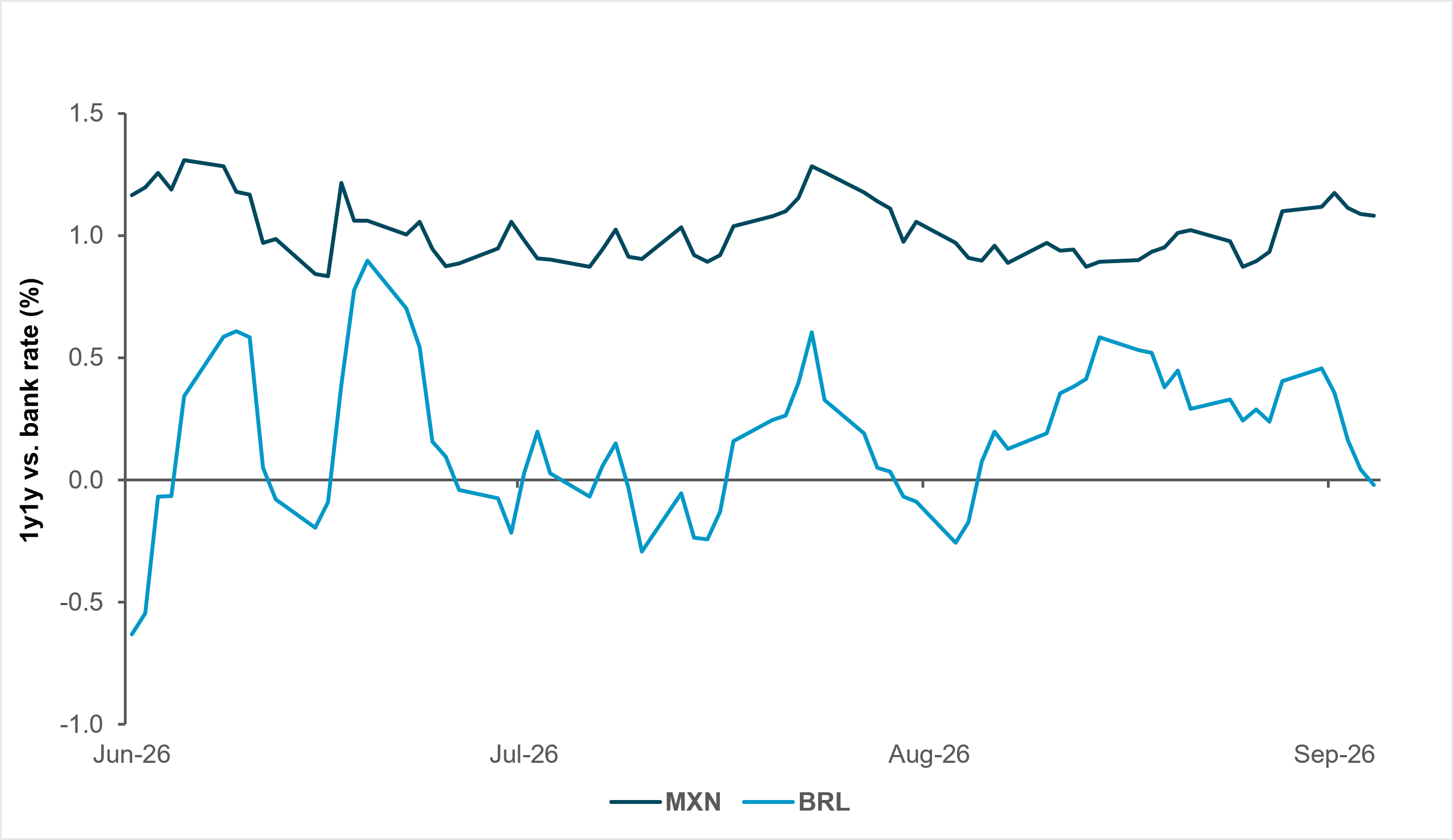
EXHIBIT #4: MEXICO’S 1Y1Y RATE WELL ABOVE POLICY RATE; BRAZIL FACTORS IN CUTS AGAIN
Source: BNY, Bloomberg
Our take: Policy uncertainty will likely rise in Latin America. As the Fed enters its blackout, strong data threatens to push forward the FOMC’s policy profile. This raises serious questions over risk-reward in the region. MXN was the only carry name to perform strongly after the July FOMC decision, but our data indicate that heavy unwinding has taken place since. Brazil is subject to political factors, while nominal rates across the region no longer have a sufficient buffer. To maintain policy vigilance, markets may need to start to pricing in a different trajectory, and central banks will need to adjust their language lest FX performance deteriorates sharply. Hungary’s recent decision to abandon rate cuts and lower its inflation target is the best such example. Out of the top Latin America names, Mexico has maintained a forward rate buffer of around 100bp, based on the 1y1y policy rate spread. This may need to rise sharply if the Fed signals a new cycle is afoot. Brazil has more room due to higher nominal levels, but the rates market is now exploring the prospect of easing again, albeit marginally. This is a position that could come under pressure, pending the Fed outcome. A different policy environment demands additional compensation for Fed risk, and presently this isn’t enough to support the region’s carry trades. Signaling new hikes isn’t necessary yet, but Hungary does offer a good template whereby any scope for cuts is pushed out to protect the currency until the Fed outlook clears.
Forward look: Inflation data dominates the week ahead, but dispersion will continue. Colombia is the clearest hawkish risk, with both headline and core CPI expected to accelerate further. That would reinforce Banco de la República’s cautious stance and make any return to easing harder to justify, especially with our flow data now indicating the market is pulling back on MXN exposures. Mexico’s CPI (cons. 3.3%) is also expected to rise on the headline measure, although core inflation should edge lower. The split matters, particularly with Banco de Mexico’s regional economy report providing a parallel read on domestic demand and whether underlying activity remains firm enough to keep price pressures persistent. Chile combines CPI (3.8% expected) with the Banco Central de Chile decision, where rates are expected to remain unchanged. A further rise in inflation would reinforce the case for an extended pause after the earlier easing cycle. We question whether this stance is even defensible given the low level of real rates. The low level of nominal rates with inflation risk is also an issue in Peru, where the Banco Central de Reserva del Peru is also expected to hold.
Brazil’s IBGE (national statistics institute) services data and IPCA (official CPI measure) inflation are due, as the October general election continues to inhibit external flow interest. Domestically, growth has already slowed, financial stress is rising and markets are increasingly looking toward rate cuts; a benign inflation print would strengthen that view, while sticky services inflation would argue for patience. Peru is also expected to hold rates, with the statement more important than the decision itself. Overall, the week will show whether regional disinflation is broad enough to reopen easing cycles, or whether domestic price pressure is becoming the new constraint.
Central bank decisions
Central bank decisions
Banco Central de Chile (Tuesday, September 8): No change is expected from the BCC, but vigilance is needed as the Latin America carry trade is currently selective and stop-start. With the market moving toward a more hawkish Fed, Chile is exposed to a poor nominal and real-rate buffer that may require adjustment up ahead. Terms-of-trade improvements could also prove challenging in a more restrictive policy environment for global growth, while China also struggles to reflate.
Narodowy Bank Polski (Wednesday, September 9): Poland’s NBP is expected to keep rates unchanged, and we don’t see any pre-emption of the ECB’s decision. Governor Adam Glapinski recently stated that there was no pre-set path for interest rates, but in light of Hungary potentially lowering its inflation target to apply more restrictive policy, the bias may need to shift until there is clear sign of easing in supply stress. Strong fiscal tailwinds also require an offset.
European Central Bank (Thursday, September 10): The ECB is expected to hike rates by 25bp to 2.50%, but the path thereafter will be more challenging. Even hawkish members such as Joachim Nagel have stated that policy will need to be taken on a “meeting by meeting” basis after September. President Christine Lagarde may also face more vigorous questioning on the issue of her succession, as German Chancellor Friedrich Merz has scheduled a meeting with the ECB with such matters now front of mind.
Türkiye Cumhuriyet Merkez Bankası (Thursday, September 10): No rate change is expected even as TRY has struggled to make meaningful gains despite a pullback in U.S. yields. If the Fed reaffirms its hawkish outlook, economies such as Türkiye’s with strong inflation impulse may need to strengthen their relevant guidance, especially with progress toward lowering inflation painfully slow. The current real rate buffer of around 5pp is insufficient given the risks involved.
Banco Central de Reserva del Peru (Thursday, September 10): We expect Peruvian rates to remain unchanged at 4.25%, but policy is no longer optimal. Lima CPI is now running closer to 4.5%, and the current environment is not conducive to Latin American economies having negative real rates. A favorable political honeymoon period could buy time, but any sign of forceful tightening by the Fed would significantly narrow the window of opportunity to strengthen regional inflows.
Source: BNY
Source: BNY