European hikes are overpriced
FX: G10 & EM provides a detailed analysis of global foreign exchange movements in major and emerging economies around the world together with macro insights.
FX: G10 & EM provides a detailed analysis of global foreign exchange movements in major and emerging economies around the world together with macro insights.

Geoff Yu
Time to Read: 6 minutes
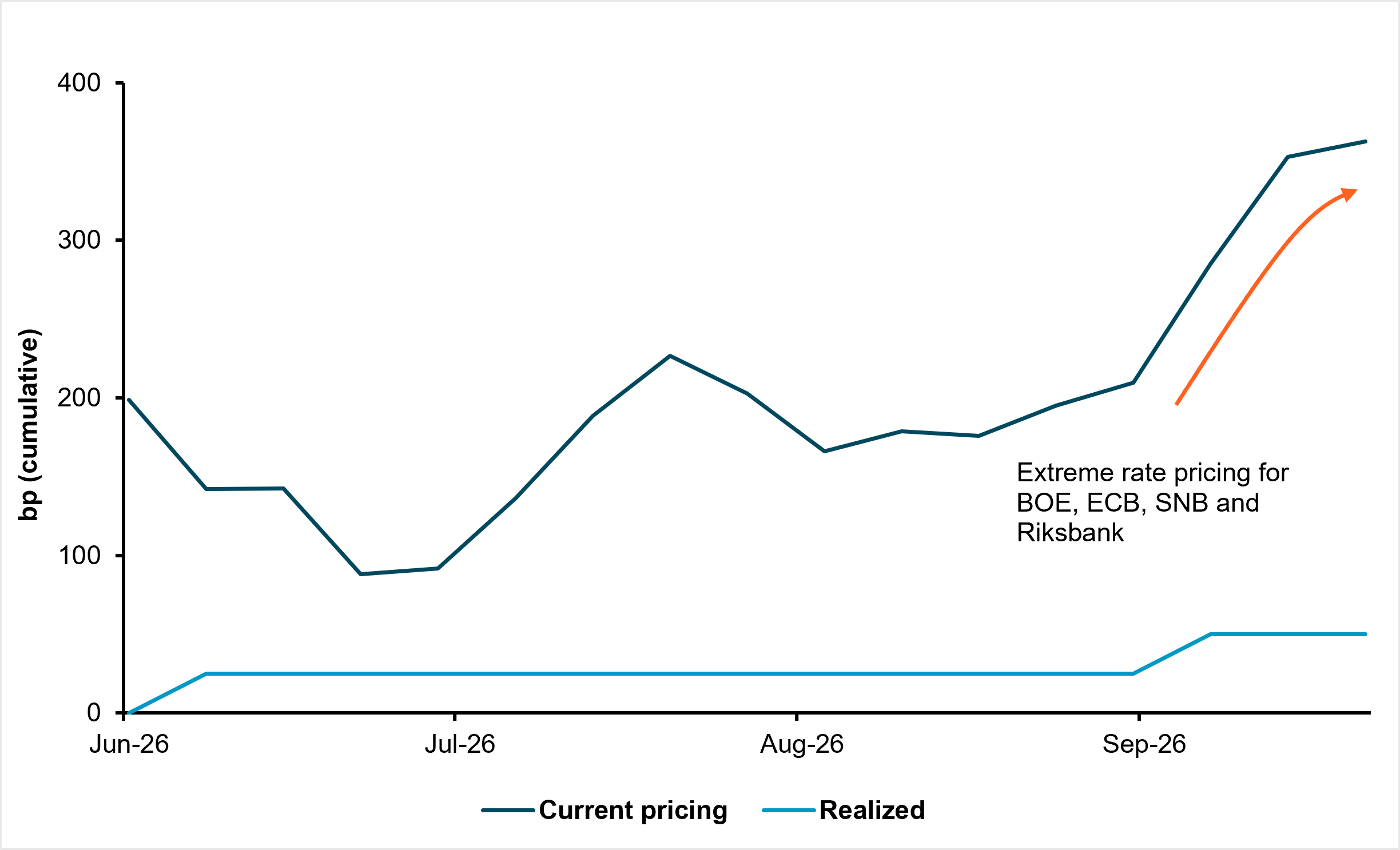
European rate pricing appears stretched. Markets discount two to four additional hikes from each major Western European central bank by June 2027. That scale of tightening is unlikely and would add unnecessary pressure to growth. The gap between priced and realized hikes is already at its widest this year (Exhibit 1) and should narrow over the next one to two quarters.
Pricing is well ahead of central-bank guidance. Ahead of September decisions, markets imply 35bp of tightening for the Swiss National Bank (SNB) and more than 100bp for both the Bank of England (BOE) and Riksbank by June 2027. Central banks remain concerned about inflation and winter energy prices, but aren’t signaling sustained hiking cycles. Unlike 2022, today’s energy shock isn’t accompanied by a post-pandemic demand surge.
A limited policy response is more likely. The BOE may deliver one further insurance hike, while the Riksbank may bring forward the two moves already in its forecast. We believe the European Central Bank (ECB) is likely finished, and there’s additional uncertainty surrounding its leadership over the next six months. The SNB is also unlikely to act until late in its forecast horizon, despite a recent pivot away from staying dovish. These outcomes fall far short of current market pricing.
EXHIBIT #1: BOE, ECB, SNB, RIKSBANK PRICING GAP VS. REALIZED HIKES AT YEAR-TO-DATE HIGHS
Source: S&P Global Flash Eurozone and Germany PMI, August 2026; BNY
Markets are assuming that energy inflation will persist. Futures pricing links higher energy prices directly to higher policy rates. Central banks still treat second-round effects as a risk rather than a base case. Without broader pressure on wages and core inflation, the energy shock alone doesn’t justify a prolonged hiking cycle.
Central-bank guidance supports this distinction. ECB President Christine Lagarde has said that “rates do not move in lockstep with the price of energy.” The ECB has raised its inflation forecasts, but its hawks still see no second-round effects. The BOE’s September decision to hold also reflected the absence of a wage-price spiral. Headline inflation exceeds core inflation in every major economy except Italy, where the gap is small (Exhibit 2), while medium-term inflation expectations remain anchored.
Energy prices also remain below the ECB’s adverse thresholds. The ECB’s severe scenario assumes Brent at $130/bbl and Dutch TTF gas at €130/MWh. At the September 18 close, prices were at $103/bbl and €80/MWh respectively, within the 75th percentile of its projections. Current rate pricing therefore implies a stronger policy response than the ECB’s own framework suggests.
EXHIBIT #2: HEADLINE INFLATION IS ABOVE CORE IN MUCH OF WESTERN EUROPE
Source: BNY, Bloomberg
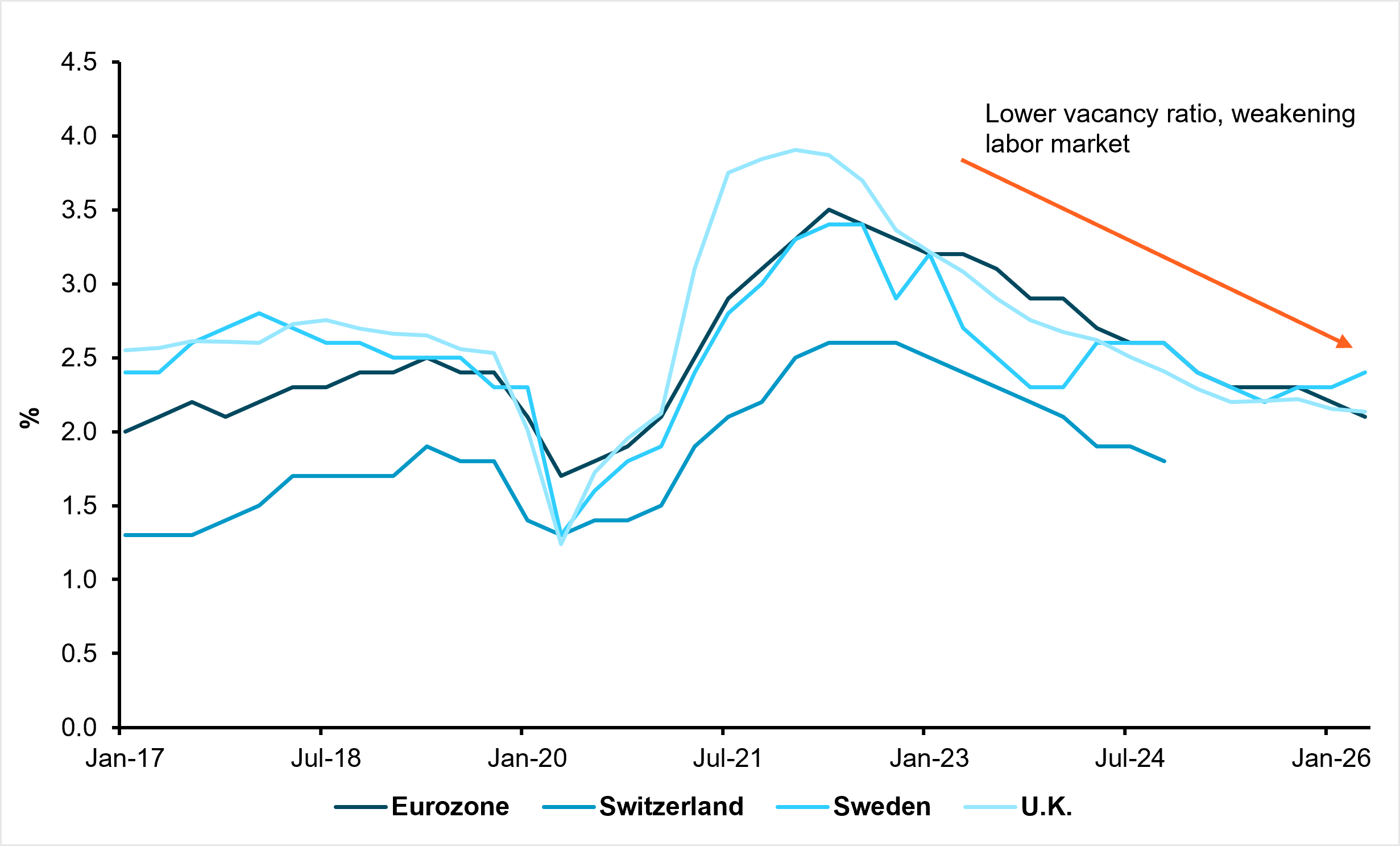
Labor-market pressure is easing. Vacancy rates have fallen for four years and are below their pre-pandemic cyclical peaks across all four markets. U.K. unemployment is above 5%, a five-year high, despite weak participation. Economic uncertainty is also restraining wage demands. This backdrop provides little support for a multi-hike cycle.
The comparison with 2022 is misleading. Vacancy rates were surging by 2021 (Exhibit 3), but the ECB didn’t begin raising rates until mid-2022, after the energy shock had intensified. Current pricing appears to assume another delayed response even though labor demand is now weakening.
Wages remain the main risk. The 2027 negotiation cycle will matter, but the conditions that produced the 2022–2023 settlements are absent. Until wage growth reaccelerates, the market is pricing a repeat of 2022 that the labor data don’t support.
EXHIBIT #3: EUROPEAN VACANCY RATES ALL FALL BELOW PRE-PANDEMIC HIGHS
Source: BNY, Macrobond
Households are already voluntarily tightening demand. Higher market-based interest rates, mortgage costs and index-linked prices are reducing disposable income and encouraging caution. Additional policy hikes would deepen the growth drag without directly addressing a supply-driven inflation shock.
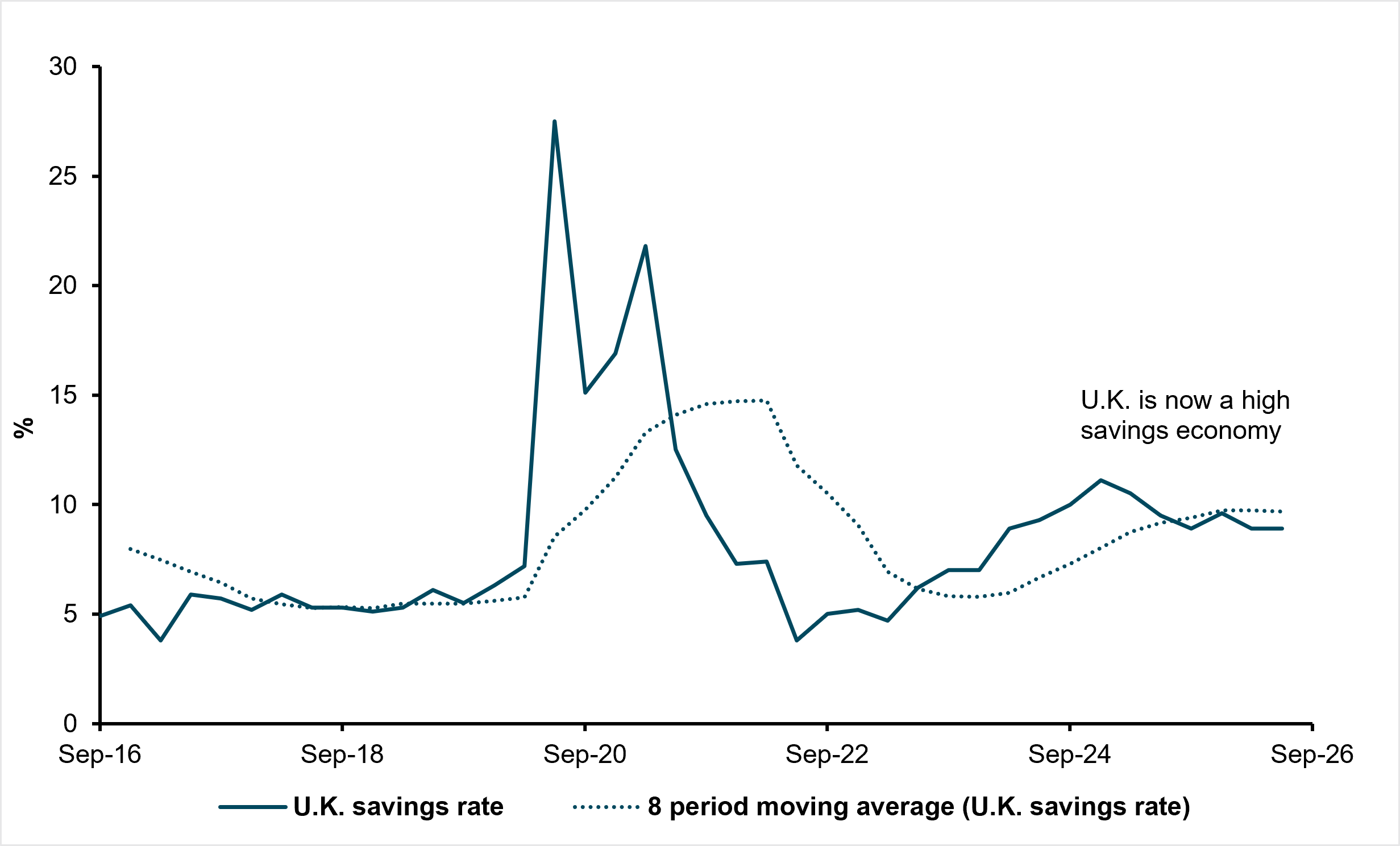
U.K. savings show the shift clearly. Savings averaged about 5% of disposable income before the pandemic, rose during lockdowns, and then fell below 3% as the economy reopened (Exhibit 4). Over the past two years, the rate has increased again as households responded to persistent economic and fiscal uncertainty. Wage restraint reinforces this cautious behavior.
A repeat of the 2022 demand surge is unlikely. In 2022, U.K. households drew down more than 15pp of disposable income as wages accelerated. A return to the 5% neutral savings rate would now release only about 4pp, with wage growth much weaker. Sweden shows similar restraint: the latest Riksbank surveys show five-year core inflation expectations remain stable, and survey respondents expect fewer than two hikes over two years, compared with three hikes priced over six months.
Higher household costs reinforce the slowdown. Savings drawdowns are likely to cover mortgages and energy bills rather than generate new demand for goods and services. That limits pressure on core inflation and reduces the need for repeated hikes.
EXHIBIT #4: U.K. SAVINGS RATE IS WELL ABOVE PRE-COVID HIGHS, POINTING TO HOUSEHOLD RESTRAINT
Source: BNY, Bloomberg
Fiscal policy is becoming a constraint. Governments can cut spending or maintain current plans and accept a higher risk premium. Either outcome tightens financial conditions. As fiscal support fades, weaker demand should reduce the need for rate hikes and may eventually restore an easing bias.
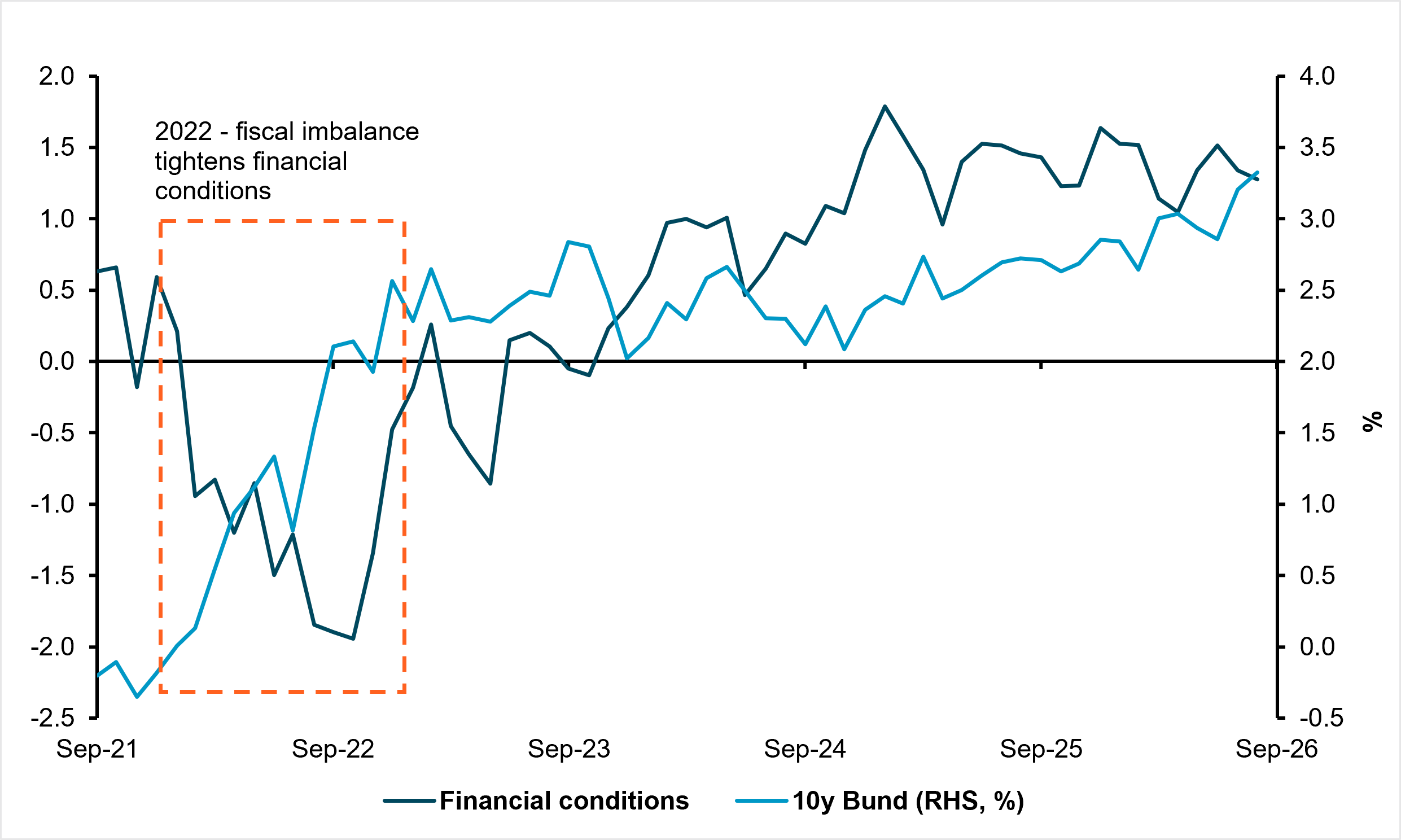
The 2025 policy mix no longer applies. ECB cuts and productive fiscal spending supported growth and allowed markets to absorb higher yields. The 10y Bund yield is now above its 2025 high, but financial conditions are no longer easing because stronger growth expectations aren’t offsetting the rise in yields.
The risk is a tighter fiscal-financial loop. In 2022, an energy shock became a fiscal shock and tightened financial conditions for more than a year. The U.K. showed how fiscal expansion during a supply shock, combined with monetary tightening, can quickly weaken growth through higher borrowing costs and the mortgage channel.
Current fiscal support is also less growth enhancing. Spending is shifting toward energy subsidies, cost-of-living support and public services. These measures protect incomes but add little productive capacity. When markets doubt the quality or credibility of spending, higher yields can offset much of the intended growth benefit. The current situation echoes Lagarde’s 2023 Sintra warning that post-pandemic employment growth had been concentrated in construction and the public sector, where productivity had declined, and in services, where productivity growth had been meager.
Fiscal restraint would shift the balance toward easing. New Zealand provides a recent example: fiscal tightening announced in May 2024 helped create the conditions for 325bp of easing over the next 18 months. Europe is moving toward the same fiscal-tightening trade-off, not the sustained hiking cycle priced by markets. Sweden retains fiscal rules, whereas the U.K. is likely to increase taxes again in October to increase fiscal headroom.
EXHIBIT #5: 2022 BUND YIELD SURGE TIGHTENED FINANCIAL CONDITIONS
Source: BNY, Bloomberg
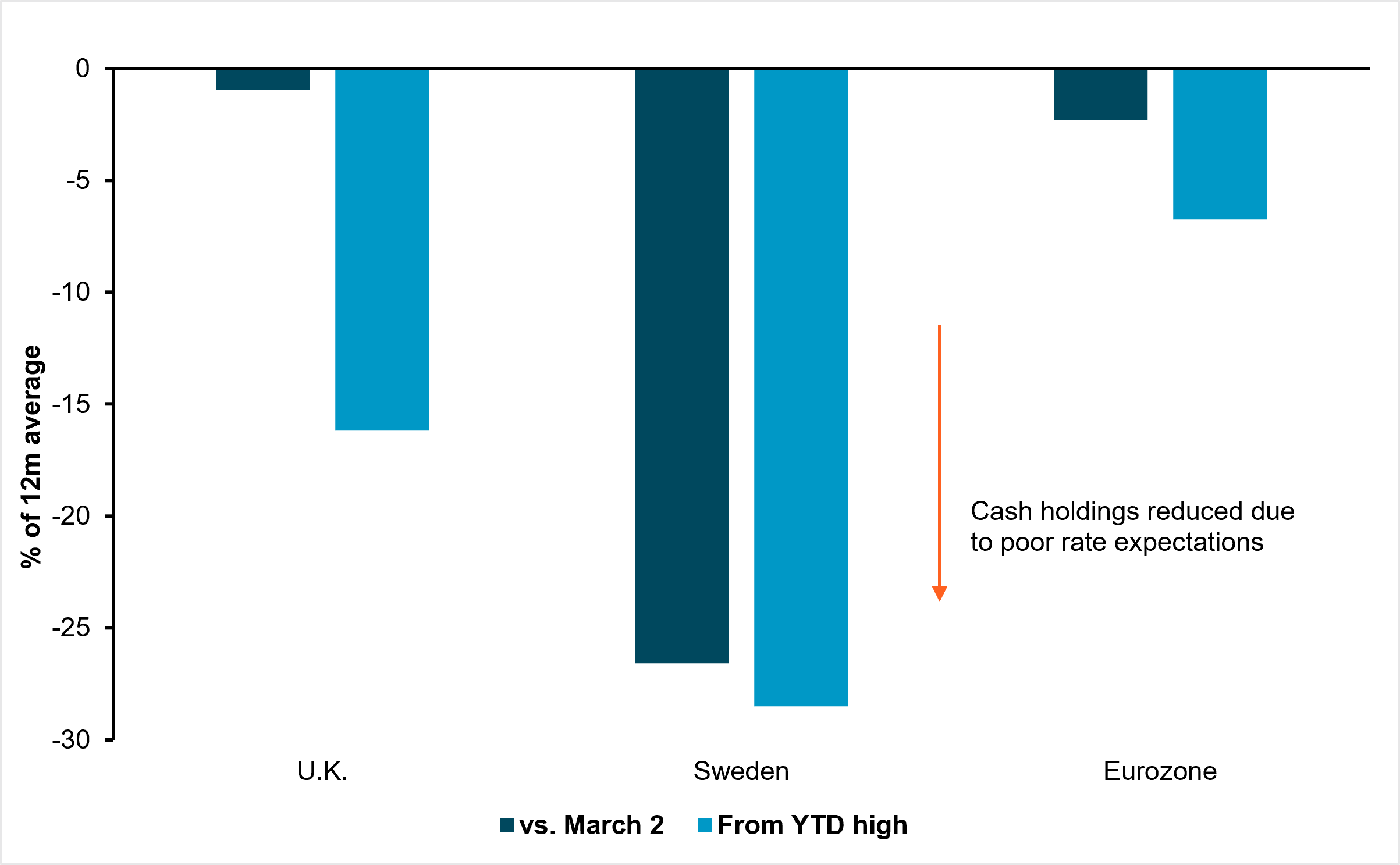
iFlow cash holdings are more cautious than the futures curve. Custody holdings of sub-12-month non-sovereign cash and short-term instruments (CAST) tend to rise with policy-rate expectations. U.K. and Swedish holdings jumped in February and early March, fell through Q2 as the Persian Gulf ceasefire eased energy prices, and recovered over the summer. Eurozone holdings also rose in September as markets priced a hike.
The recent rise in holdings has stalled. By mid-September, CAST holdings in the Eurozone, Sweden and the U.K. were close to or below their early-March levels and 2026 peaks. Switzerland is excluded because the market is too thin for a reliable signal. The data suggest that custody investors don’t expect cash rates to rise enough to justify further allocation.
Custody investors are not confirming market pricing. Unless CAST demand rises materially, the gap between priced and realized hikes should narrow.
EXHIBIT #6: CURRENT HOLDINGS OF CAST VS. 2026 BENCHMARK DATES
Source: BNY
Rate futures: The central signal is a fall in cumulative tightening expectations. A move to no further hikes from the ECB or SNB, one from the BOE and one to two from the Riksbank would reduce aggregate pricing from more than 300bp to 50–75bp.
Energy sensitivity: Rate expectations should become less sensitive to energy prices if second-round effects remain contained; September preliminary PMIs already challenge this view. An energy move beyond central banks’ severe scenarios would challenge this view and likely trigger a policy response.
Fiscal surprises: A material shift in fiscal policy would move rate pricing quickly, especially in the Eurozone and U.K. Gradual restraint is the base case. A disorderly expansion similar to the U.K.’s 2022 “mini budget” would instead push expected hikes higher.