China’s policy put comes into view
FX: G10 & EM provides a detailed analysis of global foreign exchange movements in major and emerging economies around the world together with macro insights.
FX: G10 & EM provides a detailed analysis of global foreign exchange movements in major and emerging economies around the world together with macro insights.

Jackit Wong
Time to Read: 5 minutes
The Chinese authorities are still avoiding a large-scale stimulus pivot, but policy support is becoming more active and coordinated. The People’s Bank of China (PBOC) is anchoring FX expectations and keeping liquidity supportive, while regulators and state-linked investors are visibly limiting equity downside. This is a calibrated effort to rebuild confidence while domestic growth stays uneven, rather than a reflation push. What has changed is the breadth and coordination of support, not its scale.
The buyback and shareholding-increase relending facility is now a longer-term institutional arrangement. On November 4, the PBOC lowered the stock buyback relending rate to 1.0% from 1.25%, and applications exceeded ¥200bn. The central bank has indicated it will fully accommodate future relending needs. The Securities, Funds and Insurance Companies Swap Facility remains active: its November 3 operation totaled ¥100bn, with 31 securities and fund companies at a winning bid rate of 10bp.
Central state-owned capital operators, China Reform Holdings Corporation and China Chengtong Holdings Group, keep adding A-share exposure. China Reform has deployed over ¥50bn through the relending facility, alongside matching funds, while China Chengtong bought nearly ¥10bn of state-owned enterprises and technology stocks and ETFs.
China’s first 18 actively managed ETFs start trading on November 23 with 36bn initial units. Individuals hold 77.12%, with institutional demand concentrated (Ping An-affiliated accounts took nearly 45% of Ping An Fund’s dividend product). Managers have reportedly built equity positions ahead of the launch, making this another incremental, sentiment-supportive part of the equity-support framework rather than a reflation pivot.
Combined with official emphasis on the stock market’s “inherent stability,” this looks like an explicit policy backstop. The PBOC, regulators, state-linked investors and senior leadership are all involved.
Hong Kong offers the clearest near-term expression of this shift. It’s the most liquid offshore channel for investors rebuilding China exposure without a larger commitment to mainland assets. If support keeps arriving incrementally rather than as one big package, Hong Kong should be among the first markets where positioning adjusts. A-shares should benefit too, but more gradually as sentiment filters into domestic allocation.
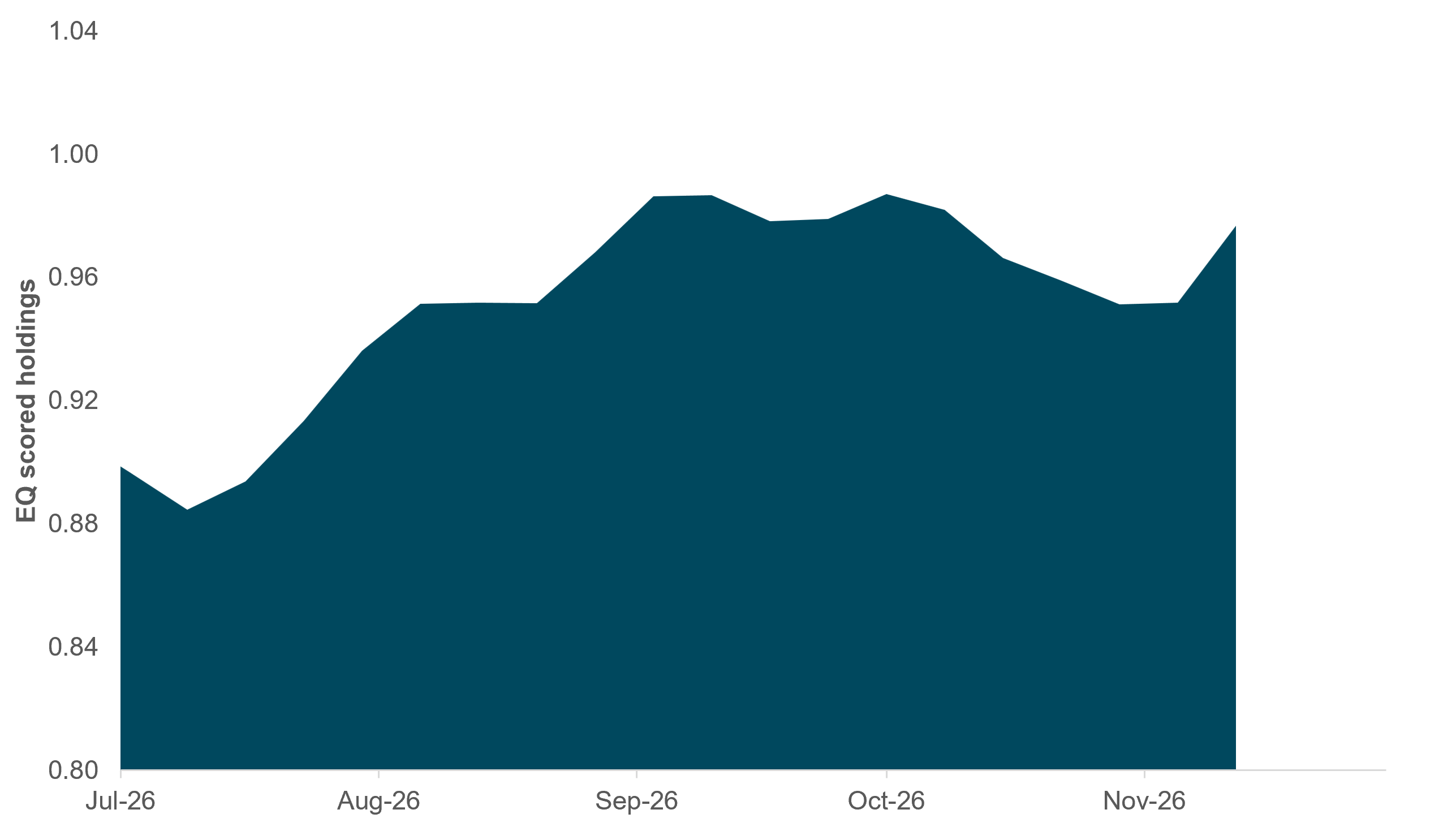
Our iFlow data are starting to confirm this. Hong Kong equity (EQ) scored holdings have risen to 0.98 as of November 12 from 0.95 on October 29, a sign exposure is being rebuilt. It’s not yet a wholesale return of risk appetite, but a notable shift from earlier defensive positioning.
EXHIBIT #1: HONG KONG EQ SCORED HOLDINGS REBOUND FROM OCTOBER’S DIP
Source: BNY iFlow
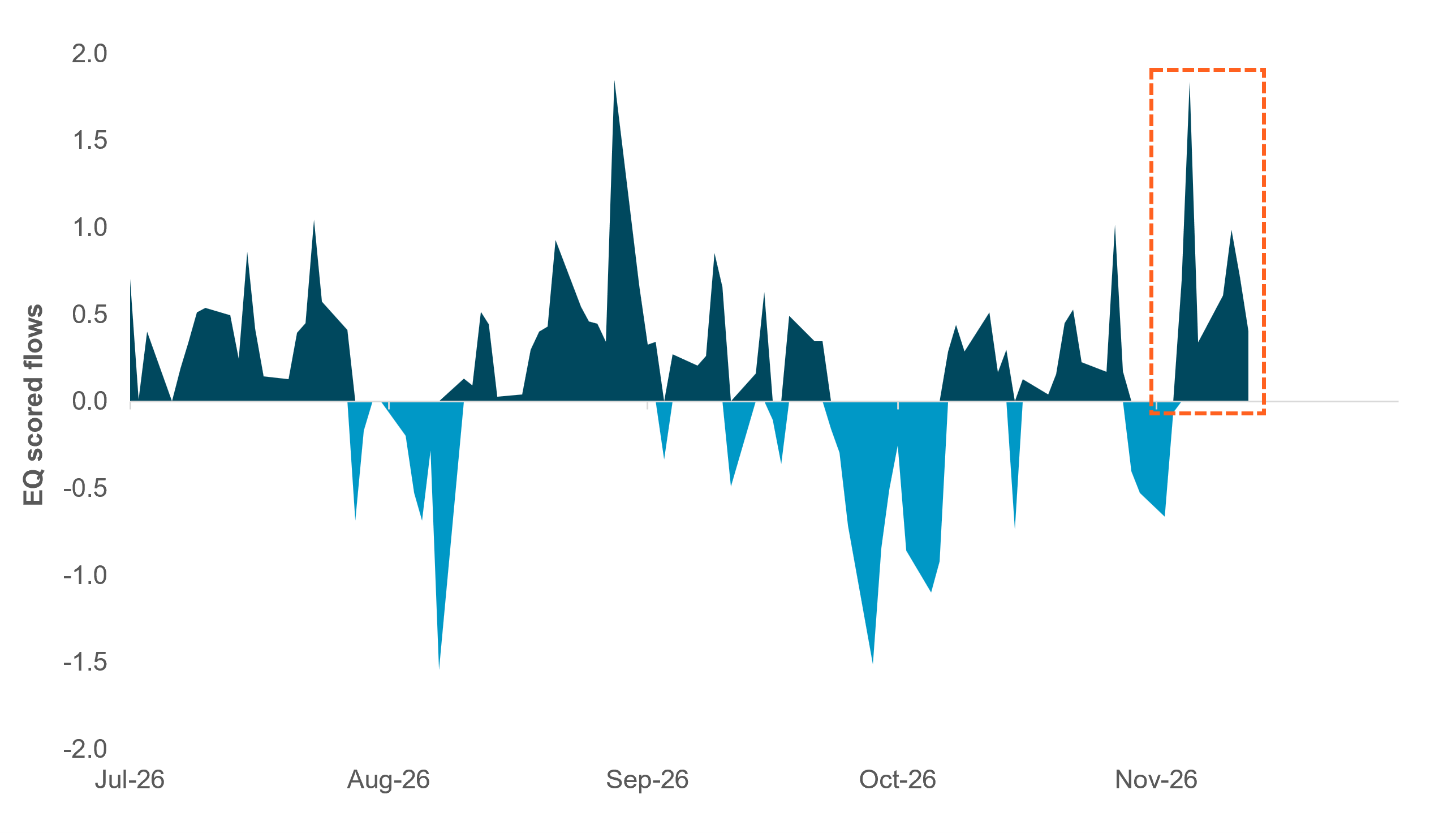
There are early signs of flow improvement. Hong Kong daily EQ scored flow has been positive since November 4, and mainland China weekly EQ scored flow is stronger year to date in 2026 than in 2025 or 2024. But the recent pick-up in inflows is modest: investors are re-engaging opportunistically.
EXHIBIT #2 :HONG KONG EQ SCORED FLOW HAS BEEN POSITIVE SINCE NOVEMBER 4
Source:BNY iFlow
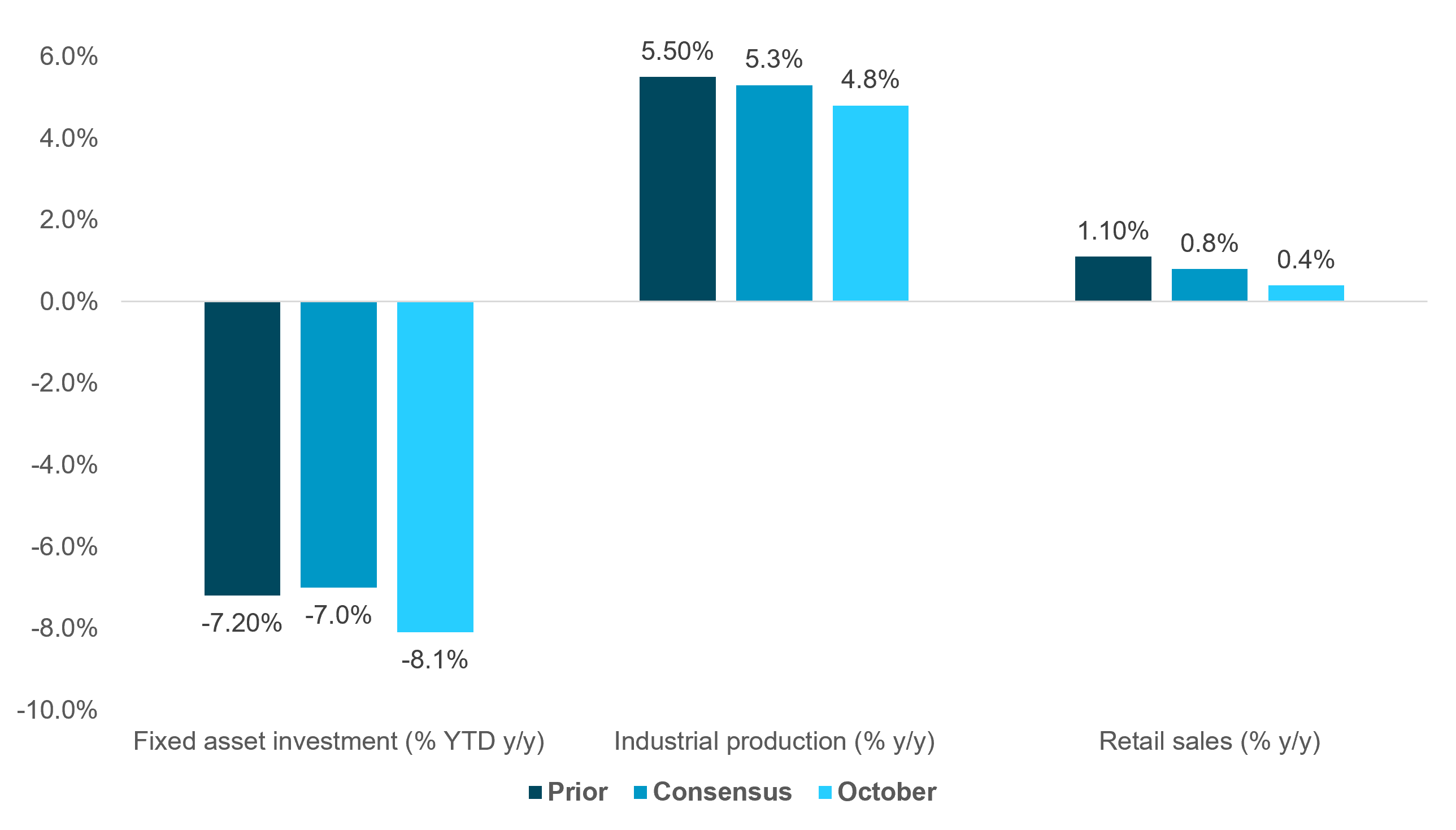
Caution remains warranted. China’s latest activity data suggest growth momentum weakened broadly in October from September, spanning fixed asset investment, industrial output and retail sales. Fixed asset investment fell 8.1% y/y year to date, a bigger drop than the 7.0% decline expected, while October industrial output rose 4.8% y/y, below the 5.3% consensus. October retail sales rose 0.4% y/y, missing the 0.8% forecast despite support from National Day holiday travel.
EXHIBIT #3: CHINA’S OCTOBER ACTIVITY DATA SLOWED AND MISSED FORECASTS
Source: Bloomberg, BNY
Property remains a key drag. New-home prices across 70 major cities fell 0.15% m/m in October, after a 0.14% decline in September, despite additional policy support. Measures announced on September 29 included mortgage interest subsidies for some first-home buyers, worth 1pp of mortgage principal annually for up to five years, but the effect on sales appears modest so far, even over the usually busier National Day holiday. January to October property development investment fell 21.6% y/y.
The gap between market support and the macro backdrop matters for the trade. Equities don’t necessarily require a strong macro reacceleration if policymakers are increasingly willing to limit downside. But the weak domestic backdrop argues against extrapolating targeted market support into a broad China reflation call.
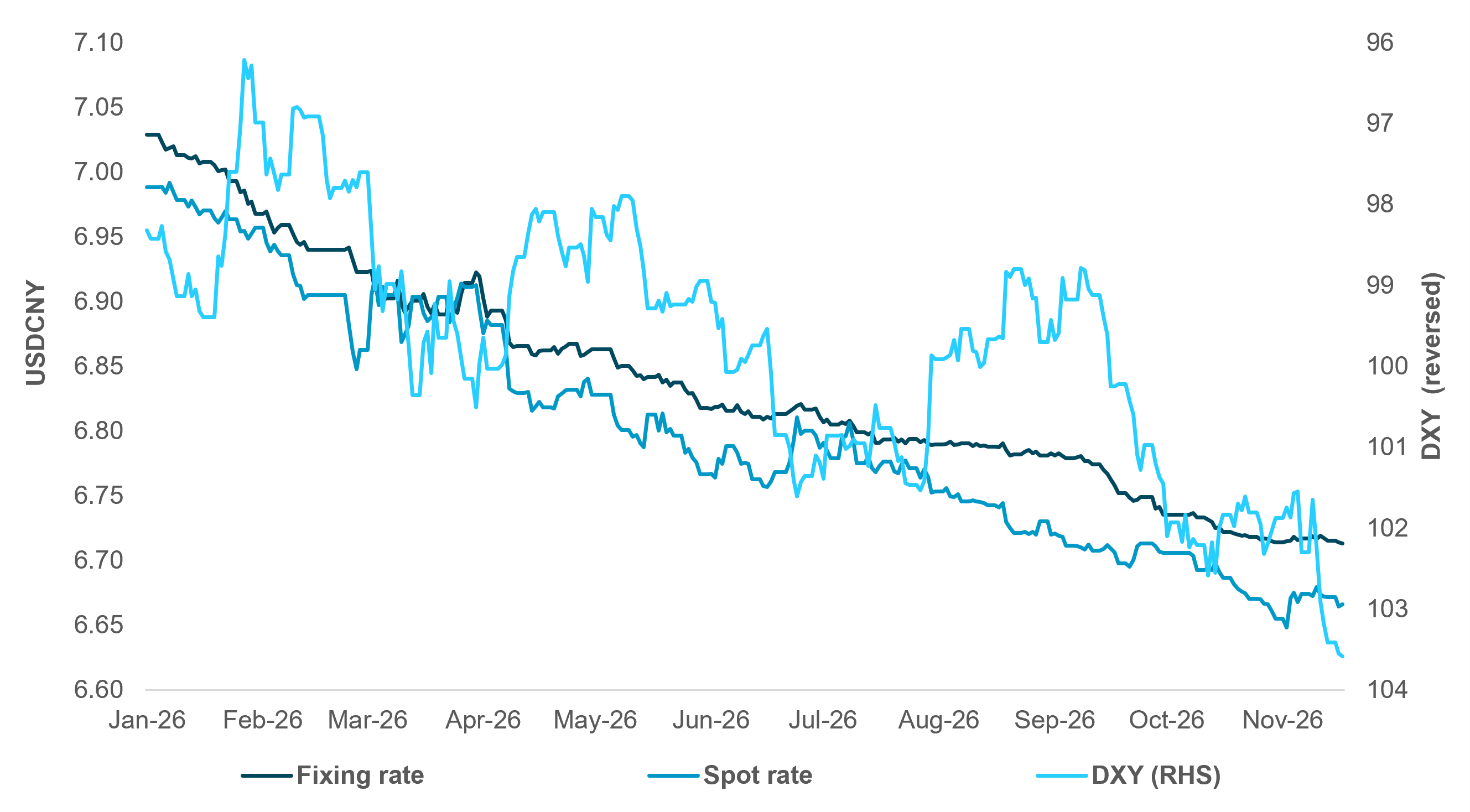
On November 3, the PBOC announced a 2pp increase in the FX reserve requirement ratio for financial institutions, from 4% to 6%, which took effect November 15. The increase looks less like a reversal signal than an attempt to moderate the speed of appreciation and temper one-way expectations. History supports that reading. When the PBOC last raised the ratio in late 2021, the impact was tactical rather than trend-changing, and the tool was later adjusted as conditions evolved.
EXHIBIT #4: USDCNY KEEPS DRIFTING LOWER DESPITE A FIRMER DOLLAR
Source: Bloomberg, BNY
The deeper story isn’t daily fixing but the RMB’s expanding role in trade settlement, financing, investment and cross-border payments, which is widening into a broader financial ecosystem.
Source: PBoC, BNY
The RMB’s share of cross-border settlements hit a record 62% in H1 2026, according to the PBOC 2026 RMB Internationalization Report. Cross-border RMB receipts and payments totaled ¥70.6tn in 2025 (+10.1%) and ¥42.4tn in H1 2026 (+21.4% y/y). Securities-related flows reached ¥26.1tn in H1 2026 (+25.4% y/y). Foreign investors held ¥11.3tn (+9.2% y/y) of onshore RMB financial assets by June 2026, Panda bond issuance reached ¥160bn in H1 2026 (circa +70% y/y), and offshore RMB bond issuance rose 94.4% y/y to ¥896.1bn.
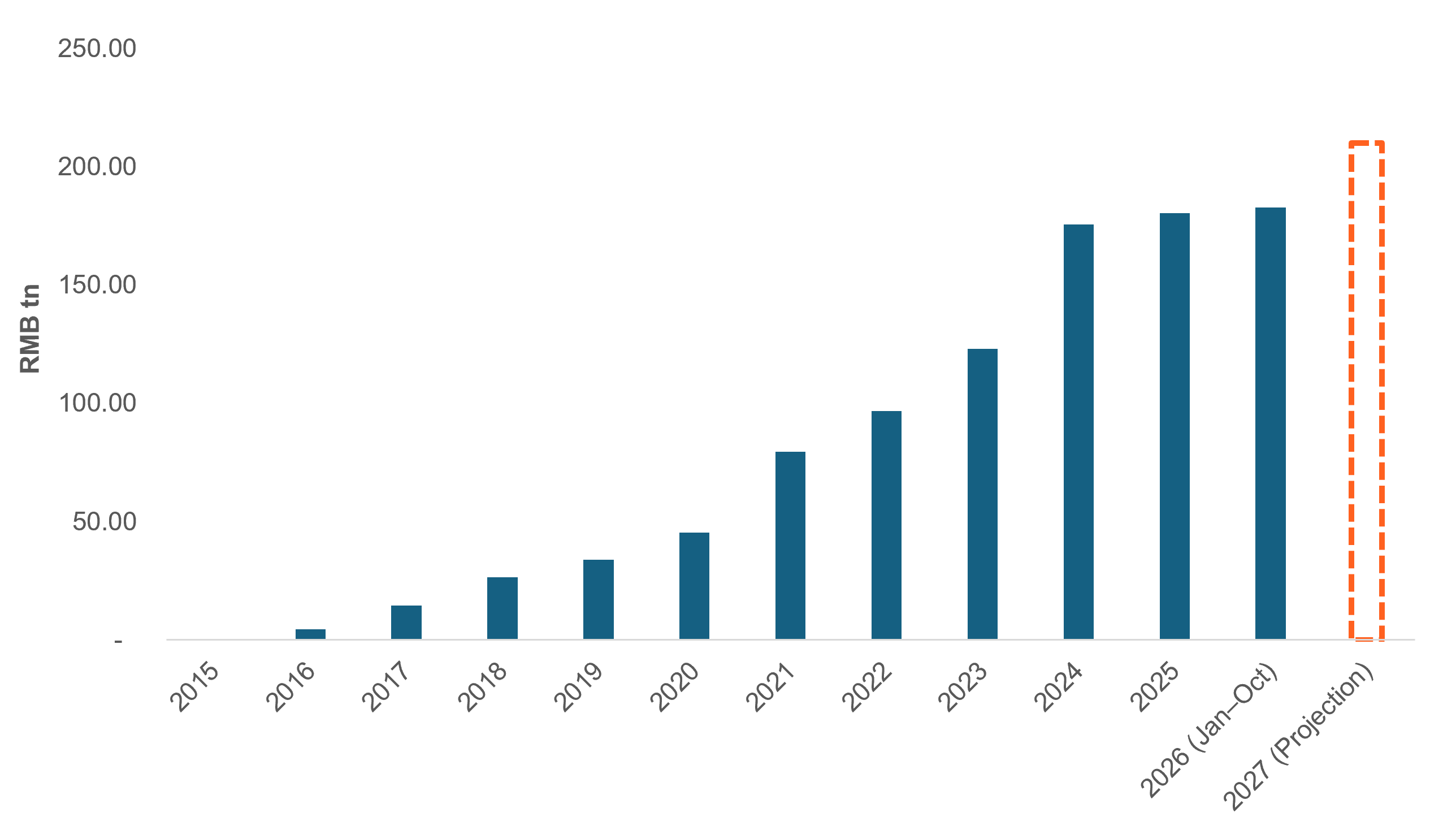
Infrastructure is keeping pace: China’s Cross-Border Interbank Payment System (CIPS) processed ¥182.8tn through October 2026, already above the full-year 2025 total, while the network of RMB clearing banks, cross-border arrangements and bilateral currency swaps keeps broadening.
EXHIBIT #5: CIPS TRANSACTION VALUE HAS ALREADY TOPPED 2025’S FULL-YEAR TOTAL
Source: CIPS, BNY. 2027 full-year projection illustrates our medium-term view.
Targeted support makes equities the cleaner near-term expression, with Hong Kong first. The RMB is the deeper structural story, and we’re constructive over the medium term, but the PBOC is likely to manage the pace closely and lean against excessive moves in either direction.
Near term: Watch whether Hong Kong EQ scored holdings keep rising toward 1.10, the year-to-date high – or ideally 1.24, the 2025 high – which would show policy support turning into renewed investor interest.
Medium term: Watch CIPS transaction value and USDCNY. Continued growth in CIPS transaction value would confirm the RMB’s expanding role in trade and finance, while a steady, gradual decline in USDCNY would support our medium-term CNY conviction.