Data & Analytics
Cloud-native and AI enabled platform for data and operations.
Performance used to be treated as an end-of-cycle reporting function. But the performance function is undergoing profound transformation led by the rapid evolution of institutional investing. The convergence of public and private portfolios, shorter settlement windows and rising transparency demands are transforming performance into a strategic data product shaping investment, risk, oversight and distribution. Meeting these demands requires uniting proven performance methodologies and deep domain expertise with a modern, cloud-native, data-centric Performance Book of Records (PBOR). Early adopters are combining these capabilities to build an advantage in a changing industry.
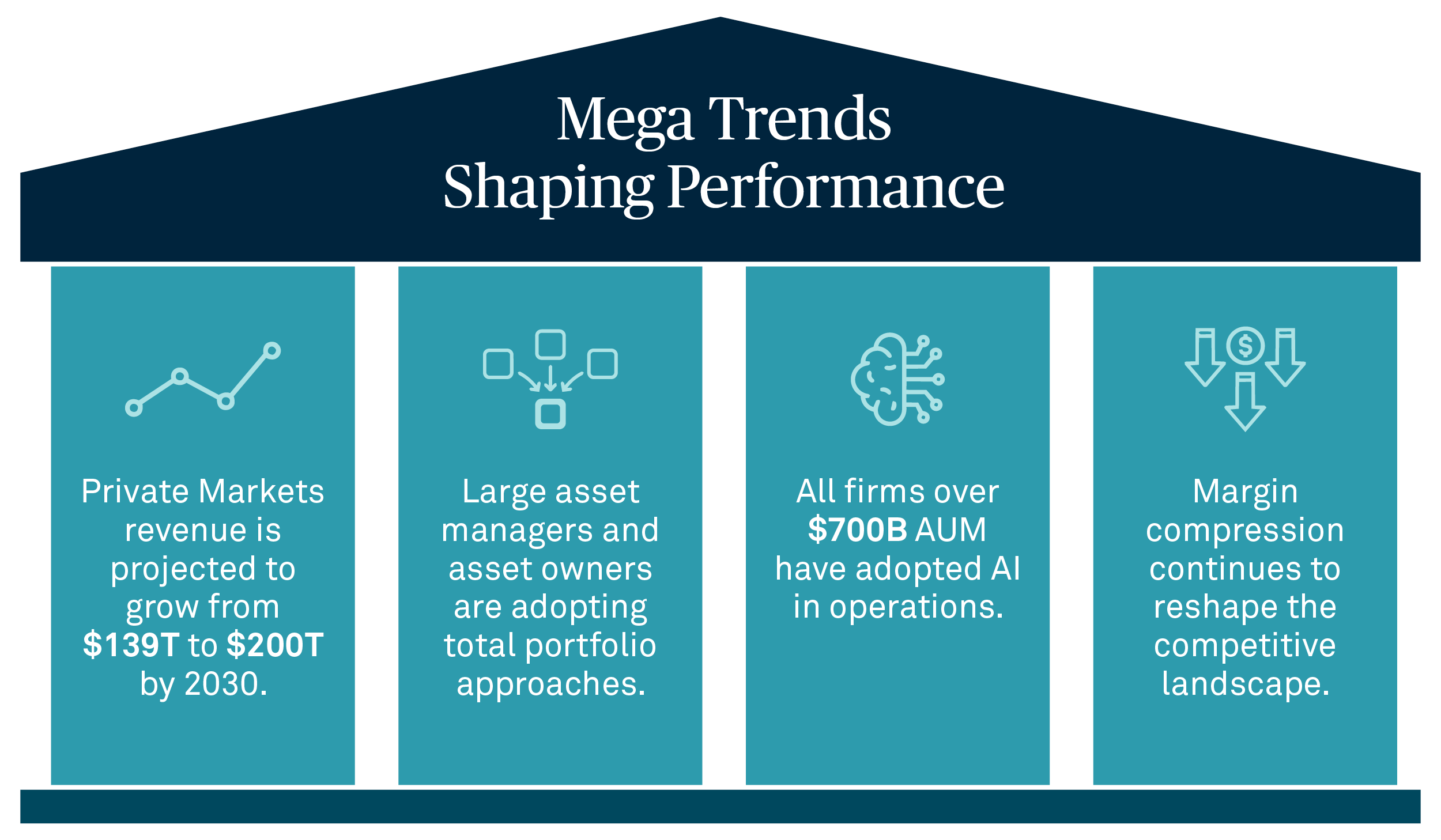
Four macro trends are converging in institutional investing, each directly impacting the performance function:
Performance is at the intersection of all four of these trends. It’s where investment decisions are explained to clients and boards, where auditors and verifiers look for evidence of process, and where every new asset class and distribution channel creates fresh data requirements. Legacy performance systems built around equity and fixed income benchmarks struggle when the portfolio includes drawdown funds, co-investments, tokenized assets and overlay strategies. The pressure isn’t incremental. It’s structural.
For asset managers and asset owners, the practical consequences of these macro trends show up in four places.
Time to answer. CIOs and boards want attribution at portfolio, strategy and total fund levels on demand, not at month-end. Calculation cycles that previously ran for hours on overnight batch now need to respond to intraday queries and ad-hoc scenario requests.
Asset coverage. Private market allocations require IRR, TVPI, DPI, public market equivalents and illiquidity-adjusted attribution alongside time-weighted returns for the public book. The methodology is well understood, but most performance books of record were never designed to hold both bases natively or to reconcile them at a total fund level.4
Audit and reporting framework burden. GIPS compliance, client due diligence questionnaires and internal model governance all demand full lineage — which price, on which date, from which source, reconciled to which accounting record.5 Manual reconciliation across disconnected systems is where errors compound.
Cost and talent. Deloitte's 2025 investment management outlook notes that firms are rebuilding data center strategy around AI workloads, which require low-latency, high-throughput infrastructure that legacy performance platforms cannot supply.6 At the same time, specialists who maintain aging performance engines are retiring, and their replacements expect modern tooling. The net effect: performance teams spend more effort explaining the numbers than producing insight from them.
Shift from application-centric to data-centric. A Performance Book of Record should be a defined, governed set of return streams, exposures and classifications that any downstream consumer, including client reporting, regulatory filings, risk analytics and AI agents, can draw from. This replaces the older pattern where every system maintains its own copy of returns and reconciles after the fact.
Separate calculation from storage and delivery. Modern architectures let firms scale compute elastically for month-end and quarter-end peaks without over-provisioning year-round. Consumption-based licensing on cloud data platforms has already lowered the entry cost for this pattern across the industry.7
Instrument private markets natively. Rather than bolting private market calculations onto a public-markets engine, performance platforms need data models that treat commitment schedules, capital calls and J-curves as first-class concepts.
Build for agents, not just analysts. As AI agents consume performance data directly, schemas and APIs need to be parsable by machines as well as readable by humans. This is the shift from dashboards to interfaces, and it’s happening faster than most roadmaps anticipate.
These aren’t optional upgrades. They're the operating assumptions of any performance product that will be competitive over the next five years.
Cloud is the substrate, but cloud alone isn’t the story. Firms that simply rehost legacy performance applications on infrastructure-as-a-service inherit the same bottlenecks in a more expensive environment. The value comes from cloud-native architecture — separated storage and compute, event-driven processing, elastic scale, API-first access and native integration with the data platforms asset managers already use for analytics.
Three capabilities matter most:
Technology doesn't substitute for domain expertise. Performance has thirty years of accumulated methodology — GIPS, multi-period linking, currency hedging attribution, fixed income decomposition — that no cloud migration erases. What matters is the combination: methodology carried forward on infrastructure that can answer the questions clients are asking now.
For firms pursuing this path, BNY Data & Analytics can help by pairing performance domain depth with a modern platform architecture. For more than two decades, BNY’s Performance & Analytics Solutions has measured returns and attribution for asset managers, asset owners and service providers. That domain expertise is embedded in the calculation engine, data model and workflows that support GIPS claims, regulatory reporting and client delivery.8
The current generation is SaaS-delivered and cloud-native, built to unify data management, investment accounting and performance and analytics on a single architecture. It supports multi-currency, multi-asset operations and scales with data volume.9 An enterprise PBOR spans portfolios across back-office systems, so firms operating multiple accounting platforms, a common state after mergers or in multi-boutique structures, can produce a single, governed return stream. That matters because modernization succeeds when firms don’t have to choose between methodological depth and operational agility.9
Three points deserve emphasis for firms evaluating the path forward:
These recommendations are independent of vendor choice. They describe what any institutional investor should do to position the performance function for the next decade.
Early adopters aren’t betting on cloud in the abstract. They’re betting that modern infrastructure combined with thirty years of performance methodology produces compounding advantages — faster cycles, better answers, lower cost to serve. The window for that advantage closes as the architecture becomes the industry default.
1PwC, “2025 Global Asset & Wealth Management Report,”November 24, 2025. https://www.pwc.com/gx/en/news-room/press-releases/2025/pwc-2025-global-asset-wealth-management-report.html
2CAIA Association, “A Blueprint for Total Portfolio Allocation with Private Assets,” July 2025. https://caia.org/blog/2025/07/21/blueprint-total-portfolio-allocation-private-assets
3Alpha FMC, “Key Trends Shaping Asset Management Operations in 2025,” Global Operations Survey. https://alphafmc.com/blog/2026/04/07/key-trends-shaping-asset-management-operations-in-2025/
4Ortec Finance, “Private Asset Performance Attribution to Effectively Analyze Investment Decisions,” webinar series. https://www.ortecfinance.com/en/insights/video/private-asset-performance-attribution-to-effectively-analyze-investment-decisions
5CFA Institute, “Portfolio Performance Evaluation,” Refresher Reading, 2026. https://www.cfainstitute.org/insights/professional-learning/refresher-readings/2026/portfolio-performance-evaluation
6Deloitte, “2025 Tech Trends for Investment Management.” https://www.deloitte.com/us/en/services/consulting/articles/technology-trends-2025-investment-management.html
7Alpha FMC, “What Are the Latest Trends in Asset Management Operations?” May 2025. https://alphafmc.com/blog/2025/05/02/what-are-the-latest-trends-in-asset-management-operations/
8BNY, “Eagle Performance Measurement,” product page. https://www.bny.com/corporate/global/en/solutions/data-and-analytics/performance-measurement.html
9BNY, “Data & Analytics — Investment Management Software and Data Management Solutions.” https://www.bny.com/corporate/global/en/solutions/platforms/data-and-analytics.html