



Global Payments & Trade
Move and manage your money, securely.
Insights
Demand Notes: Beyond the Traditional Corporate Financing Playbook
Eric Ulbrich
Time to Read: 7 minutes
Following the post-pandemic surge — in consumption, inflation and interest rates — financing costs have become materially more expensive for corporations. Tighter monetary policy and a growing set of geopolitical risks further complicate near- and long-term financial planning, leaving management teams to balance investment in future growth with the need to manage borrowing costs.
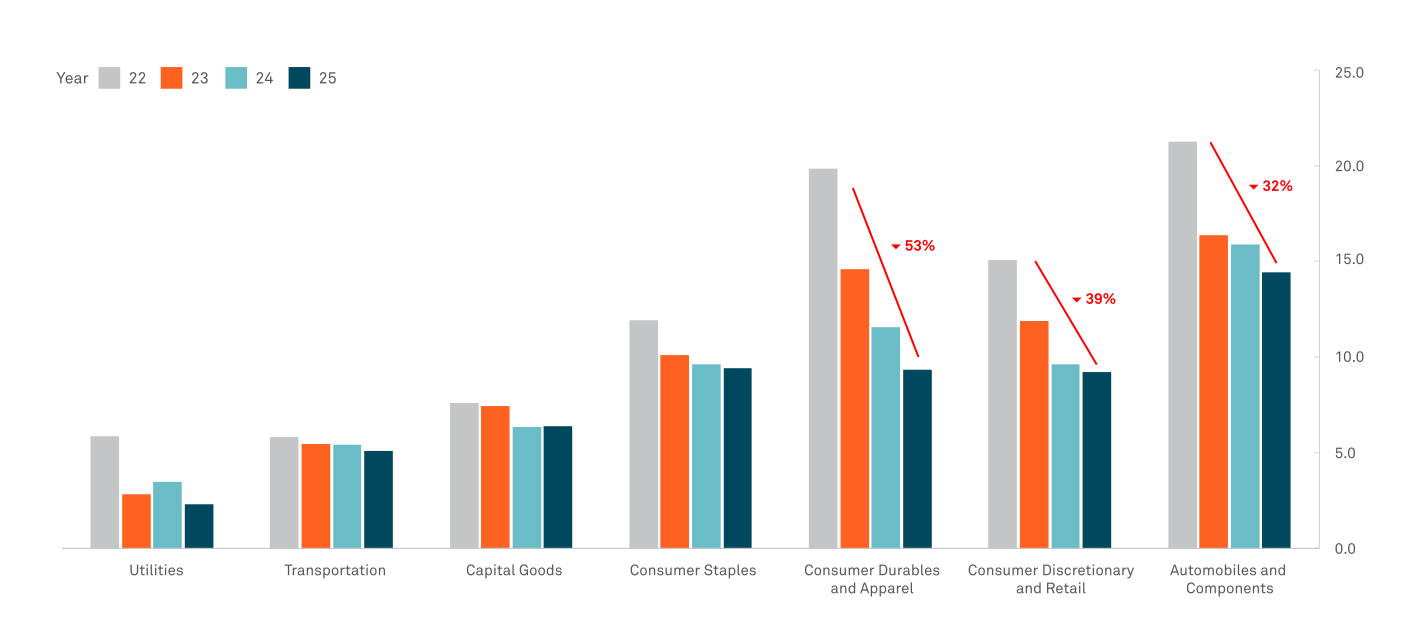
The strain is most pronounced in capital-intensive sectors, where interest expenses grew at more than twice the pace of revenues since 2022. Combined with higher operating costs, this has reduced the cash available to service debt, with interest coverage ratios down 33%, on average, since 2022 (Figure 1).
Figure 1: Interest Coverage Deterioration U.S. Corporate
EBIT-to-Interest Cost Ratio
Source: BNY Analysis of data from CapIQ, sampling includes approximately 1,100 U.S. corporates
This challenge becomes even more prominent when considering planned investments for artificial intelligence, the need to transform global supply chains, as well as the cost to refinance "cheap” corporate debt maturing in an environment of higher borrowing costs. (Figure 2).
Figure 2: Corporate Debt Maturity Schedule
Publicly-traded debt of non-financial, non-services U.S. Companies
Source: BNY analysis of data from CapIQ
We estimate that in 2025, newly issued debt for U.S. corporations (non-financial, non-services companies) was 62 basis points more expensive than like-for-like debt that matured in the same year (Figure 2). Furthermore, despite a higher rate environment over the past three years, these companies issued nearly $1.7 trillion, or 3.8x more debt than the amount that matured during the same time period, adding even greater pressure for corporate finance leaders to find more capital-efficient ways to meet their company’s liquidity and funding needs.
CFOs and corporate treasurers exploring financing strategies beyond the traditional playbook are increasingly turning to demand notes, a funding tool with more than 40 years of history. First pioneered in the auto sector and used by the likes of Ford Motor Co. and Mercedes-Benz, demand notes enable companies to source capital from their customers, employees, suppliers and existing investor base, providing an attractive alternative to traditional debt.
Treated as short-term liabilities, demand notes are unsecured debt instruments where corporates set the interest rate they pay on funds borrowed from investors. Unlike traditional borrowing vehicles, demand notes have no fixed maturity because investors have the right to “demand” repayment of principal at any time. To balance repayment “demand” with fresh inflow of funds, demand note programs are typically implemented as continuous borrowing programs where funds are raised directly from investors on an ongoing basis.
"The inherent control corporate finance leaders gain through a modernized demand note program have made demand notes attractive to a broader range of corporates, particularly amid heightened volatility and uncertain market conditions."
While the ability to demand repayment at any time is an attractive feature for investors, demand note programs also offer equally attractive features for corporates (“issuers”). Issuers control both the size of their demand note program and the rate that they market to investors. Maintaining control of these levers provides flexibility for CFOs and treasurers to create a reliable funding source all while maintaining healthy interest expense and capital levels.
Demand note programs have long been a feature of auto sector funding models, where auto manufacturers have leveraged their brand loyalty to attract investors. The inherent control corporate finance leaders gain through a modernized demand note program have made demand notes particularly attractive amid heightened volatility and uncertain market conditions, to a broader range of corporates.
For a corporate issuing demand notes, the advantages extend beyond circumventing the rigidness of traditional debt with fixed maturity schedules. The open-ended structure of a demand note program frees issuers from the underwriting and re-issuance fees typically associated with public debt offerings. By raising capital directly from investors, issuers can save on intermediary costs associated with traditional borrowing vehicles, which has the potential to significantly benefit the bottom-line.
To promote further cost savings, issuers can leverage on-demand liquidity scaling — the ability to raise or lower the offered rate depending on liquidity or interest expense needs. For example, should an issuer need to raise lower-cost funds to pay back a maturing bond issuance or attract additional on-hand cash, they could prompt an influx of note purchases with attractive, competitive rates. Conversely, issuers can lower rates to reduce interest expense when existing cash reserves cover capital needs and additional liquidity is not required.
While interest on demand notes typically tracks the Federal Funds Rate (FFR), issuers maintain the flexibility to raise or lower their rates depending on their company’s liquidity needs. For example, demand note interest rates offered by various public programs have followed FFR trends, while tracking below BBB bond yields and above one-year certificate of deposit (CD) rates. (Figure 3)
Figure 3: Flexible Financing for Corporates with Demand Notes
Source: Federal Reserve, BNY
For investors, demand notes offer a compelling combination of higher yields and liquidity, serving as an open-access investment vehicle without the fixed-term lockups typical of CDs. Investors benefit from the ability to redeem funds at any time without facing withdrawal penalties or market fluctuations seen in seemingly low-risk securities. Demand notes are accessible to a broad array of investors, often with low minimum investments—sometimes as little as $500—and they can help investors avoid paying brokerage or management fees.
For issuers, the success of a demand note program hinges less on conventional credit ratings and more on intangible assets such as brand credibility, trust and loyalty. Corporates can leverage strong relationships with customers, suppliers, employees and existing investors to attract and retain a diverse, long-term investor base. This dynamic is evident in sectors like automotive, where some of the largest demand note programs are run by companies with credit ratings below their peers but enjoy high brand recognition and trust.
By transforming brand loyalty into a strategic financial asset, issuers can unlock new capital sources and engage investors who prioritize brand strength over traditional credit metrics. Demand notes thus provide a unique opportunity for companies to diversify funding channels and build investor confidence rooted in brand affinity rather than solely on creditworthiness.
At the outset, the issuer must decide whether to offer their note program as a public offering or private placement. At the core of both public and private programs is a flexible, short-term funding solution — but program types differ in structure, regulation and overall strategy.
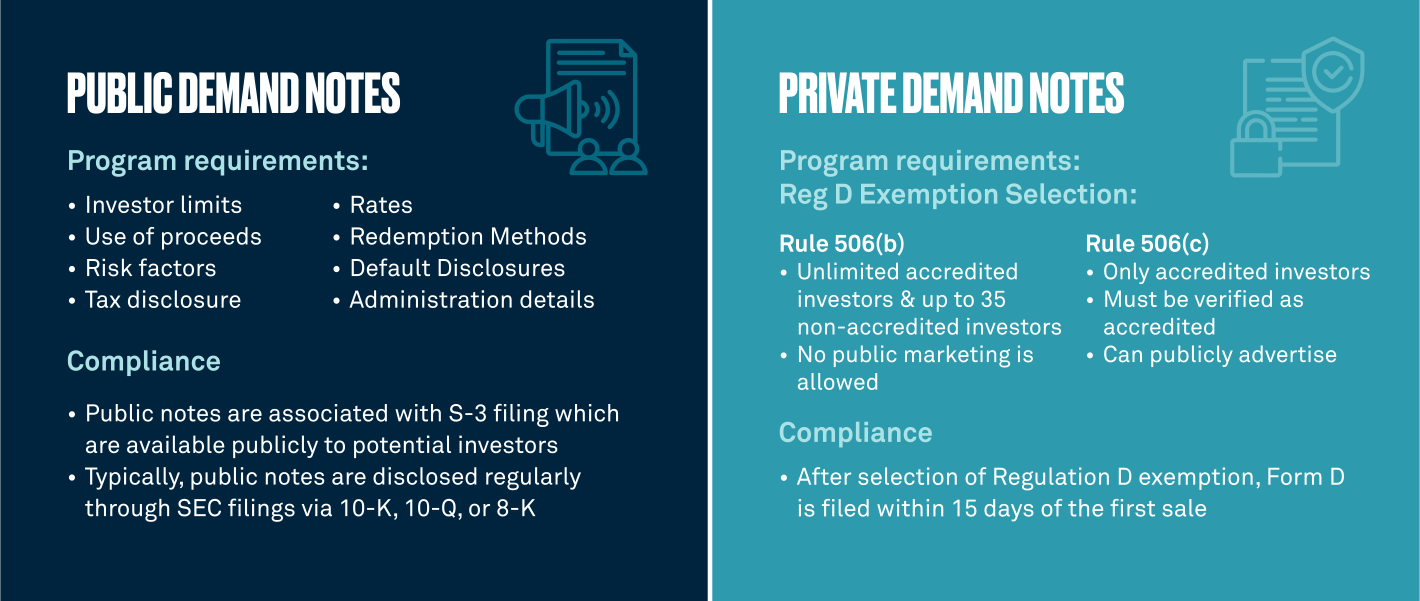
The main distinction between a public and private program lies in the composition of investor access and associated reporting requirements (Figure 4).
Figure 4: Reporting Considerations for Demand Note Programs
Public demand note programs are open to both individual and institutional investors, enabling issuers to engage a broad audience, including their own customers and employees.
Private programs, on the other hand, are limited to accredited investors and, under Rule 506(b), a specified number of non-accredited investors. Since advertising private demand note programs is often limited, they are typically used for more targeted fundraising with a select investor base that the issuer must define. While a formal investment prospectus is generally not required, a private placement memorandum is necessary to ensure investors understand risk factors, program features and limitations for a private program.
Once the demand note program has been established and the investor base defined, issuers need to begin developing a thorough understanding of their investors’ key characteristics to help drive success and efficiency.
Figure 5: Demand Notes Program Launch Process
For corporate finance leaders aiming to get started with demand notes, establishing an analytics-oriented approach should be viewed as fundamental in the successful promotion and growth of the program. As a demand note program matures, investor data can reveal valuable patterns in balance volatility, concentration and responsiveness to market conditions. Extracting and acting on these insights is central to improving program efficiency, optimizing funding costs and strengthening long-term participation.
Geography, demographics and behavioral trends are basic characteristics that drive program expansion and optimization. An issuer who refines their rollout strategy according to their investors’ attributes is better able to allocate resources and advertising spend to maximize investor participation (Figure 6).
Analytics can be leveraged to develop advanced risk models that help evaluate the relative “stickiness” of investors’ funds, including behavioral segmentation, which tracks how different investor groups respond to rate changes, outreach efforts or economic conditions. With this information, issuers are empowered to make smarter rate decisions, improve investor engagement strategies, and fine-tune the program for long-term success.
For example, if an issuer observes that the balances belonging to investors who are also employees stay consistent even during times of low consumer confidence, they can leverage the trust employees have in the brand to build a reliable source of liquidity. Similarly, if an issuer notices that younger investors tend to keep their funds invested for longer, extending the average duration of a program, it may be beneficial to focus advertising efforts on the social media channels most popular with that audience.
Figure 6: Identifying a Demand Note Program Investor
As traditional sources of capital come under pressure from rising costs and unpredictable market dynamics, establishing a demand notes program can offer a flexible alternative for today’s corporate finance leaders. By combining strategic control with investor-centric features, demand notes empower CFOs and treasurers to optimize liquidity, reduce financing costs, and diversify funding sources — all while harnessing the strength of their brand.
Author: Eric Ulbrich, Director, Client Advisory, Global Payments & Trade
Disclaimer
BNY is the corporate brand of The Bank of New York Mellon Corporation and may be used to reference the corporation as a whole and/or its various subsidiaries generally. This material and any products and services mentioned may be issued or provided in various countries by duly authorized and regulated subsidiaries, affiliates, and joint ventures of BNY. This material does not constitute a recommendation by BNY of any kind. The information herein is not intended to provide tax, legal, investment, accounting, financial or other professional advice on any matter, and should not be used or relied upon as such. The views expressed within this material are those of the contributors and not necessarily those of BNY. BNY has not independently verified the information contained in this material and makes no representation as to the accuracy, completeness, timeliness, merchantability or fitness for a specific purpose of the information provided in this material. BNY assumes no direct or consequential liability for any errors in or reliance upon this material.
This material may not be reproduced or disseminated in any form without the express prior written permission of BNY. BNY will not be responsible for updating any information contained within this material and opinions and information contained herein are subject to change without notice. Trademarks, service marks, logos and other intellectual property marks belong to their respective owners.
© 2026 BNY. All rights reserved. Member FDIC.