Making bucketing work: avoiding the pitfalls
To be successful in the long run, buffer and bucketing structures used in UK retirement income portfolios need to be astutely implemented.
 4 mins Reading time
Published on 23 July 2026
4 mins Reading time
Published on 23 July 2026


Key takeaways
- Buffer and bucketing strategies used in UK retirement income portfolios need to be astutely implemented if they are to achieve long-run success for the person drawing a retirement income.
- Implementation risks to be mindful of include cash drag, one-way rebalancing and unintended portfolio drift.
- Some ways in which these strategies can deliver better outcomes are by assessing risk and allocation at total portfolio level and by ensuring that rebalancing supports portfolio discipline rather than rigid bucket maintenance.
In our view, buffer and bucketing strategies – used thoughtfully – can support better client behaviour and more confident decision-making. However, used rigidly, they can introduce drag, distort rebalancing and ultimately reduce longer-term income sustainability.
The risk of cash drag
Cash can provide stability, but over time it is unlikely to match the investment return potential of bonds or equities. If too much is held in reserve, or if it is replenished too mechanically, the portfolio may sacrifice growth that is needed to sustain income over the long term.
The chart below, based on BNY research, shows the longer-term results on a 60/40 and 70/30 portfolio of using no cash buffer, using a cash buffer with an automatic top-up and using a cash buffer with a conditional top-up1.
Comparison of investment and withdrawal approaches (300 rolling 25-year periods)
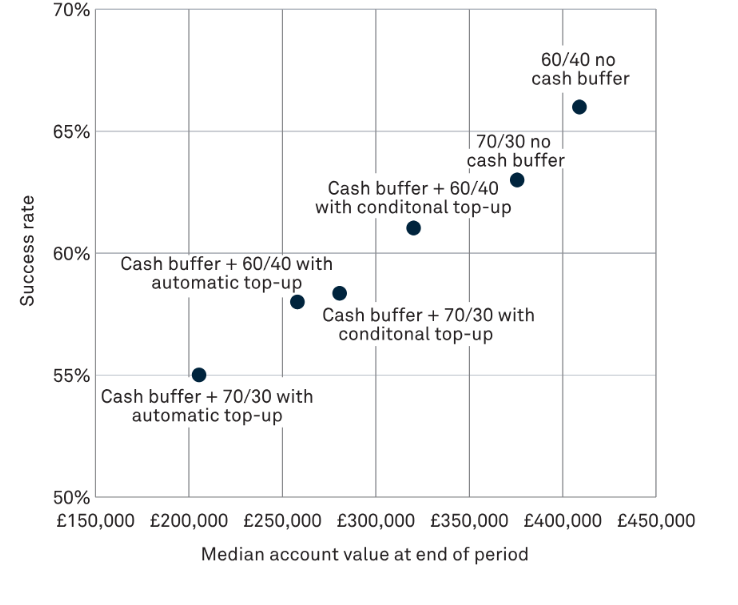
Source: BNY Investments. Cash returns are UK bank base rate less a 0.75% p.a. deduction to reflect advice and management fees. Growth portfolio returns are a weighted average of MSCI World NR GBP and FTSE Act UK Conventional Gilts All Stocks TR GBP rebalanced quarterly less a 1.25% p.a. deduction to reflect advice and management fees. All figures are in GBP terms. Success rate refers to the proportion of 25-year periods in which the client does not run out of money before the end of the period. The 300 rolling 25-year periods start at the end of 1975 and end at the end of 2025. Each period starts one month later than the previous one, creating 300 overlapping 25-year “retirement journeys”. This is for illustrative purposes only and does not take into account other factors that may have a negative impact on an investment.
One-way rebalancing
In practice, rebalancing often becomes a one-way process in which growth assets are sold to refill cash. That may feel prudent, but it can interfere with sound portfolio management.
Effective rebalancing typically involves selling relative outperformers and adding to areas that have fallen behind. After a market decline, that may mean increasing exposure to growth assets so the portfolio can participate in the recovery. A rigid bucket structure can prevent this, leaving the portfolio too cautious at exactly the wrong time. The result is weaker recovery potential or reduced “bouncebackability”. The longer the portfolio remains depressed, the longer withdrawals are made from a reduced capital base.
This is one of the main reasons a comparable multi-asset portfolio may outperform a rigidly managed bucketing approach. Managed at total portfolio level, it is more likely to rebalance in a way that supports long-term outcomes rather than simply servicing the mechanics of a bucket structure.
An example here is BNY’s multi-asset, dynamically managed retirement income fund range (FutureLegacy). Specifically designed to be used either as a standalone vehicle or as a building block in UK retirement income strategies, the funds in the FutureLegacy range align to different Dynamic Planner risk profiles – facilitating flexibility and ease of use for advisers2.
Portfolio drift
The third challenge is less visible but equally important: portfolio drift. When buckets are treated as separate compartments, strong market moves can alter the overall asset mix in ways that may not be immediately obvious. A rising equity market, for example, may leave the long-term bucket representing a larger share of the total portfolio than intended. If markets then turn, the client may be exposed to more risk than originally planned.
This matters because clients experience outcomes at total portfolio level, not by individual bucket. However intuitive a bucketed structure may look, it should never be allowed to obscure whether the client’s overall allocation still reflects their objectives, income profile and tolerance for risk.
Some practical findings
- Not using a cash buffer can deliver better results than using a cash buffer both in terms of the success rate (not running out of money) and longer-term average account values.
- Cash buffers should be used sparingly and purposefully. The role of cash is to support spending confidence, not to become a substitute for disciplined portfolio construction.
- Avoid automatic top-ups that may lock in losses after market weakness. Applying a conditional rule where cash is topped up only when the growth assets have delivered a positive return achieves a better longer-term result.
- Trying to compensate for cash drag by increasing equity exposure to 70% typically delivers a worse outcome. Although overall returns may be higher on average, the additional volatility and downside risk leads to the client running out of money in more of the scenarios than for a 60% equity portfolio.
Some investment principles
We believe advisers can make buffer, bucketing and rebalancing strategies deliver better outcomes for clients by:
- Assessing risk and allocation at total portfolio level.
- Ensuring rebalancing supports portfolio discipline rather than rigid bucket maintenance.
- Anchoring asset allocation in the client’s expected income needs over time.
In summary, buffers and buckets continue to resonate because they address one of the hardest challenges in retirement planning: helping clients feel secure while drawing from invested assets. They can improve understanding, support confidence and make the link between investments and income more tangible.
But implementation need not rely on rigid, separately managed buckets. In many cases, a diversified multi-asset portfolio can provide a more effective core solution, with only a modest cash reserve added where it genuinely improves client confidence. That approach can preserve the communication benefits of buffering while reducing the risks of cash drag, one-way rebalancing and unintended drift.
For advisers, the opportunity lies in combining the best of both worlds: using the clarity of the bucket concept to support client understanding, while relying on robust portfolio construction and rebalancing to support long-term sustainability.
BNY Mellon FutureLegacy funds – key investment risks
- Objective/Performance Risk: There is no guarantee that the Fund will achieve its objectives.
- Currency Risk: This Fund invests in international markets which means it is exposed to changes in currency rates which could affect the value of the Fund.
- Derivatives Risk: Derivatives are highly sensitive to changes in the value of the asset from which their value is derived. A small movement in the value of the underlying asset can cause a large movement in the value of the derivative. This can increase the sizes of losses and gains, causing the value of your investment to fluctuate. When using derivatives, the Fund can lose significantly more than the amount it has invested in derivatives.
- Changes in Interest Rates & Inflation Risk: Investments in bonds/money market securities are affected by interest rates and inflation trends which may negatively affect the value of the Fund.
- Credit Ratings and Unrated Securities Risk: Bonds with a low credit rating or unrated bonds have a greater risk of default. These investments may negatively affect the value of the Fund.
- Credit Risk: The issuer of a security held by the Fund may not pay income or repay capital to the Fund when due.
- Emerging Markets Risk: Emerging Markets have additional risks due to less developed market practices.
- Share Class Currency Risk: Where a share class is denominated in a different currency from the base currency of the Fund, changes in the exchange rate between the share class currency and the base currency may affect the value of your investment.
- China Interbank Bond Market and Bond Connect risk: The Fund may invest in China interbank bond market through connection between the related Mainland and Hong Kong financial infrastructure institutions. These may be subject to regulatory changes, settlement risk and quota limitations. An operational constraint such as a suspension in trading could negatively affect the Fund's ability to achieve its investment objective.
- Volcker Rule Risk: The Bank of New York Mellon Corporation or one of its affiliates ("BNYM") has invested in the Fund. As a result of restrictions under the "Volcker Rule," which has been adopted by U.S. Regulators, BNYM must reduce its shareholding percentage so that it constitutes less than 25% of the Fund within, generally, three years of the Fund's establishment (which starts when the Fund's manager begins making investments for the Fund). Risks may include: BNYM may initially own a proportionately larger percentage of the Fund, and any mandatory reductions may increase Fund portfolio turnover rates, resulting in increased costs, expenses and taxes. Details of BNYM's investment in the Fund are available upon request.
- CoCos Risk: Contingent Convertible Securities (CoCos) convert from debt to equity when the issuer's capital drops below a pre-defined level. This may result in the security converting into equities at a discounted share price, the value of the security being written down, temporarily or permanently, and/or coupon payments ceasing or being deferred.
- Responsible Investing Risk: The investment policy for this Fund places restrictions on its exposure to certain sectors or types of investments to reflect its responsible investing approach. The Fund's performance may be negatively impacted due to these restrictions in comparison to funds which do not have these restrictions. The Fund will not engage in securities lending activities and, therefore, may forego any additional returns that may be produced through such activities.
- Counterparty Risk: The insolvency of any institutions providing services such as custody of assets or acting as a counterparty to derivatives or other contractual arrangements, may expose the Fund to financial loss.
BNY Mellon FutureLegacy 3 Fund
Investment Objective: To achieve capital growth and potential for income over the long term (5 years or more) while being managed to a pre-defined level of risk. The Fund will aim to maintain a risk profile classification of 3 from a scale of 1 (lowest) to 10 (highest) which is assessed against the risk ratings scale provided by an external third-party risk rating agency.
Performance Benchmark: The Fund is actively managed without benchmark-related constraints. The Fund will measure its performance against the Investment Association's Mixed Investment 0-35% Shares NR Sector Average as a comparator benchmark (the "Benchmark"). The Fund will use the Benchmark as an appropriate comparator because it includes a broad representation of funds with levels of equity and bond exposure similar to those of the Fund.
Effective 1 August 2025, the Fund’s benchmark changed from 15% SONIA GBP, 55% ICE BofA Global Broad Index GBP Hedged and 30% MSCI ACWI GBP NR to the Investment Association's Mixed Investment 0-35% Shares NR sector average. Benchmark performance shown for all time periods is that of the Investment Association's Mixed Investment 0-35% Shares NR sector average.
BNY Mellon FutureLegacy 4 Fund
Investment Objective: To achieve capital growth and potential for income over the long term (5 years or more) while being managed to a pre-defined level of risk. The Fund will aim to maintain a risk profile classification of 4 from a scale of 1 (lowest) to 10 (highest) which is assessed against the risk ratings scale provided by an external third-party risk rating agency.
Performance Benchmark: The Fund is actively managed without benchmark-related constraints. The Fund will measure its performance against the Investment Association's Mixed Investment 20-60% Shares NR Sector Average as a comparator benchmark (the "Benchmark"). The Fund will use the Benchmark as an appropriate comparator because it includes a broad representation of funds with levels of equity and bond exposure similar to those of the Fund.
Effective 1 August 2025, the Fund’s benchmark changed from 10% SONIA GBP, 45% ICE BofA Global Broad Index GBP Hedged and 45% MSCI ACWI GBP NR to the Investment Association's Mixed Investment 20-60% Shares NR sector average. Benchmark performance shown for all time periods is that of the Investment Association's Mixed Investment 20-60% Shares NR sector average.
BNY Mellon FutureLegacy 5 Fund
Investment Objective: To achieve capital growth and potential for income over the long term (5 years or more) while being managed to a pre-defined level of risk. The Fund will aim to maintain a risk profile classification of 5 from a scale of 1 (lowest) to 10 (highest) which is assessed against the risk ratings scale provided by an external third-party risk rating agency.
Performance Benchmark: The Fund is actively managed without benchmark-related constraints. The Fund will measure its performance against the Investment Association's Mixed Investment 40-85% Shares NR Sector Average as a comparator benchmark (the "Benchmark"). The Fund will use the Benchmark as an appropriate comparator because it includes a broad representation of funds with levels of equity and bond exposure similar to those of the Fund.
Effective 1 August 2025, the Fund’s benchmark changed from 5% SONIA GBP, 35% ICE BofA Global Broad Index GBP Hedged and 60% MSCI ACWI GBP NR to the Investment Association's Mixed Investment 40-85% Shares NR sector average. Benchmark performance shown for all time periods is that of the Investment Association's Mixed Investment 40-85% Shares NR sector average.
BNY Mellon FutureLegacy 6 Fund
Investment Objective: To achieve capital growth and potential for income over the long term (5 years or more) while being managed to a pre-defined level of risk. The Fund will aim to maintain a risk profile classification of 6 from a scale of 1 (lowest) to 10 (highest) which is assessed against the risk ratings scale provided by an external third-party risk rating agency.
Performance Benchmark: The Fund is actively managed without benchmark-related constraints. The Fund will measure its performance against the Investment Association's Mixed Investment 40-85% Shares NR Sector Average as a comparator benchmark (the "Benchmark"). The Fund will use the Benchmark as an appropriate comparator because it includes a broad representation of funds with levels of equity and bond exposure similar to those of the Fund.
Effective 1 August 2025, the Fund’s benchmark changed from 25% ICE BofA Global Broad Index GBP Hedged and 75% MSCI ACWI GBP NR to the Investment Association's Mixed Investment 40-85% Shares NR sector average. Benchmark performance shown for all time periods is that of the Investment Association's Mixed Investment 40-85% Shares NR sector average.
BNY Mellon FutureLegacy 7 Fund
Investment Objective: To achieve capital growth and potential for income over the long term (5 years or more) while being managed to a pre-defined level of risk. The Fund will aim to maintain a risk profile classification of 7 from a scale of 1 (lowest) to 10 (highest) which is assessed against the risk ratings scale provided by an external third-party risk rating agency.
Performance Benchmark: The Fund is actively managed without benchmark-related constraints. The Fund will measure its performance against the Investment Association's Flexible Investment NR Sector Average as a comparator benchmark (the "Benchmark"). The Fund will use the Benchmark as an appropriate comparator because it includes a broad representation of funds with levels of equity and bond exposure similar to those of the Fund.
Effective 1 August 2025, the Fund’s benchmark changed from 10% ICE BofA Global Broad Index GBP Hedged and 90% MSCI ACWI GBP NR to the Investment Association's Flexible Investment NR sector average. Benchmark performance shown for all time periods is that of the Investment Association's Flexible Investment NR sector average.
The BNY Mellon FutureLegacy funds are actively managed typically by using forward-looking expectations of volatility. In doing so, the Investment Manager uses its own internal risk model, whilst also considering external independent risk profiling methodologies. Based on a risk profile scale of 1 (lowest) to 10 (highest), the funds target a risk profile of 3, 4, 5, 6 or 7 but this is not guaranteed. The risk profile targeted by each of these funds can be identified through the number included in the respective fund name. This risk profile is not the same as the risk and reward category shown in the KIID. The risk profiles are assessed against the risk rating scale provided by Dynamic Planner but are subject to change.
Dynamic Planner Risk Ratings should not be used for making an investment decision and it does not constitute a recommendation or advice in the selection of a specific investment or class of investments.
The funds can invest more than 35% of net assets in different transferable securities and money market instruments issued or guaranteed by the UK or an EEA State, its local authorities, a third country or public international bodies of which the UK or one or more EEA States are members.
Past performance is not a guide to future performance.
The value of investments and the income received can fall as well as rise and investors may not get back the original amount invested.
1To illustrate the effect of holding cash to meet short-term income requirements, we considered how various investment and withdrawal strategies would have fared over the past 50 years. For the purpose of this analysis, we assumed: (1) £1 million initial investment (2) 6% initial withdrawal increasing with inflation each year taken from cash buffer each month (3) Assets divided between a cash buffer (2x current income) and a growth portfolio consisting of: 60% global equities and 40% UK bonds, or 70% global equities and 30% UK bonds. Annual review of cash buffer when we either: Automatic: Always top up cash buffer; or Conditional: Only top up cash buffer if our growth portfolio has increased in value since the last time it was rebalanced. Using these assumptions, we modelled outcomes for the 300 rolling 25-year periods starting at the end of 1975 and ending at the end of 2025. Each period starts one month later than the previous one, creating 300 overlapping 25‑year “retirement journeys”. This allowed us to test outcomes across many different market environments, rather than relying on a single start date. To compare approaches, we considered two measures: (1) the median of the investment values at the end of each 25-year period, and (2) the “success rate”, meaning the proportion of 25-year periods in which the client does not run out of money before the end of the period.
2The BNY Mellon FutureLegacy funds are actively managed, typically by using forward-looking expectations of volatility. In doing so, the Investment Manager uses its own internal risk model, while also considering external independent risk profiling methodologies. Based on a risk profile scale of 1 (lowest) to 10 (highest), the funds target a risk profile of 3, 4, 5, 6 or 7, but this is not guaranteed. The risk profile targeted by each of these funds can be identified through the number included in the respective fund name. This risk profile is not the same as the risk and reward category shown in the KIID. The risk profiles are assessed against the risk rating scale provided by Dynamic Planner but are subject to change. Dynamic Planner Risk Ratings should not be used for making an investment decision and it does not constitute a recommendation or advice in the selection of a specific investment or class of investments.
Important information
For Professional Clients only. This is a financial promotion.
Please refer to the prospectus, KID/KIID or KFS where applicable and other fund documents for a full list of risks and before making any investment decisions. Documents are available in English and in selected local languages where the fund is registered. Go to bny.com/investments.
BNY Investments is the brand name for the investment management business of BNY and its investment firm affiliates worldwide. BNY is the corporate brand of The Bank of New York Mellon Corporation and may be used to reference the corporation as a whole or its various subsidiaries generally.
Any views and opinions are not investment advice or a research recommendation.
BNY Mellon Investment Funds is an open-ended investment company with variable capital (ICVC) with limited liability between sub-funds. Incorporated in England and Wales: registered number IC27. The Authorised Corporate Director (ACD) is BNY Mellon Fund Managers Limited (BNY MFM), incorporated in England and Wales: No. 1998251. Registered address: BNY Mellon Centre, 160 Queen Victoria Street, London EC4V 4LA. Authorised and regulated by the Financial Conduct Authority.
Issued in the UK by BNY Mellon Investment Management EMEA Limited, BNY Mellon Centre, 160 Queen Victoria Street, London EC4V 4LA. Registered in England No. 1118580. Authorised and regulated by the Financial Conduct Authority.
RELATED FUNDS
Easy access to our funds and related content
BNY Mellon FutureLegacy 3 Fund (UK Domiciled)
BNY Mellon FutureLegacy 4 Fund (UK Domiciled)
BNY Mellon FutureLegacy 5 Fund (UK Domiciled)
BNY Mellon FutureLegacy 6 Fund (UK Domiciled)
BNY Mellon FutureLegacy 7 Fund (UK Domiciled)
1710150 Exp : 30 June 2027
YOU MIGHT ALSO LIKE

The move to outcomes-based regulation is changing retirement advice, placing greater emphasis on evidencing client understanding, value and long-term outcomes.

Retirement planning is being reshaped by tax changes, evolving expectations and new regulation, pushing advisers to rethink how they guide clients in later life.

Buffer and bucketing strategies are popular in UK retirement income portfolios. They are intuitive, easy to explain and can give clients confidence during volatile markets.

Retirement can bring emotional and social challenges as well as financial ones, leaving advisers increasingly expected to support clients through a transition that goes far beyond money.
