
Please ensure Javascript is enabled for purposes of website accessibility

How to Reduce the Tax Impact When Selling Your Business

Reducing the Tax Impact on the Sale of Your Business

Thoughtful planning can maximize value and preserve your legacy.

When selling or transitioning a business, few factors are as important as taxes. With the recent tax changes made by the One Big Beautiful Bill Act (OBBBA), strategic planning can make a significant difference in what business owners keep and what they pass on.


The lifetime gift and estate tax exemption has been increased to $15 million, made permanent and will be adjusted annually for inflation. This pending change makes it even more urgent to consider strategies that mitigate taxes not only on the sale itself, but also on the long-term transfer of wealth.


We’ve outlined several proven tax strategies, which are organized around three core planning objectives: reducing income tax, taking advantage of rollovers and exclusions, and transferring ownership in tax-efficient ways.


Three Pillars of Tax-Smart Business Transitioning

Effective tax planning typically falls into three categories: Income Tax Mitigation, Rollover and Exclusion Strategies, and Estate Freezing and Transfer Techniques.


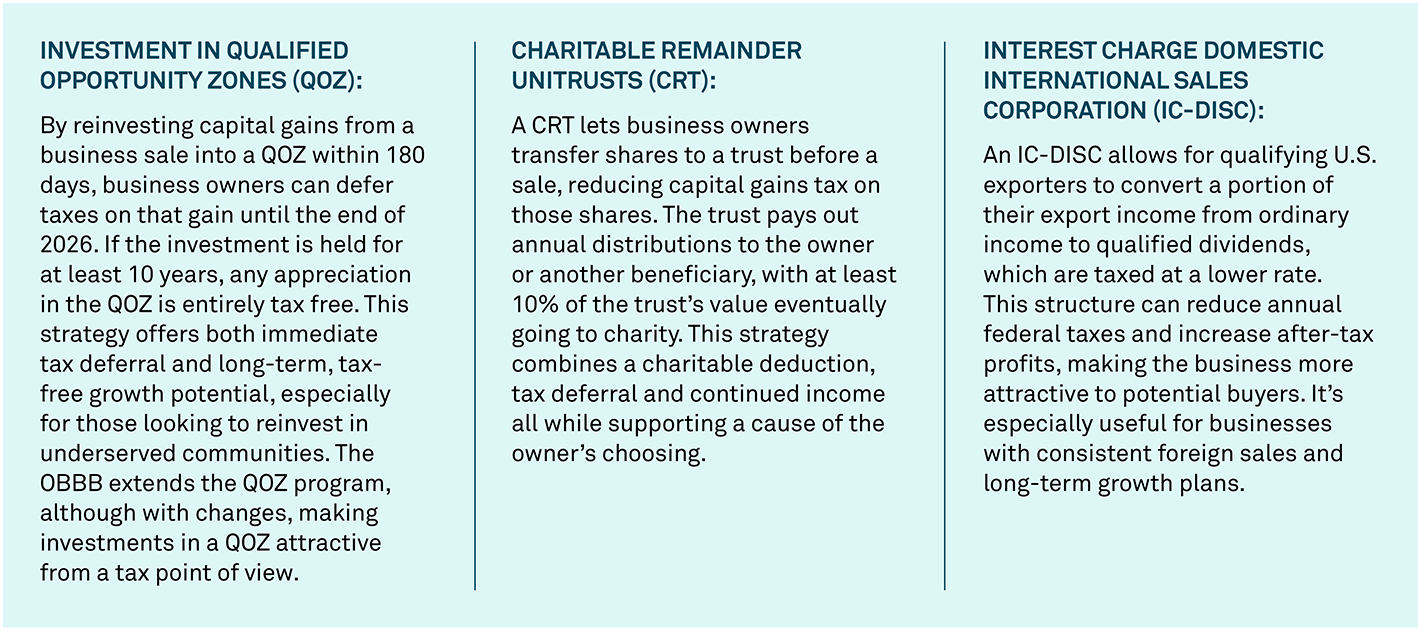
1. Income Tax Mitigation: Keep More of What You Earn

Several advanced strategies can reduce or defer federal and state income taxes on a business sale:
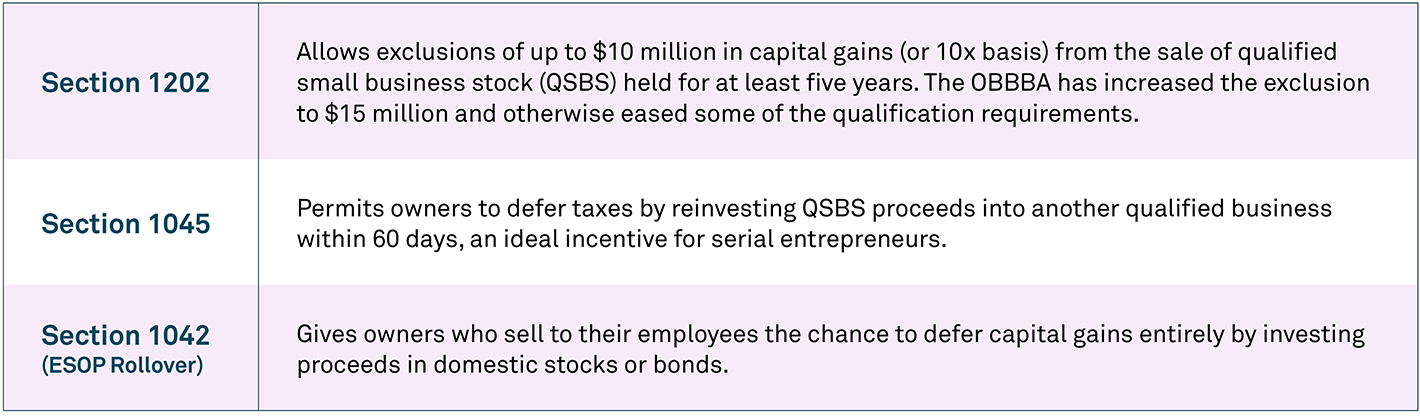
2. Rollover and Exclusion: Preserve Gains, Reinvest for Growth

The IRS offers several incentives to roll gains into other qualified assets.
Income Tax Mitigation

3. Estate Freezing: Pass the Business on Without the Tax Bill

Passing a growing business to your children while minimizing taxes is best done by “freezing” its current value. Transfer ownership now, then sell later as the business appreciates, shifting future growth out of your taxable estate.

Key strategies include:

  • Annual Gifting: Transfer up to $19,000 per year ($38,000 for couples) of company stock to each child, gradually reducing your estate.
  • Installment Sale to an Intentionally Defective Grantor Trust (IDGT): Sell all or part of your business to an irrevocable grantor trust for your children in exchange for a promissory note years before a sale. When the business is sold, the trust repays the note, and any appreciation stays in the trust, free of gift and estate tax. Business profits can fund interest payments on the note, shifting future growth out of the taxable estate.
  • Private Annuities: Exchange your business for lifetime payments from your children, providing income now while transferring ownership. This approach requires confidence in your children’s management abilities.
  • Grantor Retained Annuity Trust (GRAT): Transfer shares to a trust that pays you an annuity. Any future growth passes to heirs tax-free. This is popular technique in a low-interest rate environment.
  • Charitable Lead Annuity Trust (CLAT): Support charity with annual payments now, then pass the remaining value to your heirs tax-free, combining philanthropy with tax-efficient wealth transfer.
  • Family Limited Partnership (FLP) & Recapitalization: Retain voting control while gifting non-voting shares (often at a discount) to heirs, effectively shifting future appreciation out of our estate.

Maximize Wealth, Minimize Taxes

With trillions in assets transferring to the next generation in the coming decades, proactive tax planning is essential to protect your legacy. Partner with experienced advisors—attorneys, accountants and wealth managers—to craft a tax-smart plan that reflects your vision and protects your children.


RELATED CONTENT
Four Steps to Prepare Your Business for a Sale
Article  |  Business Owners

The day will eventually come for most business owners when it’s time to sell the company they spent many years building.

SALT and Strategy—What Wealthy Families Need to Know Now
Article  |  Business Owners

How SALT deductions and exemptions reshape UHNW estate and tax planning under the One Big Beautiful Bill Act (OBBBA).

Selling a Business?
Article  |  Business Owners

Our guide to early planning can help maximize the value of the company.

This material is provided for illustrative/educational purposes only. This material is not intended to constitute legal, tax, investment or financial advice. Effort has been made to ensure that the material presented herein is accurate at the time of publication. However, this material is not intended to be a full and exhaustive explanation of the law in any area or of all of the tax, investment or financial options available. The information discussed herein may not be applicable to or appropriate for every investor and should be used only after consultation with professionals who have reviewed your specific situation.


The Bank of New York Mellon, DIFC Branch (the “Authorized Firm”) is communicating these materials on behalf of The Bank of New York Mellon. The Bank of New York Mellon is a wholly owned subsidiary of The Bank of New York Mellon Corporation. This material is intended for Professional Clients only and no other person should act upon it. The Authorized Firm is regulated by the Dubai Financial Services Authority and is located at Dubai International Financial Centre, The Exchange Building 5 North, Level 6, Room 601, P.O. Box 506723, Dubai, UAE.


The Bank of New York Mellon is supervised and regulated by the New York State Department of Financial Services and the Federal Reserve and authorized by the Prudential Regulation Authority. The Bank of New York Mellon London Branch is subject to regulation by the Financial Conduct Authority and limited regulation by the Prudential Regulation Authority. Details about the extent of our regulation by the Prudential Regulation Authority are available from us on request. The Bank of New York Mellon is incorporated with limited liability in the State of New York, USA. Head Office: 240 Greenwich Street, New York, NY, 10286, USA.


In the U.K. a number of the services associated with BNY Wealth’s Family Office Services– International are provided through The Bank of New York Mellon, London Branch, One Canada Square, London, E14 5AL. The London Branch is registered in England and Wales with FC No. 005522 and BR000818.


Investment management services are offered through BNY Mellon Investment Management EMEA Limited, BNY Mellon Centre, One Canada Square, London E14 5AL, which is registered in England No. 1118580 and is authorized and regulated by the Financial Conduct Authority. Offshore trust and administration services are through BNY Trust Company (Cayman) Ltd.


This document is issued in the U.K. by The Bank of New York Mellon. In the United States the information provided within this document is for use by professional investors.

This material is a financial promotion in the UK and EMEA. This material, and the statements contained herein, are not an offer or solicitation to buy or sell any products (including financial products) or services or to participate in any particular strategy mentioned and should not be construed as such.


BNY Mellon Fund Services (Ireland) Limited is regulated by the Central Bank of Ireland BNY Mellon Investment Servicing (International) Limited is regulated by the Central Bank of Ireland.

Trademarks and logos belong to their respective owners.


BNY Wealth conducts business through various operating subsidiaries of The Bank of New York Mellon Corporation. BNY is the corporate name of The Bank of New York Mellon Corporation and may be used to reference the corporation as a whole and/or its various subsidiaries generally.


©2025 The Bank of New York Mellon. All rights reserved. WM-830873-2025-10-29

Let's start a conversation.

SUBSCRIBE