
Every business owner’s journey eventually leads to a transition point. Whether you sell, merge or pass it on, your choice of exit strategy—and when you execute it—can shape both the legacy you leave and the after-tax proceeds you keep.
Business owners may decide to sell their companies for a myriad of different reasons — ranging from a desire to retire or pursue other business opportunities to wanting to take advantage of market conditions that are favorable for a sale.
Regardless of the reason, owners have several options for how they will exit their business. Here are four different types of business exit strategies:
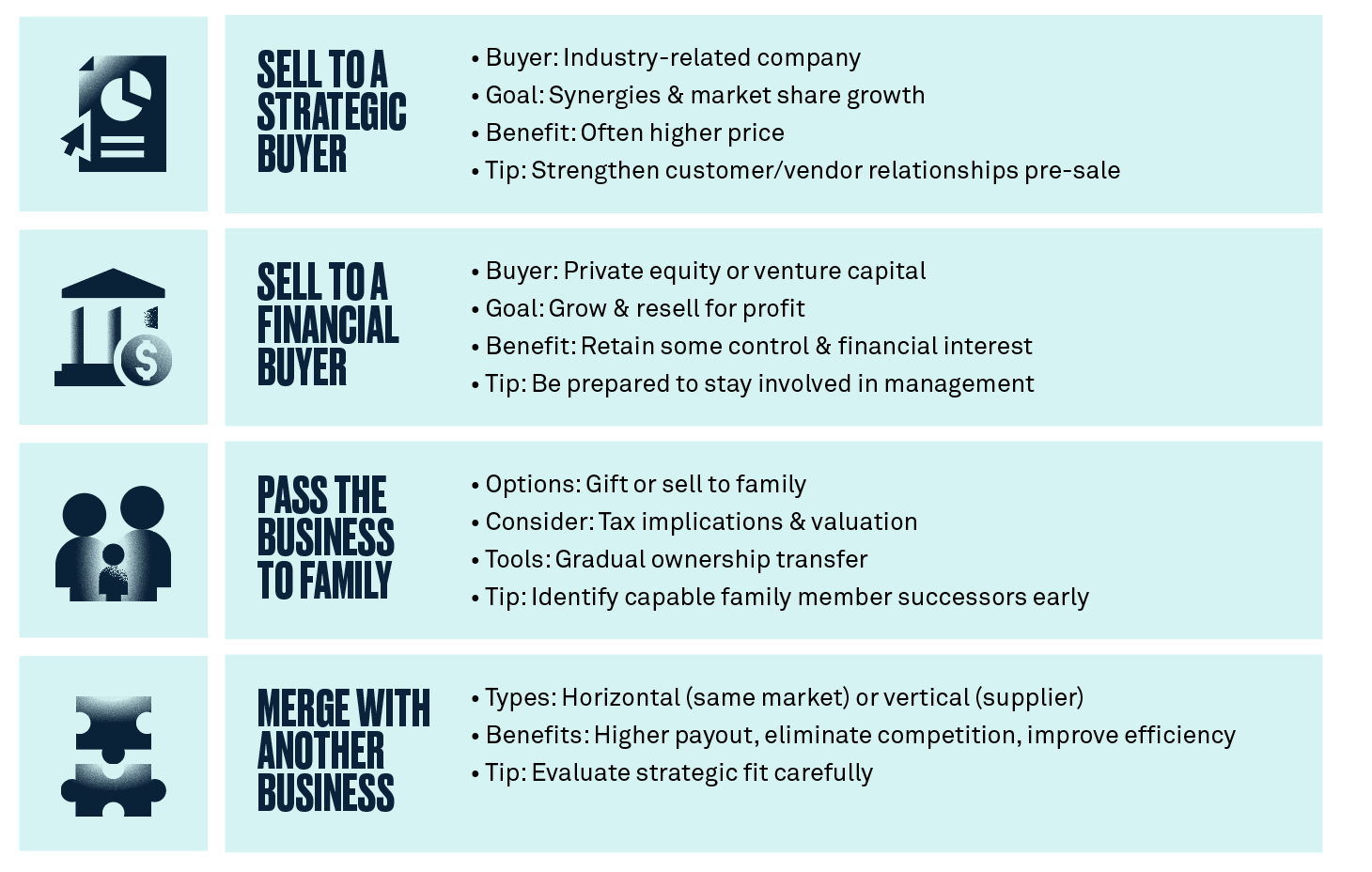
1. Sell to a Strategic Buyer
A strategic buyer is another business in the same or related industry that provides complementary products or services. This type of buyer seeks other companies that offer strategic value and synergies. For example, they may be looking to increase market share by acquiring the seller’s customer base.
Strategic buyers are often willing to pay a higher price than financial buyers (see below) since the acquisition can lead to higher growth. If your exit strategy is to sell to a strategic buyer, you should focus on strengthening your customer and vendor relationships during the time leading up to the sale.
2. Sell to a Financial Buyer
This type of buyer (usually a private equity group or venture capital firm) seeks companies with strong growth potential they can resell later at a profit. For example, they may seek to double or triple revenue and EBITDA over a three- to seven-year time frame.
One benefit of selling to a financial buyer is that you can maintain operational control of the company, as well as a financial interest by retaining a minority position. These buyers often ask owners to remain in a management role for a period of time to lend their expertise and help grow the company. Acquisitions by financial buyers are often completed quickly and valuations tend to be predictable.
3. Pass the Business on to Family Members
You may decide to keep your business “all in the family” by gifting or selling it to family members. In either case, a qualified appraiser should perform a business valuation to determine if gift taxes are due. For a sale, that business valuation may reduce the risk of an IRS determination that a gift was triggered by a below fair market value sale price.
A familiar strategy to prepare for succession is to gradually transition the economic interest of the business to family members. You can gift or sell a minority interest over time to family members working in the business while you maintain a controlling interest. Determining early on which family members have the skills and experience needed to assume the ownership reins is critical. You should also plan for how the sale of a business interest will be financed. Options include selling to an intentionally defective grantor trust or establishing an employee stock ownership plan (ESOP).
4. Merge with Another Business
There are two main kinds of business mergers: horizontal mergers, in which two businesses in the same market segment merge together, and vertical mergers, in which a business merges with a supplier to improve supply chain processes and control over distribution channels. A merger may result in a higher payout to the seller while also eliminating a competitor (in a horizontal merger), improving efficiency and building scale.