Please ensure Javascript is enabled for purposes of website accessibility The Global Economy Is Holding Up
uk
en
intermediary
intermediary
false
true
Gathering data
Disclaimer Not Available

The global economy is holding up

The global economy is holding up

This past year was rife with risks to the global economy: policy changes, tariff uncertainty and more. Yet, the global economy held up as manufacturing and services activity strengthened across the world. We see an opportunity for U.S. investors to diversify geographically.
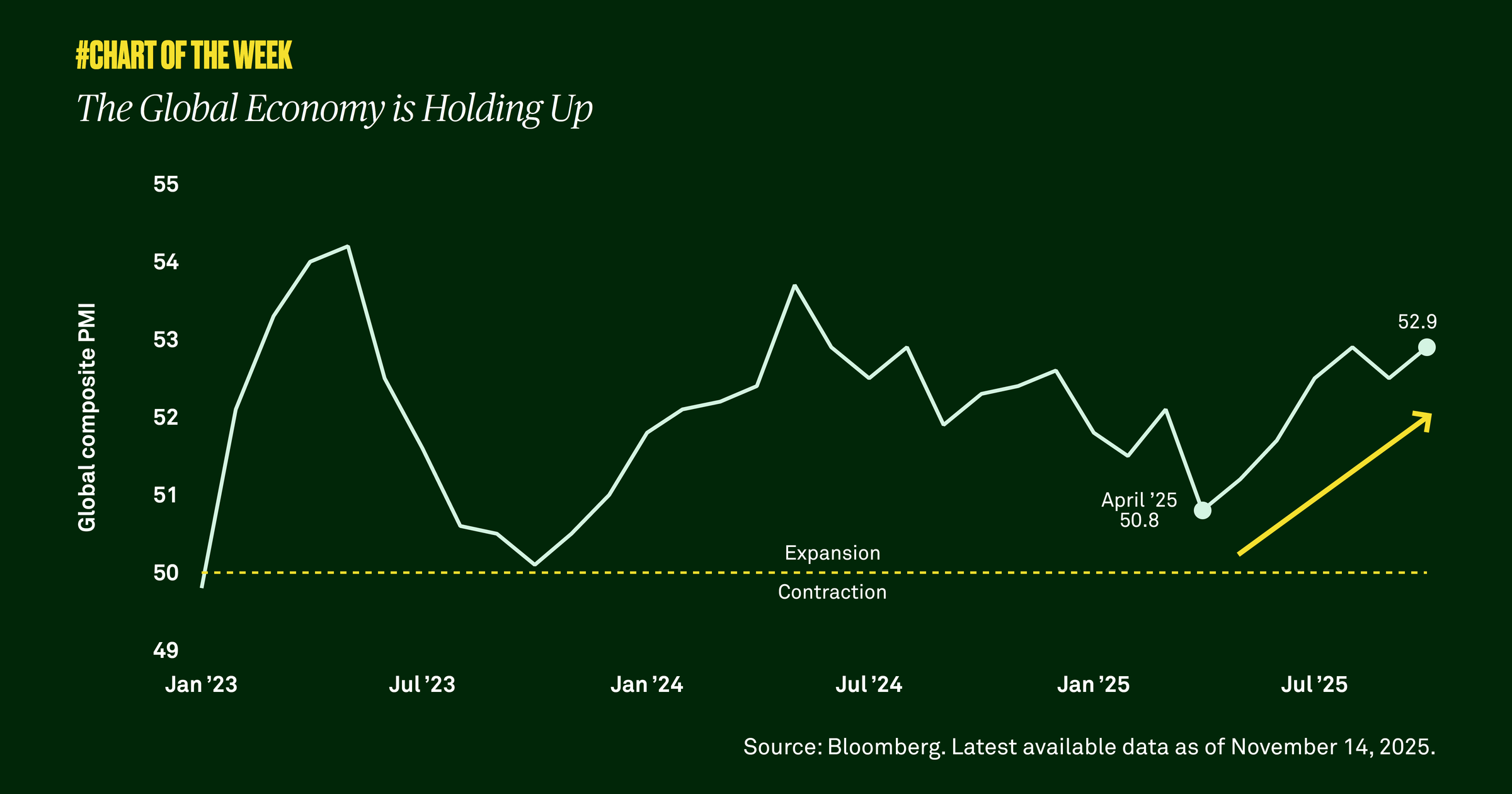

The global economy remained resilient this past year during a time of pronounced policy and tariff uncertainty, as well as geopolitical tensions. Yet, fiscal support, monetary easing and strong capital expenditures helped economies deliver positive growth.

A key measure of economic conditions, the Global Composite Purchasing Managers’ Index (PMI), a weighted average of the global manufacturing and services PMIs, provides a snapshot of overall worldwide economic health. A reading above 50 indicates economic expansion, while a reading below 50 suggests a contraction. This metric is at its highest since August 2024 and underpins our positive outlook for global growth as we head into 2026.

A strong global economy is important to investors because increased economic activity leads to higher corporate profits, boosting stock prices.  It is one of the reasons we maintain a constructive view on equities and why diversification across regions remains important.
RELATED CONTENT
Dollar strength: what does it mean for markets?
Chart of the week | Macroeconomic

Geopolitical tensions have lifted oil prices, sent U.S. stocks slightly lower and driven flows into the safety of the U.S. dollar, which has strengthened versus peers. While a weaker dollar previously supported international equity outperformance, dollar stabilization now suggests that tailwind is fading, underscoring the importance of diversification across regions and asset classes.

Returns after oil spikes
Chart of the week | Macroeconomic

The Strait of Hormuz, which moves about 20% of global oil, has seen many ships that normally travel through it curtail their activity. Consequently, WTI oil was up over 36% in the five days after the oil supply shock began. Yet equities barely budged, signaling a temporary supply shock, not a larger crisis. Historically, after similar price spikes equities tend to move higher while oil prices decline — further evidence for avoiding emotion-driven investing.

Impact of geopolitics over time?
Chart of the week | Macroeconomic

Tensions between the U.S./Israel and Iran have recently boiled over into a military conflict, which has given many investors the jitters. However, our research shows that equity market pullbacks resulting from geopolitical events are often short lived with the S&P 500 typically higher in the months following these events.

Behind the numbers: Q4 GDP
Chart of the week | Macroeconomic

Gross domestic product undershot expectations last quarter, but the shortfall appears driven more by the temporary government shutdown than broad-based weakness. Consumer demand remains resilient, and with supportive fiscal policy, easing financial conditions and a steady labor market, the outlook points to a modest acceleration in economic activity this year.

Gathering data
Disclaimer Not Available

This is a marketing communication