Positive correlation between risk assets and government bonds breaks the roles these asset classes play within a portfolio. Here, we outline why correlations have risen, and how investors can seek to limit the impact on their portfolios.
Why are equities and bonds usually negatively correlated?
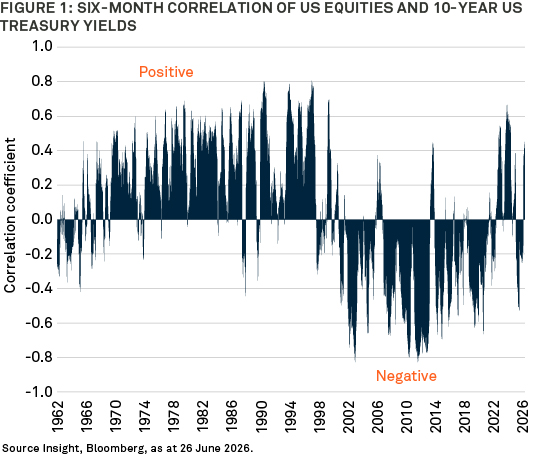
Risk assets such as equities and credit typically respond differently to growth shocks than high-quality government bonds. In a risk-off or recessionary environment, equity prices are likely to fall as the earnings outlook deteriorates, while government bonds have historically been viewed as a relative safe haven, particularly where the markets anticipate central banks may ease policy, potentially pushing yields lower and bond prices higher.
Why may equity-bond correlations become positive?
Positive correlation is most likely when inflation surprises to the upside, when supply-side shocks dominate, or when central banks are tightening into slowing growth. All three scenarios can lead to higher bond yields and create headwinds for corporates. In such environments, bond and equity prices can both come under pressure, as seen at various points in recent years.
What does the link between oil prices and government bonds in 2026 tell us about positive correlations?
Between April and June, markets experienced unusual situation where government bond prices became correlated with oil prices. This is largely due to markets pricing in the future effects of higher energy prices on global inflation, and the anticipation that central banks would react by raising interest rates. So, rather than government bonds offering a flight to safety, they instead were chiefly an expression of inflation and interest rate fears. So, US Treasury yields rose as the oil price increased from $70 to $105 over the course of March, stabilised in April, then rose together again in May, before falling for most of June as negotiations between the US and Iran made progress.
Why are we not seeing the usual flight to quality?
We believe if investors' faith in government bonds as a hedge is eroded, then positive correlation can become more likely. More recently, confidence in government bonds has eroded for three key reasons:
- Gross government debt-to-GDP levels surpassed the psychologically important 100% level for the US, Canada, the UK, France and Spain in the past 15 years. Both Italy and Japan surpassed this level in the 1990s1.
- When the sustainability of government debt is widely questioned, duration becomes less appealing, which can lead to steeper curves. When curves are steep, the transmission mechanism of monetary policy does not work as well, meaning central banks may need to hike or cut more aggressively as they manage growth and inflation.
- High indebtedness exerts pressure on governments as interest costs become a larger proportion of spending, reducing flexibility and leaving governments more exposed to bond markets.
When do positive correlations come to an end?
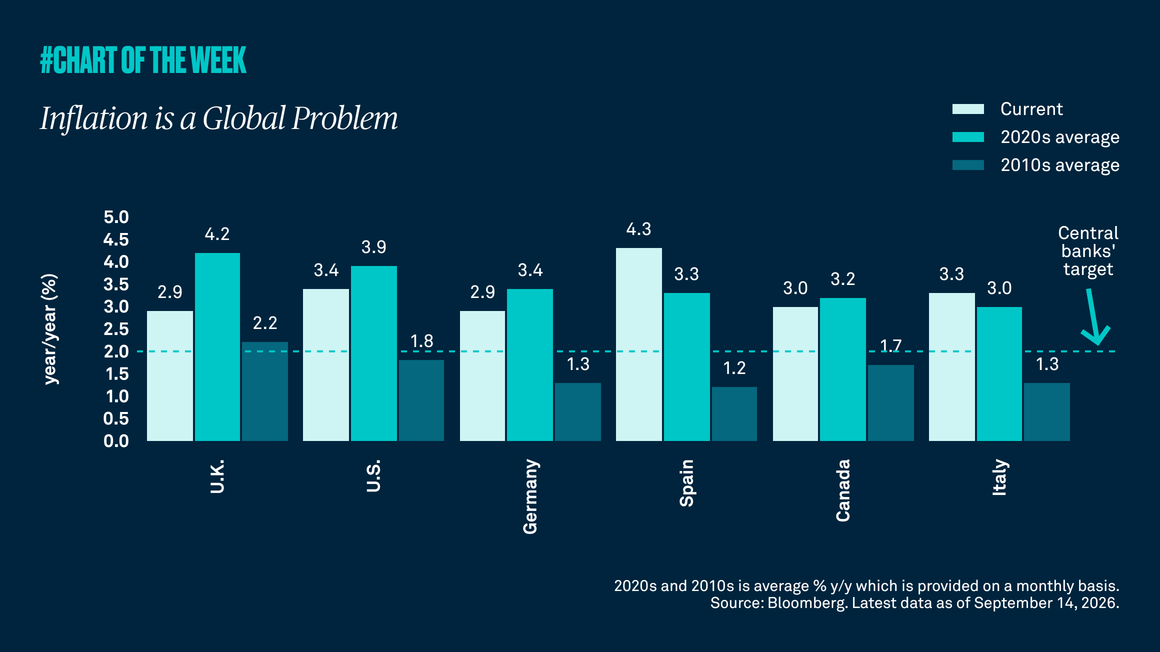
Historically, when inflation becomes anchored near central bank targets again, yields are likely to stabilise or fall. In this environment, growth is the dominant macro driver and correlations become negative again. However, there are signs that inflation may remain structurally higher, due to higher trade tariffs and a reversal of the forces of globalisation. Therefore, periods of higher correlation may become frequent when inflation concerns intensify.
How can a portfolio be structured to help limit the impact of positive correlations?
We believe a bond portfolio that is uncorrelated to both equities, credit and government bonds can be created through an unconstrained mix of positions that tap relative pricing inefficiencies across markets. Within such a portfolio, potentially no single position is allowed to dominate, and each is calibrated to contribute a specific amount of risk. Such absolute return bond portfolios can also be tailored in attempt to help limit correlation with traditional risk assets and to take long or short positions.
Conclusion
We think heightened geopolitical risk and more frequent market shocks are increasing the likelihood that bonds and risk assets move together. To help preserve the defensive role of bonds, we believe in broadening the scope for managers who seek to build portfolios that are less reliant on traditional sources of return and more resilient overall.
Correlations simply explained
Positive correlation: assets tend to rise and fall together.
Negative correlation: one asset tends to rise when the other falls.
Low or zero correlation: assets move independently of each other
1Source: Gross public debt, percent of GDP, IMF.
Asset class comparisons such as comparing equities to bonds have limitations because different asset classes may have characteristics that materially differ from each other. Because of these differences, comparisons should not be relied upon solely as a measure when evaluating an investment for any particular portfolio. Comparisons are provided for illustrative purposes only. Although stocks have greater potential for growth than bonds, they also have much higher levels of risk. With stocks, the prices can rise and fall for a variety of reasons, including factors outside of the company’s control. Bonds may be considered relatively safer. Because they’re a debt security, they function as an IOU. The company pays interest to the bondholder, and once the bond matures, the bondholder receives the principal bank. Bonds aren’t completely risk-free; there is the possibility of the issuer defaulting on its bonds, and if sold prior to maturity the market value may be higher or lower than the purchase value. But compared to stocks, historically there’s been less volatility.
Important information
FOR INSTITUTIONAL, PROFESSIONAL, QUALIFIED INVESTORS AND QUALIFIED CLIENTS.
BNY Investments is the brand name for the investment management business of BNY and its investment firm affiliates worldwide. BNY is the corporate brand of The Bank of New York Mellon Corporation and may be used to reference the corporation as a whole or its various subsidiaries generally.
The information contained herein reflects general views and is provided for informational purposes only. This material is not intended as investment advice nor is it a recommendation to adopt any investment strategy.
Opinions and views expressed are subject to change without notice.
Past performance is no guarantee of future results.
Issuing entities
This material is only for distribution in those countries and to those recipients listed, subject to the noted conditions and limitations: • United States: by BNY Mellon Securities Corporation (BNYSC), 240 Greenwich Street, New York, NY 10286. BNYSC, a registered broker-dealer and FINRA member, has entered into agreements to offer securities in the U.S. on behalf of certain BNY Investments firms. • Europe (excluding Switzerland): BNY Mellon Fund Management (Luxembourg) S.A., 2-4 Rue EugèneRuppertL-2453 Luxembourg. • UK, Africa and Latin America (ex-Brazil): BNY Mellon Investment Management EMEA Limited, BNY Mellon Centre, 160 Queen Victoria Street, London EC4V 4LA. Registered in England No. 1118580. Authorised and regulated by the Financial Conduct Authority. • South Africa: BNY Mellon Investment Management EMEA Limited is an authorised financial services provider. • Switzerland: BNY Mellon Investments Switzerland GmbH, Bärengasse 29, CH-8001 Zürich, Switzerland. • Middle East: DIFC branch of The Bank of New York Mellon. Regulated by the Dubai Financial Services Authority. • South East Asia and South Asia: BNY Mellon Investment Management Singapore Pte. Limited Co. Reg. 201230427E. Regulated by the Monetary Authority of Singapore. • Hong Kong: BNY Mellon Investment Management Hong Kong Limited. Regulated by the Hong Kong Securities and Futures Commission. • Japan: BNY Mellon Investment Management Japan Limited. BNY Mellon Investment Management Japan Limited is a Financial Instruments Business Operator with license no 406 (Kinsho) at the Commissioner of Kanto Local Finance Bureau and is a Member of the Investment Trusts Association, Japan and Japan Investment Advisers Association and Type II Financial Instruments Firms Association. • Brazil: ARX Investimentos Ltda., Av. Borges de Medeiros, 633, 4th floor, Rio de Janeiro, RJ, Brazil, CEP 22430-041. Authorized and regulated by the Brazilian Securities and Exchange Commission (CVM). • Canada: BNY Mellon Asset Management Canada Ltd. is registered in all provinces and territories of Canada as a Portfolio Manager and Exempt Market Dealer, and as a Commodity Trading Manager in Ontario. All issuing entities are subsidiaries of The Bank of New York Mellon Corporation.
No part of this material may be reproduced in any form, or referred to in any other publication, without express written permission. All information contained herein is proprietary and is protected under copyright law.
NOT FDIC INSURED | NO BANK GUARANTEE | MAY LOSE VALUE |
©2026 THE BANK OF NEW YORK MELLON CORPORATION
MARK-975474-2026-07-27
GU-912-31 July 2027