Today’s fixed income world rewards investment managers who are willing to accommodate changes in the market backdrop and outlook in real time.
Flexibility is key to both building resilience and embracing volatility as an opportunity to capture returns. For long-term investors navigating the new investment landscape, resilience is no longer a nice extra; it is essential. For UK investors focused on long-term goals, the challenge is not just to grow wealth, but to do so in a way that can cope with an uncertain and changing economic environment.
A changing backdrop
In the years before the pandemic, inflation was generally stable and interest rates remained low, creating a more supportive backdrop for markets. That enabled an environment where investment managers could take comfort in simpler diversification strategies that performed well, like the familiar mix of 60% shares and 40% bonds, effective for steady growth while remaining well spread across the markets.
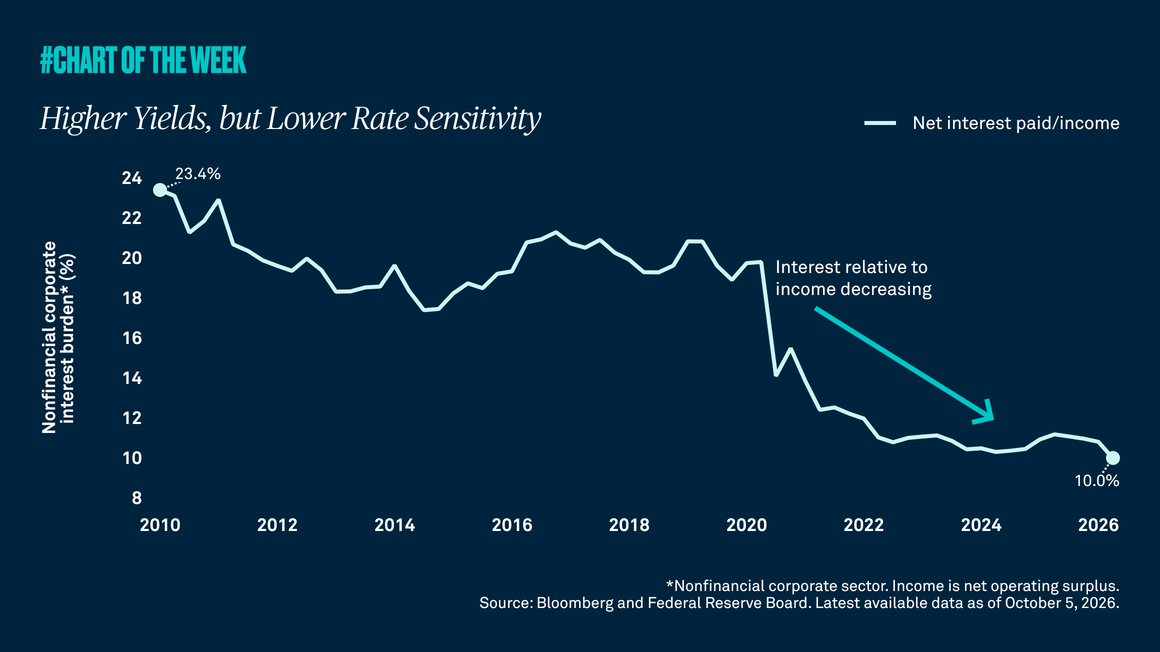
Since the pandemic this has changed. As economic growth recovered, inflation rose quickly, forcing central banks to rapidly tighten policy to help quell price pressures. But persistent and higher inflation plus higher interest rates led to lower bond values. Equities also struggled to perform as companies were confronted with historically high interest rates.
Since the pandemic, the relationship between bonds and stocks moving in opposite directions has been less reliable. This means investment managers need to rethink how portfolios are built. Today’s environment demands diversification strategies that can not only cope with different market conditions but also exploit them.
The fine print
Index bond funds track their benchmarks closely. In a bond index, the weights given to companies or governments reflect how much they borrowed. That means the largest-weighted issuers are typically the most indebted. They are not necessarily the safest or highest quality.
Rising interest rates also create challenges and potentially hidden risks for that type of approach. When rates go up, bond prices tend to fall, particularly longer maturities. In tougher economic conditions, less robust borrowers may need to offer higher interest rates to attract investors as compensation for additional potential risk, which could push bond prices down further.
Flexibility is key
The way bonds are chosen and how they are managed matters. A resilient portfolio is built to absorb shocks and adjust without forcing investors into rushed decisions. This requires flexibility.
We think investment approaches that can adapt to the new reality of higher inflation and increased market shocks make sense in this environment. Active managers can pivot to strategies that look beyond traditional bonds. This includes shorter-term and inflation-linked bonds, as well as corporate bonds. Strategies that take an unconstrained approach have the flexibility to diversify beyond the parameters of a single or specific index, which may rely too heavily on any one source of return.
Economic conditions can change quickly, and static portfolios may struggle to keep up. The ability to respond quickly to new information is key to exploiting market volatility not only to protect your portfolio but also to identify dislocations that can grow it.
Experienced investment managers see risk as an opportunity when approached with a disciplined investment process. Resilience is particularly important for long-term goals like retirement, where avoiding large losses can be just as important as achieving growth.
A practical shift in thinking
Building resilient portfolios today may require adjusting mindsets. Investors need to move away from fixed, one-size-fits-all allocations based on precedent, and towards more flexible and diversified approaches reflective of today’s more complex markets.
By reviewing how portfolios are constructed, reducing unwanted risks, and allowing for greater adaptability, investment managers can better protect their long-term outcomes.
In a world where conditions can shift quickly, resilience is no longer optional; it represents the foundation for more consistent long-term investment outcomes.
For Professional Clients only.
BNY Investments is the brand name for the investment management business of BNY and its investment firm affiliates worldwide. BNY is the corporate brand of The Bank of New York Mellon Corporation and may be used to reference the corporation as a whole or its various subsidiaries generally.
Any views and opinions are not investment advice or a research recommendation.
Issued in the UK by BNY Mellon Investment Management EMEA Limited, BNY Mellon Centre, 160 Queen Victoria Street, London EC4V 4LA. Registered in England No. 1118580. Authorised and regulated by the Financial Conduct Authority.
2044900 Exp 31 March 2027