
The BNY Strategic Bond Fund is five years old. It was launched in August 2021 and on reaching its five year-track record, the Fund has grown to £316m in assets under management1.
The portfolio has been managed by the same team in the same style since launch. Our investment approach is flexible and unconstrained, and we have a balanced and unbiased approach to investment decision-making across the full liquid global fixed income opportunity set.
From Covid’s aftermath to bonds’ worst year on record and fresh geopolitical shocks, the five years since the BNY Strategic Bond Fund’s launch have been anything but quiet. Despite this, the Fund has meaningfully outperformed its peer group and consistently delivered attractive risk-adjusted returns in a variety of market conditions. Here, we look back at five defining market moments – and how the Fund was positioned to navigate them.
Past performance is not a guide to future performance.
2022: The global bond bear market
Market backdrop: The Russia-Ukraine conflict in 2022 exacerbated global supply bottlenecks that stemmed from the pandemic, creating an inflation shock that forced central banks to hike aggressively. This marked the end of the era of ultra-low yields in fixed income markets. Inflation proved anything but transient and both government bonds and credit sold off throughout 2022.
Portfolio activity: Despite a near-unprecedented rise in government bond yields during 2022, tactically managing interest-rate risk helped limit the losses experienced relative to the wider market and drive outperformance. At the start of the year, we were positioned with a below-neutral duration stance. Then, in late summer, as US 10-year Treasuries approached 4.0%, we started to add back duration risk, taking advantage of what we believed were more attractive market levels. This worked out well as global yields came off their highs from September to November. We then took profits and moved back to an underweight duration position, which proved the right thing to do as yields once again rose into year end.
Over the course of the year, we also tilted our credit exposure towards securitised assets, taking our exposure to an all-time high. These instruments typically have coupons linked to short-term interest rates, which helps to insulate the asset class when rates are rising. The asset class ended the year being the only area of fixed income markets to deliver positive returns during 2022.
2023: Rapid hikes and regional banks
Market backdrop: In early 2023 the failure of Credit Suisse and the US regional bank crisis rocked credit markets. Compounding this, central banks continued to hike through the first half of the year, keeping upward pressure on yields.
Portfolio activity: This was a period where our credit expertise proved valuable, and we were able to take advantage of dislocations across credit markets. Taking a bottom-up approach, we focused on better-quality names we felt had been unfairly punished, with individual security selection in developed-market investment-grade credit contributing significantly to performance. This was a period where being able to take active credit positions, without being forced to hold positions purely based on their index weights, became extremely valuable.
Duration wise, we entered the year with a broadly neutral duration stance and then started to add to a modestly overweight position from May to August. Being neutral early in the year helped insulate from losses as yields rose, but we were too early in adding as, despite expectations of a more dovish outlook, the sell-off continued to October. At that point, a longer-duration position reversed some of the negative contribution from early in the year as government bonds rallied into year end. Overall, our interest-rate position outperformed the peer group but resulted in a small drag on total returns.
2024: Central bank easing
Market backdrop: Central banks finally started to lower interest rates in the summer of 2024. Government bonds largely traded sideways as stubborn inflation and resilient labour markets saw markets price in a very gradual, “higher for longer”, easing cycle. From late 2024 into 2025, markets focused on expanding government deficits, and implications around the US election.
Portfolio activity: In the first six months of the year, we added credit risk. Most of this was investment-grade, but we also raised our high-yield exposure to a relatively high level. Credit markets were weak at the start of the year but then recovered strongly from the summer to the end of the year, so this worked out well for us.
In a year when government bonds swung in both directions, rather than attempting play the intra-month volatility we chose to hold duration steady at a position marginally above neutral through the first half of the year. As yields rallied in August and September, we then took profits and moderated duration risk. For the remainder of the year, we held duration at a below-neutral level, insulating the portfolio from the sell-off in rates that followed.
2025: Tariff turmoil
Market backdrop: In April 2025, the new US administration announced sweeping tariffs for US trading partners which caused significant market volatility. The fraying of US security guarantees also forced European nations to reassess defence funding and adopt a looser stance on fiscal policy. Markets struggled to price a changing policy and tariff agenda, but the trend towards deglobalisation and a more protectionist world became clear.
Portfolio activity: We actively managed our interest-rate sensitivity through the year. We were most active in the US, where we added duration early in the year, then gradually took profits as US markets outperformed and yields declined from their peaks. In Europe we were more cautious, keeping a low sensitivity to interest rates through most of the year, but buying back risk as yields rose to more attractive levels.
Credit spreads widened dramatically in April after ‘liberation day’ but gradually recovered and were back to where they started by October. This period of volatility was another opportunity for our credit analysts to pick out high-conviction names which appeared oversold, allowing us to add to positions on weakness and hold them until markets normalised.
2026: Energy price shock
Market backdrop: In 2026, the US-Iran conflict has squeezed global energy supplies and reignited stagflation fears. Central banks face a tricky balancing act between controlling inflation and damaging growth. Looser fiscal policy and capital expenditure from artificial intelligence (AI) hyperscalers have supported growth. However, both are putting upward pressure on yields and the huge volume of debt being issued is starting to weaken credit market technical factors.
Portfolio activity: With government bond yields still elevated, we see attractive value, particularly as we believe markets have become overly aggressive in pricing further policy tightening. At the same time, we believe the main opportunity in rates will be relative value opportunities across yield curves and markets. We are running a modestly above-neutral duration position, positioning for a steeper US yield curve, a flattening at the longer end of the UK yield curve, and several cross-market positions, including long Australia versus the US, as well as intra-European positions.
Credit has been a strong contributor, primarily driven by us tactically adding then reducing risk on bouts of volatility. We have also favoured hard-asset non-cyclical sectors such as utilities which are far removed from any technology-related weakness. From an asset allocation perspective, we have ramped up our exposure to securitised asset classes which have been one of the best-performing fixed income sub-asset classes year-to date[1].
A flexible and balanced approach has been key
Since the Fund’s launch in August 2021, fixed income markets have been volatile, and we have experienced some transformative themes with far reaching implication for investors. Government bond yields have been volatile but remained elevated over the past five years. In credit markets, resilient global growth has supported spreads, which have compressed to their tightest levels since the 2008 global financial crisis.
Government bond yields and credit spreads since August 2021
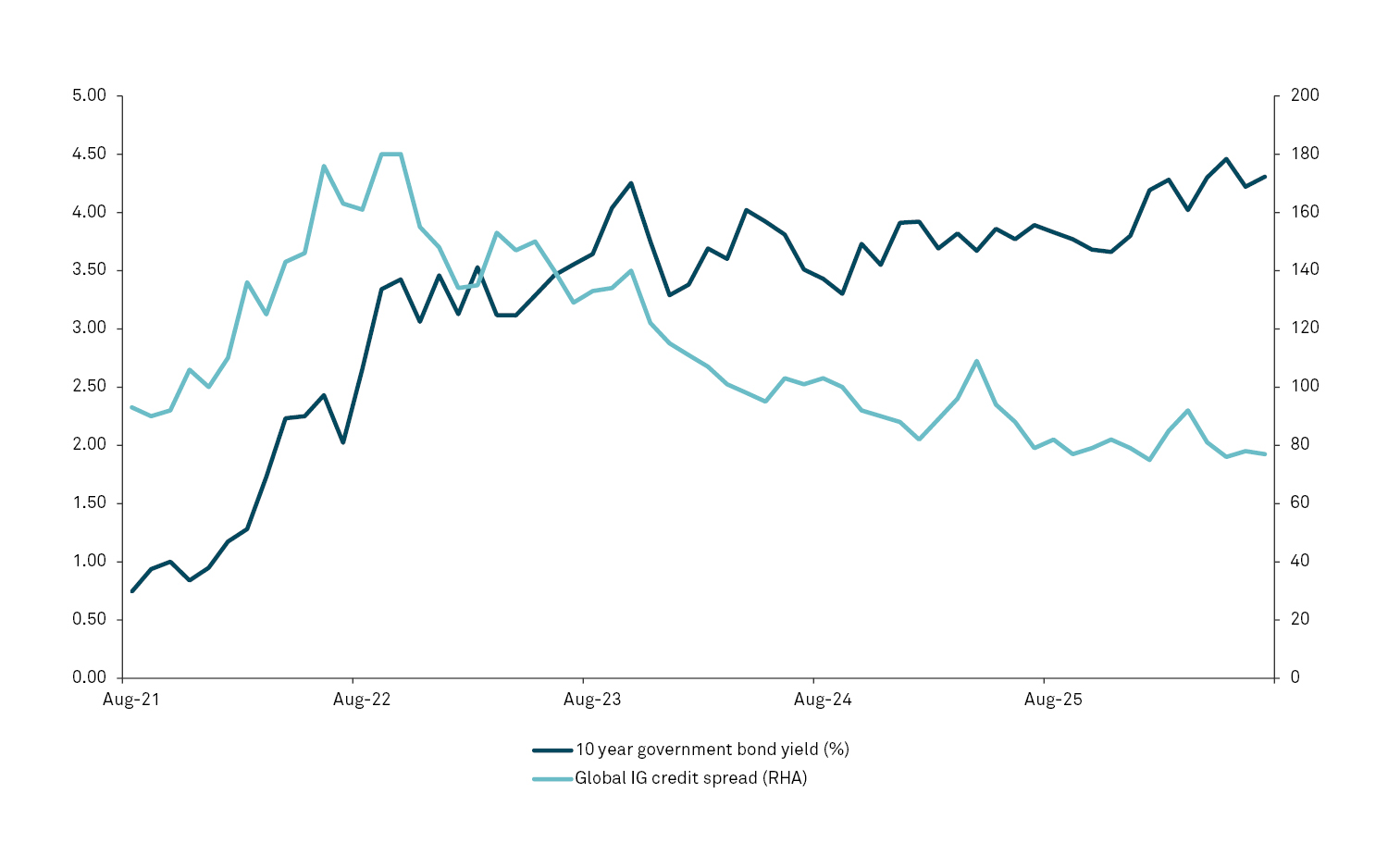
Source: Insight/BBG as of 31 August 2026. Global IG credit spread = Global Option-Adjusted Spread (G-OAS) of ICE Bank of America Global Corporate Index (G0BC). 10-year government bond yield = blend of 60% US Treasuries, 30% German bunds, 10% UK gilts.
Against this backdrop, our flexible, balanced approach has enabled us to draw on different levers across both rates and credit, combining directional views, relative value trades, sector allocation and individual security selection to deliver attractive risk-adjusted returns and strong outperformance versus peers.
Calander-year returns vs. peer group
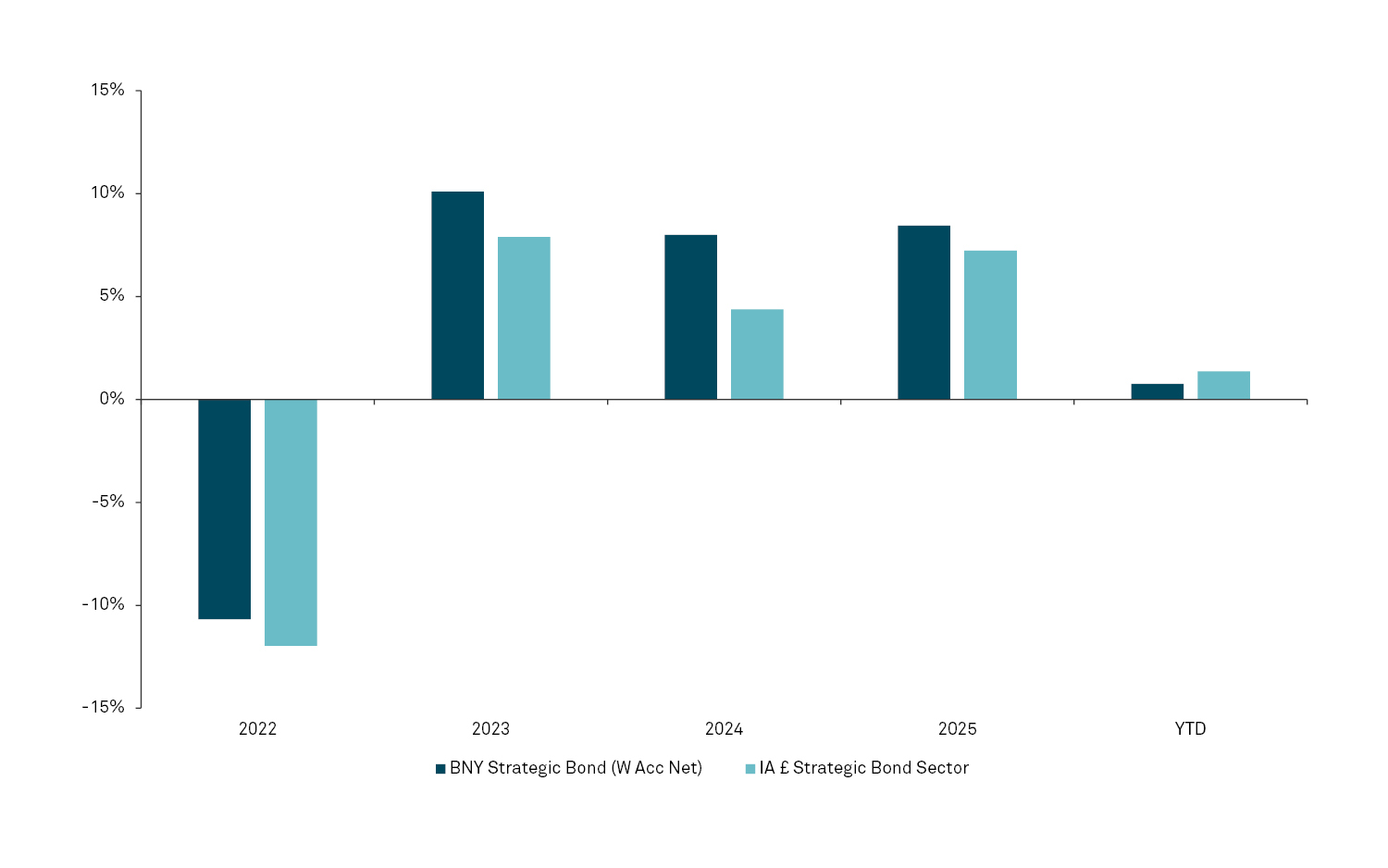
Source: Insight and Lipper as at 31 August 2026. Fund performance for the share class Institutional Shares W (Acc.) calculated as total return, including reinvested income net of UK tax and charges, based on net asset value. All figures are in GBP. The impact of an initial charge (currently not applied) can be material on the performance of your investment. The strategy is benchmarked against the IA GBP Strategic Bond sector; however internally we reference a Beta Yardstick for risk management and portfolio positioning.
The value of investments and the income received can fall as well as rise and investors may not get back the original amount invested.
BNY Strategic Bond Fund
Investment Objective
To generate a return through a combination of income and capital returns, whilst taking environmental, social and governance ("ESG") factors into account.
On 2 December 2025 the Fund's name changed from the Responsible Horizons Strategic Bond Fund to the BNY Strategic Bond Fund.
Performance Benchmark
The Fund will measure its performance against the UK Investment Association Sterling Strategic Bond Sector as a comparator benchmark (the "Benchmark"). The Fund will use the Benchmark as an appropriate comparator because it represents a broad range of similar Sterling denominated bond funds that invest in corporate bonds.
The Fund is actively managed, which means the Investment Manager has discretion over the selection of investments, subject to the investment objective and policies as disclosed in the Prospectus.
Performance 12-month returns (%)
| Aug 2021 - Aug 2022 | Aug 2022 - Aug 2023 | Aug 2023 - Aug 2024 | Aug 2024 - Aug 2025 | Aug 2025 - Aug 2026 | |
Fund | -12.02 | 2.62 | 14.73 | 6.99 | 3.01 |
Performance benchmark | -11.33 | 0 | 10.69 | 4.94 | 3.72 |
Source: Lipper as at 31 August 2026. Fund performance Institutional Shares W (Accumulation) calculated as total return, including reinvested income net of applicable UK tax and charges, based on net asset value. All figures are in GBP terms.
Past performance is not a guide to future performance.
Key risks associated with this Fund
Objective/Performance Risk: There is no guarantee that the Fund will achieve its objectives.
Currency Risk: This Fund invests in international markets which means it is exposed to changes in currency rates which could affect the value of the Fund.
Geographic Concentration Risk: Where the Fund invests significantly in a single market, this may have a material impact on the value of the Fund.
Derivatives Risk: Derivatives are highly sensitive to changes in the value of the asset from which their value is derived. A small movement in the value of the underlying asset can cause a large movement in the value of the derivative. This can increase the sizes of losses and gains, causing the value of your investment to fluctuate. When using derivatives, the Fund can lose significantly more than the amount it has invested in derivatives.
Changes in Interest Rates & Inflation Risk: Investments in bonds/money market securities are affected by interest rates and inflation trends which may negatively affect the value of the Fund.
Credit Ratings and Unrated Securities Risk: Bonds with a low credit rating or unrated bonds have a greater risk of default. These investments may negatively affect the value of the Fund.
Credit Risk: The issuer of a security held by the Fund may not pay income or repay capital to the Fund when due.
Emerging Markets Risk: Emerging Markets have additional risks due to less-developed market practices.
CoCo's Risk: Contingent Convertible Securities (CoCo's) convert from debt to equity when the issuer's capital drops below a pre-defined level. This may result in the security converting into equities at a discounted share price, the value of the security being written down, temporarily or permanently, and/or coupon payments ceasing or being deferred.
Responsible Investing Risk: The investment policy for this Fund places restrictions on its exposure to certain sectors or types of investments to reflect its responsible investing approach. The Fund's performance may be negatively impacted due to these restrictions in comparison to funds which do not have these restrictions. The Fund will not engage in securities lending activities and, therefore, may forego any additional returns that may be produced through such activities.
Counterparty Risk: The insolvency of any institutions providing services such as custody of assets or acting as a counterparty to derivatives or other contractual arrangements, may expose the Fund to financial loss.
2019265 Exp: 31 March 2027