Is there a way of accessing the attractive yield of global investment grade credit with lower volatility? This is a question that BNY Investments increasingly hears from risk-constrained investors as cash rates fall.
Since late 2022, global credit has attracted investors with its relatively high yields, low default rates, and a constructive near-term outlook for corporates. However, as a risk asset, it remains vulnerable to market shocks – such as the abrupt reaction in early April to unexpectedly severe US tariffs. This has prompted investors to ask how best to access the credit market but mitigate such volatility.
BNY Investments’ approach is to focus on investment grade credit with maturities of five years or less. Shorter-duration bonds tend to be both less sensitive to risk-off events and less exposed to fluctuations in government yields.
The volatility/opportunity trade off
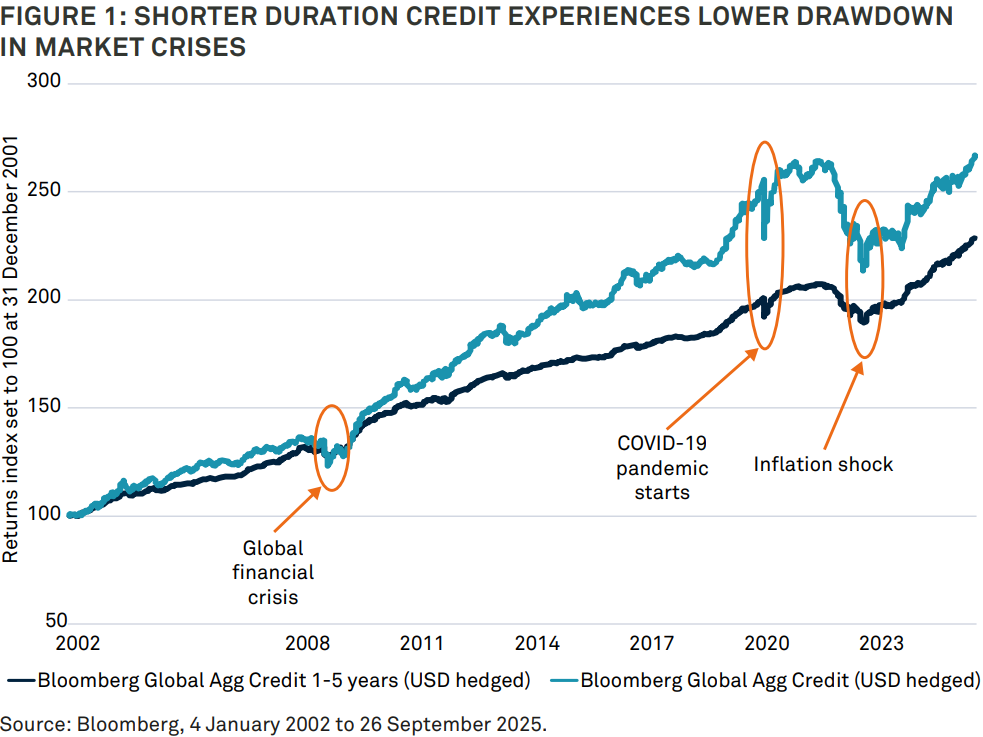
Restricting the global credit universe to securities with maturities no longer than five years can significantly smooth returns. Figure 1 shows the much-reduced drawdowns for the Bloomberg Agg Credit 1-5 years index compared to the all-maturity index during the big market crises of the past 20 years. The trade-off for this benefit is sacrificing some of the extra yield that the longest dated securities offer.
How would shorter dated credit fare in these market scenarios?
It’s important to assess how all-maturity and short-term credit strategies might perform across a range of potential market scenarios in the near to medium term. We currently see three plausible scenarios:
1. Inflation accelerates: If inflation starts to rise from already elevated levels – potentially driven by tariff-related cost pass-through – rate cuts may be delayed, and government yields could rise. This scenario is not currently priced into markets and would likely pressure global credit valuations. In such an environment, short-dated credit strategies would be more resilient, experiencing less downside than their all-maturity counterparts.
2. Growth weakens: A backdrop of sluggish growth and rising unemployment could trigger risk-off sentiment, leading to wider credit spreads and lower government bond yields. This scenario presents mixed implications for credit: spread widening is a headwind, while falling yields offer support. The net impact on short-dated versus all-maturity strategies remains uncertain and would depend on the balance between these opposing forces.
3. Interest rates decline: Should central banks resume or continue rate cuts, government bond yields are likely to fall. Global credit markets appear to be priced for this constructive scenario. An all-maturity credit portfolio would benefit most, as falling yields enhance the relative appeal of higher credit spreads and improve corporate financing conditions.
The role of short-dated credit in a portfolio
Short-term global credit strategies offer a combination of relatively high income and low volatility, making them well-suited as a core allocation within fixed income portfolios. In this role, they can function effectively as cash-plus strategies – generating incremental spread through investment grade lending while active management has the potential to further enhance returns. Unlike government bonds, these strategies provide superior income potential by tapping into the creditworthiness of high-quality corporate issuers.
Yield with limited volatility
Global credit has seen strong inflows over the past three years, supported by attractive yields and solid fundamentals. But not all investors are able to weather the periodic bouts of volatility that longer-duration strategies can experience.
Short-dated global credit strategies offer a way to capture much of the asset class’s attractive risk-reward profile with limited volatility. By focusing on shorter maturities, these strategies provide a more stable return stream without sacrificing the core benefits of investment grade credit.
The value of investments can fall. Investors may not get back the amount invested. Income from investments may vary and is not guaranteed.
Important Information
For sole and exclusive use by Institutional Investors, Accredited Investors and Professional Investors only. Not for further distribution. This is a financial promotion and is not investment advice. Any views and opinions are those of the investment manager, unless otherwise noted. The value of investment can fall. Investors may not get back the amount invested. BNY, BNY Mellon and Bank of New York Mellon are the corporate brands of The Bank of New York Mellon Corporation and may also be used to reference the corporation as a whole and/or its various subsidiaries generally. BNY Investments encompass BNY Mellon’s affiliated investment management firms and global distribution companies. Any BNY entities mentioned are ultimately owned by The Bank of New York Mellon Corporation. In Hong Kong, the issuer of this document is BNY Mellon Investment Management Hong Kong Limited, which is registered with the Securities and Futures Commission (Central Entity Number: AQI762). In Singapore, this document is issued by BNY Mellon Investment Management Singapore Pte. Limited, Co. Reg. 201230427E. Regulated by the Monetary Authority of Singapore (MAS). This advertisement has not been reviewed by the Monetary Authority of Singapore.
MC651-04-11-2025 (6M)