US midterm elections are rapidly approaching, with the latest polls pointing to a divided government, with Democrats gaining control of at least one house of Congress.
KEY POINTS
- Early polling suggests the midterms may lead to control being shared between parties, potentially reshaping Washington’s balance of power.
- While policy continuity is likely, market volatility may continue and congressional control will matter for certain sectors.
- State-specific elections could shape AI development and regulation heading into 2028.
- Federal budget pressures and U.S. manufacturing momentum look likely to continue regardless of the outcome.
So, what does this mean for investors? Depending on the outcome, market performance may be shaped by shifts in policy, sector-specific opportunities, and the governing landscape.
Scenarios for Congressional Control
A unified Democratic Congress, especially with larger margins of victory, could produce more aggressive investigations and funding constraints on the Trump administration agenda, creating more market uncertainty. Legislation to limit executive actions like tariffs or advance Democratic priorities will face frequent Trump vetoes, though this could elevate risks of debt-ceiling and budget showdowns as leverage for compromise. A split Congress with Republicans holding the Senate would likely see a more constrained legislative environment–generally positive for markets in limiting change, even as budget shutdown risks persist.
A Republican sweep would likely be read initially as supportive for risk assets, reinforcing President Trump’s agenda on deregulation, fossil fuels, and the artificial intelligence (AI) buildout. However, a Republican Congress could add the most pressure on bond markets, with greater fiscal supply risk from Trump’s spending and tax priorities and limited prospects for meaningful budget cuts.
In our view, defense, energy, healthcare, and crypto sectors could see the biggest shift in outcomes. While a Democratic Congress is unlikely to cut defense spending, any supplemental funds and increases regarding the Iran conflict will face much greater scrutiny. A Republican sweep would reinforce fossil fuel development and power infrastructure expansion tied to AI, while a Democratic Congress could restore some support to solar and wind power.
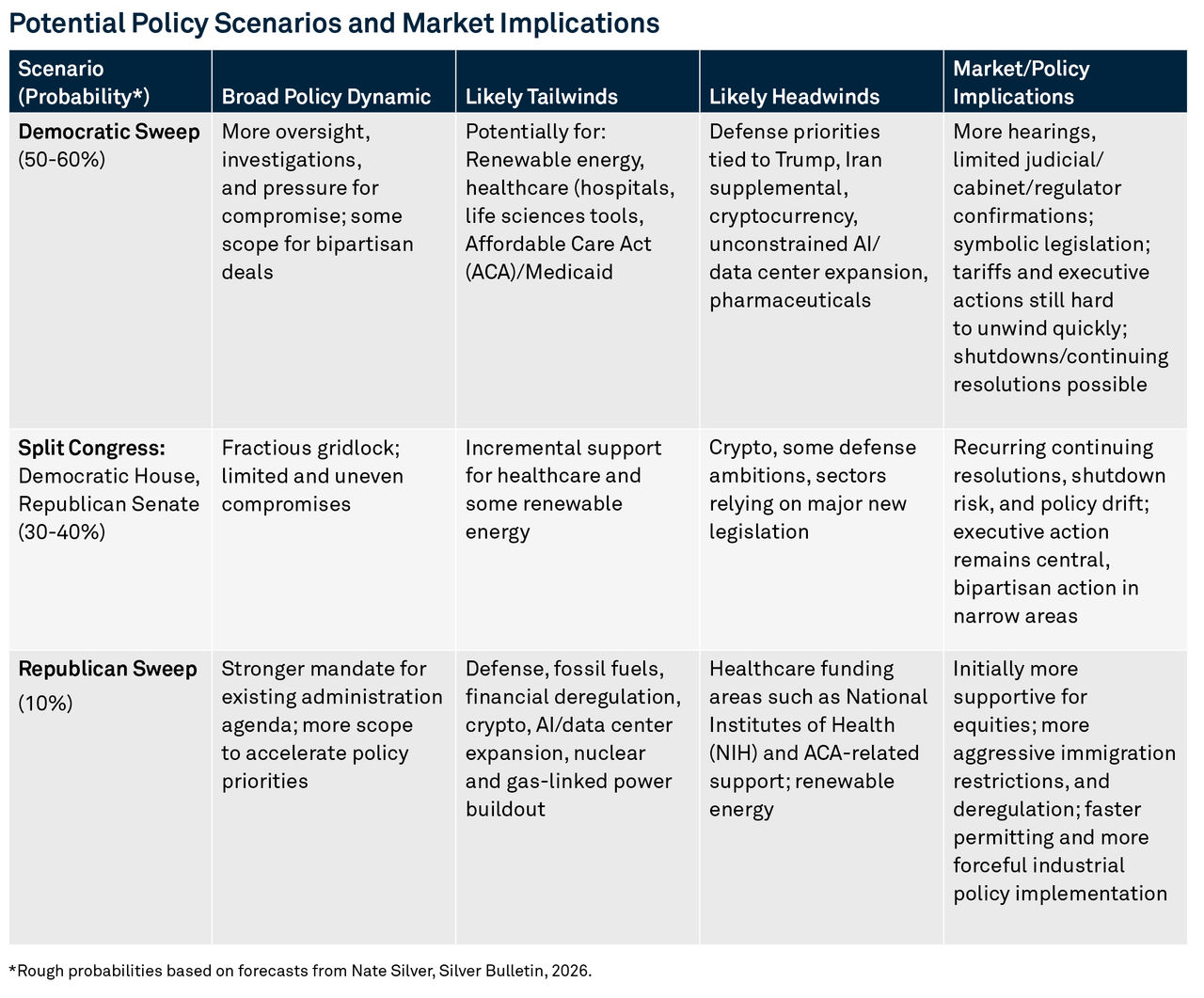
Healthcare may offer the greatest potential for compromise of a Democratic Congress and President Trump, particularly on pricing controls on pharmaceuticals, while Democrats would push to restore funding for the NIH and the ACA.
Referendum on AI
This year marks the first election shaped by the AI backlash, or “techlash,” with polls showing strong public concern over both the data center buildout and the potential disruption from rapidly improving AI models. Given AI’s centrality across markets, any policy efforts to slow it could have significant impact.
While AI concerns feature prominently in key Senate races, opposition from President Trump is likely to limit major federal regulation–making state-level action the key area to watch.
Most important are the political outlooks for the states where data center buildout is concentrated. In addition to key governors’ races, this includes utility commissions and state legislatures in states such as Texas, Georgia, Ohio, and Pennsylvania that could impact key regulatory approvals, grid costs and tax incentives.
Key States for the AI Data Center Buildout
Operating plus planned data center capacity, top 15 states ranked by total, gigawatt (GW).
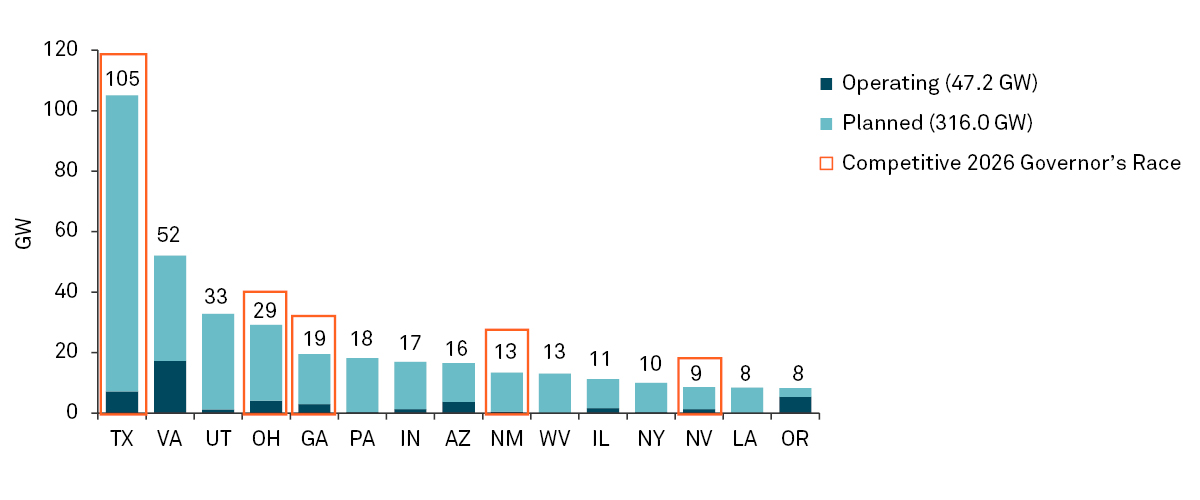
Democrats have signaled plans to expand oversight of AI development and deployment, with a new House Select Committee. With no federal guidelines or legislation and a lack of votes for federal “pre-emption” legislation, states may take the lead instead–similar to the historical role of California in driving national fuel efficiency standards.
Fiscal Pressures to Persist
With long-end yields under persistent pressure, fiscal policy will be key to watch in 2027. Despite market concerns, we see little chance of fiscal consolidation after the midterms, while at least one government shutdown, potentially paired with another debt-ceiling standoff, is likely.
The U.S. fiscal deficit is set to stay near or above 6% of GDP in 2027 and 2028, with mandatory spending and interest accounting for almost 75% of federal outlays.1 Based on past experience, divided government tends to produce modest fiscal deterioration rather than consolidation, as the two parties eventually compromise on competing priorities.
Midterms have often catalyzed budget and debt standoffs between the executive branch and Congress, as evidenced by past shutdowns and standoffs.
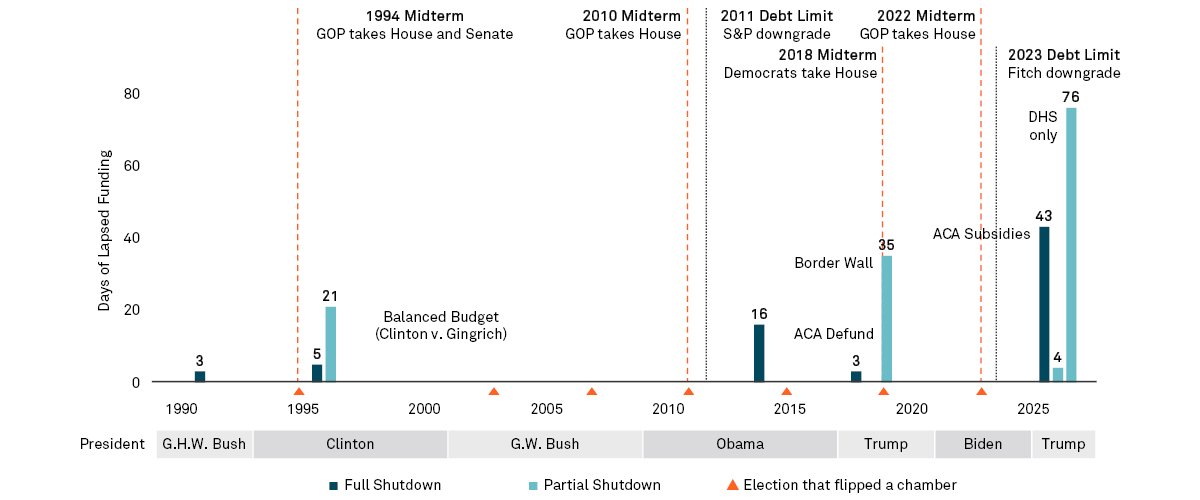
The current continuing resolution expires December 11, 2026, requiring a further stopgap into the new year, and providing a last opportunity for the outgoing Republican Congress to raise the debt ceiling and pursue spending priorities unilaterally.2
If debt ceiling action is deferred to 2027, Democrats could seek concessions such as extending ACA subsidies or preserving clean energy incentives.
For investors, fiscal standoffs could add pressure and volatility to long-end yields. A government shutdown may also revive data disruptions for key series (delayed Consumer Price Index data, payrolls, etc.), just as investors and the Federal Reserve try to gauge where the economy sits in the cycle.
America-First Trade Policies: Reshoring a Long-Term Theme
Trump administration tariffs look set to persist, with Section 301 putting a firmer floor under tariff levels, alongside continued support for U.S. manufacturing reshoring through tax incentives and industrial policy.3
Democratic legislation in the new Congress may signal the party’s stance on any future tariff adjustments. Democrats appear inclined to protect key manufacturing sectors while reducing tariffs on certain consumer goods.
Against this backdrop, reshoring should remain a durable investment theme regardless of the midterm outcome. Advanced manufacturing areas such as semiconductors, AI-linked infrastructure, pharmaceuticals, aerospace, machinery, and grid equipment are showing strong momentum, with a broader range of U.S. industrials enjoying sustained tailwinds.
The Trump administration’s hands-on industrial policy: investing in strategic sectors like critical minerals, quantum and nuclear power, is set to continue–with significant lending capacity remaining in existing programs, though it will face greater scrutiny and constraints from Congress, particularly on equity investments.
Looking Ahead
However they break, this year’s midterms should shape market sentiment through policy priorities, sector dynamics, and political leadership. The results will also signal where policy is headed into 2028–with more consequential policy changes and an unusually broad range of policy outcomes in play.
Endnotes
1Congressional Budget Office, The Budget and Economic Outlook: 2026 to 2036, February 11, 2026.
2The Senate passed the continuing resolution 90-6 on August 8, 2026, funding the federal government through December 11 at fiscal year 2026 spending levels across all 12 major appropriations divisions.
3Yale, The Budget Lab: The State of U.S. Tariffs, August 24, 2026.
Consumer Price Index measures the overall change in consumer prices based on a representative basket of goods and services over time.
Important Information
BNY Investments is the brand name for the investment management business of BNY and its investment firm affiliates worldwide. BNY is the corporate brand of The Bank of New York Mellon Corporation and may be used to reference the corporation as a whole or its various subsidiaries generally.
The information contained herein reflects general views and is provided for informational purposes only. This material is not intended as investment advice nor is it a recommendation to adopt any investment strategy. Opinions and views expressed are subject to change without notice.
Past performance is no guarantee of future results.
Issuing entities
This material is only for distribution in those countries and to those recipients listed, subject to the noted conditions and limitations: • United States: by BNY Mellon Securities Corporation (BNYSC), 240 Greenwich Street, New York, NY 10286. BNYSC, a registered broker-dealer and FINRA member, has entered into agreements to offer securities in the U.S. on behalf of certain BNY Investments firms. • Europe (excluding Switzerland): BNY Mellon Fund Management (Luxembourg) S.A., 2-4 Rue EugèneRuppertL-2453 Luxembourg. • UK, Africa and Latin America (ex-Brazil): BNY Mellon Investment Management EMEA Limited, BNY Mellon Centre, 160 Queen Victoria Street, London EC4V 4LA. Registered in England No. 1118580. Authorised and regulated by the Financial Conduct Authority. • South Africa: BNY Mellon Investment Management EMEA Limited is an authorised financial services provider. • Switzerland: BNY Mellon Investments Switzerland GmbH, Bärengasse 29, CH-8001 Zürich, Switzerland. • Middle East: DIFC branch of The Bank of New York Mellon. Regulated by the Dubai Financial Services Authority. • South East Asia and South Asia: BNY Mellon Investment Management Singapore Pte. Limited Co. Reg. 201230427E. Regulated by the Monetary Authority of Singapore. • Hong Kong: BNY Mellon Investment Management Hong Kong Limited. Regulated by the Hong Kong Securities and Futures Commission. • Japan: BNY Mellon Investment Management Japan Limited. BNY Mellon Investment Management Japan Limited is a Financial Instruments Business Operator with license no 406 (Kinsho) at the Commissioner of Kanto Local Finance Bureau and is a Member of the Investment Trusts Association, Japan and Japan Investment Advisers Association and Type II Financial Instruments Firms Association. • Brazil: ARX Investimentos Ltda., Av. Borges de Medeiros, 633, 4th floor, Rio de Janeiro, RJ, Brazil, CEP 22430-041. Authorized and regulated by the Brazilian Securities and Exchange Commission (CVM). • Canada: BNY Mellon Asset Management Canada Ltd. is registered in all provinces and territories of Canada as a Portfolio Manager and Exempt Market Dealer, and as a Commodity Trading Manager in Ontario.
All issuing entities are subsidiaries of The Bank of New York Mellon Corporation.
No part of this material may be reproduced in any form, or referred to in any other publication, without express written permission. All information contained herein is proprietary and is protected under copyright law.
NOT FDIC INSURED | NO BANK GUARANTEE | MAY LOSE VALUE
© 2026 THE BANK OF NEW YORK MELLON CORPORATION
MARK-1009537-2026-09-30
GU-951 - 1 October 2027