Renewed hostilities in the Strait of Hormuz are once again threatening the energy flows the global economy depends on — and oil prices are already responding.
KEY POINTS
- Renewed hostilities in the Strait of Hormuz risk disrupting key energy flows and have pushed oil prices higher. However, the global macro cycle remains resilient due to greater energy management flexibility.
- Our base case remains a “muddling through” scenario where the global economy continues to expand but a renewed spike in energy costs will likely raise market pressure.
- Our outlook remains cautious, favoring Japan and emerging market ex-China equities, real assets, and value-oriented stocks — which we believe are better positioned to withstand supply-side portfolio volatility.
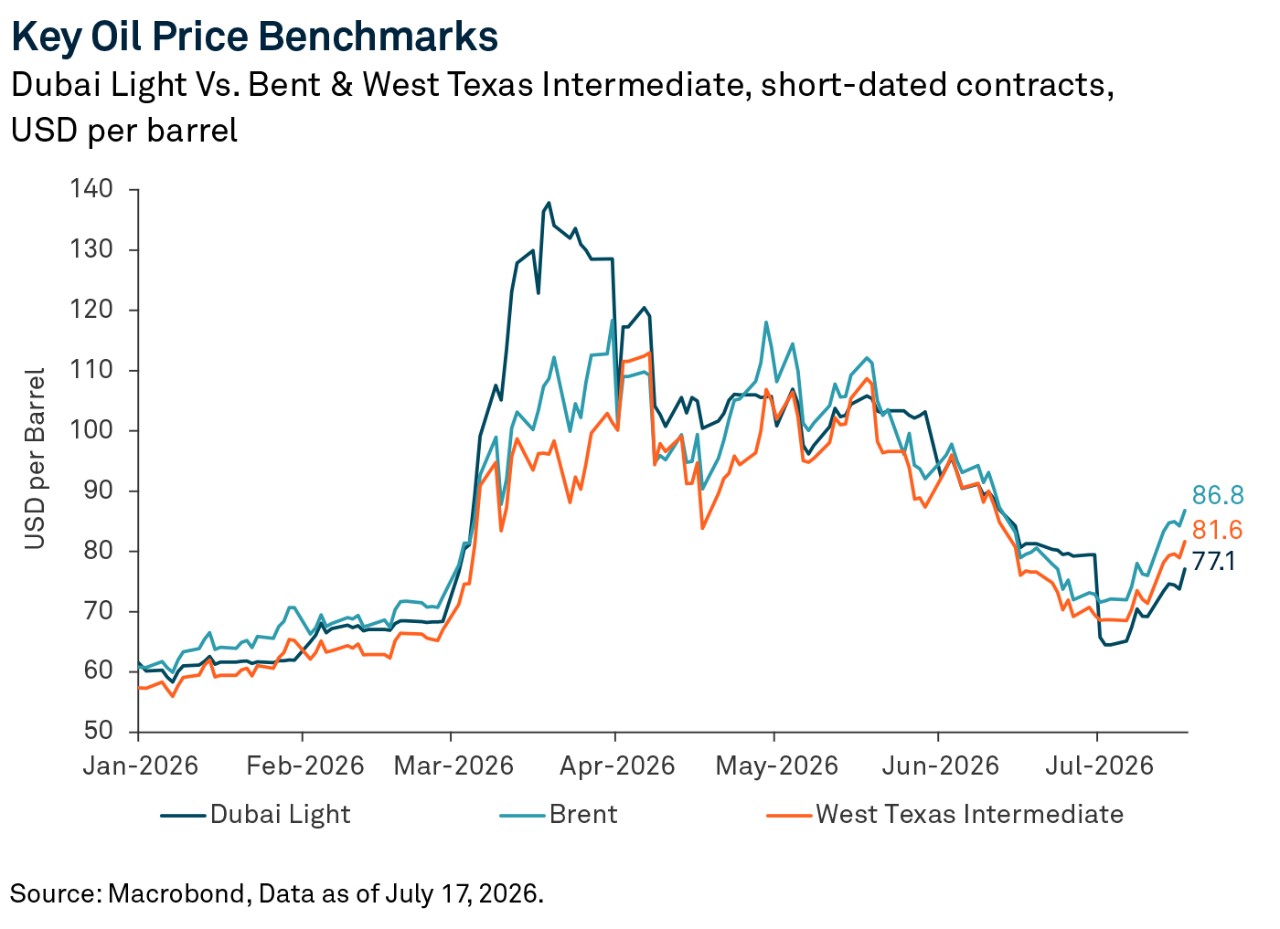
Renewed hostilities in the Strait of Hormuz are once again threatening the energy flows the global economy depends on — and oil prices are already responding. Futures curves are slipping into backwardation with frontdated crude oil contract prices now trading significantly above longer-dated futures prices. The spot price of various grades of crude oil (Brent, West Texas Intermediate and Dubai Light) is beginning to rise sharply again. The price of short-dated refined products has risen even further since late June on a worsening shortage of refined oil products around the world.
De-escalation Still in View
In our latest Quarterly Investment Outlook, we noted that stagflation risks had not entirely disappeared. Despite a memorandum of understanding between Iran and U.S., which resulted in a ceasefire, persistent energy shortages could lead to an inflationary shock at the core of the global economy. This scenario incorporates a more hawkish monetary policy reaction by the U.S. Federal Reserve (Fed) to anchor inflation expectations and to prevent energy price pressures from seeping into core inflation.
Asset prices could tilt toward a stagflation-like scenario in the near term, but it is too soon to conclude that heightened geopolitical outcomes and adverse policy reactions will become the base case. With the U.S. mid-term elections in view, we continue to believe that the political calculus in Washington still favors de-escalation. Iran, possibly facing internal divisions, is unlikely to want its lifeline of oil export revenue to come under renewed and prolonged pressure from an American embargo.
A More Resilient Energy Landscape
Despite the rising re-escalation risks, the global macro cycle has remained resilient due to greater energy management flexibility around the world. Alongside trend improvements in energy efficiency, several countries moved rapidly to alternate energy products and diversified sources of supply. The coordinated and aggressive drawdown of oil product and crude inventories by the U.S. and the Organization for Economic Co-operation and Development (OECD) countries, a group of developed economies, has also helped.
These developments helped limit sharp supply disruptions and shortages of key upstream oil and petrochemical products. In fact, the increase in the twelve-month moving average price of oil has been quite tame relative to other recent energy price shocks such as Russia’s invasion of Ukraine in 2022 or the Arab Spring episode from 2011-13. Moreover, recent inflation prints had begun surprising to the downside in the U.S. and elsewhere as energy prices abated toward pre-conflict levels through the month of June.
What This Means for Markets and Portfolios
Our base case remains a “muddling through” scenario where the global economy continues to expand but a renewed spike in energy costs will likely raise market pressure. A shift in the stance of Fed policy and the onset of rate hikes – in line with the market’s recent hawkish re-pricing of Fed policy – could raise market volatility as well as elevate stock-bond correlation and strengthen the U.S. dollar. This could create potential buying opportunities in the equity market. We remain cautious, favoring Japan and emerging market ex-China equities, real assets, and value-oriented stocks — which we believe are better positioned to withstand supply-side portfolio volatility.
Important Information
The Organization for Economic Co-operation and Development (OECD) is an influential international organization of 37 member countries that discuss and develop economic and social policy.
BNY Investments is the brand name for the investment management business of BNY and its investment firm affiliates worldwide. BNY is the corporate brand of The Bank of New York Mellon Corporation and may be used to reference the corporation as a whole or its various subsidiaries generally.
IN THE UNITED STATES: FOR GENERAL PUBLIC USE.
IN ALL OTHER JURISDICTIONS: FOR INSTITUTIONAL, PROFESSIONAL, QUALIFIED INVESTORS AND QUALIFIED CLIENTS.
Disclaimer
The information contained herein reflects general views and is provided for informational purposes only. This material is not intended as investment advice nor is it a recommendation to adopt any investment strategy. It is intended for institutional and professional audiences and may not be relied upon by retail investors jurisdictions other than the US.
Opinions and views expressed are subject to change without notice.
Past performance is no guarantee of future results.
Issuing entities
This material is only for distribution in those countries and to those recipients listed, subject to the noted conditions and limitations: • United States: by BNY Mellon Securities Corporation (BNYSC), 240 Greenwich Street, New York, NY 10286. BNYSC, a registered broker-dealer and FINRA member, has entered into agreements to offer securities in the U.S. on behalf of certain BNY Investments firms. • Europe (excluding Switzerland): BNY Mellon Fund Management (Luxembourg) S.A., 2-4 Rue EugèneRuppertL-2453 Luxembourg. • UK, Africa and Latin America (ex-Brazil): BNY Mellon Investment Management EMEA Limited, BNY Mellon Centre, 160 Queen Victoria Street, London EC4V 4LA. Registered in England No. 1118580. Authorised and regulated by the Financial Conduct Authority. • South Africa: BNY Mellon Investment Management EMEA Limited is an authorised financial services provider. • Switzerland: BNY Mellon Investments Switzerland GmbH, Bärengasse 29, CH-8001 Zürich, Switzerland. • Middle East: DIFC branch of The Bank of New York Mellon. Regulated by the Dubai Financial Services Authority. • South East Asia and South Asia: BNY Mellon Investment Management Singapore Pte. Limited Co. Reg. 201230427E. Regulated by the Monetary Authority of Singapore. • Hong Kong: BNY Mellon Investment Management Hong Kong Limited. Regulated by the Hong Kong Securities and Futures Commission. • Japan: BNY Mellon Investment Management Japan Limited. BNY Mellon Investment Management Japan Limited is a Financial Instruments Business Operator with license no 406 (Kinsho) at the Commissioner of Kanto Local Finance Bureau and is a Member of the Investment Trusts Association, Japan and Japan Investment Advisers Association and Type II Financial Instruments Firms Association. • Brazil: ARX Investimentos Ltda., Av. Borges de Medeiros, 633, 4th floor, Rio de Janeiro, RJ, Brazil, CEP 22430-041. Authorized and regulated by the Brazilian Securities and Exchange Commission (CVM). • Canada: BNY Mellon Asset Management Canada Ltd. is registered in all provinces and territories of Canada as a Portfolio Manager and Exempt Market Dealer, and as a Commodity Trading Manager in Ontario. All issuing entities are subsidiaries of The Bank of New York Mellon Corporation.
NOT FDIC INSURED | NO BANK GUARANTEE | MAY LOSE VALUE
© 2026 THE BANK OF NEW YORK MELLON CORPORATION
MARK-969135-2026-07-16
GU-904 - 30 June 2027