Q4 2026
QUARTERLY INVESTMENT OUTLOOK
Intelligence for Your Portfolios
Q4 2026
Intelligence for Your Portfolios
Global growth remains resilient despite the Middle East shock, supported by U.S. business investment and European fiscal spending. However, inflation remains above target. Against this backdrop, central banks hike more than once. Three factors shape our macro view.
Despite added production outside the Middle East, oil inventories could hit minimum operating levels, causing shortages if the conflict persists.
Pass-through from the commodity price shock is likely to peak in early 2027.
AI-related capex in the U.S. and fiscal spending on infrastructure in Germany should be positive for growth.
We remain selective and defensive in equities, with a preference for value and income, while staying cautious on duration. Real assets and inflation hedges also provide portfolio diversification.
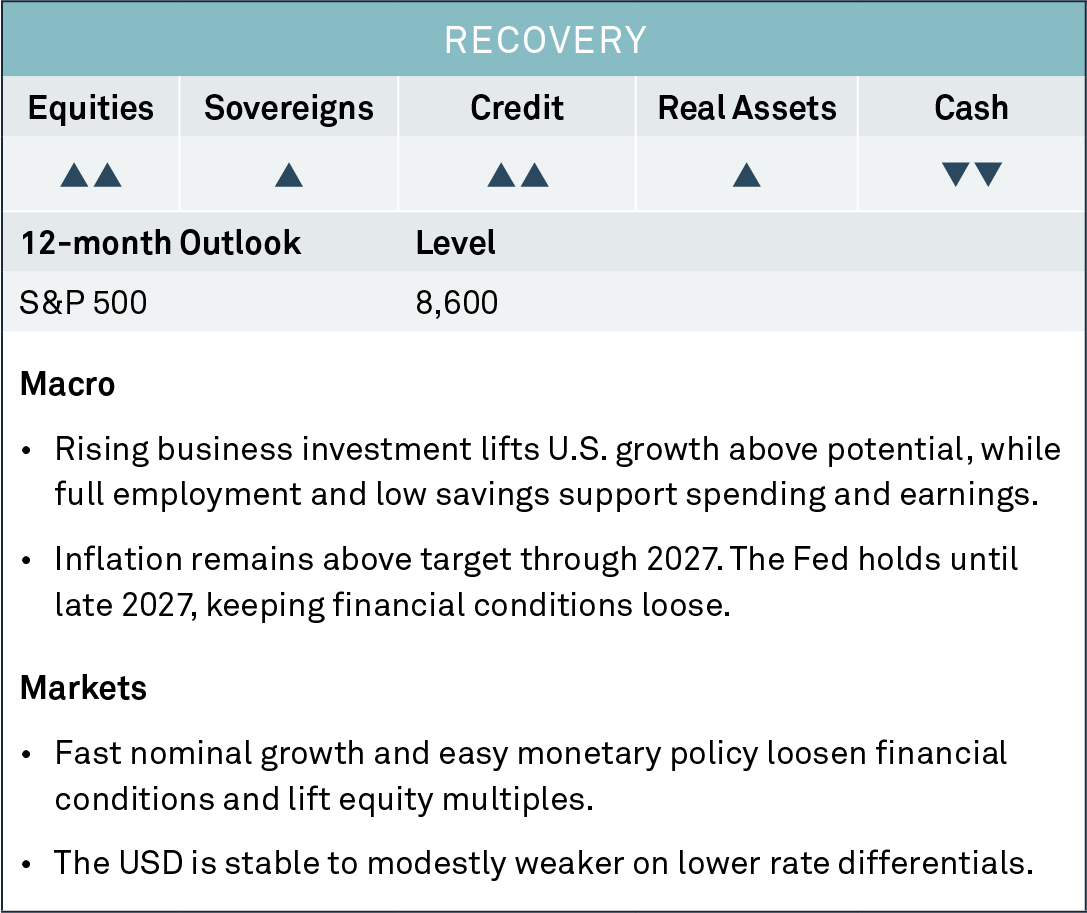
Global growth picks up as the Middle East conflict fades. In the U.S., easing energy prices, AI-led capex, and loose financial conditions outweigh fading fiscal support, pushing growth above potential. German stimulus lifts Europe, while UK’s above-potential rebound is delayed to 2028. Japan normalizes monetary policy and the yen strengthens slightly. China delivers a modest stimulus package, but disinflation lingers.
Risk assets stay volatile, with earnings driving returns.
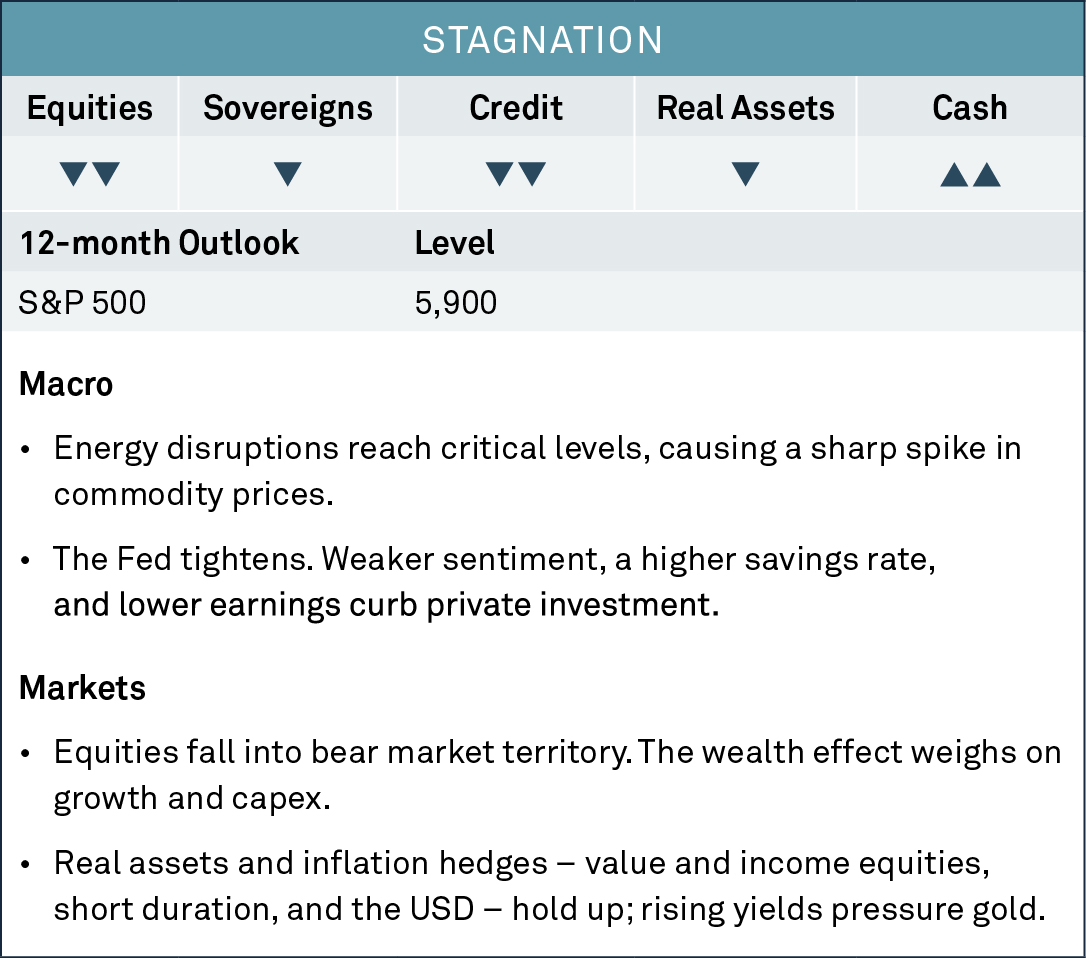
A prolonged Iran conflict spikes commodity prices as trend inflation remains above target. The Fed tightens to around 5% by mid-2027, weighing on investment, AI capex, consumption and earnings. The European Central Bank (ECB) hikes to contain second-round effects, pushing European growth below trend. The Bank of England (BoE) follows more cautiously, but UK growth flirts with recession. Japan slips into a recession on costly oil, delaying Bank of Japan (BoJ) normalization, while China’s growth falls to around 3%.
Equities enter a bear market, the U.S. dollar (USD) strengthens, and cash, real assets, and inflation hedges outperform while higher yields weigh on gold.
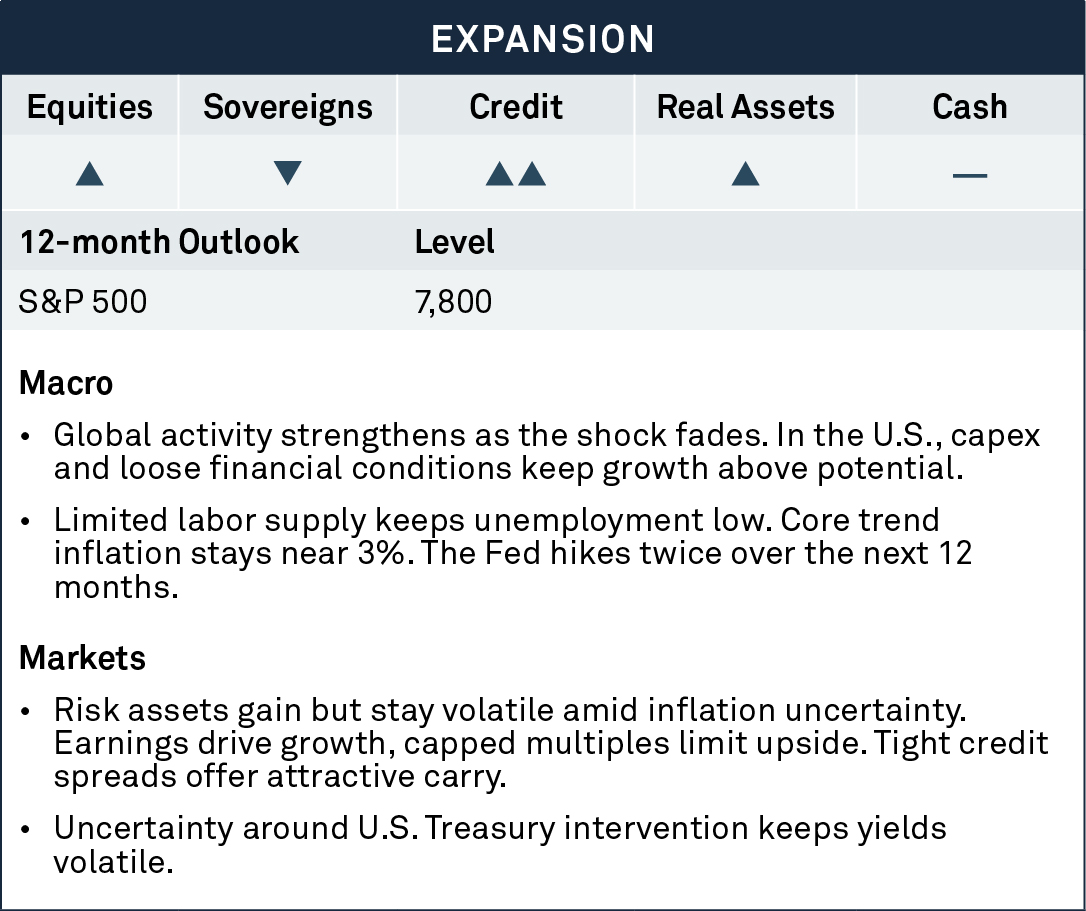
Global growth is powered by a reacceleration in the AI capex cycle. In the U.S., AI adoption broadens, the labor market stays at full employment, and a low savings rate sustains spending. Inflation stays above target through 2027, but the Fed holds, keeping financial conditions easy. The UK gains from AI spillovers and grows above potential sooner than expected, while German stimulus and data center buildouts lift Europe, with the ECB on hold. The BoJ hikes more than the other two scenarios. China grows around 5% in real terms.
Accommodative financial conditions support higher equity multiples and weakens the USD.
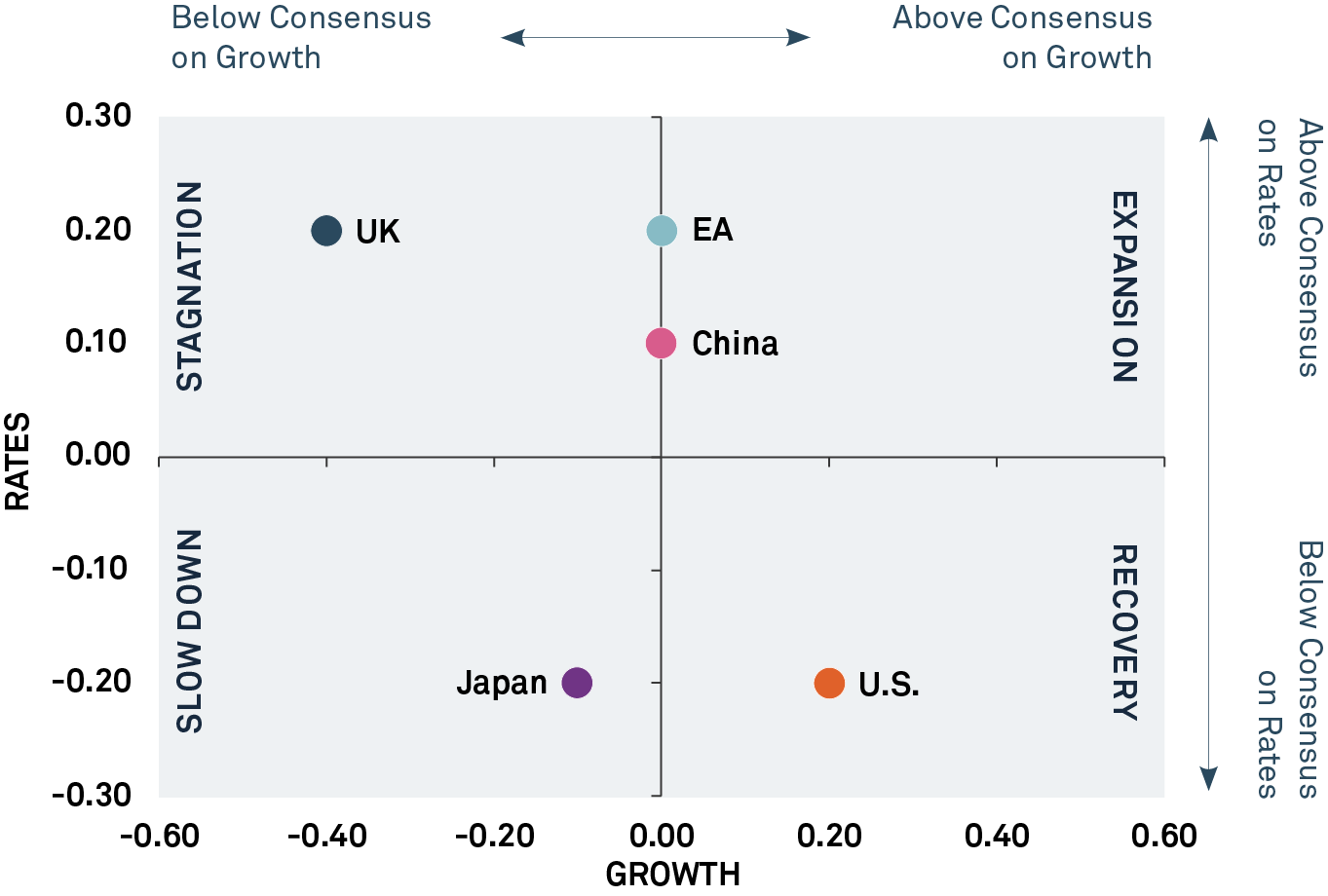
Our global outlook is one of divergence. We expect stronger-than-consensus growth in the U.S., while the UK see weaker growth and higher rates. Europe and China are in line with consensus on growth but rates are above expectations. Japan is below consensus on both growth and rates.
Dive deeper into our asset class positioning and portfolio implications in the full report, where you'll find:
✓ Economic outlook on growth, inflation, and monetary policy
✓ Three scenarios-based forecasts
✓ Key risks we are watching
✓ How our view differs from consensus
Related Research
Endurance Under Pressure
Pressure creates resilience or strain. Our CMAs provide a disciplined, long-term view to help investors build enduring portfolios.
PAST PERFORMANCE IS NO GUARANTEE OF FUTURE RESULTS.
All investments involve risk, including the possible loss of principal. No investment strategy or risk management technique can guarantee returns or eliminate risk in any market environment.
RISK CONSIDERATIONS
This report has been provided for informational purposes only and is subject to significant limitations. The views contained herein are not to be taken as advice or a recommendation to buy or sell any investment. The information contains projections or other forwardlooking statements regarding future events, targets or expectations, and is only current as of the date indicated. Targets contained herein are based upon an analysis of historical and current information and assumptions about circumstances and events that may not yet have taken place and may never occur. If any of the assumptions used do not prove to be true, results may vary substantially. Certain information has been obtained from sources believed to be reliable, but not guaranteed. We believe the information provided here is reliable, but do not warrant its accuracy or completeness. If the reader chooses to rely on the information, it is at its own risk. The information is based on current market conditions, which will fluctuate and may be superseded by subsequent market events or for other reasons. We do not undertake to advise you of any change in the information contained in this report. The report does not reflect actual trading and other factors that could impact future returns. Given the inherent limitations of the assumptions, this report does not contain sufficient information to support an investment decision and it should not be relied upon by you in evaluating the merits of investing in any securities or products. The information has been provided without taking into account the investment objective, financial situation or needs of any particular person. Please consult a legal, tax or financial professional in order to determine whether an investment product or service is appropriate for a particular situation.
Equities are subject to market, market sector, market liquidity, issuer, and investment style risks, to varying degrees. Bonds are subject to interest-rate, credit, liquidity, call and market risks, to varying degrees. Generally, all other factors being equal, bond prices are inversely related to interest-rate changes and rate increases can cause price declines. Commodities contain heightened risk, including market, political, regulatory, and natural conditions, and may not be appropriate for all investors. High yield bonds involve increased credit and liquidity risk than higher-rated bonds and are considered speculative in terms of the issuer’s ability to pay interest and repay principal on a timely basis. Investing in foreign denominated and/or domiciled securities involves special risks, including changes in currency exchange rates, political, economic, and social instability, limited company information, differing auditing and legal standards, and less market liquidity. These risks generally are greater with emerging market countries. Small and midsized company stocks tend to be more volatile and less liquid than larger company stocks as these companies are less established and have more volatile earnings histories. Currencies are can decline in value relative to a local currency, or, in the case of hedged positions, the local currency will decline relative to the currency being hedged. These risks may increase volatility. Alternative strategies may involve a high degree of risk and prospective investors are advised that these strategies are appropriate only for persons of adequate financial means who have no need for liquidity with respect to their investment and who can bear the economic risk, including the possible complete loss, of their investment. The strategies may not be subject to the same regulatory requirements as registered investment vehicles. The strategies may be leveraged and may engage in speculative investment practices that may increase the risk of investment loss. Investors should consult their financial professional prior to making an investment decision.
INDICES & DEFINITIONS
1-year forward swap: the avg. interest rate for 1-mth. in 1-year forward. GDP: gross domestic product is the total monetary or market value of all the finished goods and services produced within a country’s borders over a given time period. 10Y UK Gilt – Average yield of a range of UK government bonds all adjusted
to the equivalent of a ten-year maturity. The 10Y US Treasuries Average Yield of a range of Treasury securities all adjusted to the equivalent of a ten-year maturity. Artificial intelligence (AI): computer systems that can perform tasks typically requiring human intelligence, such as visual perception, speech recognition, decision-making, and language translation. Bloomberg US Corporate High Yield: covers the universe of fixed-rate, non-investment grade corporate debt in the US. Bloomberg US Corporate Investment Grade: designed to measure the performance of the investment grade corporate sector in the US 1-mth. Capital expenditure (capex): the funds a company spends to acquire, upgrade, or maintain long-term assets that support business operations and future growth. The CBOE VIX Index (VIX) is an indicator of the implied volatility of S&P 500 Index as calculated by the Chicago Board Options Exchange (CBOE). Consumer Prices (CPI) Index measure of prices paid by consumers for a market basket of consumer goods and services. The yearly (or monthly) growth rate represents the inflation rate. Europe STOXX 600 Index represents the performance of 600 large, mid and small capitalization companies across 18 countries in the European Union. Expansion: GDP growth above trend. Fed funds Rate: the target interest rate for overnight lending and borrowing between banks. Japan (Nikkei 225): The NIKKEI 225 is an index that tracks the performance of the largest 225 companies traded in the Japanese market. The Majors Dollar Index (USD) measures the value of the US dollar relative to a basket of currencies of the most significant trading partners of the US including the euro, Japanese yen, Canadian dollar, British pound, Swedish krona, and Swiss franc. The MSCI EM Index (Emerging Markets Equities) tracks the total return performance of emerging market equities. Purchasing Managers Index (PMI): An economic indicator derived from monthly surveys of private sector companies. A level above 50 indicates expansion compared to the prior month and below 50 contraction. Investors cannot invest directly in any index. The S&P 500 Composite Index (S&P 500) is designed to track the performance of the largest 500 US companies. Recovery: growth recovering towards long-term trend growth. Stagnation: a prolonged period of little or no economic growth, often accompanied by high unemployment and minimal improvements in living standards. Sticky inflation: type of inflation in which price increases persist and resist falling, even after the original causes of inflation fade.
STATISTICAL TERMS
Skewness in statistics represents an imbalance and an asymmetry from the mean of a data distribution. In a normal data distribution with a symmetrical bell curve, the mean and median are the same. Probability-weighted mean is similar to an ordinary arithmetic mean, except that instead of each of the data points contributing equally to the final average, data points are weighted by the statistical probability for a particular scenario outcome. Duration is a measure of a bond’s interest rate sensitivity, expressed in years. The higher the number, the greater the potential for volatility as interest rates change.
OTHER
QE: quantitative easing. Fed: US Federal Reserve. ECB: European Central Bank. BOJ: Bank of Japan. BOE: Bank of England.
BNY Investments is the brand name for the investment management business of BNY and its investment firm affiliates worldwide. BNY is the corporate brand of The Bank of New York Mellon Corporation and may be used to reference the corporation as a whole or its various subsidiaries generally.
The information contained herein reflects general views and is provided for informational purposes only. This material is not intended as investment advice nor is it a recommendation to adopt any investment strategy.
Opinions and views expressed are subject to change without notice.
Past performance is no guarantee of future results.
ISSUING ENTITIES
This material is only for distribution in those countries and to those recipients listed, subject to the noted conditions and limitations: • United States: by BNY Mellon Securities Corporation (BNYSC), 240 Greenwich Street, New York, NY 10286. BNYSC, a registered broker-dealer and FINRA member, has entered into agreements to offer securities in the U.S. on behalf of certain BNY Investments firms. • Europe (excluding Switzerland): BNY Mellon Fund Management (Luxembourg) S.A., 2-4 Rue Eug.neRuppertL-2453 Luxembourg. • UK, Africa and Latin America (ex-Brazil): BNY Mellon Investment Management EMEA Limited, BNY Mellon Centre, 160 Queen Victoria Street, London EC4V 4LA. Registered in England No. 1118580. Authorised and regulated by the Financial Conduct Authority. • South Africa: BNY Mellon Investment Management EMEA Limited is an authorised financial services provider. • Switzerland: BNY Mellon Investments Switzerland GmbH, B.rengasse 29, CH-8001 Zürich, Switzerland. • Middle East: DIFC branch of The Bank of New York Mellon. Regulated by the Dubai Financial Services Authority. • South East Asia and South Asia: BNY Mellon Investment Management Singapore Pte. Limited Co. Reg. 201230427E. Regulated by the Monetary Authority of Singapore. • Hong Kong: BNY Mellon Investment Management Hong Kong Limited. Regulated by the Hong Kong Securities and Futures Commission. • Japan: BNY Mellon Investment Management Japan Limited. BNY Mellon Investment Management Japan Limited is a Financial Instruments Business Operator with license no 406 (Kinsho) at the Commissioner of Kanto Local Finance Bureau and is a Member of the Investment Trusts Association, Japan and Japan Investment Advisers Association and Type II Financial Instruments Firms Association. • Brazil: ARX Investimentos Ltda., Av. Borges de Medeiros, 633, 4th floor, Rio de Janeiro, RJ, Brazil, CEP 22430-041. Authorized and regulated by the Brazilian Securities and Exchange Commission (CVM). • Canada: BNY Mellon Asset Management Canada Ltd. is registered in all provinces and territories of Canada as a Portfolio Manager and Exempt Market Dealer, and as a Commodity Trading Manager in Ontario. All issuing entities are subsidiaries of The Bank of New York Mellon Corporation.
No part of this material may be reproduced in any form, or referred to in any other publication, without express written permission. All information contained herein is proprietary and is protected under copyright law.
NOT FDIC INSURED | NO BANK GUARANTEE | MAY LOSE VALUE |
2026 THE BANK OF NEW YORK MELLON CORPORATION
MARK-998929-2026-09-09
GU- 945 - 30 September 2027