Please ensure Javascript is enabled for purposes of website accessibility Getting Real in Retail
be
en
intermediary
intermediary
false
true
Gathering data
Disclaimer Not Available

Getting real in retail

Getting real in retail

Despite persistent concerns that sticky inflation would erode purchasing power and drag consumer spending lower, the May retail sales data tells a different story. Spending is up not just in dollar terms, but in quantity, highlighting continued consumer resilience. 
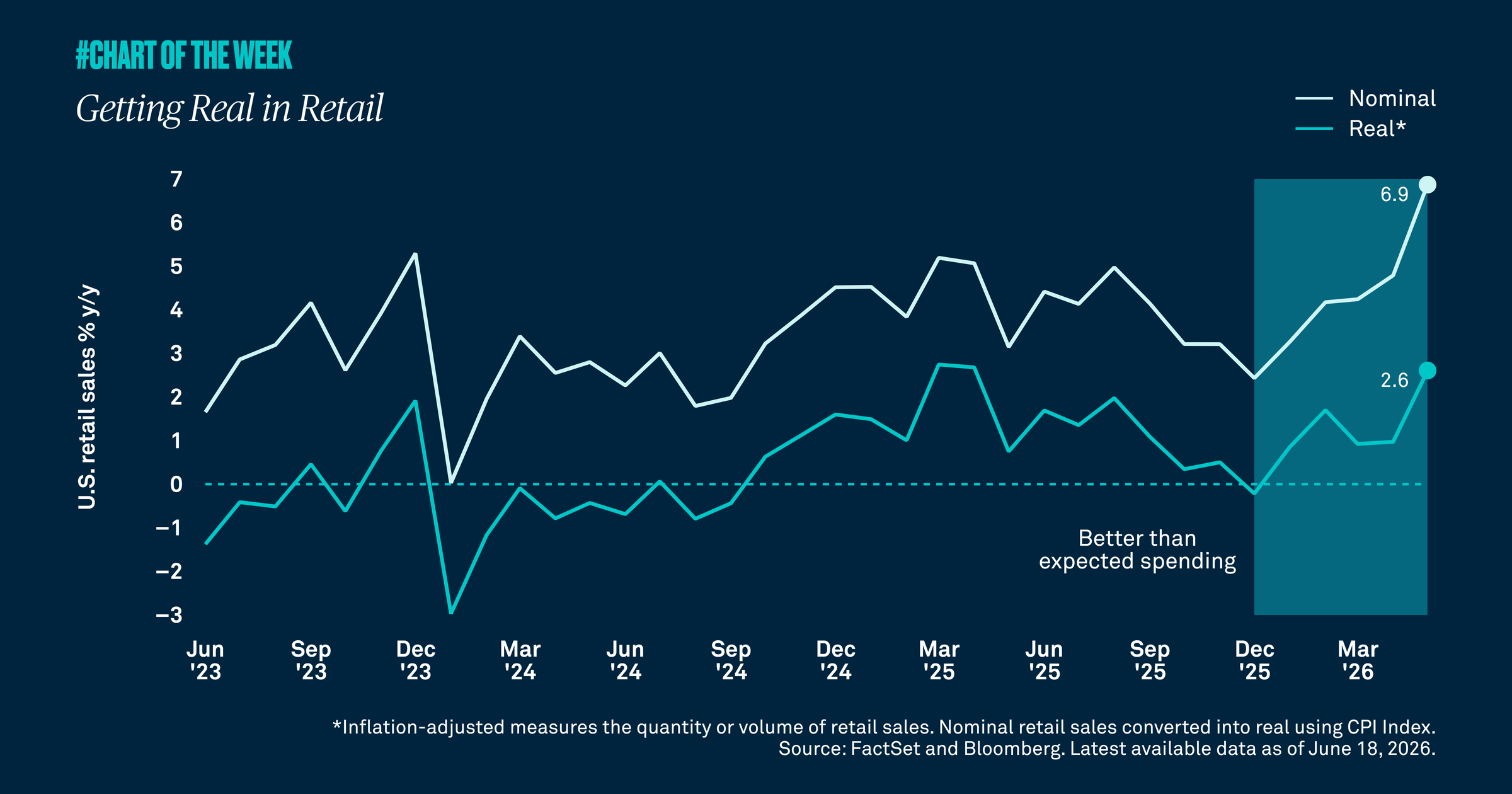

Nominal retail sales rose 6.9% year-over-year in May, the strongest growth rate in several years and more than double the average pace recorded since 2023. Importantly, this was not simply a reflection of higher prices. Real, inflation-adjusted retail sales grew 2.6% year-over-year — roughly 2% above the average — confirming that consumers are buying more, not just paying more.

However, U.S. consumer spending has not been uniform. The K-shaped dynamic (where higher-income households continue to spend while lower-income consumers face more meaningful pressure) is real and ongoing. While pockets of stress exist, total spending has held up and increased.

That said, the picture is not without risk. Higher inflation could weaken the spending momentum and lead to slower economic growth. For now, the increase in total consumer buying activity supports our constructive forward outlook and justifies remaining invested.
RELATED CONTENT
Higher inflation, contained expectations
Chart of the Week | Macroeconomic

Inflation has jumped since the Strait of Hormuz closed, squeezing consumers through higher gas and utility bills and pressuring businesses with higher freight and operating costs. Yet, longer-term inflation expectations remain contained, suggesting this looks more like a temporary energy shock than a lasting inflation upswing.

Steady hiring, fewer layoffs
Chart of the Week | Macroeconomic

May’s jobs report showed a labor market that is improving, with payroll growth exceeding expectations and layoffs down sharply from last year. Steady hiring and fewer layoffs should continue to support consumer spending and U.S. economic growth.

A broader foundation for earnings growth
Chart of the Week | Macroeconomic

Although companies benefiting most directly from AI-related capital spending are the main drivers of higher earnings, strength is no longer confined to that group. Earnings across the broader market remain solid and are expected to grow more than 10% this year and next, suggesting the risk of concentrated market leadership may not be founded.

Is the job market stabilizing?
Chart of the Week | Macroeconomic

After sluggish job growth in 2025, investors are looking for signs that the labor market may be stabilizing. With consumer spending driving 70% of economic activity, an improving labor market is essential to sustaining economic growth.

Gathering data
Disclaimer Not Available

This is a marketing communication