Please ensure Javascript is enabled for purposes of website accessibility Margin Resilience Is Key
be
en
institutional
institutional
false
true
Gathering data
Disclaimer Not Available

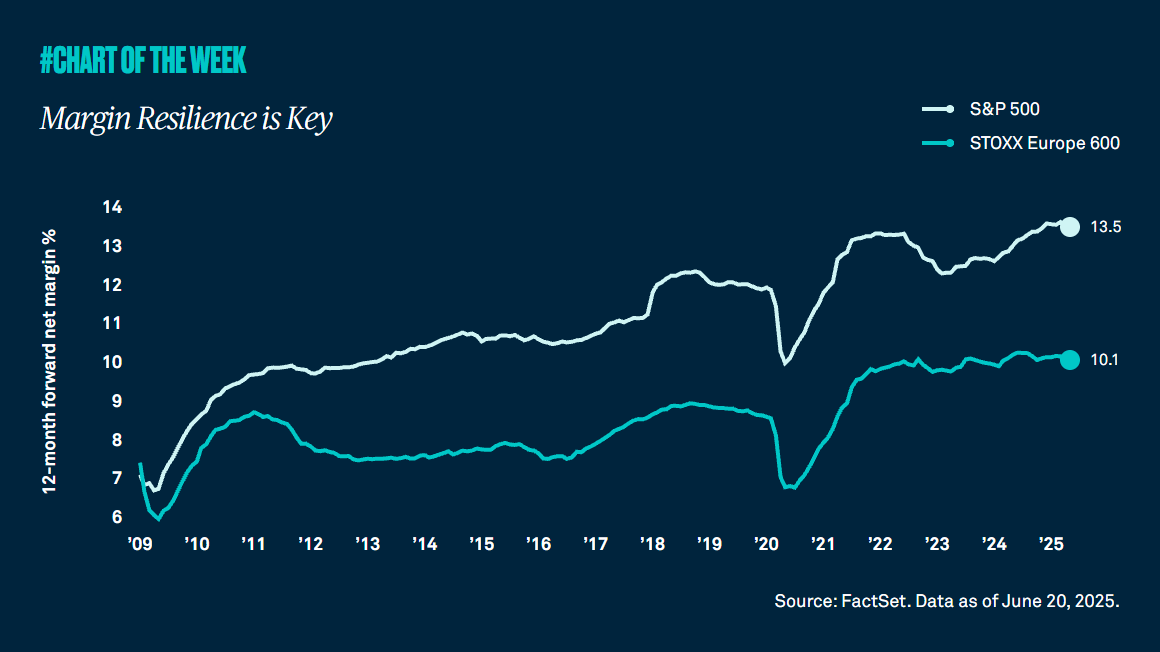
Margin resilience is key

Margin resilience is key

This year U.S. equities have underperformed the rest of the world due largely to policy uncertainty. However, an important driver of U.S. equity outperformance over the longer term has been stronger earnings and profit margins relative to peers, and our view is these factors will continue to drive long-term U.S. exceptionalism.


U.S. equities have had a challenging first half of the year, underperforming the rest of the world. A primary cause of this underperformance has been higher policy uncertainty and concerns about the impact of higher tariffs on growth.

While policy uncertainty can impact short-term volatility and lead to temporary underperformance, what does this mean for returns over the long term? An important driver of long-term returns is earnings and profit margins, where the U.S. has continued to outperform. In fact, since 2010 margins increased 6.4% to 13.5% as compared to a 2.7% increase in Europe to 10.1%. The difference between U.S. and European margins is now 3.4%, near the highest in history.

Additionally, technology leadership and increased adoption of artificial intelligence (AI) across diverse industries will likely support the continued expansion of U.S. margins, allowing them to surpass the rest of the world. Considering the many ways AI can improve profit margins for businesses, we anticipate that 2025 S&P 500 earnings per share will come in at $260-$270, demonstrating positive growth of roughly 8% as strong earnings and margin expansion continue to drive U.S. exceptionalism into the future.
RELATED CONTENT
Returns after oil spikes
Chart of the week | Macroeconomic

The Strait of Hormuz, which moves about 20% of global oil, has seen many ships that normally travel through it curtail their activity. Consequently, WTI oil was up over 36% in the five days after the oil supply shock began. Yet equities barely budged, signaling a temporary supply shock, not a larger crisis. Historically, after similar price spikes equities tend to move higher while oil prices decline — further evidence for avoiding emotion-driven investing.

Impact of geopolitics over time?
Chart of the week | Macroeconomic

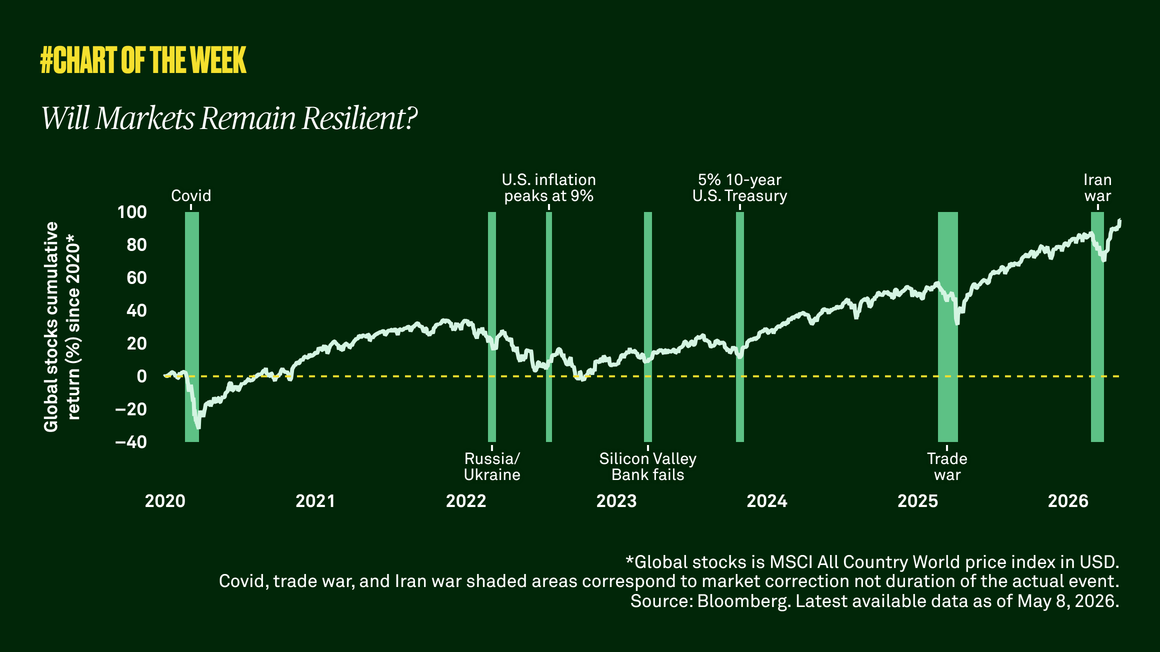
Tensions between the U.S./Israel and Iran have recently boiled over into a military conflict, which has given many investors the jitters. However, our research shows that equity market pullbacks resulting from geopolitical events are often short lived with the S&P 500 typically higher in the months following these events.

Behind the numbers: Q4 GDP
Chart of the week | Macroeconomic

Gross domestic product undershot expectations last quarter, but the shortfall appears driven more by the temporary government shutdown than broad-based weakness. Consumer demand remains resilient, and with supportive fiscal policy, easing financial conditions and a steady labor market, the outlook points to a modest acceleration in economic activity this year.

Narrow drawdown?
Chart of the week | Macroeconomic

Equity volatility is rising, but all is not what it seems. The technology sector is weighing on the S&P 500 while value and cyclical stocks lead. A market rotation is underway as many investors begin to favor companies beyond tech.

Gathering data
Disclaimer Not Available

This is a marketing communication