
Asia’s AI and technology sectors may create income opportunities, while a focus on dividends and cash flow can help balance growth potential with concentration and valuation considerations.
Key points
- Asia is in focus as stronger market performance and shifting capital flows draw renewed attention to the region.
- The region plays an increasingly important role in AI and technology, spanning semiconductors, memory and infrastructure.
- An income-focused approach may help maintain discipline where valuations look stretched and market enthusiasm is high.
- Income investing in Asia may offer something global equity benchmarks cannot: a built-in mechanism for resilience.
AI has put Asia firmly back on the map for global investors as its countries go toe-to-toe with the US on elements of the rapidly developing technology, including large language models (LLMs) and chip memory.
But there is more to Asia’s story than just its near-term AI prowess. On a longer-term view, facilitated by AI, Asia is set to become a global technology and manufacturing powerhouse, with the potential to influence the region’s growth prospects.
Taking the AI baton
Asia's AI investment opportunity may be supported by two distinct engines. The first is its own technology ecosystem, which is growing fast and producing homegrown innovation across software, hardware and applied AI.
The second is its position in the global semiconductor supply chain – a role being amplified by US hyperscalers committing immense amounts of capital to scale their AI operations.
This momentum has helped deliver strong performance for Asian equities. Over the past year, the FTSE AW Asia Pacific ex Japan index has outperformed the S&P 500 (see Figure 1). Around two-thirds of Asia’s market gains over this period were driven by AI-related beneficiaries, proving the region’s place at the heart of the AI super cycle. The South Korean stock market – largely driven by semiconductors – rallied by close to 80% in 20251, while Taiwan’s market has climbed around 120% over the past year2.
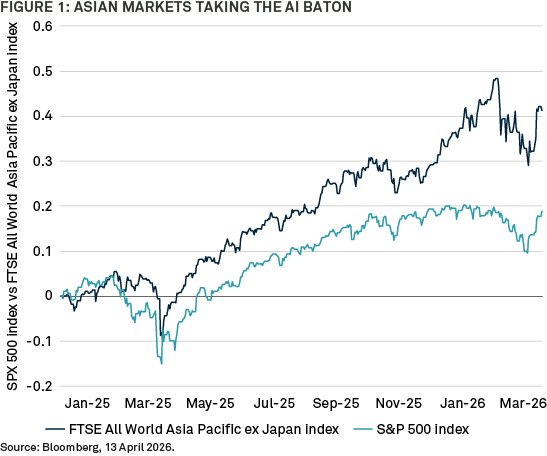
Past performance is not a guide to future performance.
Benefiting from US capex
We are in the middle of an unprecedented capex race. Spending on datacentres by US hyperscalers is tipped to exceed $700bn in 2026 alone (see Figure 2).
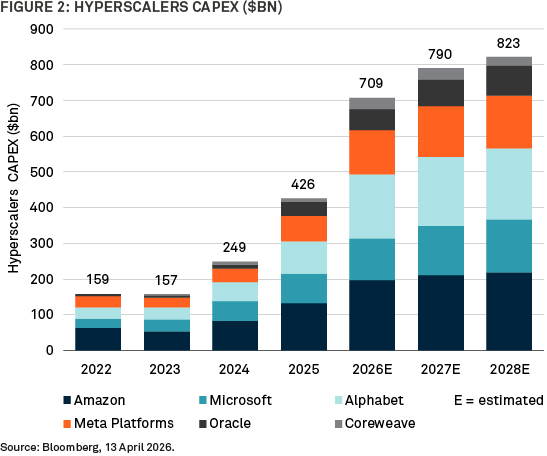
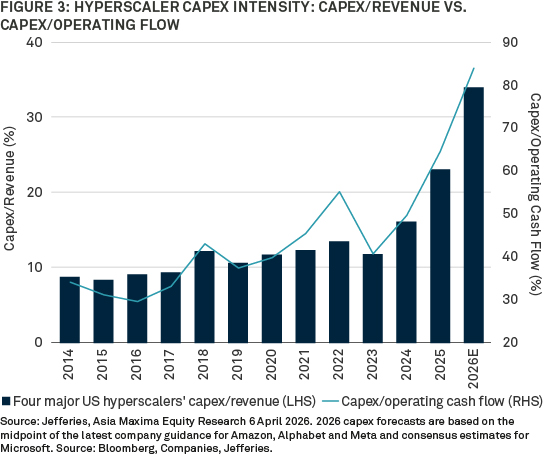
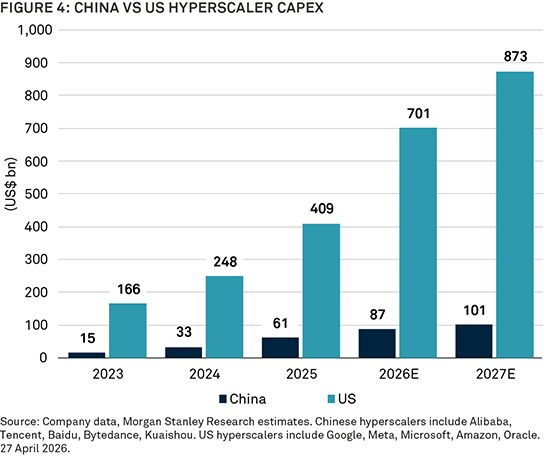
Sinking so much capital into data centres is affecting hyperscalers’ capital intensity. Capex -to-sales ratios have jumped to more than 30% from around 10% before the AI boom. This is eating up cashflows, with capex as a percentage of operating cashflows hovering around 85%, compared with 40% in 2023 (see Figure 3). Arguably, the US hyperscalers are moving from asset light to asset intensive business models. By contrast, China is early in the capex cycle, spending just 15% of what the US hyperscalers did last year. (see Figure 4).
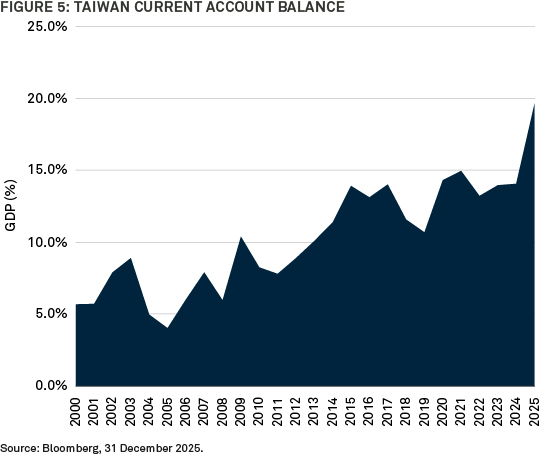
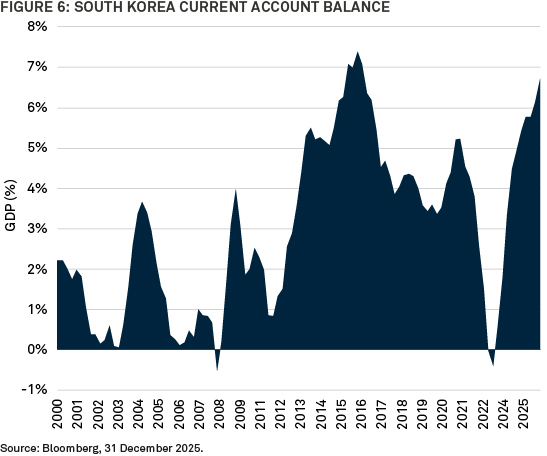
This vast US capex spend has boosted sales for Asia. From central processing units (CPUs) to liquid cooling plates, Asia is where almost everything in the semiconductor supply chain is manufactured. South Korea and Taiwan, for instance, have enjoyed gains linked to hyperscaler spending, boosting their current account balances as a percentage of GDP (see Figures 5 and 6).
Asia’s own tech champions
China has become a key competitor in large language models (LLMs), partly due to healthy competition within its own market. Despite not having access to Nvidia’s latest chips, it has created its own highly competitive AI battlefield where the likes of Alibaba, ByteDance and DeepSeek vie for dominance alongside smaller LLM challengers.
Yet China’s AI lab models are on a par with the US in terms of intelligence. China already dominates other tech areas like electric vehicles, drones and quantum computing, so it is not hard to imagine AI models joining this list.
Asia also dominates the memory space. South Korea is globally dominant in DRAM (Dynamic Random Access Memory), which is vital for temporarily holding the vast amounts of data computers need to work rapidly. South Korea’s Samsung and SK Hynix are the two largest players by market share, followed by the US’s Micron3. The DRAM sector is consolidating while demand from data centres is growing, driving prices higher and increasing wait times. An element of cyclicality is inevitable, but earnings and margins have improved, which could be supportive of sustainable dividends.
Why Asia for income?
Technology is typically linked with growth companies, but it plays a significant role in Asian income investing too.
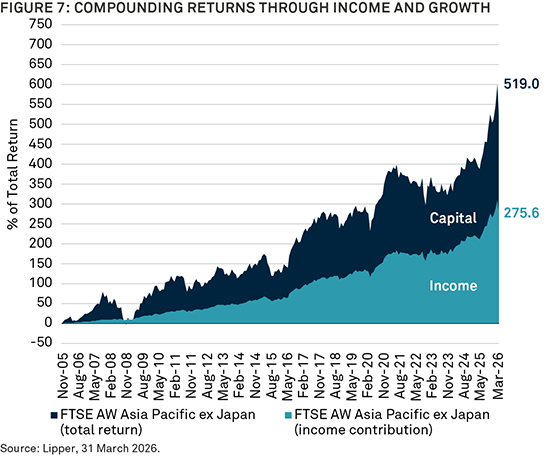
The importance of dividends in Asia can be seen in the benchmark composition of total returns between capital and income. Thanks to compounding dividends, over a 20-year period, income has contributed more than half of the index's total return (Figure 7). The reliability of dividends and their compounding can offer portfolio resilience, particularly during times of market volatility.
Past performance is not a guide to future performance.
Capturing Asia’s AI upside
Asia offers attractive AI- and technology-led income opportunities, but caution is warranted. Like the US, benchmark concentration also exists in Asia, making active stock selection vital to building a portfolio that differs meaningfully from the benchmark.
For those seeking to capture income from Asia’s longer-term AI growth, a measured approach makes sense: protecting on the downside while retaining upside participation. A benchmark-agnostic equity income strategy with a disciplined yield focus and a fundamental lens can uncover high-quality companies with durable moats, strong balance sheets, disciplined capital allocation and appealing valuations. The result can be a lower-volatility portfolio with attractive dividends and a favourable risk-reward profile.
1FT. South Korea’s astounding market ride. 5 March 2026.
2Source: Trading Economics. TAIEX (Taiwan Capitalisation Weighted Stock Index) gain year to date as of 22 June 2026.
3Counterpointresearch.com. Global DRAM and HBM Market Share: Quarterly. 9 June 2026.
Charts are for illustrative purposes only.
IMPORTANT INFORMATION
FOR INSTITUTIONAL, PROFESSIONAL, QUALIFIED INVESTORS AND QUALIFIED CLIENTS ONLY.
This material should not be considered as investment advice or a recommendation of any investment manager or account arrangement, and should not serve as a primary basis for investment decisions. Any statements and opinions expressed are those of the author as at the date of publication, are subject to change as economic and market conditions dictate, and do not necessarily represent the views of BNY. The information has been provided as a general market commentary only and does not constitute legal, tax, accounting, other professional counsel or investment advice, is not predictive of future performance, and should not be construed as an offer to sell or a solicitation to buy any security or make an offer where otherwise unlawful. The information has been provided without taking into account the investment objective, financial situation or needs of any particular person. BNY is not responsible for any subsequent investment advice given based on the information supplied. This is not investment research or a research recommendation for regulatory purposes as it does not constitute substantive research or analysis. This information may contain projections or other forward-looking statements regarding future events, targets or expectations, and is only current as of the date indicated. There is no assurance that such events or expectations will be achieved, and actual results may be significantly different from that shown here. The information is based on current market conditions, which will fluctuate and may be superseded by subsequent market events or for other reasons. References to specific securities, asset classes and financial markets are for illustrative purposes only and are not intended to be and should not be interpreted as recommendations. Past performance is no guarantee of future results. Information and opinions presented have been obtained or derived from sources which BNY believed to be reliable, but BNY makes no representation to its accuracy and completeness. BNY accepts no liability for loss arising from use of this material. BNY, BNY Mellon and Bank of New York Mellon are the corporate brands of The Bank of New York Mellon Corporation and may also be used to reference the corporation as a whole and/or its various subsidiaries generally.
All investments involve risk including loss of principal.
Not for distribution to, or use by, any person or entity in any jurisdiction or country in which such distribution or use would be contrary to local law or regulation. This information may not be distributed or used for the purpose of offers or solicitations in any jurisdiction or in any circumstances in which such offers or solicitations are unlawful or not authorized, or where there would be, by virtue of such distribution, new or additional registration requirements. Persons into whose possession this information comes are required to inform themselves about and to observe any restrictions that apply to the distribution of this information in their jurisdiction.
Issuing entities
This material is only for distribution in those countries and to those recipients listed, subject to the noted conditions and limitations: • United States:by BNY Mellon Securities Corporation (BNYMSC), 240 Greenwich Street, New York, NY 10286. BNYMSC, a registered broker-dealer and FINRA member, has entered into agreements to offer securities in the U.S. on behalf of certain BNY Investments firms. • Europe (excluding Switzerland): BNY Mellon Fund Management (Luxembourg) S.A., 2-4 Rue EugèneRuppertL-2453 Luxembourg. •UK, Africa and Latin America (ex-Brazil): BNY Mellon Investment Management EMEA Limited, BNY Mellon Centre, 160 Queen Victoria Street, London EC4V 4LA. Registered in England No. 1118580. Authorised and regulated by the Financial Conduct Authority. • South Africa: BNY Mellon Investment Management EMEA Limited is an authorised financial services provider. • Switzerland: BNY Mellon Investments Switzerland GmbH, Bärengasse 29, CH-8001 Zürich, Switzerland. • Middle East: DIFC branch of The Bank of New York Mellon. Regulated by the DubaiFinancial Services Authority. • Singapore: BNY Mellon Investment Management Singapore Pte. Limited Co. Reg. 201230427E. Regulated by the Monetary Authority of Singapore. • Hong Kong: BNY Mellon Investment Management Hong Kong Limited. Regulated by the Hong Kong Securities and Futures Commission. • Japan: BNY Mellon Investment Management Japan Limited. BNY Mellon Investment Management Japan Limited is a Financial Instruments Business Operator with license no 406 (Kinsho) at the Commissioner of Kanto Local Finance Bureau and is a Member of the Investment Trusts Association, Japan and Japan Investment Advisers Association and Type II Financial Instruments Firms Association. •Brazil: ARX Investimentos Ltda., Av. Borges de Medeiros, 633, 4th floor, Rio de Janeiro, RJ, Brazil, CEP 22430-041. Authorized andregulated by the Brazilian Securities and Exchange Commission (CVM). • Canada: BNY Mellon Asset Management Canada Ltd. is registered in all provinces and territories of Canada as a Portfolio Managerand Exempt Market Dealer, and as a Commodity Trading Manager in Ontario. All entities are subsidiaries of The Bank of New York Mellon Corporation.
BNY COMPANY INFORMATION
BNY Investments is one of the world’s leading investment management organizations, encompassing BNY Mellon’s affiliated investment management firms and global distribution companies. BNY, BNY Mellon and Bank of New York Mellon are the corporate brands of The Bank of New York Mellon Corporation and may also be used to reference the corporation as a whole and/or its various subsidiaries generally. • Mellon Investments Corporation (MIC) is a registered investment advisor and subsidiary of The Bank of New York Mellon Corporation. MIC is composed of two divisions: Mellon, which specializes in index management, and Dreyfus, which specializes in cash management and short duration strategies. • Insight Investment - Investment advisory services in North America are provided through two different investment advisers registered with the Securities and Exchange Commission (SEC) using the brand Insight Investment: Insight North America LLC (INA) and Insight Investment International Limited (IIIL). The North American investment advisers are associated with other global investment managers that also (individually and collectively) use the corporate brand Insight. Insight is a subsidiary of The Bank of New York Mellon Corporation. • Newton Investment Management - “Newton” and/or “Newton Investment Management” is a corporate brand which refers to the following group of affiliated companies: Newton Investment Management Limited (NIM), Newton Investment Management North America LLC (NIMNA) and Newton Investment Management Japan Limited (NIMJ). NIMNA was established in 2021, NIMJ was established in March 2023. NIM and NIMNA are registered with the Securities and Exchange Commission (SEC) in the United States of America as an investment adviser under the Investment Advisers Act of 1940. Newton is a subsidiary of The Bank of New York Mellon Corporation. • ARX is the brand used to describe the Brazilian investment capabilities of BNY Mellon ARX Investimentos Ltda. ARX is a subsidiary of The Bank of New York Mellon Corporation. • Walter Scott & Partners Limited (Walter Scott) is an investment management firm authorized and regulated by the Financial Conduct Authority, and a subsidiary of The Bank of New York Mellon Corporation. • Siguler Guff - BNY owns a 20% interest in Siguler Guff & Company, LP and certain related entities (including Siguler Guff Advisers LLC). • BNY Mellon Advisors, Inc. (BNY Advisors) is an investment adviser registered as such with the U.S. Securities and Exchange Commission (“SEC”) pursuant to the Investment Advisers Act of 1940, as amended. BNY Advisors is a subsidiary of The Bank of New York Mellon Corporation.
No part of this material may be reproduced in any form, or referred to in any other publication, without express written permission. All information contained herein is proprietary and is protected under copyright law.
NOT FDIC INSURED |NO BANK GUARANTEE | MAY LOSE VALUE |
©2025 THE BANK OF NEW YORK MELLON CORPORATION
1679823 Exp: 1 February 2027