
The artificial intelligence investment narrative is becoming more nuanced. After several years of unprecedented capital spending by the world’s largest technology companies, investors are no longer debating AI’s theoretical potential. The questions now are whether AI can translate scale into durable, recurring revenue, whether elevated infrastructure demand is sustainable and what level of disruption will affect existing business models. It’s no longer about the promise of AI — it’s about proof.
Six themes are likely to shape the AI landscape in 2026: monetization, physical AI, agentic AI, infrastructure growth, status quo disruption and competition. Together, they will determine whether AI remains a multi-year compounding opportunity or enters a period of consolidation and valuation pressure.
From Spending to Returns: Monetization in Focus
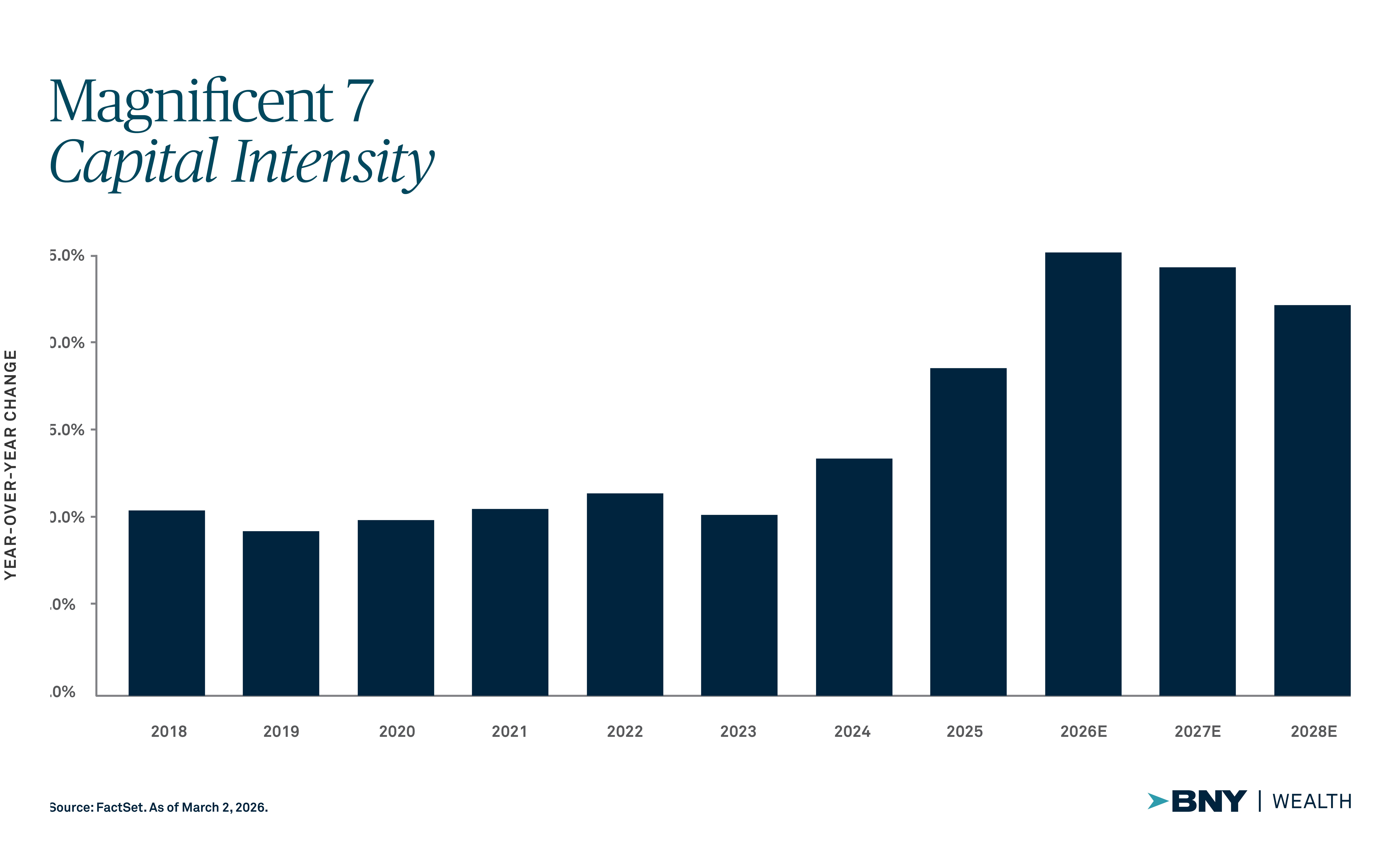
The defining feature of the AI cycle through 2025 was capital expenditure. Spending on AI-related infrastructure saw growth rates exceeding 50% annually and total industry investment approached levels rarely seen outside of wartime mobilization or the early internet buildout. Today, capital intensity, the amount of fixed assets a company needs to generate revenue, is increasing as companies front-load the capex spend to build out necessary infrastructure. While this has expanded capacity and driven technology leadership, it has also invited skepticism. However, revenue growth should remain strong while capex growth moderates, with capital intensity peaking in 2026. Attention has now turned decisively from scale to return on investment.
A useful way to frame the monetization challenge is to reverse-engineer what success requires. If we assume the AI economic model looks similar to the cloud market in terms of its margin profile and necessary rate of return, revenues will need to reach hundreds of billions of dollars annually by the end of the decade.
While this threshold is ambitious and will increase as additional capex is spent in future years, it does not appear unattainable. Leading AI platforms have already articulated revenue trajectories that point toward this scale over time, with multiple players contributing meaningfully rather than a single dominant provider. The challenge is not just demand, but also execution. Sustained adoption, continuous model improvement, pricing power, and the creation of entirely new revenue streams will be critical.
For investors, 2026 is likely to be a year when monetization progress needs to become more observable. Clear evidence of recurring revenue growth would reinforce confidence in the long-term thesis, while a lack of progress would likely pressure valuations across the ecosystem.
Physical AI: Concept to Commercial Reality
One of the most underappreciated developments in the AI landscape is the emergence of physical AI — the embedding of intelligence into physical systems so they can perceive their environment, make decisions and take actions. While often framed as futuristic, physical AI is already transitioning from proof-of-concept to real-world deployment.
The potential market opportunity is enormous, spanning robotics, autonomous vehicles, manufacturing, logistics and infrastructure. What is increasingly notable is not the size of the opportunity, but the growing number of tangible examples. Fully automated restaurants, autonomous vehicle deliveries and AI-driven industrial systems are operating today as functioning businesses. A recent example is Waymo’s current plan to enter over a dozen new cities this year with its autonomous vehicle services. We can also see consumer demand is following, as with each city that Waymo enters, the adoption curve is sooner and steeper.
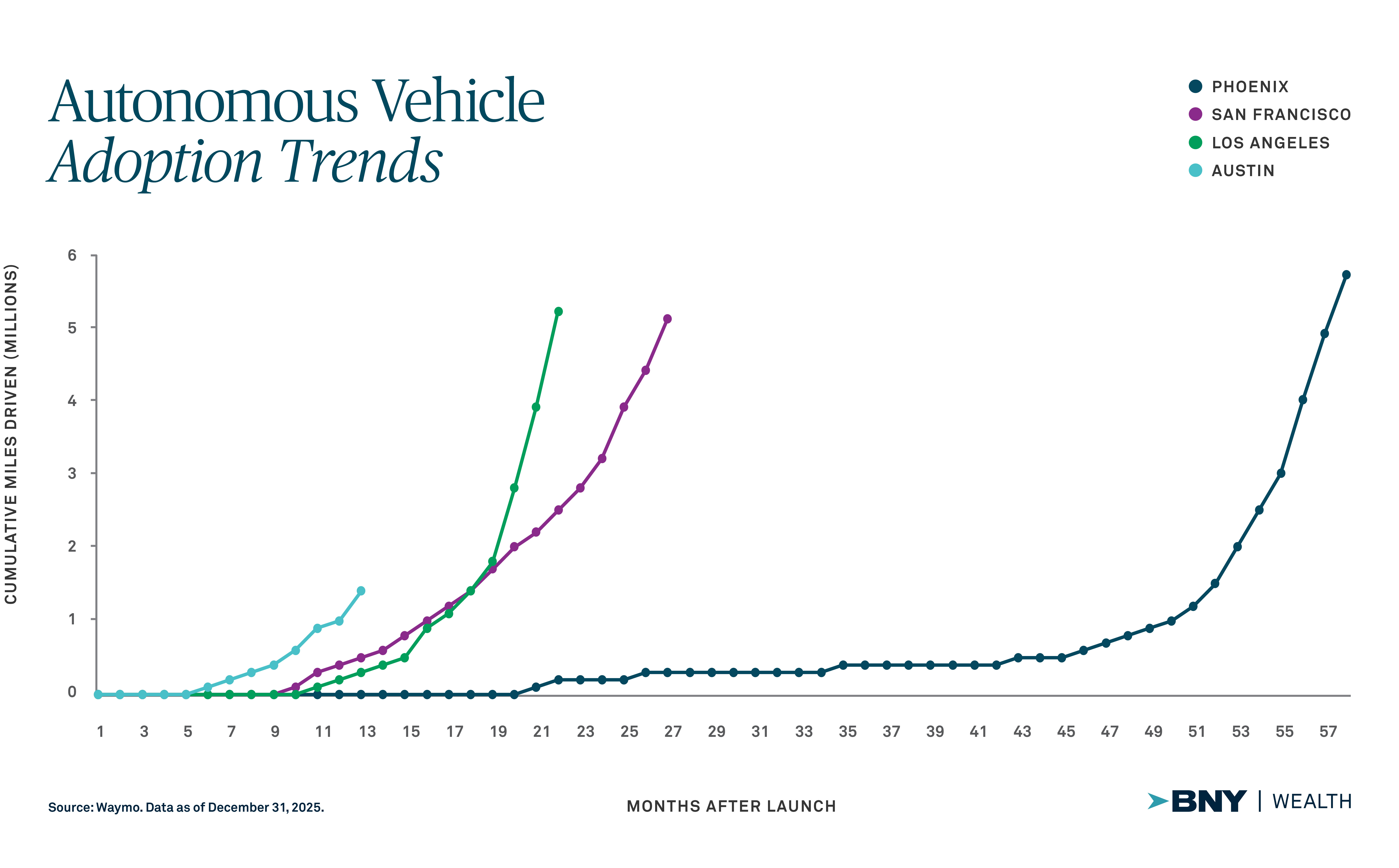
However, physical AI adoption remains uneven. Regulatory complexity and consumer readiness continue to slow progress in the U.S., while more aggressively automated regions like China demonstrate what is possible when policy, capital and scale align. For investors, physical AI represents a long-term opportunity. Near-term revenues may be modest, but early leaders could benefit from compounding growth over time.
Agentic AI: Assistance to Automation
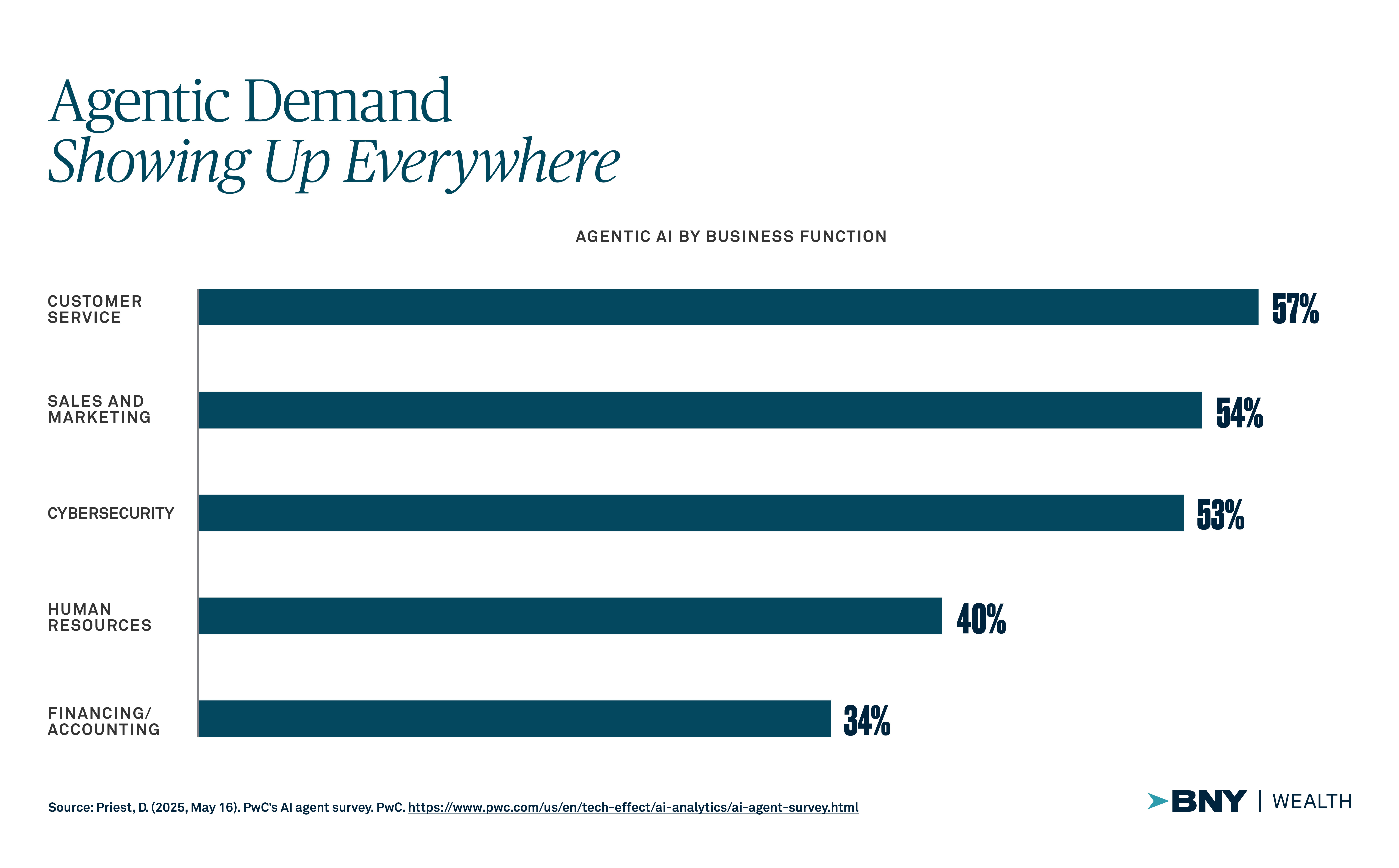
The most important enterprise-focused development in 2026 may be the rise of agentic AI, which represents a shift from AI as a tool that assists workers to systems that autonomously execute tasks and workflows for the entire company. In practical terms, AI progresses from an incremental productivity enhancement to structural automation.
Early adopters report benefits across productivity, cost reduction, speed to market and operational resilience. As a result, a large majority of enterprise decision-makers expect AI budgets to increase specifically due to agentic capabilities.
Strategically, agentic AI has profound implications. If successful, it becomes relevant across nearly every industry, geography and corporate function. Companies that fail to adopt it risk falling behind peers who achieve material efficiency gains. For investors, tangible evidence of deployment and budget reallocation toward automation will be an important signal to monitor in 2026.
AI Infrastructure: Strong Demand, Rising Scrutiny
Despite growing concerns about overbuilding, current data indicate that AI infrastructure remains structurally undersupplied. Across semiconductors, memory, manufacturing capacity and data centers, demand continues to exceed available supply. There continues to be a shortage of memory components critical to AI servers, with suppliers signaling that they are unable to meet current demand and do not expect market equilibrium for several years.
Chip designers and manufacturers tell a similar story. Order backlogs remain far larger than near-term revenue expectations, indicating that shipment capacity, not end demand, is the binding constraint. Advanced manufacturing capacity is tight enough that price increases are expected to persist for multiple years, reflecting structural rather than cyclical dynamics. Data center availability also remains limited, with vacancy rates at historic lows and most new capacity pre-leased well ahead of completion.
At the same time, investor focus is shifting from growth rates to sustainability. The key question is whether efficiency improvements eventually reduce the need for incremental infrastructure investment. Early warning signs would include order cancellations, shipment delays driven by customer pullbacks or abrupt gains in model efficiency that materially lower compute requirements. Absent these signals, infrastructure spending is likely to remain elevated through 2026, even if growth moderates from recent peaks.
AI Causes Business Models to Evolve: Software and Cloud Service Provider Examples
AI is reshaping the technology landscape in ways that challenge many of the assumptions that have underpinned the sector for the past decade. In software, moats that once felt durable, such as proprietary data, deeply embedded workflows and high switching costs, are becoming more heavily debated. Large language models are potentially commoditizing some functionality, and AI tools are increasingly sitting between applications and end users, which could capture mindshare and shift value away from traditional systems of record. Business models are also evolving. The shift from predictable per-seat software-as-a-service pricing to usage- and outcome-based models introduces greater variability.
Meanwhile, cloud service providers are ramping up capex after years of free cash flow margin expansion, which is driving a significant change in their financial profile. Free cash flow margins among the group are expected to drop to a low single-digit percent and represent a 50% decline compared to 2025 levels. AI has shifted many of the Magnificent 7’s capital-light business model into a capital-intense one.
Competition and Geopolitics: Leadership Still Compounds
Despite the rapid pace of innovation, the competitive landscape around AI remains concentrated. A small group of U.S.-based platforms continues to dominate global usage, particularly for enterprises. While challengers attract attention, sustained market share gains have been limited to date.
Geopolitics add complexity, particularly regarding export restrictions and supply chain controls. These constraints affect not just chips, but nearly every critical step in advanced semiconductor manufacturing. Industry commentary suggests that while nothing is guaranteed over the long term, the probability of rapid convergence is lower than often assumed.
This reinforces a broader investment principle: technological leadership is rarely mean reverting. Once an advantage is established, it tends to compound unless disrupted by a fundamentally new paradigm. We anticipate the U.S. will maintain leadership throughout 2026 as new AI models are introduced and extend the advantages of pre-existing ones.
Conclusion: What to Watch Now
The AI investment story is evolving from excitement to execution. In 2026, investors should focus less on narratives and more on measurable outcomes. Are revenues scaling in line with investment? Is infrastructure demand still resilient with no signs of excess? Are physical AI and agentic AI growing increasingly prominent? Are there growing signs of broader disruption from AI adoption?
The answers to these questions will determine how the technology is perceived. The AI opportunity remains significant, but it is entering a period of differentiation. Companies that translate technological advantages into durable revenue and efficient deployment are likely to separate themselves from those who rely on capital intensity alone. Despite the scorecard of who wins or who loses in this technology race, we view AI as a durable investment theme for the foreseeable future.