Please ensure Javascript is enabled for purposes of website accessibility

What Happens on Bad Days?

What Happens on Bad Days?

The recent one-day equity selloff reflected weaker sentiment amid election uncertainty and concerns that slower artificial intelligence spending could weigh on growth and earnings. Still, pullbacks of this magnitude have often been followed by solid returns, and we remain constructive given the economy’s resilience and AI’s long-term potential.

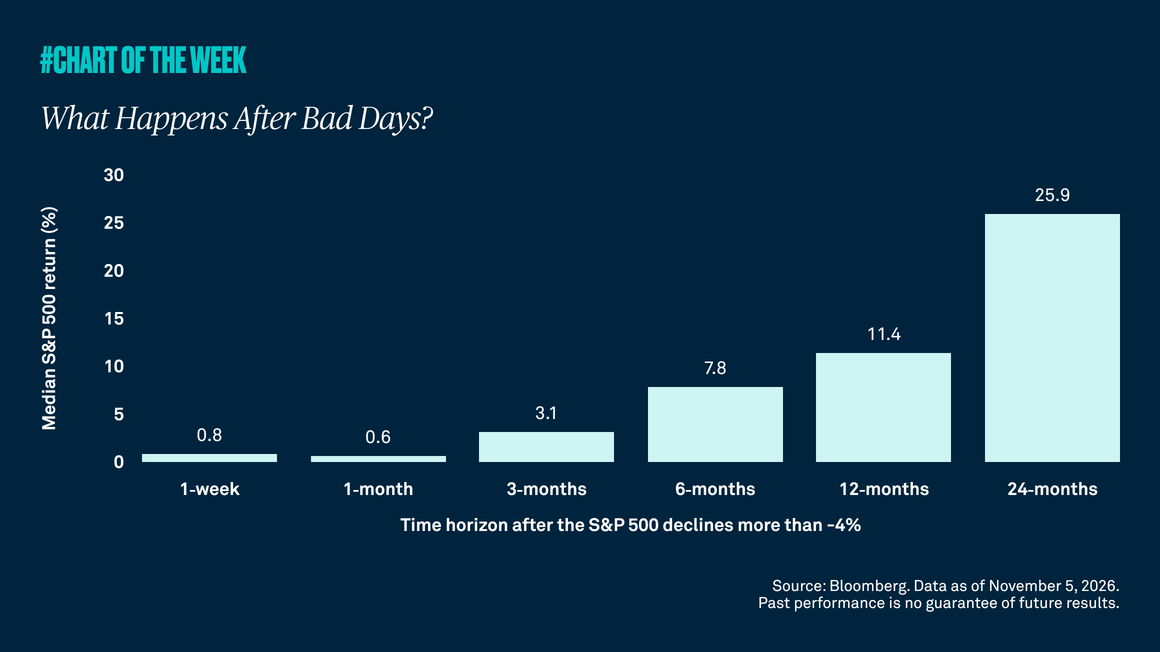
During a recent volatile week, the S&P 500 closed down more than 4% in a single day, marking a material decline in equities, especially AI stocks. Sentiment weakened after the election results due to concerns that AI capital spending and the pace of the data center buildout could slow. If so, economic growth and earnings momentum could also weaken.
 

While we expect near-term volatility to persist, history suggests stocks will gradually recover, particularly if there is no recession — and we do not expect one. Since 1928, the S&P 500 has posted a one-day decline of 4% or more 159 times, or 0.6% of all trading days. Twelve months later, the index has posted a median return of 11.4%.
 

Looking ahead, we expect growth to slow in 2027. However, we believe the economy will continue to expand, though at a more moderate pace than this year, and that earnings growth should remain positive and even above average. We also remain constructive on the long-term AI investment case, given the technology’s potential for durable efficiency gains and productivity improvements as adoption spreads.
 

Our advice remains the same: stay diversified, stay fully invested and use market pullbacks to add equity exposure. 

  • Chart of the Week
RELATED CONTENT
Play the Long Game
Article  |  Chart of the Week

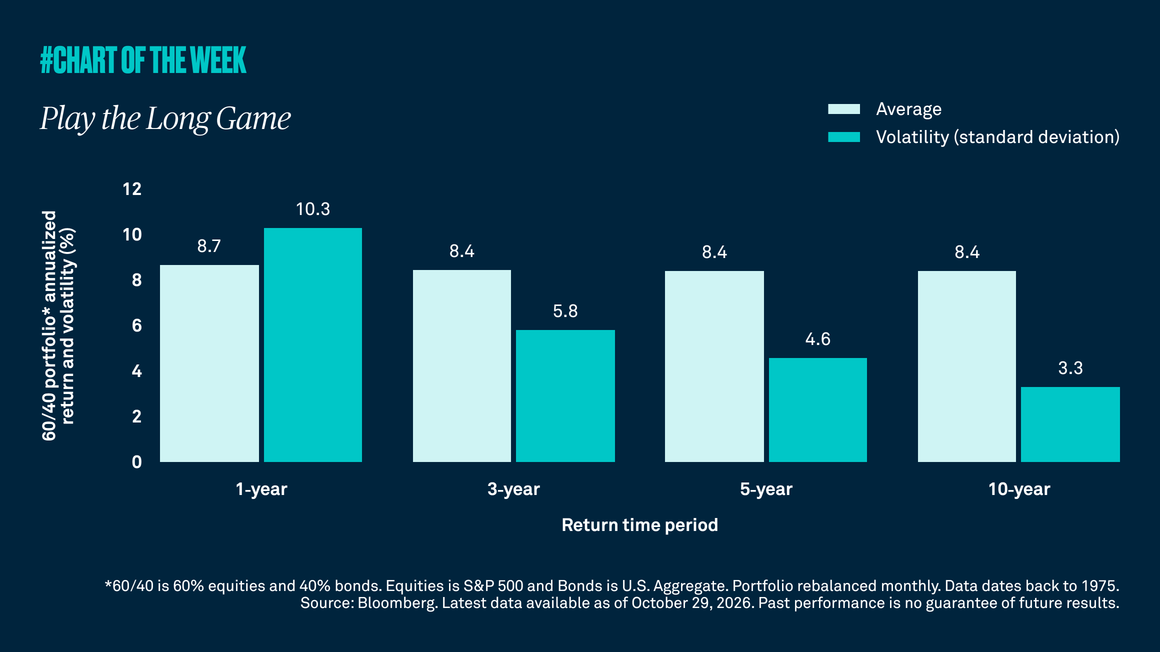
When it comes to investing, time matters. While headlines and short-term perspectives can lead investors to try to time the market, investors have historically been rewarded by playing the long game. Rather than overreacting to market noise, investing over longer time periods can help smooth the ride without sacrificing returns. The lesson: stay diversified and invested for the long term.

Contained Contagion?
Article  |  Chart of the Week

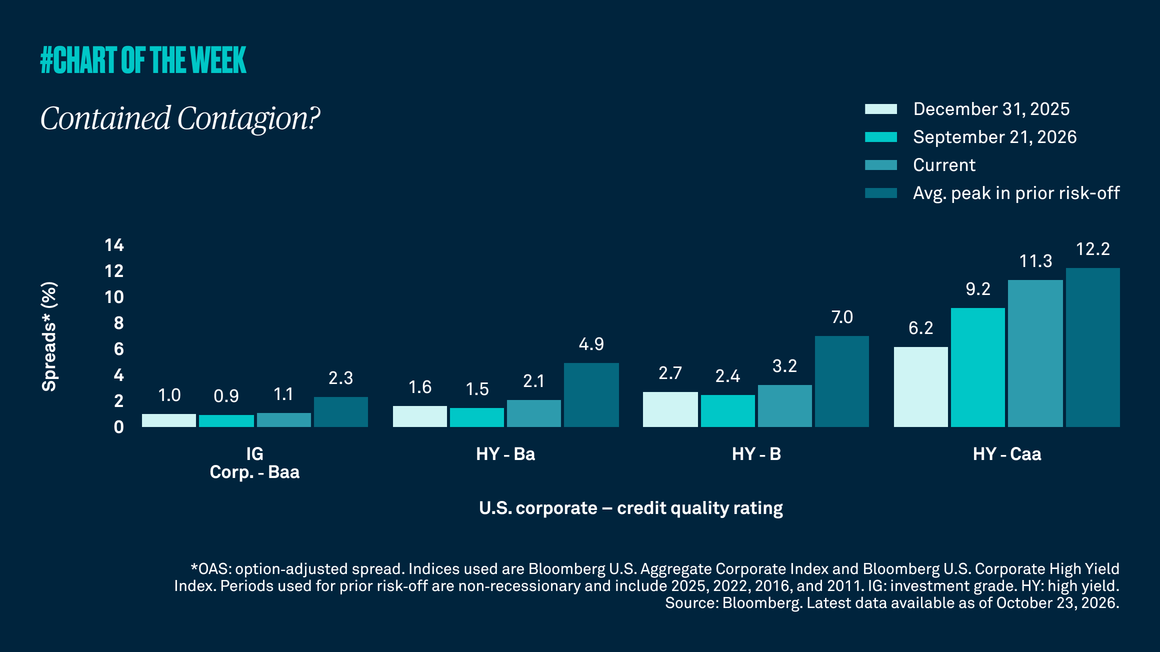
U.S. high yield credit spreads have widened year to date, reflecting greater investor caution about perceived default risk. The move also raises concerns about possible credit contagion. However, because spread widening has been concentrated in the lowest-quality issuers rather than higher-quality issuers, we don’t anticipate broader market stress.

Can the Bull Run in Corporate Margins Continue?
Article  |  Chart of the Week

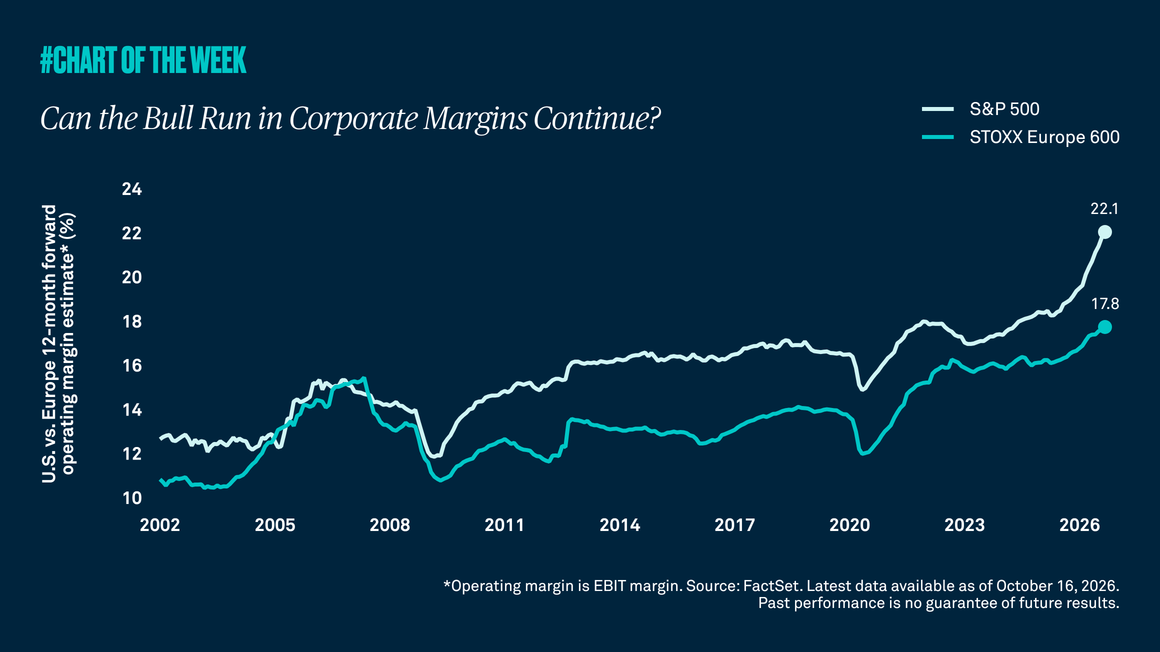
Higher inflation and elevated interest rates typically weigh on corporate profitability, yet corporate margins continue to climb to record highs. While that strength is evident both in the U.S. and abroad, U.S. outperformance versus Europe is now the widest on record. Stronger margins have helped contribute to better-than-expected earnings and reinforce U.S. equity leadership. The question now is whether that strength can persist.

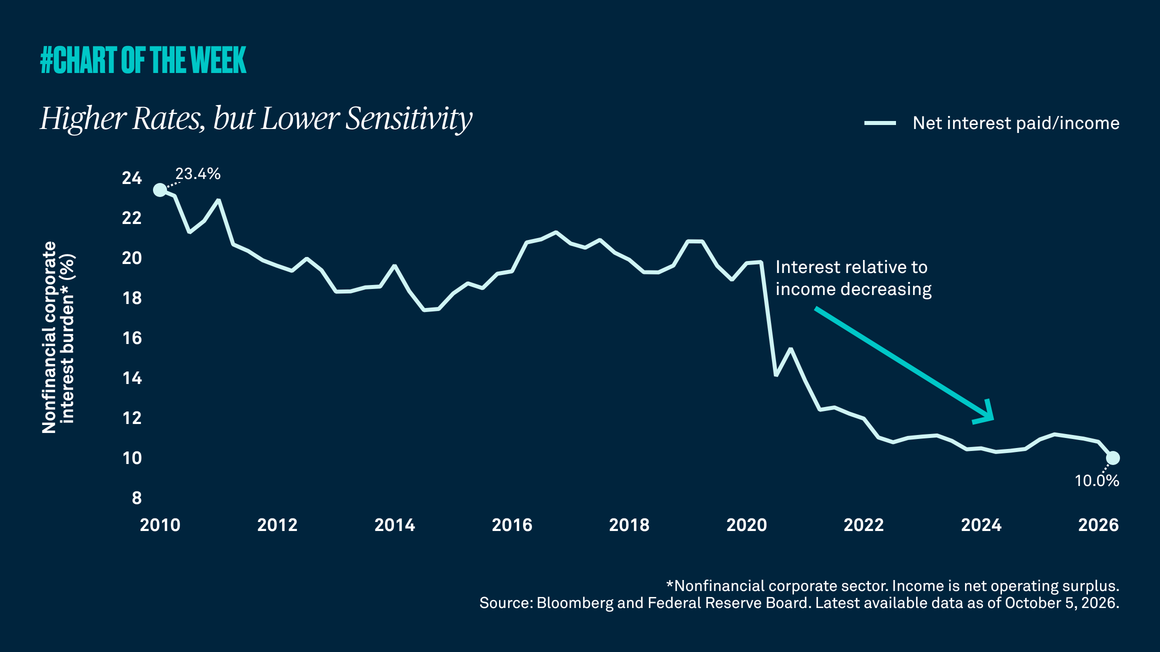
Higher Rates, but Lower Sensitivity
Article  |  Chart of the Week

Higher interest rates have become a frequently cited risk to corporate earnings and the economy. The conventional thinking is straightforward: when borrowing costs rise, companies face higher interest expenses, profits come under pressure, and economic growth slows. While there is truth to that relationship, the current cycle may differ from investors’ expectations.

Past performance is no guarantee of future results. This material is provided for illustrative/educational purposes only. This material is not intended to constitute legal, tax, investment or financial advice. Effort has been made to ensure that the material presented herein is accurate at the time of publication. However, this material is not intended to be a full and exhaustive explanation of the law in any area or of all of the tax, investment or financial options available. The information discussed herein may not be applicable to or appropriate for every investor and should be used only after consultation with professionals who have reviewed your specific situation.


The Bank of New York Mellon, DIFC Branch (the “Authorized Firm”) is communicating these materials on behalf of The Bank of New York Mellon. The Bank of New York Mellon is a wholly owned subsidiary of The Bank of New York Mellon Corporation. This material is intended for Professional Clients only and no other person should act upon it. The Authorized Firm is regulated by the Dubai Financial Services Authority and is located at Dubai International Financial Centre, The Exchange Building 5 North, Level 6, Room 601, P.O. Box 506723, Dubai, UAE.


The Bank of New York Mellon is supervised and regulated by the New York State Department of Financial Services and the Federal Reserve and authorized by the Prudential Regulation Authority. The Bank of New York Mellon London Branch is subject to regulation by the Financial Conduct Authority and limited regulation by the Prudential Regulation Authority. Details about the extent of our regulation by the Prudential Regulation Authority are available from us on request. The Bank of New York Mellon is incorporated with limited liability in the State of New York, USA. Head Office: 240 Greenwich Street, New York, NY, 10286, USA.


In the U.K. a number of the services associated with BNY Wealth’s Family Office Services– International are provided through The Bank of New York Mellon, London Branch, One Canada Square, London, E14 5AL. The London Branch is registered in England and Wales with FC No. 005522 and BR000818.


Investment management services are administered by BNY Mellon Investment Management EMEA Limited, BNY Mellon Centre, 160 Queen Victoria Street, London EC4V 4LA. Registered in England No. 1118580. Authorised and regulated by the Financial Conduct Authority. Offshore trust and administration services are through BNY Trust Company (Cayman) Ltd.


This document is issued in the U.K. by The Bank of New York Mellon. In the United States the information provided within this document is for use by professional investors.


This material is a financial promotion in the U.K. and EMEA. This material, and the statements contained herein, are not an offer or solicitation to buy or sell any products (including financial products) or services or to participate in any particular strategy mentioned and should not be construed as such.


BNY Mellon Fund Services (Ireland) Limited is regulated by the Central Bank of Ireland BNY Mellon Investment Servicing (International) Limited is regulated by the Central Bank of Ireland.


Trademarks and logos belong to their respective owners.


BNY Wealth conducts business through various operating subsidiaries of The Bank of New York Mellon Corporation. BNY is the corporate name of The Bank of New York Mellon Corporation and may be used to reference the corporation as a whole and/or its various subsidiaries generally.


©2026 The Bank of New York Mellon. All rights reserved.

WI-1036934-2026-11-09

Let’s start a conversation.

SUBSCRIBE