Please ensure Javascript is enabled for purposes of website accessibility

Dollar Strength: What Does It Mean for Markets?

Dollar Strength: What Does It Mean for Markets?

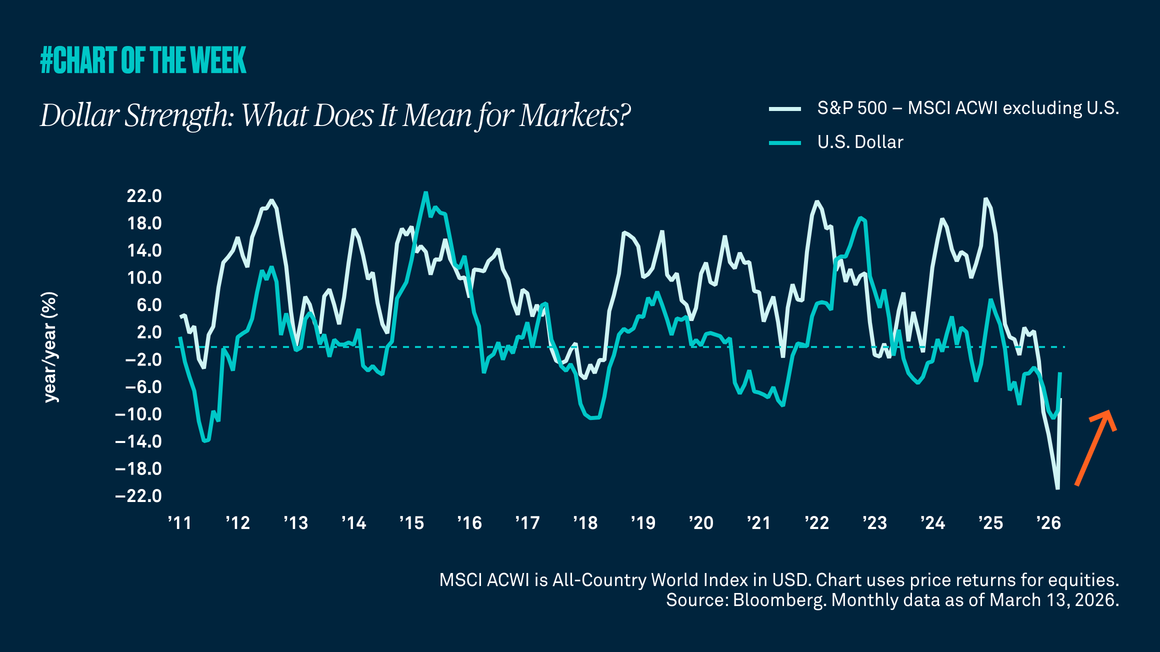
Geopolitical tensions have lifted oil prices, sent stocks lower and driven flows into the safety of the U.S. dollar, which has strengthened versus peers. While a weaker dollar previously supported international equity outperformance, dollar stabilization now suggests that tailwind is fading, underscoring the importance of diversification across regions and asset classes.

The conflict in the Middle East has seen oil prices rise, equities fall and investors flock to safe haven assets. In times of turmoil, investors often seek the stability of the U.S. dollar (USD) because of its reserve currency status and liquidity, as well as the perceived credit strength of the U.S. This episode of geopolitical uncertainty is proving to be no different with the USD gaining strength relative to global peers.


Historically, the performance gap between U.S. equities and the rest of the world has hinged on the relative strength of the USD. While a weaker USD makes U.S. exports more competitive, this has often coincided with the outperformance of major non-U.S. indices on a relative basis. That pattern has been evident over the last year, with international equity benchmarks outperforming the S&P 500.


In our view, signs of USD stabilization suggest the tailwind from dollar weakness to non‑U.S. outperformance has likely peaked. The USD is near its highest level since May 2025, and the combination of sticky inflation, U.S. energy independence and resilient growth could limit further dollar softness and challenge the recent leadership of international markets. Diversifying across geographies and asset classes remains prudent to capture potential upside amid today’s varied global conditions.

  • Chart of the Week
RELATED CONTENT
Returns after Oil Spikes
Article  |  Chart of the Week

The Strait of Hormuz, which moves about 20% of global oil, has seen many ships that normally travel through it curtail their activity. Consequently, WTI oil was up over 36% in the five days after the oil supply shock began. Yet equities barely budged, signaling a temporary supply shock, not a larger crisis. Historically, after similar price spikes equities tend to move higher while oil prices decline — further evidence for avoiding emotion-driven investing.

Impact of Geopolitics over Time?
Article  |  Chart of the Week

Tensions between the U.S./Israel and Iran have recently boiled over into a military conflict, which has given many investors the jitters. However, our research shows that equity market pullbacks resulting from geopolitical events are often short lived with the S&P 500 typically higher in the months following these events.

Behind the Numbers: Q4 GDP
Article  |  Chart of the Week

Gross domestic product undershot expectations last quarter, but the shortfall appears driven more by the temporary government shutdown than broad-based weakness. Consumer demand remains resilient, and with supportive fiscal policy, easing financial conditions and a steady labor market, the outlook points to a modest acceleration in economic activity this year.

Narrow Drawdown?
Article  |  Chart of the Week

Equity volatility is rising, but all is not what it seems. The technology sector is weighing on the S&P 500 while value and cyclical stocks lead. A market rotation is underway as many investors begin to favor companies beyond tech.

Past performance is no guarantee of future results. This material is provided for illustrative/educational purposes only. This material is not intended to constitute legal, tax, investment or financial advice. Effort has been made to ensure that the material presented herein is accurate at the time of publication. However, this material is not intended to be a full and exhaustive explanation of the law in any area or of all of the tax, investment or financial options available. The information discussed herein may not be applicable to or appropriate for every investor and should be used only after consultation with professionals who have reviewed your specific situation.


The Bank of New York Mellon, DIFC Branch (the “Authorized Firm”) is communicating these materials on behalf of The Bank of New York Mellon. The Bank of New York Mellon is a wholly owned subsidiary of The Bank of New York Mellon Corporation. This material is intended for Professional Clients only and no other person should act upon it. The Authorized Firm is regulated by the Dubai Financial Services Authority and is located at Dubai International Financial Centre, The Exchange Building 5 North, Level 6, Room 601, P.O. Box 506723, Dubai, UAE.


The Bank of New York Mellon is supervised and regulated by the New York State Department of Financial Services and the Federal Reserve and authorized by the Prudential Regulation Authority. The Bank of New York Mellon London Branch is subject to regulation by the Financial Conduct Authority and limited regulation by the Prudential Regulation Authority. Details about the extent of our regulation by the Prudential Regulation Authority are available from us on request. The Bank of New York Mellon is incorporated with limited liability in the State of New York, USA. Head Office: 240 Greenwich Street, New York, NY, 10286, USA.


In the U.K. a number of the services associated with BNY Wealth’s Family Office Services– International are provided through The Bank of New York Mellon, London Branch, One Canada Square, London, E14 5AL. The London Branch is registered in England and Wales with FC No. 005522 and BR000818.


Investment management services are administered by BNY Mellon Investment Management EMEA Limited, BNY Mellon Centre, 160 Queen Victoria Street, London EC4V 4LA. Registered in England No. 1118580. Authorised and regulated by the Financial Conduct Authority. Offshore trust and administration services are through BNY Trust Company (Cayman) Ltd.


This document is issued in the U.K. by The Bank of New York Mellon. In the United States the information provided within this document is for use by professional investors.


This material is a financial promotion in the UK and EMEA. This material, and the statements contained herein, are not an offer or solicitation to buy or sell any products (including financial products) or services or to participate in any particular strategy mentioned and should not be construed as such.


BNY Mellon Fund Services (Ireland) Limited is regulated by the Central Bank of Ireland BNY Mellon Investment Servicing (International) Limited is regulated by the Central Bank of Ireland.


Trademarks and logos belong to their respective owners.


BNY Wealth conducts business through various operating subsidiaries of The Bank of New York Mellon Corporation. BNY is the corporate name of The Bank of New York Mellon Corporation and may be used to reference the corporation as a whole and/or its various subsidiaries generally.


©2026 The Bank of New York Mellon. All rights reserved.

WI-894279-2026-03-02 

Let's start a conversation.

SUBSCRIBE