
BNY Investments Newton Portfolio Manager and Quantitative Analyst Paul Byrne explores how active, volatility-managed portfolios can help investors navigate today’s market risks.
Key takeaways
- Market turbulence and concentration risks have intensified, making dynamic risk management increasingly important for protecting client portfolios.
- Volatility-managed strategies can provide true diversification and adaptability, enabling portfolios to respond in real time to shifting market conditions – unlike static model portfolios.
- Active risk control across all life stages helps investors capture opportunities and preserve capital, especially during periods of rapid market change and heightened drawdown risks.
Financial markets have become increasingly turbulent in recent years. The outbreak of the Covid-19 pandemic in 2020 was followed by supply shocks and growing inflationary pressures. Since then, the trend towards deglobalisation has gathered pace, geopolitical tensions have risen, and there has been a surge in innovation linked to artificial intelligence.
The last few years have also seen a dramatic shift in concentration risks. Five years ago, the top 10 holdings in the MSCI AC World Index accounted for around 15% of the index’s weight, reflecting a more balanced spread. By December 2025, this had climbed to a staggering 24%, dominated by US mega-cap technology names.1 That surge means that less than 1% of the index’s 2,500-plus constituents currently drive a quarter of its performance.
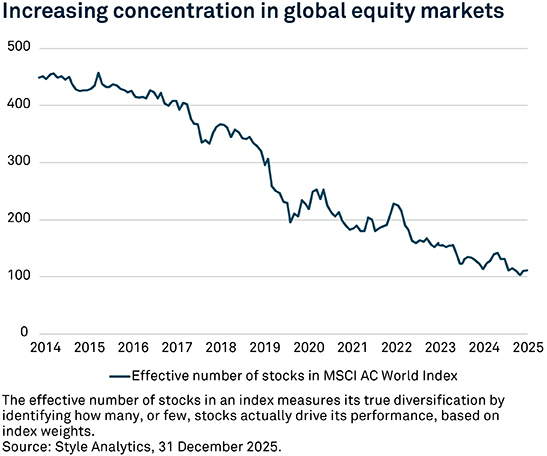
In this environment, when market-moving events occur, such as the launch of China’s ground-breaking DeepSeek AI model in January 2025, or the announcement of US ‘Liberation Day’ tariffs in April, we have seen correlations breaking down and drawdowns propagating to a much greater extent than they did in the past.
The need for dynamic risk management
These pronounced market fluctuations – and the risk of declining pension pots – often present considerable concerns for clients nearing or commencing their retirement journey. We believe that mitigating some of this risk demands a disciplined approach that can adjust portfolio risk for a future state rather than relying upon historical data.
Active, directly invested, volatility-managed portfolios use just this type of repeatable, research-driven process which aims to give true fundamental diversification to investors. Unlike static model portfolios that rebalance on fixed schedules, these strategies can adapt dynamically to changing conditions. Real-time risk adjustments can be made to portfolios when macroeconomic conditions shift using tactical asset allocation overlays. Moreover, being reactive to the market allows a portfolio to look to smooth return profiles and to seek to offer superior risk-adjusted returns over the long term.
Volatility management across life stages
While passive approaches and model portfolio services (MPS) face heightened vulnerabilities from increased concentration risks and their inability to adapt quickly to changes in financial markets, an active, volatility-managed approach can provide flexibility and control across all life stages.
In the accumulation phase, an active portfolio can help capture fundamental diversification across regions, sectors, and factors. Tactical positioning can help investors to enhance returns without taking on undue risk, as it enables exposures to be adjusted when market leadership changes – for example, between high-growth technology stocks and ‘value’ stocks. As market regimes evolve and correlations change, these can be incorporated in the portfolio’s allocations.
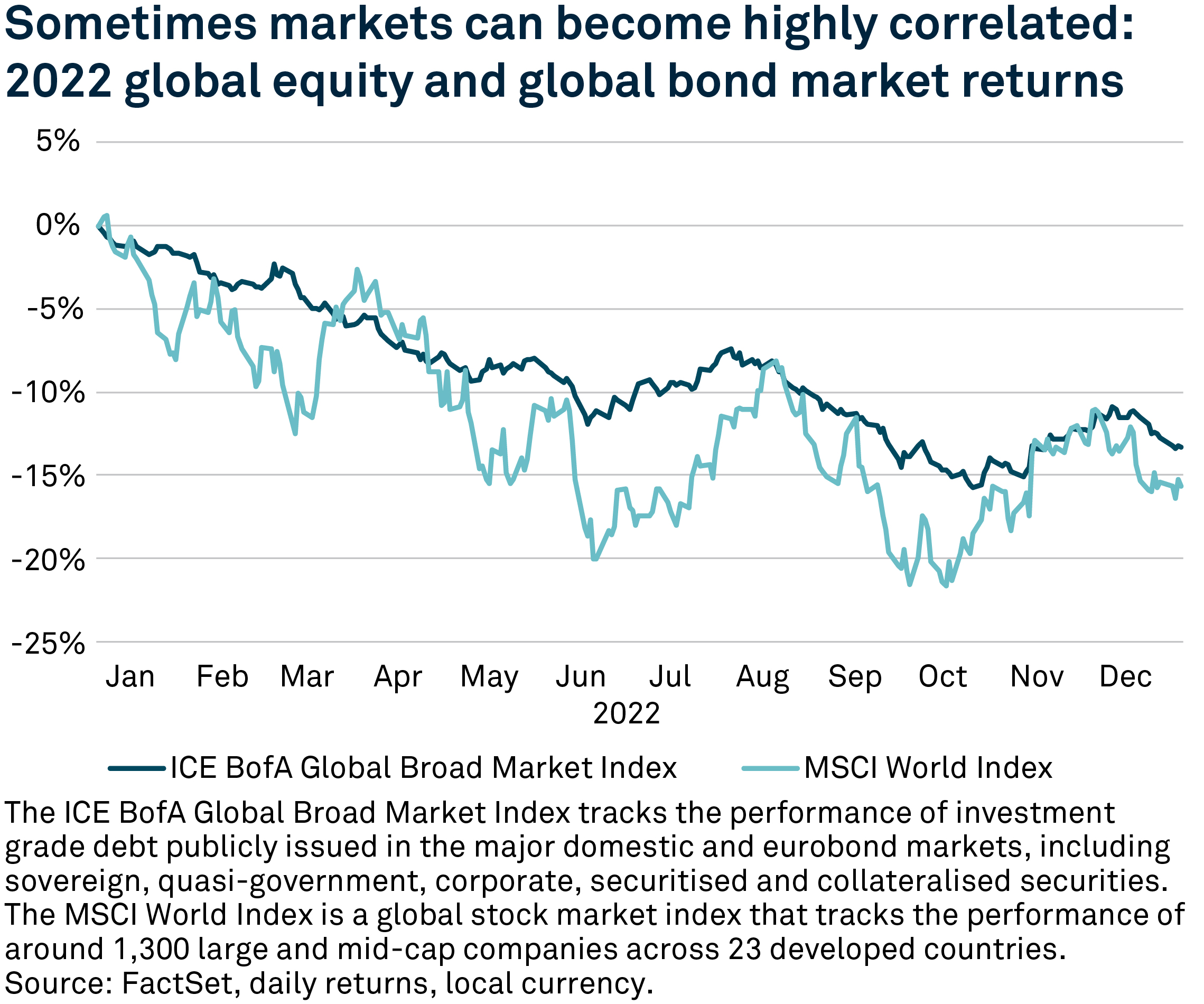
In the decumulation phase, volatility control is critical to avoid sequence-of-returns risk, where early retirement withdrawals during downturns can erode portfolios quickly. In today’s markets, faster sector rotations and tight correlations can make drawdowns more pronounced. We saw the consequences of this in 2022 when global bond markets declined by over 15% as interest rates spiked,2 and high correlations meant some ‘low risk’ strategies lagged the riskier ones, blindsiding conservative investors. In this context, investment strategies using dynamic asset allocation can help to preserve capital while meeting income needs, and structured risk management seeks to reduce the impact of large drawdowns on withdrawals.
FutureLegacy: actively managed to control volatility
BNY Mellon FutureLegacy is a range of five risk-targeted multi-asset funds that are managed by a dedicated team at BNY Investments Newton and designed to control volatility and harness a global research platform to take advantage of timely investment opportunities.3
The FutureLegacy funds manage risk in line with each client’s risk profile, using risk ratings as a guide and continuously adjusting to changes in market outlook and asset class correlations. As the funds are actively managed and directly invested, we can identify and adjust risk factors as markets evolve, incorporating forward-looking views to anticipate future risks and not simply analysing past patterns.
The approach starts with BNY Investments Newton’s multidimensional research framework, which looks at all asset classes through multiple lenses. Deep fundamental analysis is at the heart of these research capabilities, but we also employ thematic research, which identifies long-term structural opportunities in markets, and quantitative tools, which help provide focus and robustness. Other specialist inputs such as geopolitical, responsible investment, and investigative research add further, valuable insights to help make sense of the opportunities and risks inherent in individual securities.
While markets lack foresight, implementing a structured and collaborative approach helps us to distinguish enduring trends from short-term fluctuations, thereby supporting confident investment decisions in dynamic market conditions.
Dynamic risk controls in practice
The BNY Mellon FutureLegacy funds employ dynamic risk controls, enabling the investment team to adjust allocations in a flexible manner with the goal of smoothing return profiles for investors.
Continuous monitoring and regular rebalancing are conducted by a dedicated investment team, who aim to control portfolio volatility and ensure that each fund remains within its pre-defined risk parameters. Various tools are utilised to add flexibility to this approach, including the use of derivatives, currency hedging, and cash management strategies. These instruments help the team to manage exposures and further reinforce the risk control framework within the funds.
In constructing the portfolios, achieving fundamental diversification is crucial. This approach ensures that portfolios are built with a clear understanding of the underlying drivers of returns, deliberately avoiding the hidden concentration risks that are often associated with passive index strategies. By diversifying across multiple dimensions and monitoring risk factors closely, the FutureLegacy funds seek to offer robust, volatility-managed solutions for investors throughout different market cycles.
The value of investments and the income received can fall as well as rise and investors may not get back the original amount invested.
The funds can invest more than 35% of net assets in different transferable securities and money market instruments issued or guaranteed by the UK or an EEA State, its local authorities, a third country or public international bodies of which the UK or one or more EEA States are members.
Please refer to the prospectus, KID/KIID or KFS where applicable and other fund documents for a full list of risks and before making any investment decisions. Documents are available in English and in selected local languages where the fund is registered. Go to bny.com/investments.
BNY Mellon FutureLegacy funds – key investment risks
- Objective/Performance Risk: There is no guarantee that the Fund will achieve its objectives.
- Currency Risk: This Fund invests in international markets which means it is exposed to changes in currency rates which could affect the value of the Fund.
- Derivatives Risk: Derivatives are highly sensitive to changes in the value of the asset from which their value is derived. A small movement in the value of the underlying asset can cause a large movement in the value of the derivative. This can increase the sizes of losses and gains, causing the value of your investment to fluctuate. When using derivatives, the Fund can lose significantly more than the amount it has invested in derivatives.
- Changes in Interest Rates & Inflation Risk: Investments in bonds/money market securities are affected by interest rates and inflation trends which may negatively affect the value of the Fund.
- Credit Ratings and Unrated Securities Risk: Bonds with a low credit rating or unrated bonds have a greater risk of default. These investments may negatively affect the value of the Fund.
- Credit Risk: The issuer of a security held by the Fund may not pay income or repay capital to the Fund when due.
- Emerging Markets Risk: Emerging Markets have additional risks due to less-developed market practices.
- Share Class Currency Risk: Where a share class is denominated in a different currency from the base currency of the Fund, changes in the exchange rate between the share class currency and the base currency may affect the value of your investment.
- China Interbank Bond Market and Bond Connect risk: The Fund may invest in China interbank bond market through connection between the related Mainland and Hong Kong financial infrastructure institutions. These may be subject to regulatory changes, settlement risk and quota limitations. An operational constraint such as a suspension in trading could negatively affect the Fund's ability to achieve its investment objective.
- Volcker Rule Risk: The Bank of New York Mellon Corporation or one of its affiliates ("BNYM") has invested in the Fund. As a result of restrictions under the "Volcker Rule," which has been adopted by U.S. Regulators, BNYM must reduce its shareholding percentage so that it constitutes less than 25% of the Fund within, generally, three years of the Fund's establishment (which starts when the Fund's manager begins making investments for the Fund). Risks may include: BNYM may initially own a proportionately larger percentage of the Fund, and any mandatory reductions may increase Fund portfolio turnover rates, resulting in increased costs, expenses and taxes. Details of BNYM's investment in the Fund are available upon request.
- CoCos Risk: Contingent Convertible Securities (CoCos) convert from debt to equity when the issuer's capital drops below a pre-defined level. This may result in the security converting into equities at a discounted share price, the value of the security being written down, temporarily or permanently, and/or coupon payments ceasing or being deferred.
- Responsible Investing Risk: The investment policy for this Fund places restrictions on its exposure to certain sectors or types of investments to reflect its responsible investing approach. The Fund's performance may be negatively impacted due to these restrictions in comparison to funds which do not have these restrictions. The Fund will not engage in securities lending activities and, therefore, may forego any additional returns that may be produced through such activities.
- Counterparty Risk: The insolvency of any institutions providing services such as custody of assets or acting as a counterparty to derivatives or other contractual arrangements, may expose the Fund to financial loss.
BNY Mellon FutureLegacy 3 Fund
Investment Objective: To achieve capital growth and potential for income over the long term (5 years or more) while being managed to a pre-defined level of risk. The Fund will aim to maintain a risk profile classification of 3 from a scale of 1 (lowest) to 10 (highest) which is assessed against the risk ratings scale provided by an external third party risk rating agency.
Performance Benchmark: The Fund is actively managed without benchmark-related constraints. The Fund will measure its performance against the Investment Association's Mixed Investment 0-35% Shares NR Sector Average as a comparator benchmark (the "Benchmark"). The Fund will use the Benchmark as an appropriate comparator because it includes a broad representation of funds with levels of equity and bond exposure similar to those of the Fund.
Effective 1 August 2025, the Fund’s benchmark changed from 15% SONIA GBP, 55% ICE BofA Global Broad Index GBP Hedged and 30% MSCI ACWI GBP NR to the Investment Association's Mixed Investment 0-35% Shares NR sector average. Benchmark performance shown for all time periods is that of the Investment Association's Mixed Investment 0-35% Shares NR sector average.
BNY Mellon FutureLegacy 4 Fund
Investment Objective: To achieve capital growth and potential for income over the long term (5 years or more) while being managed to a pre-defined level of risk. The Fund will aim to maintain a risk profile classification of 4 from a scale of 1 (lowest) to 10 (highest) which is assessed against the risk ratings scale provided by an external third party risk rating agency.
Performance Benchmark: The Fund is actively managed without benchmark-related constraints. The Fund will measure its performance against the Investment Association's Mixed Investment 20-60% Shares NR Sector Average as a comparator benchmark (the "Benchmark"). The Fund will use the Benchmark as an appropriate comparator because it includes a broad representation of funds with levels of equity and bond exposure similar to those of the Fund.
Effective 1 August 2025, the Fund’s benchmark changed from 10% SONIA GBP, 45% ICE BofA Global Broad Index GBP Hedged and 45% MSCI ACWI GBP NR to the Investment Association's Mixed Investment 20-60% Shares NR sector average. Benchmark performance shown for all time periods is that of the Investment Association's Mixed Investment 20-60% Shares NR sector average.
BNY Mellon FutureLegacy 5 Fund
Investment Objective: To achieve capital growth and potential for income over the long term (5 years or more) while being managed to a pre-defined level of risk. The Fund will aim to maintain a risk profile classification of 5 from a scale of 1 (lowest) to 10 (highest) which is assessed against the risk ratings scale provided by an external third party risk rating agency.
Performance Benchmark: The Fund is actively managed without benchmark-related constraints. The Fund will measure its performance against the Investment Association's Mixed Investment 40-85% Shares NR Sector Average as a comparator benchmark (the "Benchmark"). The Fund will use the Benchmark as an appropriate comparator because it includes a broad representation of funds with levels of equity and bond exposure similar to those of the Fund.
Effective 1 August 2025, the Fund’s benchmark changed from 5% SONIA GBP, 35% ICE BofA Global Broad Index GBP Hedged and 60% MSCI ACWI GBP NR to the Investment Association's Mixed Investment 40-85% Shares NR sector average. Benchmark performance shown for all time periods is that of the Investment Association's Mixed Investment 40-85% Shares NR sector average.
BNY Mellon FutureLegacy 6 Fund
Investment Objective: To achieve capital growth and potential for income over the long term (5 years or more) while being managed to a pre-defined level of risk. The Fund will aim to maintain a risk profile classification of 6 from a scale of 1 (lowest) to 10 (highest) which is assessed against the risk ratings scale provided by an external third party risk rating agency.
Performance Benchmark: The Fund is actively managed without benchmark-related constraints. The Fund will measure its performance against the Investment Association's Mixed Investment 40-85% Shares NR Sector Average as a comparator benchmark (the "Benchmark"). The Fund will use the Benchmark as an appropriate comparator because it includes a broad representation of funds with levels of equity and bond exposure similar to those of the Fund..
Effective 1 August 2025, the Fund’s benchmark changed from 25% ICE BofA Global Broad Index GBP Hedged and 75% MSCI ACWI GBP NR to the Investment Association's Mixed Investment 40-85% Shares NR sector average. Benchmark performance shown for all time periods is that of the Investment Association's Mixed Investment 40-85% Shares NR sector average.
BNY Mellon FutureLegacy 7 Fund
Investment Objective: To achieve capital growth and potential for income over the long term (5 years or more) while being managed to a pre-defined level of risk. The Fund will aim to maintain a risk profile classification of 7 from a scale of 1 (lowest) to 10 (highest) which is assessed against the risk ratings scale provided by an external third party risk rating agency.
Performance Benchmark: The Fund is actively managed without benchmark-related constraints. The Fund will measure its performance against the Investment Association's Flexible Investment NR Sector Average as a comparator benchmark (the "Benchmark"). The Fund will use the Benchmark as an appropriate comparator because it includes a broad representation of funds with levels of equity and bond exposure similar to those of the Fund.
Effective 1 August 2025, the Fund’s benchmark changed from 10% ICE BofA Global Broad Index GBP Hedged and 90% MSCI ACWI GBP NR to the Investment Association's Flexible Investment NR sector average. Benchmark performance shown for all time periods is that of the Investment Association's Flexible Investment NR sector average.
1MSCI AC World Index, as of 31 December 2025, msci.com
2Stock and bond markets shed more than $30tn in ‘brutal’ 2022, Financial Times, 30 December 2022
3The BNY Mellon FutureLegacy funds are actively managed typically by using forward-looking expectations of volatility. In doing so, the Investment Manager uses its own internal risk model, while also considering external independent risk profiling methodologies. Based on a risk profile scale of 1 (lowest) to 10 (highest), the funds target a risk profile of 3, 4, 5, 6 or 7 but this is not guaranteed. The risk profile targeted by each of these funds can be identified through the number included in the respective fund name. This risk profile is not the same as the risk and reward category shown in the KIID. The risk profiles are assessed against the risk rating scale provided by Dynamic Planner, but are subject to change.
3080674 Exp : 20 August 2026