Please ensure Javascript is enabled for purposes of website accessibility Oil: less sensitive to middle east conflict
sg
en
institutional
institutional
false
true
Gathering data
Disclaimer Not Available

Oil: less sensitive to middle east conflict

Oil: less sensitive to middle east conflict

The recent Middle East conflict sparked concerns surrounding Iran’s oil supply and the impact it could have on oil prices and the current disinflation trend. However, the price of oil is now at the level it was before the first strike on Iran. Due to the shale revolution, the oil market is ruled by new dynamics. 
 

less-sensitive-to-middle-east-conflict


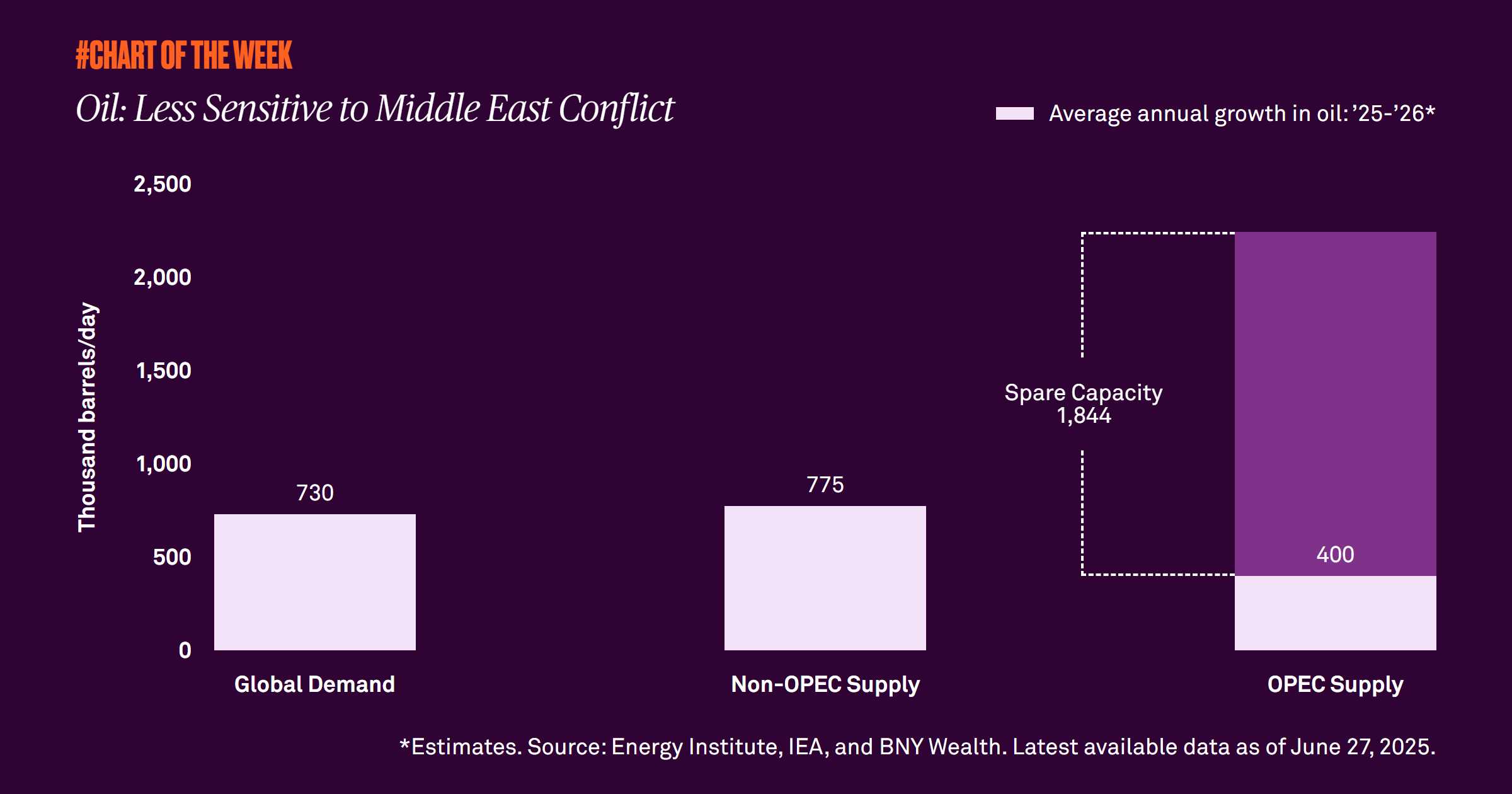
Historically, one consequence of geopolitical tensions in the Middle East has been higher oil prices. The recent conflict sparked concerns surrounding Iran’s oil supply and the impact it could have on oil prices and the current disinflation trend. However, after spiking briefly following Israel’s first strike on Iran on June 13, the price of oil has remained steady and is back to where it was before tensions intensified.

Why? In short, it’s due to the shale revolution that has transpired over the last decade or so, increasing U.S. oil production and reducing the world’s dependence on crude oil from the Middle East. From 2013 to 2024, growth in global oil demand was largely met by supply outside of the Organization of the Petroleum Exporting Countries (OPEC), an international organization of policy-setting oil-producing countries to which Iran belongs. The expectation for 2025 and 2026 is that supply from non-OPEC countries will continue meeting global demand for oil. Nevertheless, if Iran’s 1.6 million barrels per day of oil exports were no longer available, OPEC would still harbor excess capacity.

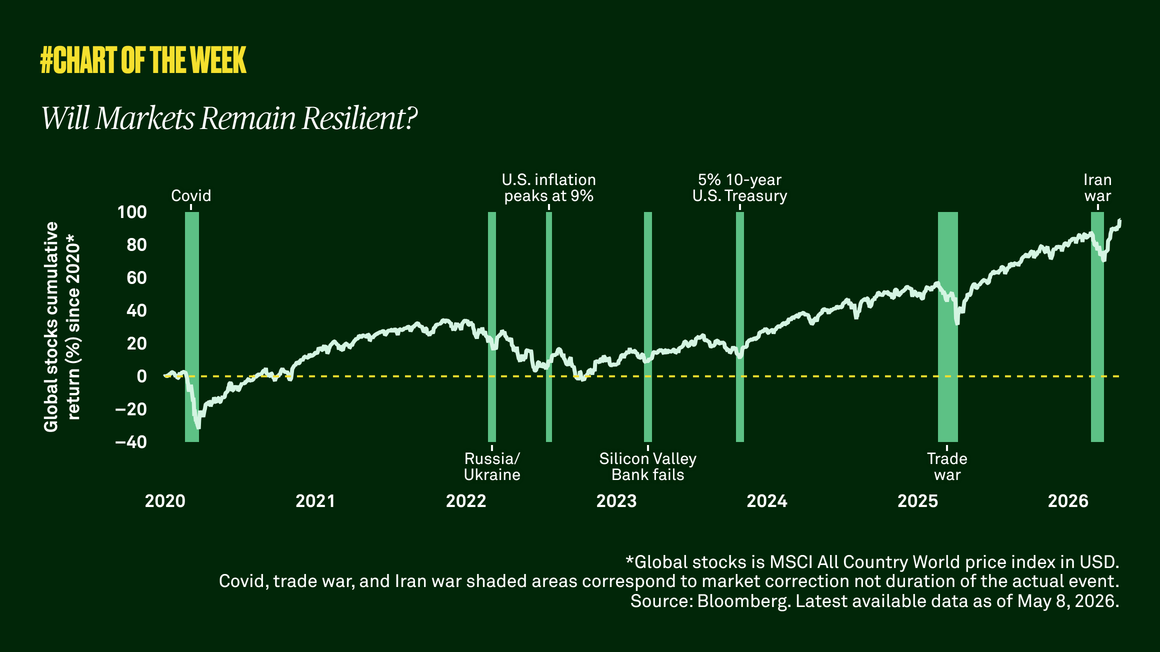
It appears that the global oil market is not extremely exposed to affairs in the Middle East as it once was. Since the latest conflict began, the S&P 500 has remained resilient, indicating that investors understand these oil market dynamics and have become somewhat desensitized to geopolitics. We remain constructive on U.S. equities and maintain our year-end forecast of 6,400 for the S&P 500.
RELATED CONTENT
Capex as a catalyst
Chart of the week | Macroeconomic

Improved business confidence and recent tax legislation are compelling corporations to reinvest their cash flows in their businesses. We believe this is a positive signal for economic growth.

Global leading indicator turning higher
Chart of the week | Macroeconomic

Headline volatility persists and yet the global growth outlook continues to improve. We examined a leading indicator, and why there is good cause to diversify equity holdings if you haven’t already.

A cyclical rotation?
Chart of the week | Macroeconomic

Stronger growth expectations are driving a global rotation out of growth-oriented and mega cap technology stocks, and into cyclical companies. At a time when geopolitical tensions and tariff discussions continue to simmer, we remind investors to stay invested despite the headline noise.

S&P 500 Returns After All-Time Highs
Chart of the week | Macroeconomic

The S&P 500 recently hit a new all-time high after a notable year of peaks in 2025. Is now the time for caution? History tells us attractive performance often follows record highs.


For sole and exclusive use by Institutional Investors, Accredited Investors and Professional Investors only. Not for further distribution. This is a financial promotion and is not investment advice. Any views and opinions are those of the investment manager, unless otherwise noted. The value of investment can fall. Investors may not get back the amount invested. BNY, BNY Mellon and Bank of New York Mellon are the corporate brands of The Bank of New York Mellon Corporation and may also be used to reference the corporation as a whole and/or its various subsidiaries generally.  BNY Investments encompass BNY Mellon’s affiliated investment management firms and global distribution companies.  Any BNY entities mentioned are ultimately owned by The Bank of New York Mellon Corporation. In Hong Kong, the issuer of this document is BNY Mellon Investment Management Hong Kong Limited, which is registered with the Securities and Futures Commission (Central Entity Number: AQI762). In Singapore, this document is issued by BNY Mellon Investment Management Singapore Pte. Limited, Co. Reg. 201230427E. Regulated by the Monetary Authority of Singapore (MAS). This advertisement has not been reviewed by the Monetary Authority of Singapore.
 

Gathering data
Disclaimer Not Available

CONTACT US  |  +65 6654 1000