Key Takeaways
- Is France moving closer to a crisis? French government bond spreads are at their widest in almost 15 years driven by high inflation, rising global yields, and ongoing fiscal challenges, among other factors.
- Polls indicate a dramatic political shift: Surveys suggest Marine Le Pen is the most likely to win the presidential election in April 2027. Addressing the fiscal situation has not historically been a high priority for Le Pen.
- French assets will likely stay under pressure though default risk remains very low in our view: Long-term investors may find current spread levels attractive. However, historical comparisons suggest spreads could widen further, offering potential opportunities within dynamically managed active portfolios.
Markets signal rising concerns over France
Persistent deficits and rising debt mean the French fiscal situation has become increasingly unsustainable, and risks associated with the 2027 presidential election are becoming more acute. The spread between French and German 10-year government bond yields recently widened to 140 basis points (bp), the highest level since the 2012 eurozone sovereign crisis (see Figure 1).
Figure 1: French government bond spreads relative to German bunds have widened dramatically
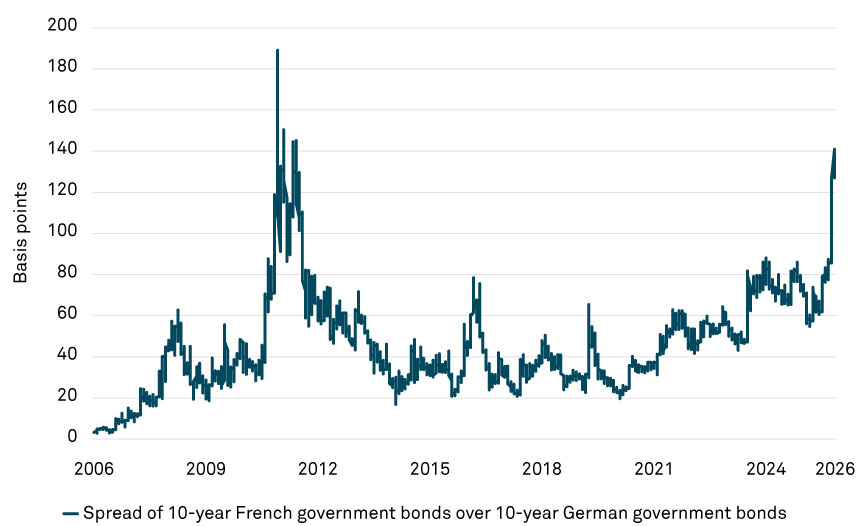
Source: Bloomberg, as at 9 October 2026. For illustrative purposes only. Past performance is no guarantee of future performance.
There are several interrelated reasons why French spreads have widened.
- Prices are rising: The latest French inflation reading (HCPI) shows prices over the year to September rose 3.4%, up from the equivalent August reading at 2.6%. Inflation is above central bank targets globally and so interest rate hikes have led to rising bond yields, and widening yield spreads within the eurozone.
- Changing dynamics for Japanese investors: Rising Japanese government bond yields offer an increasingly attractive alternative for Japanese investors, who have historically been supportive holders of French government bonds.
- Ongoing fiscal challenges for France: The French budget plans are in progress, but the deficit is likely to stay high – the government now expects a deficit of 5.4% this year and is unlikely to get parliamentary support for meaningful consolidation ahead of the presidential elections next April.
Against this backdrop, a key focus for investors are French political dynamics. Attempts to shore up the French fiscal situation have so far failed.
A dramatic political shift looks likely
The outlook for the 2027 presidential elections signals a dramatic shift, with polls showing Marine Le Pen of the right-wing Rassemblement National (RN) party far in the lead. Significantly, Édouard Philippe of the Horizons party, the leading centrist/centre-right candidate, has now fallen behind Jean-Luc Mélenchon of the left-wing La France Insoumise party (see Figure 2). It is important to note that the final candidates who will stand for election in the first round are as yet unclear.
It appears that Philippe and other centrist candidates have failed to generate political enthusiasm or momentum. The polls suggest that voter preferences are being driven by the same issues that are driving voters in other countries, such as the cost-of-living crisis and its impact on median real wages. Diesel and petrol prices are playing a significant role (see Figure 3). These have been an issue in French politics before, driving the ‘gilets jaunes’ (‘yellow jacket’) protests which began in 2018.
Figure 2: Polls show Marine Le Pen has a commanding lead ahead of the next election
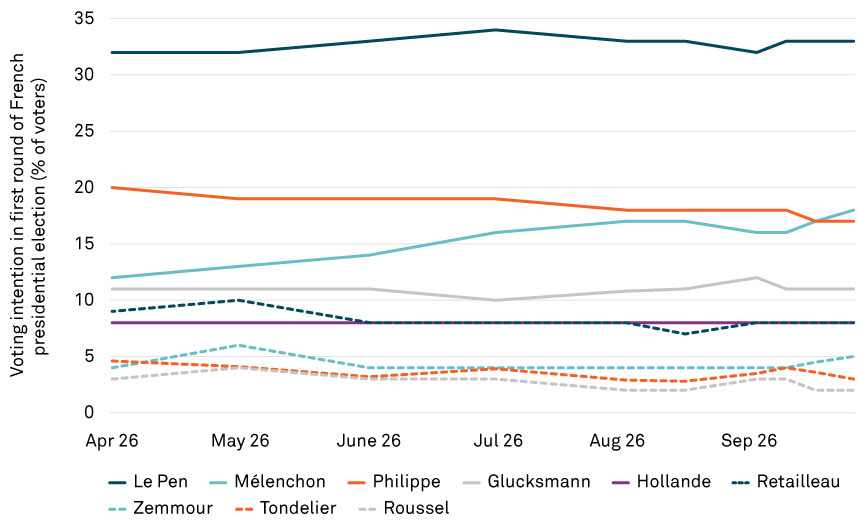
Source: Politico, as at 1 October 2026. For illustrative purposes only.
Figure 3: Rising diesel prices in France are a key political issue
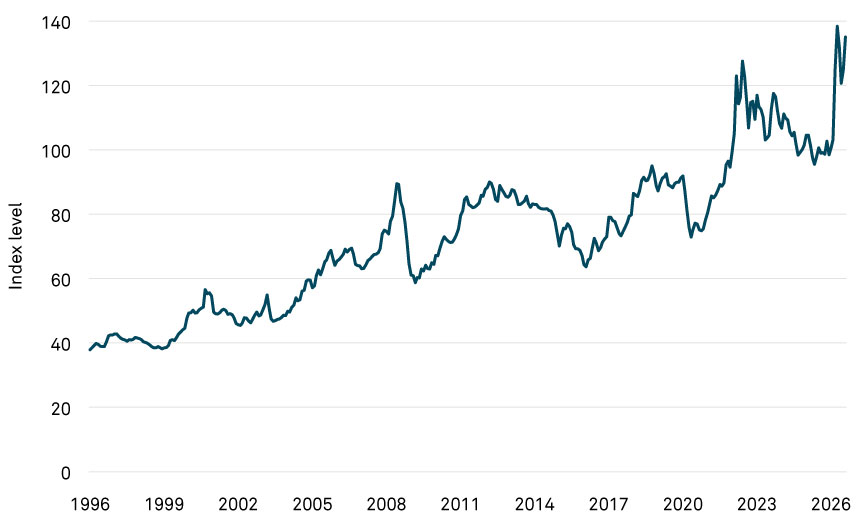
Source: Macrobond, as at 1 October 2026. Index shown is France, Consumer Price Index, Transport, Operation of Personal Transport Equipment, Parts & Accessories for Personal Transport Equipment, Fuels & Lubricants for Personal Transport Equipment, Diesel, Index.
Polls consistently show Le Pen winning the first round in the presidential election. In the last two weeks, Mélenchon has overtaken Philippe: it appears to be a roughly even chance of a second round vote between Le Pen and Mélenchon, rather than Le Pen and Philippe which previously seemed likely.
If this were to occur, Le Pen is expected to comfortably beat Mélenchon, with polls suggesting a vote split of about 68%-32%. By comparison, a contest between Le Pen and Philippe would be closer – though in such a contest polls show Le Pen’s support has been rising from 51% (July) to 57% (September) of the vote.
Overall, these numbers suggest an increasing probability of Le Pen taking the presidency in April 2027. Focusing purely on the implications for French government bonds, we believe unsustainable debt dynamics are likely to remain under a Le Pen presidency. Le Pen has outlined planned cuts to spending, reportedly increasing proposals for net savings of €123bn to €140bn by 2032 relative to 20261.
French bond spreads tightened slightly on the day Le Pen announced these plans, but questions remain over the feasibility of the proposals.
History suggests French spreads could widen much further
Given the level of French debt, markets are likely to punish fiscal mis-steps, and in our view, spreads are likely to widen further as the election approaches, even though default risk remains very low in our view.
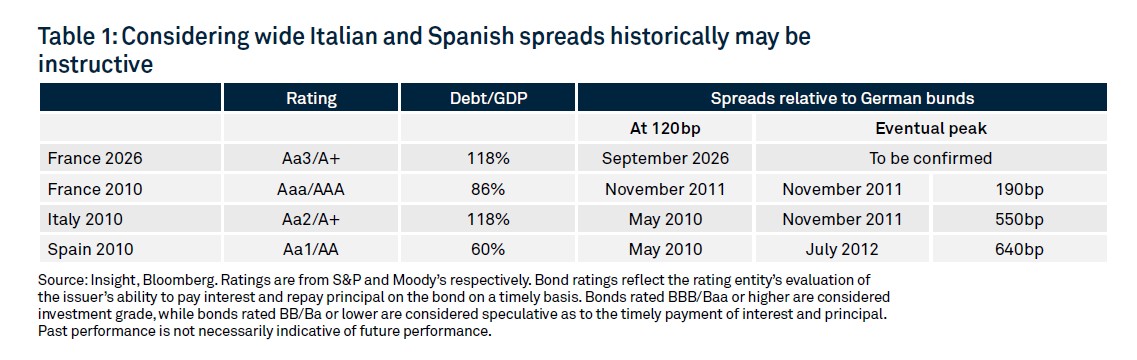
The question is how far spreads might widen. Would the highs in 2011 be attractive? Any comparison between French debt today, and back in 2011, must bear in mind that the French rating then was Aaa/AAA, and the nation’s debt/GDP ratio was 86%. Today, its rating has fallen to Aa3/A+, and its debt/GDP ratio is 118% and rising.
It may be more instructive to look at the spreads on Italian and Spanish debt in 2010 (see Table 1). In May 2010 Italian and Spanish spreads were at similar levels to French spreads today, approaching the highs from the global financial crisis a few years before. Spreads went on to widen much further.
A positive outcome for French bond markets is still possible
There are three potential scenarios that might improve the outlook for French government bonds.
1. A centrist resurgence: Philippe or another centrist candidate might recover. Catalysts for this could include a new candidate; a sharp decline in diesel prices, though this currently seems unlikely; or if there is a geopolitical shock of sufficient magnitude that makes voters reconsider their priorities. If the probability of a more centrist candidate winning the presidential election meaningfully rises, this may provide a rationale to cover underweight positions.
2. Positive fiscal action under Le Pen: Assumptions around Le Pen’s proposals and attitude toward the fiscal situation in France may prove mistaken. If new president Le Pen gives the right fiscal signals, and if RN achieves a legislative majority, this could be a signal to cover underweight positions and consider building overweight positions in French government bonds.
3. Action by the EU: If a crisis does develop and a bailout is required from the EU, French government bond spreads will likely have widened materially – this would potentially be an attractive opportunity to buy French debt, as it was previously for Italy and Spain (but not Greece).
For long-term investors, current spread levels may offer an opportunity to buy French government bonds at attractive levels. Scenarios like the three above might lead markets to recover from here, although currently we expect the crisis to deepen and opportunities to arise for long-term investors to add further to positions. For more active portfolios, there is a rationale to remain cautious on French assets until one of the scenarios above emerges and only seek to move overweight if the political backdrop changes. Active investors looking for other ways to position for a deepening crisis could look to underweight positions in Belgium, the EU, or the eurozone periphery.
Endnotes
1. Source: Le Pen eyes bond markets with promise of bigger spending cuts if far right wins presidency, 6 October 2026, Reuters.
Appendix
Basis points (bp) is a unit of measurement equal to one one-hundredth of one percent (0.01%), commonly used to describe changes in interest rates and bond yields. One basis point equals 0.01%, so 100 basis points equal 1.00%.
Bond spread is the difference in yield between two bonds, typically between a riskier bond and a safer benchmark bond such as a German bund, used as an indicator of perceived credit risk. A widening spread generally signals growing concern about the riskier borrower.
Consumer Price Index (CPI) is a measure of the overall change in consumer prices based on a representative basket of goods and services over time.
Credit rating is an assessment of the creditworthiness of a borrower, such as a government or corporation, typically assigned by rating agencies such as Moody’s, S&P, or Fitch on a scale from AAA (highest quality) to D (default). A lower rating indicates higher perceived risk of non-payment.
‘Gilets jaunes’ (‘yellow jacket’) is a protest movement that began in France in 2018, initially in opposition to higher fuel taxes and rising living costs. It was named after the high-visibility yellow vests worn by protesters.
Government bond is a debt security issued by a national government to borrow money from investors, with the government promising to pay periodic interest and repay the principal at maturity.
Gross domestic product (GDP) is a measure of the overall change in consumer prices based on a representative basket of goods and services over time.
Debt/GDP ratio is a measure of a country’s government debt compared to its gross domestic product, used to assess the sustainability of its borrowing relative to the size of its economy. A higher ratio indicates a heavier debt burden.
Default risk is the risk that a borrower, such as a government or company, will be unable to make required payments on its debt obligations, potentially leading to default.
Fiscal relates to government revenue, spending, and debt management, particularly through taxation and budgetary policy.
Fiscal consolidation is the process of reducing a government’s deficit and debt levels, typically through spending cuts, tax increases, or a combination of both.
HCPI (Harmonised Consumer Price Index) is a standardised measure of inflation used across European Union countries, calculated using a common methodology to allow consistent comparison of price changes between member states.
Important information
BNY Investments is the brand name for the investment management business of BNY and its investment firm affiliates worldwide. BNY is the corporate brand of The Bank of New York Mellon Corporation and may be used to reference the corporation as a whole or its various subsidiaries generally.
The information contained herein reflects general views and is provided for informational purposes only. This material is not intended as investment advice nor is it a recommendation to adopt any investment strategy.
Opinions and views expressed are subject to change without notice.
Past performance is no guarantee of future results.
Issuing entities
This material is only for distribution in those countries and to those recipients listed, subject to the noted conditions and limitations: • United States: by BNY Mellon Securities Corporation (BNYSC), 240 Greenwich Street, New York, NY 10286. BNYSC, a registered broker-dealer and FINRA member, has entered into agreements to offer securities in the U.S. on behalf of certain BNY Investments firms. • Europe (excluding Switzerland): BNY Mellon Fund Management (Luxembourg) S.A., 2-4 Rue EugèneRuppertL-2453 Luxembourg. • UK, Africa and Latin America (ex-Brazil): BNY Mellon Investment Management EMEA Limited, BNY Mellon Centre, 160 Queen Victoria Street, London EC4V 4LA. Registered in England No. 1118580. Authorised and regulated by the Financial Conduct Authority. • South Africa: BNY Mellon Investment Management EMEA Limited is an authorised financial services provider. • Switzerland: BNY Mellon Investments Switzerland GmbH, Bärengasse 29, CH-8001 Zürich, Switzerland. • Middle East: DIFC branch of The Bank of New York Mellon. Regulated by the Dubai Financial Services Authority. • South East Asia and South Asia: BNY Mellon Investment Management Singapore Pte. Limited Co. Reg. 201230427E. Regulated by the Monetary Authority of Singapore. • Hong Kong: BNY Mellon Investment Management Hong Kong Limited. Regulated by the Hong Kong Securities and Futures Commission. • Japan: BNY Mellon Investment Management Japan Limited. BNY Mellon Investment Management Japan Limited is a Financial Instruments Business Operator with license no 406 (Kinsho) at the Commissioner of Kanto Local Finance Bureau and is a Member of the Investment Trusts Association, Japan and Japan Investment Advisers Association and Type II Financial Instruments Firms Association. • Brazil: ARX Investimentos Ltda., Av. Borges de Medeiros, 633, 4th floor, Rio de Janeiro, RJ, Brazil, CEP 22430-041. Authorized and regulated by the Brazilian Securities and Exchange Commission (CVM). • Canada: BNY Mellon Asset Management Canada Ltd. is registered in all provinces and territories of Canada as a Portfolio Manager and Exempt Market Dealer, and as a Commodity Trading Manager in Ontario. All issuing entities are subsidiaries of The Bank of New York Mellon Corporation.
No part of this material may be reproduced in any form, or referred to in any other publication, without express written permission. All information contained herein is proprietary and is protected under copyright law.
NOT FDIC INSURED | NO BANK GUARANTEE | MAY LOSE VALUE
©2026 THE BANK OF NEW YORK MELLON CORPORATION
MARK-1020079-2026-10-15
GU-964 - 15 October 2027