Please ensure Javascript is enabled for purposes of website accessibility Positive Signals from Capex?
no
en
intermediary
intermediary
false
true
Gathering data
Disclaimer Not Available

Positive signals from capex?

Positive signals from capex?

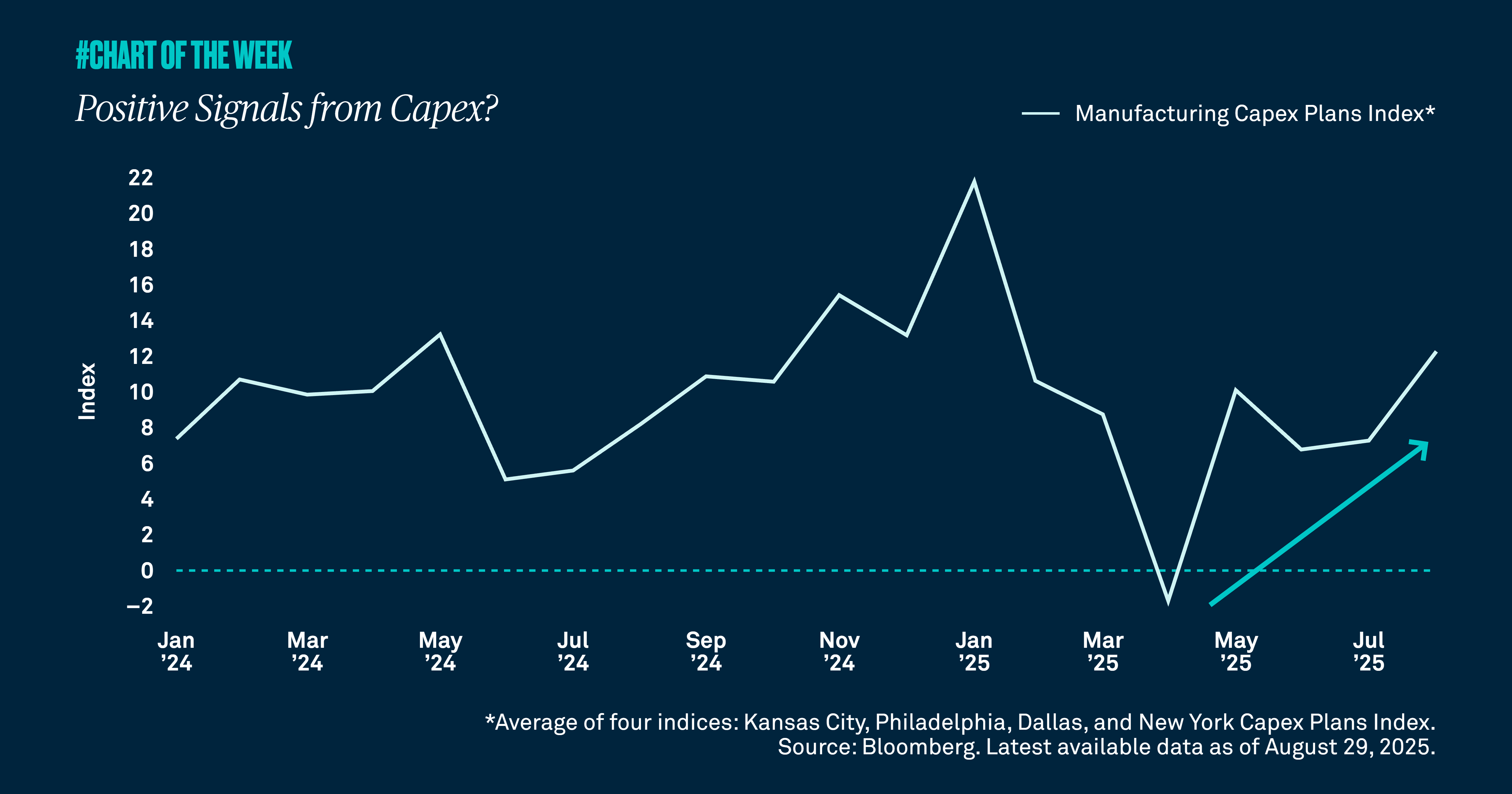
The One Big Beautiful Bill Act’s provision regarding the full expensing of capital expenditures is already having an impact on companies’ investment plans. We believe this a positive signal for economic growth. 

This past Independence Day, President Trump signed the long-awaited One Big Beautiful Bill Act into law. Along with the tax and spending cuts included in the Act are notable pro-growth policies, such as the full expensing of capital expenditures (capex) for businesses. Additionally, under the Act, companies can write off qualifying research and development expenditures in the year they are incurred.

In anticipation of these provisions, manufacturers have begun to increase their capex plans, which we view as a positive signal for future economic growth. Continued reshoring and the growing need for data center power are driving increased capex in the Industrials, Energy and Materials sectors. Additionally, the new tax incentives and proliferation of artificial intelligence adoption are leading to new investment in semiconductors and supply chains,

We expect the Act’s business-friendly clauses to stimulate investment and boost productivity. Historically, rising capex has aligned with stronger growth. 
RELATED CONTENT
Resilience is a historical trend
Chart of the Week | Macroeconomic

The S&P 500’s history shows that despite recessions, wars, inflation, and corrections, the market’s long-term trajectory has remained upward. As the U.S. marks 250 years of resilience, the lesson for investors is clear: wealth is built through patience, discipline and staying invested.

Resilient through uncertainty
Chart of the Week | Macroeconomic

U.S. policy uncertainty has remained elevated and consumer sentiment has weakened. Even so, the economy has stayed resilient, and because growth has held up better than sentiment and headlines suggest, we continue to forecast 2% U.S. growth in 2026, in line with trend.

Getting real in retail
Chart of the Week | Macroeconomic

Despite persistent concerns that sticky inflation would erode purchasing power and drag consumer spending lower, the May retail sales data tells a different story. Spending is up not just in dollar terms, but in quantity, highlighting continued consumer resilience.

Higher inflation, contained expectations
Chart of the Week | Macroeconomic

Inflation has jumped since the Strait of Hormuz closed, squeezing consumers through higher gas and utility bills and pressuring businesses with higher freight and operating costs. Yet, longer-term inflation expectations remain contained, suggesting this looks more like a temporary energy shock than a lasting inflation upswing.

Gathering data
Disclaimer Not Available

This is a marketing communication