Please ensure Javascript is enabled for purposes of website accessibility A “Good Enough” Job Market
no
en
intermediary
intermediary
false
true
Gathering data
Disclaimer Not Available

A “good enough” job market

A “good enough” job market

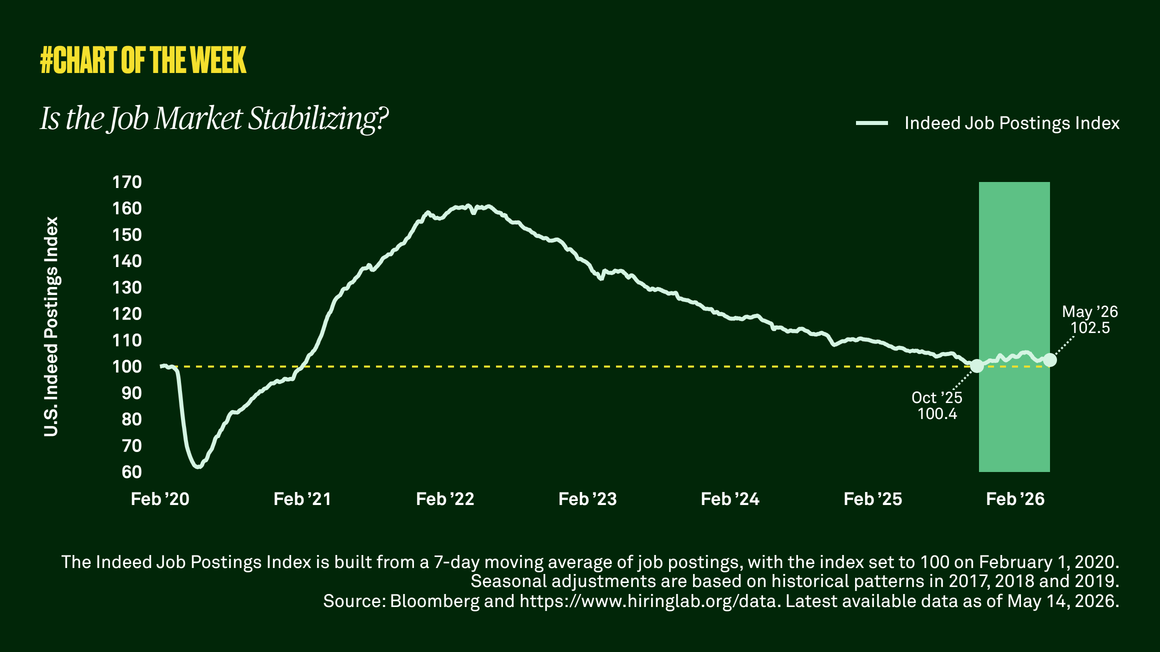
By no measure are we seeing a booming job market, but we are also not seeing a deteriorating one. In fact, current labor metrics lead us to conclude that the job market remains “good enough” to support our economic growth expectations for the year. 


Despite heightened uncertainty around the administration’s trade and tax policies as well as concerns about slowing economic growth, the labor market, a beacon for the direction of consumer spending, remains stable. Metrics such as the number of layoffs and the unemployment rate can dramatically affect the attitudes and spending habits of consumers, who act as the driving force of gross domestic product (GDP).

As released this past Friday, nonfarm payrolls grew 139,000 in May—more than expected and only slightly lower than April’s 147,000. Moreover, job growth in April and May came in at the highest levels reported this year and were just shy of the 155,000 average over the last 18 months. Jobless claims remain in the 210,000-250,000 range reported over the past year while at 1.1%, the layoff rate is the lowest it has been in 12 months.

While we do not believe the current job market is thriving, it does not show material deterioration. It remains “good” enough to support positive economic growth. We maintain our expectation for GDP of about 1% this year amid a non-recessionary slowdown. 
RELATED CONTENT
Job market hanging in there
Chart of the week | Macroeconomic

Recent jobless claims data point to a resilient U.S. labor market, with both initial and continuing claims remaining low and signaling that unemployment is still contained. Although job growth has softened and remains subdued, March’s job growth of 178,000, the highest since 2024, is encouraging. Our constructive outlook still holds despite continued uncertainty related to the war in the Middle East.

cotw-30-03-2026-thumbnail-580x326px
Chart of the week | Macroeconomic

Markets are reacting to the Middle East conflict with sharp moves across asset classes, signaling broad risk repricing and shifting safe haven behavior. While volatility is elevated, fundamentals like earnings growth continue to support our constructive outlook.

Signals from spreads
Chart of the week | Macroeconomic

Credit spreads have risen yet remain historically low, reinforcing our view that the oil shock is likely temporary — not a driver of long-term growth concerns.

Dollar strength: what does it mean for markets?
Chart of the week | Macroeconomic

Geopolitical tensions have lifted oil prices, sent U.S. stocks slightly lower and driven flows into the safety of the U.S. dollar, which has strengthened versus peers. While a weaker dollar previously supported international equity outperformance, dollar stabilization now suggests that tailwind is fading, underscoring the importance of diversification across regions and asset classes.

Gathering data
Disclaimer Not Available

This is a marketing communication