After sluggish job growth in 2025, investors are looking for signs that the labor market may be stabilizing. With consumer spending driving 70% of economic activity, an improving labor market is essential to sustaining economic growth.
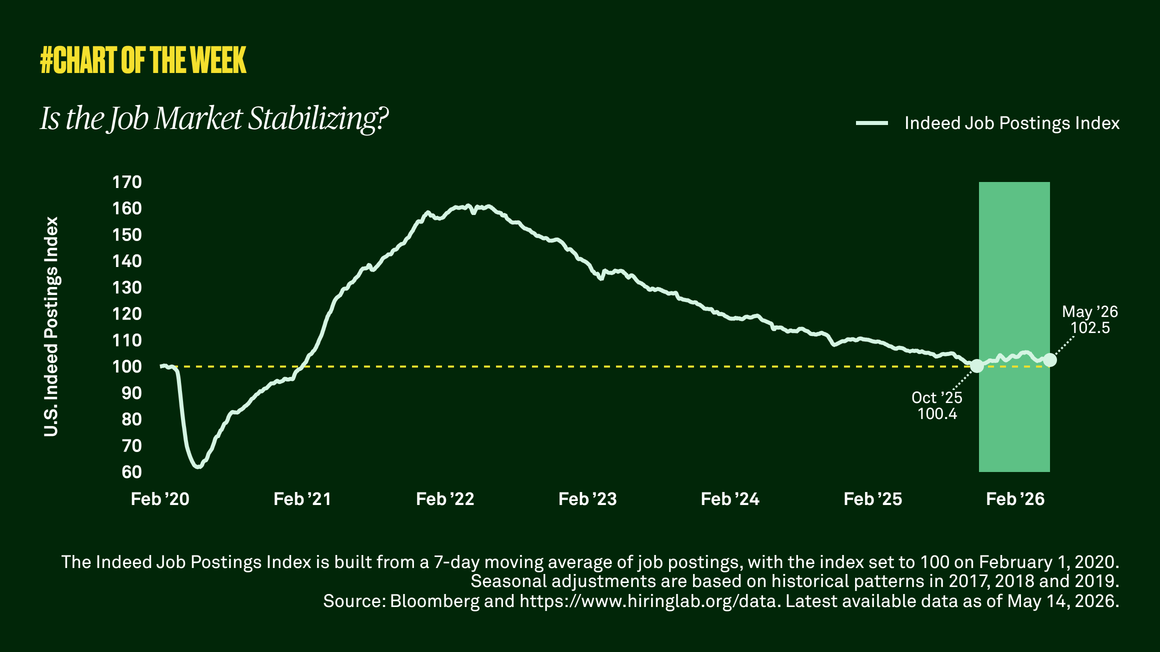
Chart is for illustrative purposes only. Past performance is not necessarily an indication of future results.
Since April 2022, job availability, as measured by the Indeed Job Postings Index, has trended lower, softening confidence in the labor market. With consumer spending accounting for 70% of gross domestic product (GDP), lower confidence in the ability to find jobs could prompt consumers to pull back spending — and weigh on economic growth.
Recently, however, the Indeed Job Postings Index has shown signs of stabilizing, along with other job market indicators. The Index has been in an uptrend since last October and job growth year to date stands at 304,000, compared to the 116,000 jobs for all of 2025. Initial weekly jobless claims — a timelier measure of labor market health — have averaged 204,000 over the last four weeks, the lowest in four years. Continuing jobless claims have also fallen from their peak of 1.96 million in July of 2025 to 1.77 million – the lowest in over two years. And, despite recent headlines, layoffs year to date through April are the lowest since 2022.
While job growth may be resetting to a lower monthly average because of aging demographics, reduced immigration and improved productivity, stabilization of the labor market may be another positive sign for the consumer and the broader economy.
All investments involve risk, including the possible loss of principal. Certain investments have specific or unique risks that should be considered along with the objectives, fees, and expenses before investing.
Asset allocation and diversification cannot ensure a profit or protect against a loss.
Indeed Job Postings Index: a measure of employer hiring demand based on the number of job postings on Indeed, typically shown relative to a fixed baseline over time.
This material has been provided for informational purposes only and should not be construed as investment advice or a recommendation of any particular investment product, strategy, investment manager or account arrangement, and should not serve as a primary basis for investment decisions. Prospective investors should consult a legal, tax or financial professional in order to determine whether any investment product, strategy or service is appropriate for their particular circumstances.
Views expressed are those of the author stated and do not reflect views of other managers or the firm overall. Views are current as of the date of this publication and subject to change. This information contains projections or other forward-looking statements regarding future events, targets or expectations, and is only current as of the date indicated. There is no assurance that such events or expectations will be achieved, and actual results may be significantly different from that shown here. The information is based on current market conditions, which will fluctuate and may be superseded by subsequent market events or for other reasons. References to specific securities, asset classes and financial markets are for illustrative purposes only and are not intended to be and should not be interpreted as recommendations. Information contained herein has been obtained from sources believed to be reliable but not guaranteed. No part of this material may be reproduced in any form, or referred to in any other publication, without express written permission.
BNY Investments is the brand name for the investment management business of BNY and its investment firm affiliates worldwide. BNY is the corporate brand of The Bank of New York Mellon Corporation and may also be used to reference the corporation as a whole or its various subsidiaries generally.
NOT FDIC INSURED | NO BANK GUARANTEE | MAY LOSE VALUE
MARK-940511-2026-05-20