The forthcoming regulatory changes brought about by Solvency II reforms will create new opportunities for European insurers. The 2027 Solvency II reforms do more than reduce capital requirements for some asset classes; they also reduce some of the constraints that have prevented insurers from making certain investments for practical reasons.
Key points:
- The 2027 Solvency II reforms broaden the practical investment universe for European insurers, particularly in areas such as securitisation and long-term equities, where the previous framework often limited economic viability.
- A broader universe can help improve risk diversification. A carefully constructed allocation across these asset classes may also improve expected portfolio returns while keeping solvency capital ratios broadly stable, thereby achieving improved balance-sheet efficiency, not just higher yields.
- Insurers will need to work closely with a specialist asset manager who can partner with them to review the new regulations and help them implement appropriate strategies to enhance their portfolios.
Now is the time for insurers to review their asset allocations, including their liquidity risk management strategies, to free up valuable capital and take advantage of these new opportunities.
Improving balance-sheet efficiency through a broader opportunity set
For nearly a decade, the Solvency II Standard Formula has made some asset classes extremely capital-intensive relative to their actual economic risks, thereby significantly affecting their role in long-term insurers’ portfolios.
The 2027 reforms aim to address parts of that imbalance by recalibrating the framework and broadening the practical investment universe for insurers.
However, not every asset class will suit every portfolio. The most compelling opportunities are typically introduced to portfolios to support three characteristics:
- Return generation from risk factors that are not correlated with core credit exposures
- Potential to improve risk-adjusted returns in a capital-efficient manner
- Ability to produce reliable, predictable income that can be matched against liability cash flows
Capturing opportunities from the Solvency II reform
The Solvency II reforms are expected to increase the investment opportunities available to insurers. In many cases, revised capital charges and updated eligibility criteria reduce the regulatory and practical costs of holding certain assets, allowing insurers to seek higher returns and greater diversification while maintaining appropriate risk controls. For insurers willing to revisit long- standing portfolio assumptions, now is the time to review their asset allocations and approaches to liquidity risk management to free up and redeploy capital.
To take advantage of the new opportunities, insurers will need to keep an open mind about certain asset classes, focussing more on quantitative data than on historic perceptions that may no longer be accurate and do not reflect the evolution of the asset class.
Where to focus: capital efficiency meets structural fit
Allocators looking to expand their investment universe should review the new opportunity set, assessing which categories align best with existing risk appetites and operational capacity. In our view, the new regulations support allocations to asset-backed securities and long-term equities, providing a distinct combination of capital efficiency and structural fit.
Another asset class often overlooked by insurers is high-yield bonds. While these assets have not been affected by the most recent regulatory change, insurers who are reviewing their allocations more broadly should consider how an allocation to very short-dated bonds from insurers with predictable cash flows can enhance an insurer’s portfolio, particularly in the current environment of tight credit spreads on investment-grade assets.
Asset-backed securities: improved capital efficiency and diversification
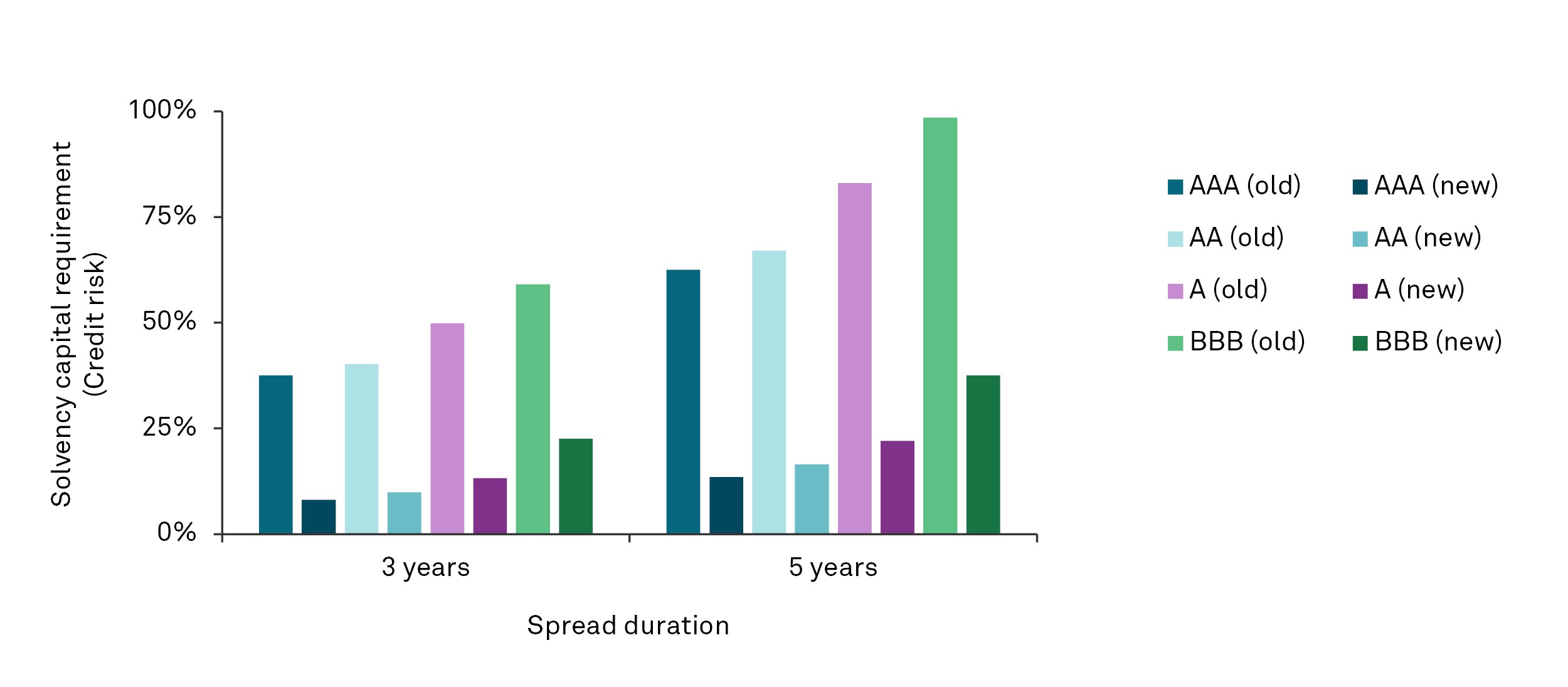
The investment case for asset-backed securities (ABS) has strengthened materially under the revised Solvency II framework. Historically, capital charges made much of the securitised market unattractive for many standard- formula insurers, except for senior simple, transparent and standardised (STS) securitisations which received capital treatment akin to similarly rated corporate bonds if they met certain criteria. The 2027 reforms change that equation, particularly for senior non-STS securitisations, where capital requirements will fall significantly.
Combined with the complexity premium that ABS have typically offered over similarly rated corporate bonds, lower capital charges improve the asset class’s capital-adjusted return potential. Importantly, the benefits extend beyond yield. ABS performance is linked to pools of underlying loans rather than the fortunes of a single corporate issuer, providing a different source of risk and return and enhancing diversification within credit portfolios.
The opportunity set spans consumer ABS, auto-loan securitisations, residential mortgage-backed securities and broader secured-finance portfolios for insurers willing to look beyond the traditional senior STS universe.
Figure 1: EIOPA Solvency II changes for senior non-STS ABS1
Why insurers may find ABS attractive:
- Improved capital efficiency under the reformed Solvency II framework
- Higher spread potential than comparably rated corporate bonds
- Diversified credit exposure across pools of underlying borrowers beyond investment-grade corporate credit
- Structural protections through collateral and credit enhancement features
- Lower interest-rate sensitivity in floating-rate structures
- Tailored risk-return trade-offs as insurers can choose between the highest quality (AAA-rated) instruments, sub-investment-grade issues and anywhere in between using institutional ABS strategies in pooled fund and segregated mandates
- Complementary to corporate bond allocations, enhancing diversification and portfolio efficiency
Global short-dated high yield: accessing spread income without excessive duration risk
Global short-dated high yield offers a different route to improving portfolio income. By focusing on bonds approaching maturity, insurers can access much of the spread available in high-yield markets while reducing exposure to interest-rate movements and spread volatility compared with longer-dated sub- investment-grade credit. Most importantly, credit risks can be managed more effectively because there is greater visibility into an insurer’s cash flows over a short time horizon.
This can be particularly attractive under Solvency II because spread capital charges are influenced by duration as well as credit quality. Shorter-dated high yield bonds can therefore provide a relatively efficient balance between yield generation and capital consumption, despite their lower credit ratings.
The global opportunity set, particularly in the US market, is significantly larger and more diversified than the European high-yield market alone, providing access to a broader range of issuers and sectors. Within a portfolio, short-dated high yield can complement long-duration government and corporate bonds and liability-matching assets, helping insurers enhance income while maintaining overall duration characteristics consistent with their liabilities.
Why insurers may find global short-dated high yield attractive:
- Higher income potential than investment-grade credit and cash alternatives
- Lower duration risk than traditional high-yield allocations
- Lower credit risk than the broader high-yield market through robust bottom- up credit selection
- Potentially more efficient capital usage than longer-dated sub-investment- grade exposures
- Global diversification across sectors, regions and issuers
- Natural portfolio turnover as bonds approach maturity, helping to manage credit risk and reinvestment opportunities
- Complementary role alongside liability-matching assets, allowing insurers to separate income generation from duration management
Long-term equity investments: the changes matter
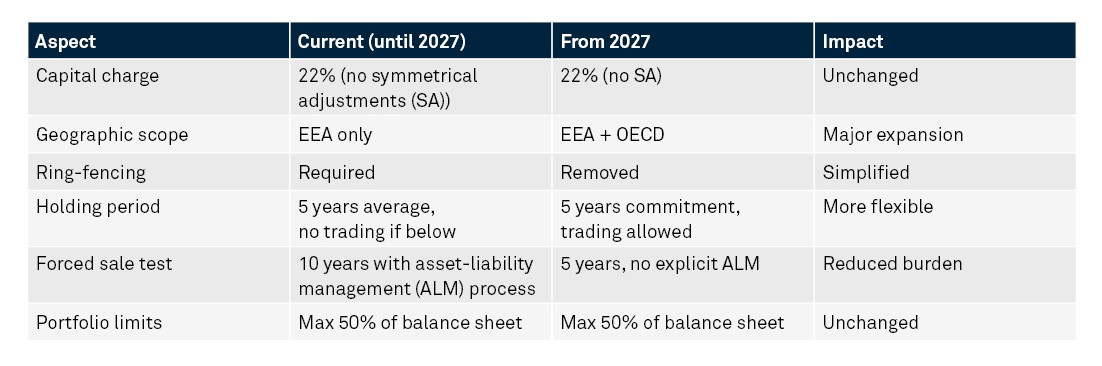
The revised long-term equity investments (LTEI) framework is among the most significant changes effective 30 January 2027. Two modifications stand out:
- The eligible universe expands from equities in the European Economic Area (EEA) to those across the Organisation for Economic Co-operation and Development (OECD), materially widening the practical implementation options
- The ring-fencing requirement is removed, which substantially reduces the operational burden of maintaining a qualifying allocation
The capital charge of 22% remains unchanged, but the breadth of what qualifies at that charge is now far greater. Public high-income equities – companies with consistent dividend distributions – are well suited to life insurers seeking cash- flow distributions to match liabilities. Infrastructure equity, with its inflation- linked income profile, is increasingly relevant for non-life insurers looking to hedge against inflation.
The reforms also strengthen the case for long-term growth equity investing by some types of insurers. By broadening eligibility to OECD markets, insurers can access a wider universe of quality businesses with strong balance-sheets, resilient cash generation and the ability to grow earnings over time. For investors with long-dated liabilities, such strategies offer the potential to compound capital over decades while benefiting from favourable LTEI capital treatment.
Both can be structured to meet the average holding period commitment that LTEI qualification requires, and trading within that holding period is now permitted – a meaningful operational improvement.
For insurers who held back under the old ring-fencing constraints, or who limited LTEI exposure because the eligible universe was too narrow, the case for revisiting the allocation is direct. The criteria are more practical and the universe is broader.
By divesting some existing equity exposures into a new LTEI portfolio, insurers can free up capital to take advantage of the other investment opportunities introduced by the new regulatory framework.
Putting it together
The 2027 reforms create a real opportunity for insurers to rethink how they allocate capital. Insurers that are open-minded with a clear plan, linking new allocations to specific balance-sheet goals, rather than simply using new capacity, have the potential for stronger returns and more durable income streams.
Each of the asset classes discussed here plays a different role. ABS can offer additional spread and diversification beyond traditional corporate credit. Global short-dated high yield can add income without taking on as much duration risk as longer-dated credit. Long-term equity investments can provide capital- efficient exposure to equities.
BNY Investments helps insurers access this expanded opportunity set through investment capabilities across securitised credit, short-dated high yield, and long-term equity, incorporating specialist regulatory reporting, and governance infrastructure designed to help manage complex multi-asset portfolios at scale.
Importantly, these opportunities are accessible through both pooled funds and segregated mandate solutions, making them available to all types of insurers, and come with specialist regulatory reporting and technical support. We partner with insurers to build portfolios aligned with their specific circumstances, objectives and preferences, with allocations spanning asset-backed securities, global short-dated high yield, long-term equity and other asset classes.
The opportunity is there. The key is capturing it efficiently and with appropriate discipline.
Endnotes
1. Source: Draft Commission Delegated Regulation amending Delegated Regulation (EU) 2015/35 on Solvency II
The value of investments and the income received can fall as well as rise and investors may not get back the original amount invested.
Important information
For Professional Clients only. In Switzerland for Qualified Investors only. This is a financial promotion.
BNY Investments is the brand name for the investment management business of BNY and its investment firm affiliates worldwide. BNY is the corporate brand of The Bank of New York Mellon Corporation and may be used to reference the corporation as a whole or its various subsidiaries generally.
Any views and opinions are not investment advice or a research recommendation.
Issued in the UK by BNY Mellon Investment Management EMEA Limited, BNY Mellon Centre, 160 Queen Victoria Street, London EC4V 4LA. Registered in England No. 1118580. Authorised and regulated by the Financial Conduct Authority.
Issued in Switzerland by BNY Mellon Investments Switzerland GmbH, Bärengasse 29, CH-8001 Zürich, Switzerland.
Issued in Europe (excluding Switzerland) by BNY Mellon Fund Management (Luxembourg) S.A. (BNY MFML), a public limited company (société anonyme) incorporated and existing under Luxembourg law under registration number B28166 and having its registered address at 2-4 Rue Eugène Ruppert L-2453 Luxembourg. BNY MFML is regulated by the Commission de Surveillance du Secteur Financier (CSSF).
1991650 Exp: 10 March 2027